


I added Guayama almost as an afterthought to a longer Puerto Rico loop, and it ended up feeling like three different destinations in one. I drove in with a rental car from Ponce along the southern coast, spent one night just outside the historic center, and used a full day and a half to explore the town plaza, the fishing community of Pozuelo on the Caribbean, Jobos Bay’s mangroves, and the greener slopes that roll up toward Carite Forest. What I found was not a compact resort hub but a spread‑out municipality where you need wheels, some Spanish, and realistic expectations about heat, distances, and opening hours.
Get the latest updates straight to your inbox!
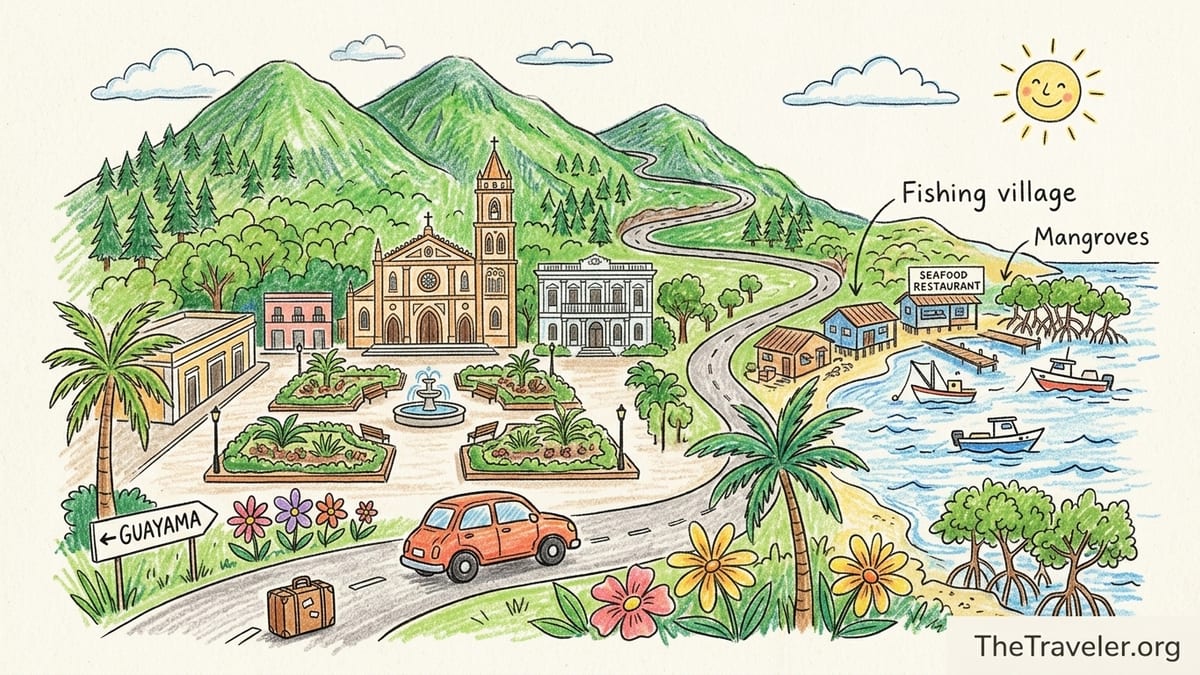
Arriving in Guayama and First Impressions
I reached Guayama by rental car, following Highway PR‑52 from Ponce and then cutting across to PR‑3. The closer I got to town, the more the scenery shifted from sugarcane flats and industrial plants to low pastel houses and glimpses of church towers. Unlike arriving in Old San Juan, where everything feels concentrated, Guayama announces itself gradually. There is no single gateway view or big resort strip, just a sign for the municipality and then a series of barrios that hint at how spread out the area really is.
I booked a small family‑run guesthouse a short walk from Plaza de Recreo Cristóbal Colón, the main square. From here I could park once and explore the historic center on foot, then use the car to reach the coast and the foothills the next day. Having my own car was essential. Public transport within Guayama is limited and inconsistent, and the places that make the town interesting are 15 to 30 minutes apart by road in different directions.
I gave Guayama roughly a day and a half: an afternoon and evening in the center, followed by a full day split between Pozuelo and Jobos Bay on the coast and then a late‑day push up toward Carite. In hindsight, that timing felt rushed for nature and relaxed for town life. I had enough time for the plaza, a museum and a lingering dinner, but I was only skimming what the mangroves and forests offer. If you want to hike, birdwatch or play a full round of golf, two nights would be more realistic.
What struck me immediately on arrival in mid‑afternoon was the heat. The car thermostat read around the low 90s Fahrenheit in March, and the humidity wrapped around the downtown streets. The plaza has shade and fountains, but short walks between the square, Casa Cautiño and nearby streets still felt draining. I quickly learned to plan indoor or coastal stops for midday and leave the plaza strolling and hill driving for early morning or late afternoon.
The Historic Center: Plaza, Architecture and Everyday Life
Guayama’s historic center gathers around Plaza de Recreo Cristóbal Colón, a generous square framed by the neoclassical Casa Cautiño, the ornate Iglesia San Antonio de Padua and other 19th‑ and early 20th‑century buildings. The plaza is known locally as one of the more handsome in the south, and up close the description fits: manicured plant beds, a central fountain, patterned paving and benches where older residents chat in the evenings.
Parking for the historic center is easier than in San Juan but still requires a small search. I usually found street parking within a few blocks of the plaza, either along Calle Baldorioty or side streets behind the church. Spaces are not marked with meters; you simply parallel park where allowed and respect any loading zones and driveways. In business hours, spots near the square can fill with locals running errands, but turnover is steady. I never needed to pay a private lot, something that would be rare near Old San Juan’s main sights.
The main architectural visit in town is Casa Cautiño, a 19th‑century mansion now run as a museum with period furniture and local art. It sits right on the edge of the plaza. Current information from local tourism sources indicates it usually opens on weekdays and some Saturdays, with a midday closure. I made the mistake of showing up close to noon without checking same‑day hours and found the doors closed for the lunch break. After adjusting, I returned later and joined a small group tour led in Spanish. The staff were friendly and slowed their speech when they realized I was not a native speaker. The experience felt personal and distinctly small‑town: there were perhaps five visitors in total.
A few blocks away, buildings such as the Centro de Bellas Artes Adolfo Porrata Doria and older theaters show Guayama’s cultural side, but during my visit many venues were only open for evening events. Around the plaza, the street atmosphere changed with the clock. Mid‑afternoon, the area had an unhurried, almost sleepy rhythm: children leaving school, older men sitting in the shade, a few people drifting between the bakery and pharmacies. By early evening, the plaza filled out with families, teens with ice creams and couples sitting by the fountain. Compared with San Juan, I heard almost no English on the benches; conversations were overwhelmingly in Spanish, and I switched my phone’s offline dictionary on more than once.
Eating in Town: Opening Patterns and Language
One practical surprise in Guayama was how restaurant hours actually worked on the ground. In San Juan, Condado or Isla Verde, you can count on late‑night kitchens and a dense strip of options. In Guayama’s center, many cafes and small eateries open early and close early, focusing on breakfast and lunch for locals. When I walked around at 8:30 p.m. on a weeknight, several places I had marked on my map earlier were either closed or already sweeping floors.
For dinner, I ended up at a sit‑down restaurant a short walk from the plaza, after finding two smaller spots closed before 8 p.m. The menu skewed toward Puerto Rican staples like mofongo, skirt steak and fried seafood, with some daily specials listed on a whiteboard. Prices were noticeably lower than in touristy areas: main dishes in the mid‑teens to low twenties in US dollars rather than high‑twenties or more. Service was in Spanish, with occasional English phrases, and the atmosphere felt more like a neighborhood night out than a tourist venue. I did not see printed English menus, so being able to recognize dishes such as chillo frito, carne guisada and arroz mamposteao made ordering easier.
During the day, panaderías and small lunch counters near the plaza provided coffee, pastries and inexpensive plates of rice, beans and meat. Here, English was even less common. I managed fine with basic Spanish and a willingness to ask staff to repeat or point to items in the display. Travelers who speak no Spanish can still get by, but they should expect to gesture, use translation apps and smile through misunderstandings. Guayama, unlike major resort zones, clearly serves its residents first and visitors second.
Reflecting on expectations, I initially thought Guayama’s center might have a bit more visible tourist infrastructure, such as a staffed information booth, bilingual signage or souvenir shops around the plaza. In reality, tourism offices and information boards exist but are not as prominent or extended‑hours as in capital‑area destinations. That is not a flaw, just a cue that this is foremost a working town with some attractions, rather than a destination engineered around visitors.
The Coast: Pozuelo, Jobos Bay and Aguirre
The drive from the historic center to the coast at Pozuelo took around 15 to 20 minutes in light traffic, heading along local roads toward PR‑7710. As the route approached the water, sugarcane remnants gave way to low mangroves, modest homes and the kind of informal roadside stands that hint you are entering a fishing community. Pozuelo itself felt like a different world from the plaza: salt in the air, the sounds of boats and more businesses built directly around the sea.
Pozuelo is an active fishing community and the gateway to Guayama’s Coastal Gastronomy Route, with seafood restaurants lining segments of the coastal road. Some are simple wooden structures with plastic chairs and corrugated roofs, others more enclosed with big dining rooms and decks over the water. Menus highlight pastelillos, alcapurrias and fried fish, and many places share a direct link with local fishers. Rather than polished resort boardwalks, expect a practical working‑coast feel: parked pickup trucks, coolers, nets drying in the sun and loud family groups at long tables on weekends.
Parking in Pozuelo was more ad hoc than in town. Some restaurants had small gravel lots; others simply expected customers to park along the roadside wherever there was space. On busy lunch hours, especially on Sundays, these shoulders can become crowded. I drove through once and circled back to grab a spot a little uphill, then walked down. This is one place where having a compact car and being comfortable with close roadside parking helps.
From Pozuelo, I continued toward the Aguirre State Forest and the broader Jobos Bay National Estuarine Research Reserve, which extend along the coast of Guayama and neighboring Salinas. Here the scenery turns to mangroves, lagoons and low keys. There is a small visitor center on the Salinas side for Jobos Bay, with basic parking and educational displays about the estuary and research work. It is not a theme‑park attraction; think simple exhibits, trails and viewpoints. I underestimated how much advance planning some activities require. Guided kayak or boat excursions into lagoon areas often run only on certain days or through private operators, and capacity is limited to protect the environment. Arriving casually on a weekday, I found no last‑minute tour spots and resigned myself to exploring short trails and roadside viewpoints instead.
Into the Green: Driving Toward Carite and Guavate
Guayama’s other face lies inland, where the low coastal plain rises quickly toward the Sierra de Cayey and the Carite State Forest. By car, leaving the center and heading north toward Cayey, the change is immediate: temperatures drop a few degrees, the air feels less heavy, and switchbacks replace straight coastal roads. Clouds frequently hang over the ridges, especially in the afternoon, giving the area a soft, cool light that contrasts with Guayama’s sunny plaza and humid mangroves.
Parts of Carite State Forest fall within Guayama’s municipal boundaries, and the broader area connects to the well‑known lechonera stretch in Guavate, just over the line in Cayey. Driving up from Guayama, I needed to pay close attention to road signs and slow down for sharp curves. The highway itself is paved and in usable condition, but heavy rain can leave slick patches and minor debris on the sides. The ascent took around 35 to 40 minutes from Guayama’s center to the cooler elevations where pines and cloud forest vegetation begin to appear.
Recreation areas in and around Carite range from basic trailheads to day‑use zones with picnic facilities. Compared with more famous forests like El Yunque, facilities here feel lower key and less oriented toward first‑time tourists. Some signage is only in Spanish, and official websites and social media pages are the best sources for up‑to‑date information about trail access, closures and opening hours. I had planned a short walk near a lake overlook but discovered that recent weather had led to partial closures of some paths. That was my second planning mistake in Guayama: assuming that smaller forests would be less regulated and easier to improvise than the marquee national sites.
On the way back down, I followed part of the road toward Cayey’s Guavate area, famous for its roast pork restaurants. Even from a Guayama base, this mountain food route is a realistic half‑day add‑on if you start early. The contrast between the bustling, food‑centric mountain strip and Guayama’s quieter plaza and coast underlined how diverse the region is in a short radius. However, after a full day of driving between center, coast, estuary and hills, the winding returns began to feel long. Guayama is absolutely cross‑sectional Puerto Rico, but stitching its sections into one day is tiring.
Golf, Museums and Culture Beyond the Plaza
Guayama’s tourism messaging often combines museums, architecture, forests, estuary, golf and food into one package, and El Legado Golf Resort is a key part of that mix. The 18‑hole course, designed by Puerto Rican golf legend Chi Chi Rodríguez, spreads between the coastal plain and low hills with views toward both the central mountains and the Caribbean. Even if you are not a dedicated golfer, the setting illustrates another layer of Guayama: broad green fairways and a clubhouse environment that feels a world apart from Pozuelo’s working wharf.
Green fees at El Legado and any rental or cart charges vary by season, tee time and residency, and are best confirmed directly, but they tend to be more accessible than at luxury resort courses attached to high‑end hotels. A visitor with their own clubs and rental car can feasibly stay in town, drive 15 to 20 minutes to the course for a morning round, then head to the coast for lunch. The main limitation is weather: midday heat and wind off the sea can make late‑morning tee times challenging.
Beyond Casa Cautiño, Guayama also has smaller cultural spaces and heritage sites, including a museum dedicated to local poet Luis Palés Matos and remnants of the historic Aguirre sugar mill community. These do not cluster neatly in one compact tourist district. Some require short drives from the plaza, and others may open only on certain days or for prearranged visits. When I tried to visit a smaller cultural center, information online and on the door did not fully match. I arrived to find it opening later than listed, with staff explaining that schedules shift around events and funding. In a large resort area, that kind of inconsistency might feel like a failure; in Guayama, it seemed more like the normal rhythm of small‑town institutions.
Evening cultural life concentrates largely around local events, such as town festivities and performances at the Centro de Bellas Artes. These can be vibrant, but they are not programmed primarily with tourists in mind, and announcements often circulate through local media and social channels in Spanish. I did not encounter the kind of English‑language flyers or concierge suggestions common in San Juan hotels. Travelers willing to navigate Spanish event notices and accept an element of improvisation will get more out of Guayama’s cultural layer.
Heat, Driving and How Local Guayama Feels
One of the most tangible differences between Guayama and Puerto Rico’s main tourist zones is how climate and distance shape your day. The coastal sun around Pozuelo and Jobos Bay can be intense, with little shade along the road. Air conditioning in the car felt less like a luxury and more like basic survival between stops. Even in town, briefly leaving the plaza’s shade to walk a few blocks at midday led me to plan siesta‑style breaks back at my guesthouse. The cooler temperatures near Carite and Cayey were a welcome contrast but required that uphill drive.
Driving between Guayama’s zones was straightforward in terms of navigation but demanding in repetition. The historic center to Pozuelo or Jobos Bay might be only 10 to 30 minutes, but once you factor in stopping for views, parking, unplanned detours and possible slow traffic behind trucks, it adds up. The mountain roads toward Carite and Guavate are paved but full of curves; drivers who are nervous about winding two‑lane roads in unfamiliar countries may find the approach tiring. I was glad I chose a small rental car rather than a large SUV, both for these hill roads and for tight street parking in town and along the coast.
In terms of how touristy Guayama feels, the answer is: not very, and that is much of its charm. Compared with Old San Juan, Condado or big western beach strips, there are far fewer obvious visitors, souvenir stalls or tour touts. On my walks through the plaza and surrounding streets, I rarely heard foreign accents. At Pozuelo, most conversations at restaurant tables were clearly between locals out with friends or family, with a scattering of visitors from other parts of the island. English is understood by some staff in tourism‑facing spots, but outside those settings it is far more limited than near San Juan or at major all‑inclusive resorts.
That local feel does have trade‑offs. There are fewer big supermarkets within walking distance of central lodgings, fewer late‑night food options and almost no bar culture designed around tourists. On the other hand, prices for parking, meals and basic services felt more grounded in local income levels. I paid less for a plate of seafood and plantains in Pozuelo than for some appetizers alone in San Juan’s trendiest districts. For travelers seeking immersion and interaction rather than amenities and nightlife, this feels like a fair exchange.
The Takeaway: Who Guayama Is For and What I Would Do Differently
Looking back on my time in Guayama, the main lesson was to stop imagining it as a single “place” and instead see it as a triangle between the plaza, the coast and the mountains. The historic center supplies architecture, museums and evening plaza life; Pozuelo and Jobos Bay bring fishing culture, mangroves and seafood; the Carite side adds green relief, cooler air and access to forest and mountain food routes. Trying to experience all three sides in one tight day left me more rushed than I expected, even with a rental car.
My biggest missteps came from underestimating how local and small‑scale Guayama’s tourism infrastructure remains. I arrived at Casa Cautiño just as it closed for lunch, drove to the estuary without confirming tour options, and only half‑planned my forest stop without checking current trail conditions. None of these ruined the trip, but they chipped away at time I could have spent relaxing by the water in Pozuelo or lingering in the plaza at sunset.
If I were to redo the visit, I would book two nights in or near the historic center, devote my arrival afternoon entirely to the plaza, Casa Cautiño and a leisurely dinner, then give the second day wholly to the coast and Jobos Bay with either a prebooked kayak or boat excursion. I would save the Carite and Guavate side for a separate day trip tied to Cayey, instead of cramming it on top of Guayama’s own offerings. I would also confirm opening hours for any cultural sites directly with local tourism contacts or by phone, rather than trusting static web pages.
Guayama is genuinely worth visiting for travelers who enjoy seeing how architecture, fishing, forests and golf coexist in a real Puerto Rican municipality that does not revolve around visitors. It suits independent travelers comfortable driving, using at least basic Spanish and accepting a bit of unpredictability in exchange for authenticity. Those looking for swim‑up bars, walkable beach resorts and English‑forward nightlife will be happier in San Juan, Dorado or the resort strips of the east and west coasts. In Guayama, the reward lies in an evening breeze on the plaza, the sound of fishing boats returning to Pozuelo, the cool air near Carite and the knowledge that you are briefly sharing space with a town still mostly living on its own terms.
FAQ
Q1. Do I need a rental car to visit Guayama?
Yes. While taxis and ride‑hailing services exist in Puerto Rico, Guayama’s attractions are spread between the historic center, Pozuelo, Jobos Bay and the Carite side, which are not connected by reliable public transport. A rental car gives you flexibility and is the most practical way to move between these areas.
Q2. How many days should I spend in Guayama?
One full day and one or two nights is a good baseline if you want to see the plaza, visit at least one museum, eat seafood in Pozuelo and make a short visit to Jobos Bay. Add another day if you plan to hike in Carite Forest, play golf at El Legado or include a longer mountain food stop in nearby Guavate.
Q3. Is Guayama safe for visitors?
Guayama’s central and coastal areas felt broadly safe in daylight, with people out in plazas and around restaurants. As in any small city, it is prudent to stay on well‑lit streets at night, avoid displaying valuables and follow local advice about where not to wander after dark. Most visitors’ safety concerns are more about driving and heat than crime.
Q4. Can I get by speaking only English in Guayama?
You can manage with English, but Spanish is much more common. Staff in some museums, hotels and larger restaurants may speak functional English, while many small eateries, shops and services operate almost entirely in Spanish. A translation app and learning key food and direction phrases will make daily interactions more comfortable.
Q5. Are there good beaches in Guayama?
Guayama’s coastline around Pozuelo and Jobos Bay is more about fishing, mangroves and estuary landscapes than classic long sandy resort beaches. There are small shoreline areas and waterfront decks at restaurants, but if your priority is wide swimming beaches with lifeguards and facilities, you may prefer nearby coastal towns or other regions of Puerto Rico.
Q6. What is the best time of day to explore the historic center?
Early morning and late afternoon into evening are the most comfortable times for walking around Plaza de Recreo and nearby streets. Midday can be very hot and humid, so many visitors combine indoor museum visits or a rest during those hours, then return to the plaza as locals come out in the cooler early evening.
Q7. Do I need to reserve tours in Jobos Bay in advance?
For structured activities such as guided kayak or boat tours in and around Jobos Bay, advance reservations are strongly recommended. Operators often run on limited schedules and capacity is controlled to protect the estuary. Turning up without a booking may leave you limited to walking trails and viewpoints near the visitor center.
Q8. Is Guayama a good base for visiting Carite Forest and Guavate?
Guayama works as a base if you are comfortable with winding mountain roads. Driving times to recreational areas in Carite and the food stretch in Guavate are reasonable, generally under an hour, but involve climbs and curves. Some travelers prefer to pair Carite and Guavate with a night in or near Cayey instead of commuting from the coast.
Q9. How does Guayama compare in cost to San Juan?
In general, meals, parking and everyday expenses in Guayama are lower than in San Juan’s main tourist districts. You are more likely to find full plates of seafood or meat at moderate prices and free or inexpensive parking. Accommodation can also be more affordable, though with fewer upscale options than the capital.
Q10. Who will enjoy Guayama the most?
Guayama is best suited to independent travelers who appreciate local life, are curious about history and nature, and are comfortable renting a car and using some Spanish. It is ideal if you want a genuine small‑city and coastal experience rather than a polished resort environment with extensive nightlife and English‑language services.