


Huddersfield is one of those northern English towns that quietly surprises you. On paper it is a former mill town between Leeds and Manchester; on the ground it is grand Victorian streets, a skyline crowned by Castle Hill, parks full of families and runners, and a food and drink scene that is far better than its modest reputation suggests. If you are interested in history, local flavours and everyday Yorkshire culture rather than blockbuster attractions, Huddersfield is an easy and rewarding place to explore for a couple of days.
Get the latest updates straight to your inbox!
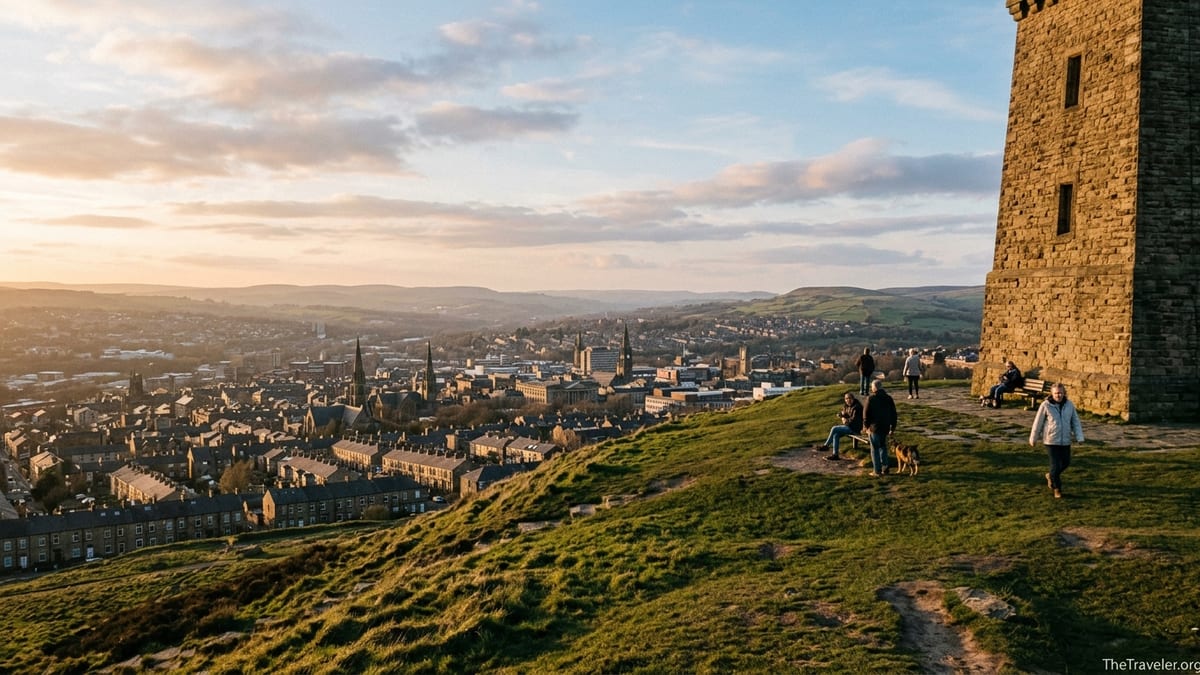
Start with the View from Castle Hill and Victoria Tower
If you want to get your bearings in Huddersfield, begin above it. Castle Hill rises just south of the town and is topped by the stone Victoria Tower, a Grade II listed landmark that you can see from almost anywhere in the valley. The hill has been a strategic site since at least the Iron Age, and walking up today gives you the same sweep of the Pennine hills and the town’s mills and terraces that earlier settlers would have watched over.
Most visitors drive or take a taxi to the car park near the summit and then walk the last short, steep section to the tower. The climb is exposed, so bring a windproof layer even in summer, but the reward is a 360 degree panorama taking in the moors towards Holmfirth, the rooftops of the university campus and the elegant facade of Huddersfield railway station. On clear evenings locals come up with fish and chips or a flask of tea to watch the sunset and the lights flicker on over town.
The tower itself generally opens on selected days, especially on bank holidays and during local events, with small entry fees that are usually just a few pounds. Climbing the narrow internal staircase adds another level to the view and gives a closer look at the stonework and commemorative plaques. Even if you visit when the tower is closed, the grassy plateau around it is a classic Huddersfield experience: dog walkers chatting, children rolling down the slopes and kites tugging in the strong hilltop wind.
For a deeper sense of place, pause to imagine the layers of history under your feet. Archaeological finds here point to Bronze and Iron Age settlement, and information boards near the car park outline the story in accessible language. Bring a picnic from town and you can turn a short viewpoint stop into a leisurely afternoon above Huddersfield’s past and present.
Explore Town-Centre Heritage and Grand Victorian Streets
Back in the centre, Huddersfield’s history is written in stone. Start at St George’s Square, where the Italianate frontage of Huddersfield railway station is often described as one of the finest in England. Its classical columns and pediment are more stately home than transport hub, an architectural reminder of how important the textile trade once made this town. Trains arrive from Leeds and Manchester in under an hour, so for many visitors the station is both gateway and first sightseeing stop.
From the square, wander into the grid of Victorian and Edwardian streets. Look up as you walk: elaborate stone carving, old mill owners’ offices and former warehouses now converted into flats and studios tell the story of the woollen boom years. The Pack Horse Centre, a covered shopping arcade created over an old cobbled yard, still hints at days when goods were brought into town by packhorse on rough Pennine tracks rather than tarmac roads.
For a more structured dose of local history, head to the Tolson Museum in Ravensknowle Park, a short bus ride or 25 minute walk east along Wakefield Road. Housed in a Victorian mansion donated to the town in memory of two brothers killed in the First World War, the museum focuses on the industrial and social history of Huddersfield and the wider Kirklees district. Inside you will find textile machinery, exhibits on local engineering companies and reconstructions of traditional Yorkshire rooms, giving context to the mills and chimneys you passed on the way.
The perfect way to join the dots between the hilltop view, the grand civic buildings and the museum displays is simply to walk. Huddersfield’s centre is compact, and a morning spent strolling from the station to Greenhead Park and back via the high street, indoor market site and old yards shows how closely the town’s industrial heritage and daily life still sit together.
Dive into Huddersfield’s Independent Food and Coffee Scene
Huddersfield will not compete with Leeds or Manchester for sheer volume of restaurants, but what it has is character and value. Many of the best places are independent, small-scale and woven into everyday local routines. Coffee is a good opening act. Arcade Coffee & Food, tucked inside the historic Byram Arcade, has become a favourite for students, creatives and young families. Expect speciality espresso from regional roasters, brunch plates built around seasonal Yorkshire produce and prices that, while higher than a basic chain cafe, still feel reasonable for the quality.
Byram Arcade itself is worth lingering in. Completed in 1881, it is the oldest arcade of its kind in the town, with wrought-iron balconies, a glass roof and an easy-going atmosphere that shelters you from West Yorkshire weather. Independent boutiques, makers’ studios and small food outlets share the space, so you might have poached eggs and halloumi at one end, browse handmade jewellery in the middle and finish with a slice of cake and a flat white at another cafe. For travellers, this is one of the most relaxed ways to plug into Huddersfield’s current creative culture.
Beyond the arcade, Huddersfield’s food is an honest mix of long-standing curry houses, Turkish grills, pizza places and budget-friendly pub chains. Locals on a night out talk about sharing platters at Turkish restaurants for groups, or grabbing reliable pub food and a pint at town-centre venues where mains often fall in the 10 to 15 pound range. Portions tend to be generous, and you will hear plenty of Yorkshire accents discussing football, shifts at local factories and the latest from the university.
If you have access to a car or are comfortable with local buses, consider heading to nearby village centres like Slaithwaite and Marsden in the Colne Valley for canalside cafes and craft beer bars linked to the wider Kirklees food economy. Many visitors combine a half-day walking along the Huddersfield Narrow Canal with a stop at a roastery cafe or bakery, then return to town for an evening performance or drinks.
Experience Everyday Culture in Huddersfield’s Parks and Pubs
To understand a town, watch how it uses its green spaces. Greenhead Park, a 10 to 15 minute walk uphill from the railway station, is Huddersfield’s classic Victorian park, complete with bandstand, ornamental lake and broad avenues lined with mature trees. At weekends the paths are busy with dog walkers, children on scooters and joggers, while in summer there are often community events or informal games of cricket on the lawns.
The park cafe is a simple spot for a drink and a snack, and in warmer months the ice cream counter is a local favourite. Families recommend the locally made milk ices and cones, and on a sunny afternoon you may find yourself in a queue that snakes past pushchairs and teenagers still in school uniform. Prices are in line with typical UK park cafes, but the pleasure of sitting with a coffee watching Huddersfield life unfold around you is hard to put a value on.
Later in the day, the focus shifts from parks to pubs and bars. Huddersfield has a well-regarded real ale scene, and names like The Grove, The Sportsman, the Rat and Ratchet and Arcade Beers come up regularly when locals discuss where to drink. Each has a different personality: one might be known for experimental craft beers and a slightly hip crowd, another for traditional cask ales and a more old-school feel. Expect pints in the 4 to 6 pound range, lower than in nearby big cities, and conversations that range from Huddersfield Town’s football fortunes to the state of local buses.
For visitors, an evening spent moving between a couple of these pubs is as instructive as any museum. You will hear a mix of long-term residents, students and fans up for a match at the John Smith’s Stadium, and you quickly sense that Huddersfield’s culture is rooted in sociable, unpretentious spaces where people still meet face to face rather than online.
Catch a Show at the Lawrence Batley Theatre
Huddersfield’s most atmospheric cultural venue is the Lawrence Batley Theatre, just a few minutes’ walk from the town centre. The building began life in 1819 as the Queen Street Chapel, a large Methodist church that once held thousands of worshippers. After various incarnations, including time as an arts centre and even a squash club, it was rescued and converted into a modern theatre in the 1990s, keeping much of its Georgian character.
Today the Lawrence Batley Theatre hosts a varied programme of drama, comedy, dance, family shows and live music, drawing in touring companies as well as local performers. Seats are usually reserved and ticket prices are often more accessible than in bigger cities, making it easy for visitors to book on impulse once they arrive in town. The courtyard in front of the theatre, dotted with tables and benches, is a pleasant place to sit with a pre-show drink on lighter evenings.
One of the most interesting ways to experience the theatre’s heritage is through behind-the-scenes tours and events that run at different times of year, particularly around national Heritage Open Days. These offer a chance to see backstage areas, hear stories about the building’s transformation from chapel to cultural hub and appreciate how community volunteers and local campaigners helped save it from dereliction.
Even if your schedule does not allow for a performance, simply walking past the theatre, noting its stone facade and quiet courtyard tucked just off Queen Street, adds another layer to your understanding of Huddersfield. It is a tangible example of how the town has adapted older buildings to new cultural uses rather than sweeping them away.
Walk, Shop and Snack Through Byram Arcade and Other Quirky Corners
Huddersfield’s most distinctive indoor spaces are not glossy malls but older structures given new life. Byram Arcade sits at the heart of this story. Completed in the late 19th century, its three storeys of galleries overlook a central space covered by a high glass roof, which floods the interior with natural light even on grey days. Independent retailers, design studios, tattoo artists and food businesses all share the building, creating a small ecosystem of creative enterprise.
As a visitor, the pleasure of Byram Arcade is in moving slowly. Start with a coffee or brunch at a cafe such as Arcade Coffee & Food, then climb the staircases to wander past studios selling jewellery, art and handmade gifts. Prices vary, but you can often find affordable prints and crafts that make more meaningful souvenirs than generic high street items. Occasional live music, markets and makers’ events add extra buzz, particularly around weekends and holidays.
Elsewhere in the centre, look for smaller corners that hint at older Huddersfield. Short ginnels between streets reveal brick yards; old signage painted on side walls still advertises long-closed businesses; and the remains of the open market and indoor market buildings remind you that this has long been a trading town. While some areas show the wear and tear of reduced investment, they also give a realistic view of a post-industrial northern town adapting to new economic realities.
If you enjoy photography, these details are worth capturing: faded lettering, stone lintels worn by weather, reflections in rain-slicked cobbles. Combined with the grander set pieces of St George’s Square and Castle Hill, they form a visual record of Huddersfield’s layered story.
Connect with University and Festival Life
The University of Huddersfield brings thousands of students into the town and injects youthful energy into the cultural calendar. The campus, a short walk from the station, sits beside the canal and incorporates carefully renovated old mills alongside modern teaching blocks. It is worth wandering through even if you are not studying here: canalside paths, student-friendly cafes and public art give a different perspective on Huddersfield’s regeneration.
During term time and around graduation season, you will notice the impact in town: fuller cafes at lunchtime, families taking photographs in academic gowns in the square, and more diverse accents in pubs and on buses. For travellers, this means a wider choice of budget eating options and nightlife than you might expect in a town of this size, from simple noodle bars to late-opening bars with live music.
Huddersfield also hosts a variety of festivals and events across the year, some focused on contemporary and classical music, others celebrating local food, drink and culture. Programmes change annually, but a typical year might include town-centre events that turn multiple venues into a walking trail of gigs, street food and art. If your visit coincides with one of these, they are a concentrated way to sample Huddersfield’s creative side in a single evening.
Even without a major festival underway, keep an eye out for posters and chalkboards advertising smaller happenings: spoken word nights at cafes, quiz evenings in pubs, community theatre in church halls and exhibitions in repurposed buildings. Huddersfield’s culture often operates at this intimate, grassroots level rather than in grand institutions.
The Takeaway
Huddersfield is not a place of big-ticket attractions and selfie queues. Its appeal lies in piecing together views from Castle Hill, Victorian architecture, independent food and drink, and a sense of everyday northern life. Stand on the hilltop as the wind tugs your coat, walk past the station’s colonnade, linger over brunch in Byram Arcade and sit in a real ale pub listening to local conversation, and you will have experienced the best of what the town quietly offers.
For travellers who value authenticity, modest prices and human scale over spectacle, Huddersfield rewards curiosity. It is a town where an hour spent in a park or cafe can be as revealing as a formal tour, and where history, food and local culture interlock in ways that are easy to slip into for a day or two. Come with comfortable shoes, an open schedule and a willingness to look beyond the surface, and Huddersfield will show you more than you might have expected.
FAQ
Q1. How long do I need to see the best of Huddersfield’s history, food and culture?
For most visitors, one full day and an overnight stay is enough to see Castle Hill, explore the town centre, try a couple of cafes or pubs and maybe catch a show, though two days gives a more relaxed pace.
Q2. Is Huddersfield a good base for exploring the wider Yorkshire countryside?
Yes, Huddersfield sits between Leeds and Manchester with quick rail links and has easy access to the Pennine hills, the Colne Valley and nearby towns and villages, so it works well as a modestly priced base.
Q3. Can I visit Castle Hill and Victoria Tower without a car?
It is possible but less convenient; you can take a taxi from the centre for a short ride uphill or use local buses part of the way and then walk, but many visitors opt for a taxi to save time and energy.
Q4. What kind of food can I expect in Huddersfield?
Expect a mix of independent brunch cafes, long-established curry houses, Turkish grills, pizza places and value-focused pubs, with plenty of affordable options and generous portions typical of northern England.
Q5. Is Huddersfield safe to walk around as a visitor?
Like many UK towns, Huddersfield has some run-down areas, but the central streets, main parks and popular pub and cafe areas are generally fine for visitors who take normal city-level precautions, especially in the evening.
Q6. Are there free things to do that still give a feel for local culture?
Yes, walking up Castle Hill, exploring Greenhead Park, wandering the Victorian streets, browsing Byram Arcade and watching everyday life around the station and university all cost nothing beyond transport.
Q7. Do I need to book cafes and restaurants in advance?
For popular brunch spots and independent restaurants it is sensible to book at busy weekend times, but during weekdays or outside peak hours you can usually just walk in without a reservation.
Q8. What is the best time of year to visit Huddersfield?
Spring and early autumn often offer the best balance of mild temperatures, greener parks and clearer views from Castle Hill, though even in winter the town’s indoor cafes, pubs and theatre remain welcoming.
Q9. Is Huddersfield suitable for budget travellers and students?
Yes, the presence of the university keeps prices for food, drink and some accommodation relatively moderate, and many of the town’s main experiences, from parks to viewpoints, are low cost or free.
Q10. Can I combine Huddersfield with a visit to Leeds or Manchester in the same trip?
Absolutely, frequent trains link Huddersfield to both cities in under an hour, so you can easily spend a day or two in Huddersfield as part of a wider Yorkshire and northwest England itinerary.