


I arrived in Huddersfield expecting a functional Yorkshire market town: a railway junction with a few stalls, some charity shops and a quick coffee before heading back to Manchester or Leeds. Instead, I found a place where grand classical facades frame everyday scenes, brutalist concrete hides bold art, and a new generation of makers and food traders is quietly reshaping the streets. Huddersfield did not just exceed expectations; it challenged the lazy idea that a “market town” has to be quaint, sleepy or stuck in the past.
Get the latest updates straight to your inbox!
First Impressions: A Grand Entrance for a “Modest” Town
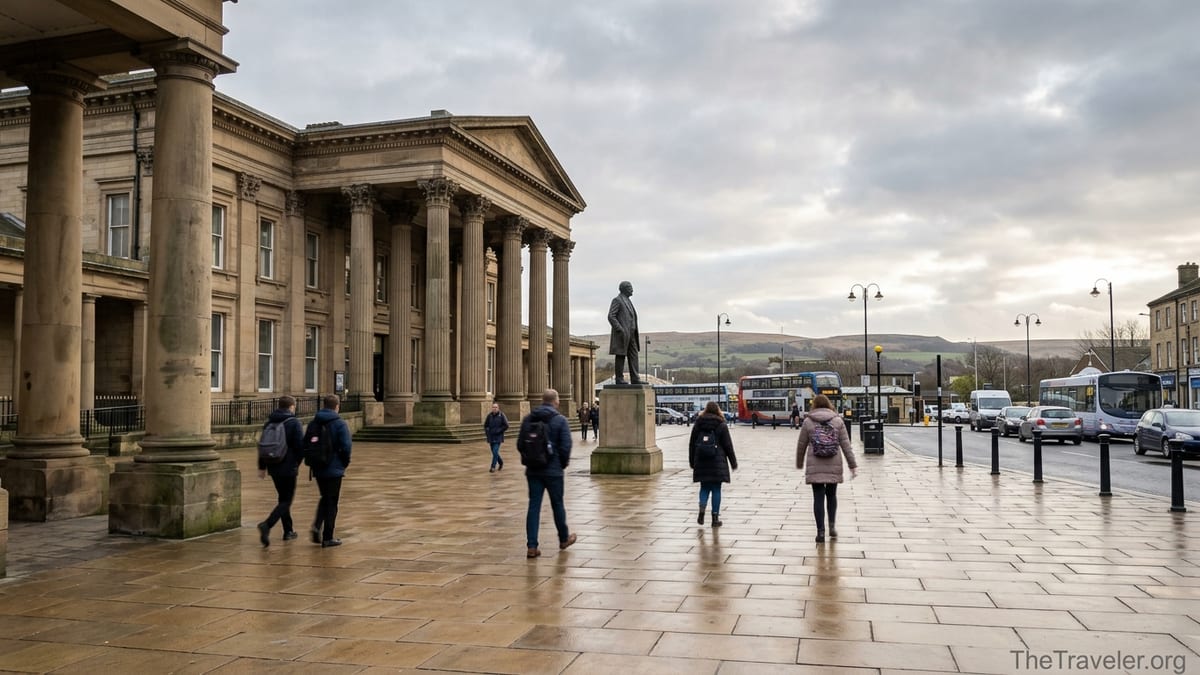
Your introduction to Huddersfield is likely the moment you step out of the railway station into St George’s Square. For a town of around 140,000 people, the scale and confidence of this Grade I listed station are startling. Its imposing neo-classical frontage, long colonnade and stately proportions have earned it a reputation as one of the most handsome stations in Britain, more reminiscent of a city capital than a satellite market town. Commuters hurry past Corinthian columns, and buses loop around the square beneath the watchful gaze of the bronze statue of former Prime Minister Harold Wilson, who was born just a few streets away.
Spend a few minutes in the square and the character of Huddersfield starts to reveal itself. Teenagers lean on the low stone walls with takeaway coffees from independent kiosks, office workers cross between buses and trains, and students from the University of Huddersfield drag suitcases over cobbles. On a clear day the light picks out the honeyed tones of the local stone; in rain, the building’s detailing becomes moodier and more dramatic. It feels like a civic stage set, and it immediately signals that this is no anonymous commuter stop.
Practically, the station also underpins Huddersfield’s appeal as a base. Direct trains from Manchester and Leeds typically take around 30 to 45 minutes, with day returns often available for under the cost of a couple of city-centre cocktails, depending on when you book and whether rail works are scheduled. That combination of grand arrival and easy connectivity makes Huddersfield a surprisingly compelling day trip or low-key city alternative.
Streets of Stone: Victorian Confidence and Modern Life
Walk away from the station and you quickly understand why local tourism materials boast of more than a thousand listed buildings. Around New Street, Kirkgate and Market Place, entire blocks of 19th-century warehouses and commercial premises stand shoulder to shoulder, their tall sash windows and stone cornices giving the town centre a coherence that many larger places envy. Even routine buildings – former banks now housing phone shops or fashion chains – have an air of gravity about them.
This architectural backdrop shapes everyday experiences. Sitting with a flat white at a small café off Market Place, I watched buses angle around tight corners between tall stone facades while shoppers threaded through narrow alleyways that have changed little in a century. The pavements might be busy with modern retail life, but look up and you see carved dates, merchant initials and the occasional ornate chimney. The effect is of a town that has always taken itself seriously, even if the national conversation often overlooks it.
Huddersfield’s scale is part of its charm. It is big enough to feel urban yet compact enough to cross on foot in 15 minutes. That walk, from station to university or from Greenhead Park down into the centre, gives you a continuous run of stone streetscapes. Unlike some market towns where heritage is confined to a single square, Huddersfield wears its history on almost every block, and that depth of character reveals itself best at walking pace.
Markets Old and New: From Traditional Stalls to a Cultural Heart
Huddersfield grew up around markets, and their legacy still shapes both the town’s image and its future. The open market, with roots in the late 19th century, continues to trade in fresh produce, household goods and clothing, drawing regulars from nearby villages in the Colne and Holme valleys. On busy days you might pay a little under what you would in a Leeds city-centre supermarket for fruit and veg piled high in crates, or pick up Yorkshire cheeses and cured meats from long-standing traders who know customers by name.
Yet the most intriguing story is what is happening around the former Queensgate Market. This Grade II listed concrete hall, famous for its striking ceramic panels along Queensgate, was once the beating heart of everyday shopping. Today it sits at the centre of a multi-year regeneration known as Our Cultural Heart, a project of more than 200 million pounds that aims to turn the area into a new food, culture and leisure quarter for the town. Hoardings, diverted pavements and construction vehicles already hint at what is to come, with the market hall set to become a food hall of independent vendors and flexible events space, surrounded by a new library, museum and a public square.
For visitors arriving now, that means living with some disruption – fenced-off walkways, temporary routes around Queensgate and glimpses of demolition where the Piazza shopping centre once stood. But it also creates a sense of anticipation. You get the impression of a town deliberately trying to future-proof itself, swapping ageing retail units for experiences and culture. If the plan succeeds, it will give Huddersfield something distinct from its neighbours: a modern cultural district still anchored in the brutalist drama of its original market building.
Byram Arcade, Side Streets and an Indie Undercurrent
If Queensgate hints at Huddersfield’s future, Byram Arcade shows how its past can be reimagined. Completed in the 1880s, this three-storey glass-roofed arcade just off Westgate is a mini-world of its own. Step inside and you move from traffic and chain stores into a calmer, softly lit space of balconies, ornate ironwork and tiled walkways. Independent fashion designers, jewellers, tattoo studios and small creative agencies occupy compact units, giving the arcade a slightly bohemian air.
It is also one of the best places in town to feel the new Huddersfield taking shape. You can order speciality coffee and a light lunch from a café on the ground floor, browse local artwork upstairs, then listen to buskers spill sound in through the open doorway. On event days, makers’ markets and small performances turn the arcade into a community hub. For travellers who like to feel plugged into local creative scenes rather than just ticking off landmarks, Byram Arcade is an easy highlight.
Venture further and the indie streak continues. Around New Street and the streets leading towards the university you will find small bars specialising in craft beer, micro-roaster coffee shops where a carefully prepared pour-over costs much the same as a standard latte in a national chain, and barbers and vintage stores catering to the student population. It is not as obviously hip as a big-city creative quarter, but that is part of its charm; the places feel built for locals first, visitors second.
From Parks to Viaducts: Huddersfield’s Outdoor Character
Huddersfield’s setting between the Pennine hills and the Calder Valley gives it a landscape drama that most market towns can only dream of. Within a 15-minute walk of the centre you can be in Greenhead Park, a classic Victorian green space with ornamental lakes, formal flowerbeds, a bandstand and a café. On a sunny weekend the lawns fill with families, students with picnic blankets, and older couples strolling the perimeter paths. It is easy to imagine Victorian mill owners taking the same route more than a century ago, escaping the noise of town for an hour.
Look up from many streets and you will catch glimpses of surrounding hills or the long stone spans of the nearby viaduct carrying trains towards Manchester or Leeds. This infrastructure is more than just practical; it shapes the town’s silhouette and contributes to a sense of place. Stand on the edge of town at dusk, as commuter trains rumble over the viaduct and lights begin to flicker in the valley, and Huddersfield suddenly feels bigger than the label “market town” suggests.
For walkers and day-trippers, Huddersfield’s railway line offers access to some of the most appealing countryside in northern England. Short train hops take you to stations like Slaithwaite and Marsden, where converted mills house canalside cafés and microbreweries. From there, signposted routes lead onto moorland paths, reservoirs and sections of the Pennine Way. A return ticket from Huddersfield often costs less than a city-centre lunch, making it realistic to base yourself in town and treat the surrounding countryside as your playground.
Food, Drink and Evenings: Subtle but Satisfying
Huddersfield is not a place of endless small plates and experimental tasting menus, but its food and drink scene is quietly confident. In and around the town centre you will find a mix of traditional Yorkshire pubs, South Asian curry houses, Turkish grills and modern cafés, alongside familiar chains in the Kingsgate shopping centre. Many visitors will find dinner for two in a mid-range independent restaurant, including drinks, comes in comfortably below what they might expect to pay in Manchester city centre or central Leeds.
The brewing heritage of West Yorkshire is evident in the number of pubs that still take cask ale seriously. It is not difficult to find a hand-pulled local bitter or pale ale for the price of a soft drink in a capital city bar, often poured in surroundings that mix Victorian woodwork with the occasional football scarf or rugby shirt. Given that Huddersfield is the birthplace of Rugby League, it is no surprise that match days bring a special atmosphere; the chatter in certain pubs can switch from building developments and university research to team tactics in an instant.
Evenings in Huddersfield can be as low-key or lively as you like. Some visitors confine themselves to a pre-train drink in the bar across from the station, but it is worth wandering a little deeper. Student-focused venues offer live music, comedy nights and pub quizzes, particularly in term time, while the Lawrence Batley Theatre, set in a converted Georgian chapel, hosts touring plays, stand-up and dance performances. None of it screams big-city nightlife, but taken together it adds another layer of character that many passing visitors never see.
Regeneration, Reality and Why Expectations Are Changing
Spend time talking to residents and you will hear mixed feelings about the town centre. Like many places across the UK, Huddersfield has seen traditional retail decline: empty units, a shift towards discount stores and a sense that the high street is no longer the straightforward shopping strip it once was. Online shopping and the gravitational pull of Leeds and Manchester have taken their toll, and not everyone is convinced that the current wave of regeneration will fix things quickly.
Yet it is exactly this tension that makes Huddersfield interesting to visit now. The Our Cultural Heart project, improvements around New Street and investment in the railway station are all attempts to rewrite the town’s story, turning it from a place people travel through into one they linger in. You can already see small signs of change: fresher public realm, pop-up events, Sunday markets showcasing local makers, and trial cultural programming in spaces that used to be purely commercial. None of it is instant, but taken as a whole it suggests a town trying to build a future that suits its scale and identity rather than copying its bigger neighbours.
For travellers, this means accepting a certain work-in-progress feel. You might have to navigate hoardings, or see a beloved but tired shopping centre half-demolished. In return, you get the opportunity to experience a town at a turning point. When you sit on a bench in St George’s Square or under the glass roof of Byram Arcade, you are not just admiring heritage; you are watching a post-industrial northern town experiment with what comes next.
The Takeaway
Huddersfield surprised me not because it is flawless, but because it feels more complex than its reputation. On paper it is a market town with a strong university, a big rugby history and a convenient station on the line between Manchester and Leeds. In person it is a town of grand architecture and gritty side streets, brutalist concrete enlivened by art, independent traders opening in unlikely corners, and major regeneration works that could reshape how people use the centre for decades.
If you like polished tourist experiences, you may find the construction zones and occasional empty units jarring. But if you are drawn to places that are still figuring themselves out, where you can walk from a Victorian arcade to a future food hall site and then catch a train to wild moorland within half an hour, Huddersfield offers more depth and character than any marketing slogan suggests. It is exactly the sort of place that rewards curiosity: a town that reveals itself slowly to those willing to look beyond first impressions of “just another market town.”
FAQ
Q1. Is Huddersfield worth visiting as a day trip from Manchester or Leeds?
Yes. With journey times often around 30 to 45 minutes by train and frequent services, Huddersfield works well as a day trip for architecture, markets, independent shops and a walk in Greenhead Park, especially if you want a change of pace from larger cities.
Q2. What is the best area to explore on foot in Huddersfield town centre?
The most rewarding walking loop runs from St George’s Square and the railway station through New Street, Market Place and Kirkgate, with a detour into Byram Arcade. This route gives a good mix of grand civic buildings, smaller Victorian streets and newer independent businesses.
Q3. Are the markets in Huddersfield still active?
Yes, but they are changing. Traditional markets continue to operate, especially for fresh produce and general goods, while the former Queensgate Market is being transformed into a food hall and events space as part of the wider Our Cultural Heart regeneration.
Q4. Will construction work around Queensgate spoil my visit?
There are hoardings, diverted pavements and visible construction around Queensgate and the old Piazza site, which can be inconvenient. However, most of the main shopping streets, Byram Arcade, the station area and Greenhead Park remain accessible and enjoyable to explore.
Q5. Is Huddersfield expensive compared with bigger northern cities?
Generally, no. Eating out, pub drinks and many everyday costs often come in lower than in central Manchester or Leeds. You are more likely to find reasonably priced local cafes and pubs than high-end fine dining, which suits many visitors’ budgets.
Q6. What makes Huddersfield different from other Yorkshire market towns?
Huddersfield combines the walkable scale of a market town with the architectural ambition of a small city. Its grand railway station, dense Victorian stone streets, large university and major regeneration projects give it a more urban, layered feel than many similarly sized places.
Q7. Is Huddersfield family friendly?
Yes. Greenhead Park offers playgrounds and open space, while the town centre and nearby leisure facilities provide swimming, soft play and casual dining options. The compact centre and frequent trains also make logistics with children simpler than in some larger cities.
Q8. Can I use Huddersfield as a base for walking in the countryside?
Absolutely. Short train rides from Huddersfield reach villages such as Slaithwaite and Marsden, which have direct access to canal paths, reservoirs and moorland routes. This makes it easy to combine town-based accommodation with day walks in the Pennine landscape.
Q9. Is Huddersfield safe for solo travellers?
Like most UK towns, Huddersfield has busy areas and quieter corners, but the central streets around the station, main shopping area and university are usually well used, especially during the day. Sensible city-style precautions apply, but most solo visitors experience no issues.
Q10. How long should I plan to spend in Huddersfield?
A day is enough to see the highlights: the station and St George’s Square, Byram Arcade, the main streets and a stroll through Greenhead Park. With two or three days you can add countryside walks, theatre visits and more time in independent cafes and bars.