


Most people arrive at Villa d’Este with one image in mind: a cascading hillside of water, terraces and the thunder of the Neptune and Organ fountains. Then, after an hour of snapping photos by the balustrades and strolling the Hundred Fountains, they are back on the coach to Rome. What they miss is an entire parallel villa: intimate frescoed rooms almost empty at midday, quiet paths where the only sound is water in mossy channels, and small details that turn a beautiful garden into a lived, human story. This guide looks past the famous postcard views to the corners of Villa d’Este that reward travelers who linger.
Get the latest updates straight to your inbox!
The Villa Before the Garden: Stepping Inside the Cardinal’s World
Many visitors race straight through the palace to reach the terraces, treating the interior as a corridor to the gardens. Yet the rooms of Cardinal Ippolito II d’Este are where the story of the villa really begins. Commissioned in the mid 16th century by this ambitious son of Lucrezia Borgia, the building was laid out as a theatrical backdrop for power, learning and pleasure, not just a frame for fountains. Today, if you slow down and look up, the walls still read like a private manifesto in paint and stucco.
Start in the so called Noble Apartment on the main floor, where large reception halls are covered in Mannerist frescoes. One room shows the myths and history of Tivoli itself, with personifications of the local rivers and mountains painted by artists from the Roman Mannerist school. In another, the ceiling is ringed with the Este eagle gripping golden apples, paired with the Latin motto about a sleepless dragon, a veiled reference to the Garden of the Hesperides. These symbolic programs are not just decorative. They quietly link the family’s aspirations to the ancient world, something that is easy to miss when you only give the ceilings a passing glance.
Upstairs, in the more intimate Cardinal’s Apartments, the mood shifts from statecraft to personal refuge. Rooms are smaller, the fresco themes more introspective. Here you find allegories of virtues, scenes from classical literature and views that frame the countryside like landscape paintings. In quieter hours, especially in late afternoon when most group tours have already left, you can sometimes stand alone in these spaces and hear only your own footsteps on the terracotta floors. For anyone interested in Renaissance domestic life, these upper rooms can be as revealing as the most famous jet of water below.
Because interior access is included in the standard ticket, there is no extra cost to slow down here. The real investment is time. Plan to spend at least thirty to forty minutes in the palace before you even step into the garden. If you are coming on a day trip from Rome, consider taking an early regional train so that you arrive soon after opening time, when the palace is at its calmest and light from the east slides in through the high windows, catching the dust in the air and making the frescoes glow softly.
Reading the Frescoes: Stories Hidden in Plain Sight
Even travelers who pause in the rooms of Villa d’Este often experience the frescoes as a blur of color and cherubs. With a bit of context, they become a narrative thread that ties the whole site together. On the ground floor, look for the First and Second Tiburtine Rooms. Their painted cycles recount the mythical origins of Tivoli, weaving in tales of Sibyls, emperors and river gods. When you later stand in the gardens looking toward the Aniene Valley and the faint line of Hadrian’s Villa, these mythic scenes suddenly feel anchored in the actual landscape just beyond the windows.
One easily overlooked detail is how often Fortune appears, sometimes subtly crowned with a cardinal’s hat or even a papal tiara. Guides from local car services who specialize in Tivoli tours often point out that this was no casual choice. It reflected Ippolito’s frustrated hopes of higher office in Rome. Once you know to look for her, you begin to spot Fortune again and again, riding ships, balancing on spheres or surrounded by the symbols of power. It turns a decorative figure into a recurring character in the villa’s visual drama.
In the Sala di Passaggio on a lower level, a fresco of particular interest shows a painted plan of the villa itself with the palace still under construction. It is easy to walk straight through this narrow room without noticing what is on the wall, especially in peak season when indoor spaces can feel like a funnel toward the gardens. Take a minute to stand back and study this image. It is both a piece of sixteenth century project management and a reminder that what looks timeless outside was once an active building site.
Because there is rarely in depth signage next to each painting, it can be worth bringing a compact guidebook or downloading a short PDF on the villa’s iconography before your visit. Unlike the crowds around the fountains, the people who pause with a small booklet in hand inside the palace tend to be few. That simple bit of homework can transform the interior from a pretty prelude into a set of rooms you remember in detail years later.
Quiet Corners of the Garden Most Tours Skip
Down in the gardens, even independent travelers tend to follow the same loop. They descend from the palace terraces, pause at the Oval Fountain, walk along the Hundred Fountains, cluster at the Rometta and Neptune fountains, then climb back up. It is a spectacular route, but it leaves several of the most atmospheric corners nearly untouched, especially in the middle of the day when buses from Rome disgorge tour groups into the central axis.
One such overlooked area lies to the sides of the main terraces. Instead of always taking the central stairs, look for lateral paths that wind under pergolas and through shaded groves. On a hot July afternoon, when the stone stairs can feel like a kiln, these side routes are several degrees cooler. Moss covered retaining walls run with water in narrow rills, and smaller fountains gurgle in niches half hidden by climbing plants. Travelers who have taken the time to wander here often remark that, for a few minutes, they forget they are in a UNESCO listed show garden and feel instead as if they have stumbled into a private country estate.
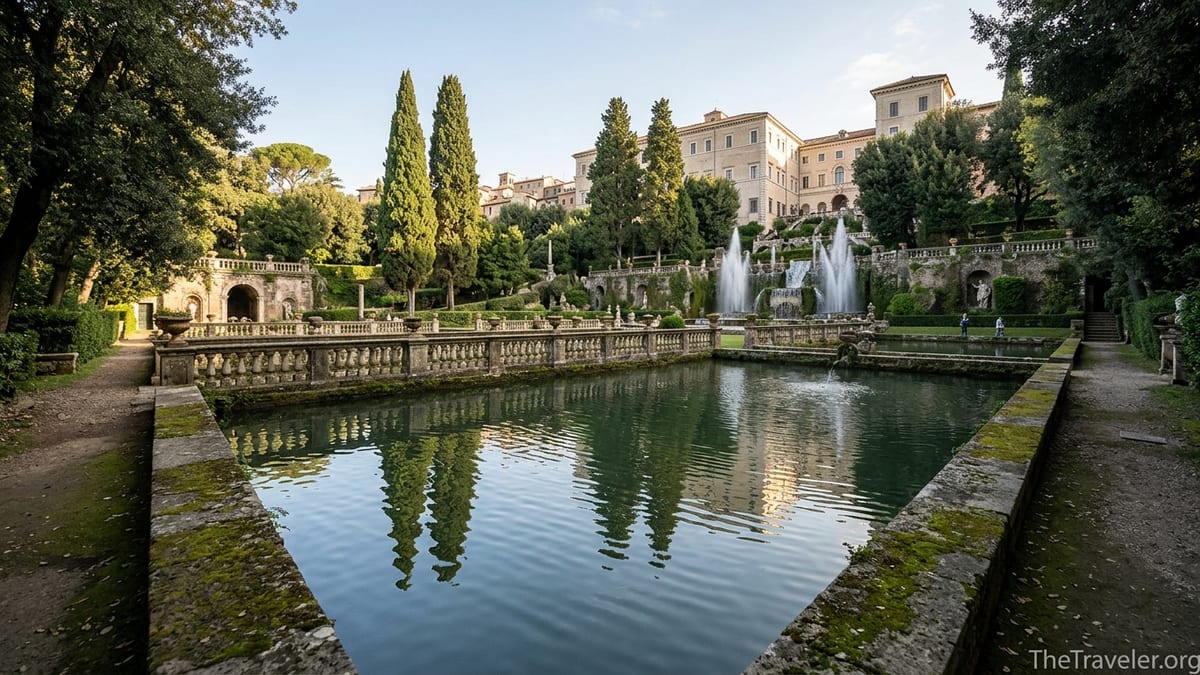
Near the fish ponds at the lowest level, most visitors snap a panoramic photo of the long reflecting basins stretching toward the Fountain of the Organ and then head directly back up that axis. If you walk to the far ends of these ponds instead, small staircases lead to terraced lawns and more secluded viewpoints. These spots, looking back up at the villa framed by cypress and umbrella pines, are among the best places to appreciate the overall design. In traveler photos, they are curiously rare, simply because they are thirty or forty meters off the standard loop.
Likewise, the garden includes rocky grottos and tucked away statues that are easy to miss in the rush from one marquee fountain to another. A sculpture of a sleeping nymph, guarded by Este eagles and framed by stone apple branches that echo the mythic garden theme, rests in a side grotto many people barely register as they pass. On a weekday morning in shoulder season, you may share this cool, damp space only with the sound of dripping water. These quieter pockets are where the garden shifts from spectacle to intimacy, and they reward anyone willing to stray slightly from the crowds.
Engineering Marvels: Understanding the Water Without the Jargon
Guidebooks love to mention that Villa d’Este’s waterworks are powered entirely by gravity. In practice, though, most travelers only experience this as a pleasant background fact while they photograph the Neptune Fountain. The real wonder lies in how the sixteenth century engineers coaxed an entire hillside into performance, and you can still trace that ingenuity with your own eyes on a casual visit.
The water feeding the garden is diverted from the Aniene River through underground channels that enter the property above the highest terraces. From there, a system of pipes and hidden conduits steps the flow down through the site, turning height into pressure. When you walk from the Oval Fountain toward the Hundred Fountains, you are effectively strolling along a sloping water main disguised as a rustic wall. The continuous run of spouts and masks is not just charming; it bleeds off pressure in controlled ways so that the more dramatic jets farther down the hill can perform without bursting their stone basins.
At the Fountain of the Organ, which has been carefully restored over recent decades, the hydraulic show goes beyond vertical jets. Inside its structure is a historical water organ that uses falling water to drive a mechanism that pushes air through pipes, producing music. The organ is not always running, and the exact demonstration times can vary by season, but even when silent it is worth stepping close and looking at the back of the structure, where service doors and grilles hint at the machinery within. When you realize that this was designed in an era before modern pumps and electricity, the entire hillside starts to feel like an enormous, gravity powered instrument.
Travelers who are curious about the engineering but not experts can prepare by reading a short overview of Renaissance hydraulic systems before arriving. Then, as you move through the gardens, small details like the incline of channels, the placement of overflow basins or the way a grotto is positioned to cool and calm water begin to stand out. This awareness does not require any technical background, but it turns each fountain from a photo opportunity into a visible piece of problem solving from nearly five hundred years ago.
Views, Light and Timing: Experiencing the Garden at Its Best
Because Villa d’Este is relatively close to central Rome, many travelers treat it as a half day excursion squeezed between city sights. As a result, the garden is often busiest from late morning through mid afternoon, especially from May to September. Those who adjust their timing discover a very different villa. Arriving soon after opening, often around 8:30 in the morning, means meeting the palace and the upper terraces in slanting light, when long shadows emphasize the relief on carved balustrades and the air still holds a hint of coolness from the night.
In summer, the midday sun can bleach the stone and make the main vistas feel harsh. This is when the shaded stairs and woodland corners away from the primary axes become useful not just as curiosities but as practical refuges. A reusable water bottle becomes more than a token eco friendly accessory here; the walk back up through Tivoli’s lanes to the bus stop or train station is uphill, and having a drink in hand can make the difference between a pleasant climb and an uncomfortable slog.
Late afternoon, especially in spring and autumn, is an underrated time to visit if opening hours allow. As the sun lowers behind the hill, the garden’s western side glows warmly, and the long pools near the fish ponds become giant mirrors for the sky. On quieter weekdays, you may find yourself in the unusual position of seeing more gardeners than tourists in some areas. The soundscape shifts from excited chatter in many languages to the scrape of rakes on gravel, clipped phrases in Italian and the steady rush of water.
For photographers, this timing also matters. Wide angle shots of the central axis taken around midday often suffer from flat light and blown highlights in the spray. By contrast, a visit timed for the first or last two hours of opening can yield softer contrast, deeper greens in the cypress and a better chance that reflective surfaces like the fish ponds are not disturbed by large crowds tossing coins or leaning on the railings directly in front of your lens.
Beyond the Turnstiles: Tivoli’s Context and Simple Local Experiences
Another element many visitors miss at Villa d’Este has nothing to do with fountains or frescoes. It is the town around the villa. Tivoli is often experienced as little more than a transit point, a place where a coach drops people at the entrance and collects them two hours later. Yet even a short walk through the surrounding streets, before or after your villa visit, can place the site in a living context instead of isolating it as a museum piece.
Tivoli’s historic center clings to a hilltop above the Aniene Valley. Narrow lanes radiate from the area near the villa’s entrance, leading past small groceries, cafes and houses that have nothing to do with tourism beyond the occasional cluster of visitors consulting maps. Grabbing an espresso at a standing bar two or three blocks away from the villa often costs less than in Rome’s center and provides a moment of ordinary local rhythm. You might find schoolchildren stopping for a snack, municipal employees on a quick break or elderly residents discussing the weather in front of a newsstand.
For travelers with more time, pairing Villa d’Este with Hadrian’s Villa in the valley below provides a compelling contrast. One is an intimate, theatrical Renaissance estate; the other, a sprawling imperial complex whose ruins Cardinal Ippolito plundered for marble and statues. Even if you choose not to visit the archaeological site on the same day, simply standing at the villa’s terraces and knowing that the broken columns you see in the distance once provided material for the sculptures at your feet gives a sharper edge to the beauty.
Simple logistical choices can also change how you experience the day. Taking the regional train from Rome to Tivoli and then walking through town to the villa, rather than booking a door to door coach excursion, introduces you to the everyday Italy that exists between UNESCO sites. Ticket prices for public transport are usually modest compared with organized tours, and the extra time required is repaid in freedom to linger. If you choose a return train in the early evening, you may catch the Aniene Valley in golden light as your day at Villa d’Este fades into the suburbs on the way back to Rome.
The Takeaway
Villa d’Este has earned every bit of its fame for cascading terraces, roaring fountains and theatrical vistas. Yet those headline features can obscure a quieter, equally compelling villa that lives in its upper rooms, its side paths and its relationship to the town and landscape of Tivoli. Travelers who resist the urge to treat the site as a quick photo stop and instead give it half a day or more, who pause in the painted interiors, explore the overlooked corners of the garden, pay attention to the ingenious waterworks and allow time for a coffee or short stroll in town, come away with a deeper memory.
The difference lies less in specialist knowledge than in pace and awareness. By shifting your focus from a checklist of famous fountains to the lived, layered story of a cardinal’s hillside retreat, Villa d’Este transforms from a spectacular backdrop into a place that feels, in some small way, personally known. The next time you look at a picture of its terraces, you will not just see water and stone, but recall the cool of a grotto, the painted face of Fortune on a ceiling and the view down to the valley where everything begins with a diverted river.
FAQ
Q1. How much time should I plan for Villa d’Este if I want to see more than the fountains?
Most travelers who want to explore both the interiors and the quieter corners of the garden should allow at least three to four hours inside the complex, not counting travel time from Rome.
Q2. Is it worth visiting the palace interiors, or should I focus on the gardens?
The interiors are absolutely worth your time. They hold the cardinal’s apartments and richly symbolic fresco cycles that explain the villa’s history and themes, and they are often far less crowded than the gardens.
Q3. When is the best time of day to avoid crowds at Villa d’Este?
Arriving soon after opening or visiting in the last two hours before closing generally offers the calmest experience, with fewer groups in both the palace and the gardens.
Q4. Are there lesser known areas of the garden that are especially good in hot weather?
Yes. The shaded side paths, grottos and woodland steps away from the main central staircases are noticeably cooler and quieter on hot days compared with the exposed terraces.
Q5. Can I see the water organ actually play at the Fountain of the Organ?
The historical water organ is sometimes demonstrated on a schedule that can vary by season and maintenance needs, so it is best to check the current information on site that day rather than assume it will always be operating.
Q6. Do I need a guided tour to appreciate the frescoes and symbolism inside the villa?
A guide can be helpful, but a good short guidebook or booklet on the villa’s iconography is often enough for independent travelers to understand the key stories and symbols in the rooms.
Q7. Is Villa d’Este suitable for visitors with limited mobility?
The palace interior is relatively manageable, but the gardens are laid out on steep terraces with many stairs and some uneven paths, so parts of the site can be challenging for those with mobility issues.
Q8. Can I combine a visit to Villa d’Este with Hadrian’s Villa in one day?
Yes, many travelers do both in a single day, but it makes for a full schedule. If you want time to explore Villa d’Este’s hidden corners, consider dedicating most of your day to it and seeing Hadrian’s Villa on a separate visit.
Q9. Are there good places to eat near Villa d’Este, or should I bring snacks?
You will find plenty of cafes and small eateries within a short walk of the entrance in Tivoli’s historic center, but carrying a light snack and water is still wise, especially in warmer months.
Q10. Is Villa d’Este a good destination for children, or is it mainly for adults?
The dramatic fountains, long pools and echoing stairways can be very engaging for children, and older kids often enjoy learning that the entire water system works using gravity rather than modern pumps.