


Helsinki Cathedral is more than a postcard-perfect landmark. Sitting high above Senate Square, its white steps and green domes are the heart of Helsinki’s historic center and the starting point for many of the city’s best walks. With compact streets, a lively harborfront and major sights clustered within minutes, this is one of the easiest capitals in Europe to explore on foot. Here is how to make the most of Helsinki Cathedral, with practical walking routes, guided tour ideas and the most rewarding nearby attractions.
Get the latest updates straight to your inbox!
Understanding Helsinki Cathedral and Senate Square
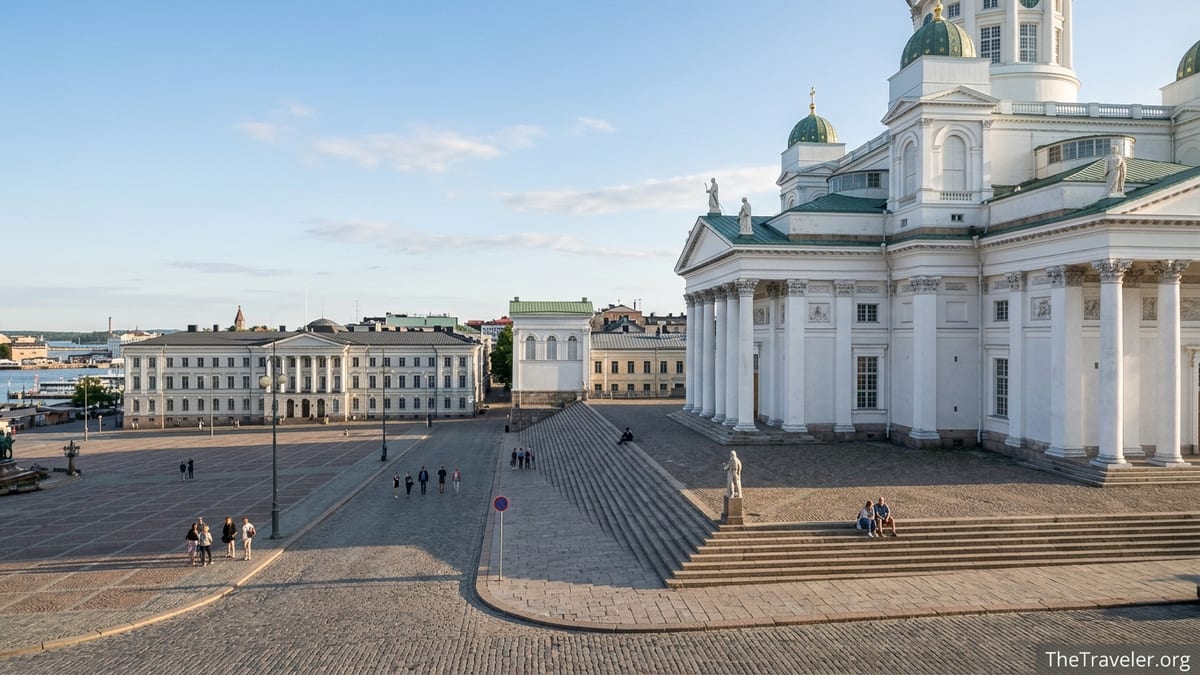
Helsinki Cathedral crowns Senate Square, a grand neoclassical space laid out in the 19th century by architect Carl Ludvig Engel. The square is framed by the Government Palace, the main building of the University of Helsinki and the National Library of Finland, which together with the Lutheran cathedral represent political, scientific, cultural and religious power in one compact ensemble. The cathedral itself, completed in the 1850s, is a national symbol and one of the most photographed buildings in Finland, instantly recognizable by its tall central dome and four smaller corner domes that rise above the city’s low skyline.
For visitors, the drama begins at ground level. From the cobbles of Senate Square, broad granite steps climb steeply to the cathedral’s entrance, forming a giant urban staircase where locals and travelers sit with coffee in summer or snap photos of the city center below. The square is a natural meeting point and a starting hub for walking tours, and you will frequently see guides gathering groups near the statue of Tsar Alexander II in the middle of the square. Thanks to the open views, it is also one of the best places in Helsinki to appreciate the play of Nordic light, from pale early-morning skies in summer to the soft pink and blue of winter afternoons.
Inside, the atmosphere is intentionally restrained. The Lutheran interior is clean and bright, with white walls, sparse decoration and a central pulpit that reflects the Protestant emphasis on preaching rather than ornate images. A ring of statues of the Reformers and simple wooden pews keep the focus on space and light rather than decoration. Most visitors spend 15 to 30 minutes inside, longer if they stay for an organ recital or a moment of quiet reflection away from the busier harborfront and shopping streets.
Helsinki Cathedral is generally open daily, with extended hours in summer and slightly shorter hours in winter, although times vary on Sundays and during services. Recent visitor information notes that there is a small admission fee during normal visiting hours for most tourists, while parish members and children may enter free of charge, so it is wise to carry a contactless card and check the latest details before you go. Allow at least an hour to enjoy the interior, the steps and the surrounding buildings of Senate Square before continuing on foot toward the harbor.
Joining a Guided Walking Tour Focused on the Cathedral
One of the simplest ways to understand Helsinki Cathedral in context is to join a guided walking tour that starts or stops at Senate Square. Official city and private operators typically offer two-hour city center walks that cover Helsinki Cathedral, the Government Palace, the University buildings, the National Library, the Market Square and the harborfront. Group tours usually cost in the region of 25 to 40 euros per person, which is competitive for a Nordic capital and includes a local guide who can explain how the city grew from a Swedish trading town to a Russian imperial outpost and eventually the capital of an independent Finland.
A typical city-center route begins near the cathedral steps, loops through the neoclassical core and continues down Unioninkatu or Sofiankatu toward the waterfront. Some tours then cross to the red-brick Uspenski Cathedral for views back to the white domes of Helsinki Cathedral, before ending at the bustling Market Square. Others extend west along the green Esplanadi park, lined with cafes and Finnish design stores, or north toward the Central Railway Station and Oodi Central Library. Walking distances are modest, often around 2–3 kilometers, which makes them manageable even for travelers recovering from flights or cruise passengers on limited shore time.
Many tour companies now offer private versions of their city walks that can be customized around your interests. A private “Helsinki highlights” walk might still start at Senate Square but can include a deeper focus on church architecture, detours to the Rock Church (Temppeliaukio), or more time in the National Library and Helsinki City Museum. Private guides often charge by the hour, so a family or small group splitting a 2.5-hour tour can keep the per-person cost close to what they would pay on a larger group tour, with the advantage of a flexible pace and the possibility to stop for coffee at a favorite cafe along Aleksanterinkatu.
While you can book many tours online before your trip, it is also common to arrange them through your hotel once you arrive, especially outside the busiest summer weekends. In high season, particularly June through August and during big events, it is wise to reserve ahead, as guides and specific time slots can sell out. If you prefer to keep plans open, consider downloading an audio tour that uses GPS and your phone’s headphones, so you can follow a curated route around the cathedral and harbor while staying independent.
Designing Your Own Self-Guided Cathedral Walk
Helsinki’s compact center makes it easy to design a self-guided walk that puts the cathedral at the heart of your route. One classic loop begins at the Central Railway Station, a landmark in its own right with its granite facade and famous lantern-bearing statues. From there, follow the tram tracks along Aleksanterinkatu toward the east. In less than 15 minutes on foot you will emerge into Senate Square, with the cathedral directly ahead. This short approach heightens the impact, as the tight shopping streets suddenly open into a broad space dominated by neoclassical facades and the church towering above.
Spend time exploring the square at your own pace. For architecture enthusiasts, it is worth stepping into the National Library, whose richly decorated reading rooms contrast with the austere interior of the cathedral. The Helsinki City Museum, located a short walk away, helps place the square and cathedral in the context of Helsinki’s development, with exhibits on how people have lived and moved around the city over the last two centuries. Entry to the city museum’s main location is often free, making it a useful stop for budget-conscious travelers and families.
After visiting the cathedral interior and enjoying the view from the steps, continue your walk by descending the staircase and following the gentle slope down toward the harbor. The route along Sofiankatu or Katariinankatu leads directly to Market Square, where the smell of grilled salmon and cinnamon buns often greets you before the sea comes into view. At this point you can decide whether to focus on the waterfront and ferries, continue your walking tour toward Uspenski Cathedral on the Katajanokka peninsula, or loop back west along Esplanadi toward shopping streets and modern museums.
Travelers using public transport can easily integrate these self-guided routes. Trams and buses stop near both the cathedral area and the harbor, and a day ticket on the Helsinki region transport network is typically good value if you plan multiple rides. Contactless payment on trams is widely available, and there are no ticket gates on most public transport, so you simply validate your ride as you board. The lack of barriers means you can step off at Senate Square, walk to the cathedral at your leisure and then hop back on a tram when the weather changes or your feet get tired.
Exploring Market Square, Old Market Hall and the Harborfront
From the base of Helsinki Cathedral, a gentle five-minute walk leads to Market Square, the city’s historic open-air marketplace on the waterfront. Here, orange-roofed stalls sell seasonal berries, smoked fish, reindeer sausages, local crafts and souvenirs. In October, the long-running Baltic Herring Market transforms the square into a festival of fishing boats and food stands, but even in summer it is lively with cruise boats loading passengers and locals stopping for coffee by the harbor’s edge. The Presidential Palace and City Hall occupy stately buildings along the northern side of the square, emphasizing how commerce, state power and everyday life converge in this small space.
Just next to the open-air market is the Old Market Hall, a 19th-century indoor food hall that has become a favorite with both residents and visitors. Inside, rows of stalls offer cheeses, cured meats, fresh fish, pastries and Finnish specialties such as salmon soup and Karelian pies. Stopping here after a visit to Helsinki Cathedral makes practical sense: you can warm up over a bowl of soup in winter or enjoy an ice cream and coffee during Helsinki’s long summer evenings. Prices reflect central Helsinki’s status as a Nordic capital, but grabbing a quick lunch at one of the simple counters is still a relatively budget-friendly way to sample Finnish flavors compared with a full restaurant meal.
The harbor around Market Square doubles as a transport hub. Year-round ferries operated by the local transport authority connect the square with Suomenlinna Sea Fortress, a UNESCO World Heritage site spread across several islands. The crossing takes around 15 minutes, and tickets are usually priced similarly to regular public transport fares, which makes a half-day trip to Suomenlinna one of the best-value extensions to a cathedral-focused walking day. In summer, private operators run additional sightseeing cruises around the archipelago, allowing you to see the cathedral, Uspenski Cathedral and the city skyline from the water.
If you prefer to stay on land, the harborfront promenade leads west toward the Allas Sea Pool and further along to parks and waterfront neighborhoods. A popular evening strategy in June or July is to start with an early dinner near Senate Square or Market Square, stroll past the Havis Amanda fountain and along the water to Allas or the nearby ferris wheel, and then look back toward the illuminated white cathedral and red-brick Uspenski Cathedral as the sun lingers low on the horizon. The walk is short and flat, and even travelers with just a few hours between flights or ferries can fit this loop around the cathedral and harbor into a layover.
Linking Helsinki Cathedral With Uspenski Cathedral and Katajanokka
One of the most rewarding short walks from Helsinki Cathedral is the route to Uspenski Cathedral, the largest Orthodox church in Finland and often cited as the largest Orthodox cathedral in Western Europe. From Senate Square, walk downhill to Market Square, then follow the waterfront east toward the low-roofed market buildings and the terminals serving ferries to the Baltic. Ahead of you, Uspenski Cathedral rises on a rocky hilltop on the Katajanokka peninsula, with onion domes and red brick that clearly reflect the period when Finland was part of the Russian Empire.
The walk between the two cathedrals takes about 10 to 15 minutes at an easy pace, and the contrast between them is striking. Helsinki Cathedral’s white neoclassicism reflects Lutheran simplicity and 19th-century Western European influences, while Uspenski’s warm brick and golden cupolas introduce Byzantine and Russian elements. Many visitors plan their day to see both, often visiting Helsinki Cathedral earlier in the morning when Senate Square is quiet, and timing Uspenski for mid-morning or early afternoon before its usual closing time in the late afternoon. Since Uspenski has introduced a modest admission fee for many visitors, it is worth having cards or small cash ready and checking current hours in advance.
After exploring Uspenski Cathedral and the views from its churchyard back toward Helsinki Cathedral and the harbor, continue deeper into Katajanokka. This former harbor and warehouse area now mixes Art Nouveau apartment buildings with restaurants, cafes and waterside paths. From here, you can choose to return to Senate Square via the same route, or extend your walk along the bayfront, watching cruise ships dock and depart. Even a short loop through Katajanokka gives you a feeling for Helsinki’s maritime character and its layers of Swedish, Russian and Finnish history, all within walking distance of the cathedral steps.
Travelers interested in photography will find this twin-cathedral route particularly rewarding. Early morning or late evening light adds depth to the white facade of Helsinki Cathedral, while the slightly elevated position of Uspenski offers panoramic views across South Harbour and back to Senate Square. On clear days, the green domes of the Lutheran cathedral, the cranes of the harbor and the islands of the archipelago line up for classic skyline shots that show Helsinki at a glance.
Extending Your Walk to Suomenlinna and Other Nearby Highlights
For many visitors, the perfect Helsinki day combines time around the cathedral with a short trip out into the archipelago. From Market Square, the public ferry to Suomenlinna Sea Fortress departs regularly year round, with more frequent sailings in summer. The journey itself is part of the experience: as the boat pulls away, you can look back at the white steps of Helsinki Cathedral rising above the pastel facades around Senate Square, then watch as the skyline recedes and the low rocky islands of the Gulf of Finland come into view.
Suomenlinna, originally built in the 18th century and later expanded under Russian rule, is today a mixed community of residents, museums, cafes and coastal paths. It is one of Finland’s most visited attractions, drawing hundreds of thousands of people each year. Once on the island, you can walk along the defensive walls, explore the dry dock, visit small museums or simply follow the paths around the shoreline. Plan for at least three to four hours including ferry rides if you want more than a quick photo stop, and bring layers, as winds on the sea can be cooler than the sheltered streets around Senate Square.
Back on the mainland, you can round out a cathedral-centered day with other compact attractions in the city center. Esplanadi, the long park connecting Market Square to the shopping area, is perfect for a relaxed stroll under tree-lined paths, often with street musicians and outdoor terraces in summer. A little further inland, the Rock Church is an architectural highlight, carved directly into granite bedrock and roofed with a copper dome. It lies within walking distance of the cathedral, though the route is slightly uphill and may be easier if you break it up with a tram ride part of the way.
If you have more time in Helsinki, other nearby sights can be layered onto your walking itineraries that start at the cathedral. The Ateneum and Kiasma art museums, the Oodi Central Library, and green spaces such as Töölönlahti Bay are all within a moderate walk or short tram ride from Senate Square. Many visitors plan one intensive central day that focuses on Helsinki Cathedral, Senate Square, Market Square, Uspenski and perhaps Suomenlinna, then use additional days to branch out to neighborhoods like Punavuori, Eira or Seurasaari Island for a broader picture of the city.
Practical Tips: Timing, Seasons and Visitor Logistics
The experience of visiting Helsinki Cathedral and its surroundings changes significantly with the seasons. In summer, especially from June to early August, long daylight hours mean you can start a walking tour early in the morning or continue exploring late into the evening, when the light is soft and temperatures are mild. Senate Square can be busy with tour groups and events at midday, so photographers often prefer to arrive before 9 a.m. or closer to 7 or 8 p.m., when the steps are less crowded and the low sun adds depth to the cathedral’s white facade.
In winter, daylight is shorter, especially around December and January, but the square and cathedral have a different charm. Snow can dust the steps and rooftops, and warm light spills from nearby cafes and the windows of surrounding buildings. Walking tours still operate, though routes may be adjusted based on ice and weather conditions. If you are visiting in the colder months, it is practical to structure your day with warm indoor breaks: time your cathedral visit for late morning, retreat to the Old Market Hall or a nearby cafe at midday, then continue to Uspenski Cathedral or museums in the early afternoon before it gets dark.
Access to the cathedral area is straightforward. Trams and buses stop a short walk away, and from the Central Railway Station it is about 15 minutes on foot. Comfortable walking shoes are essential, as the steps up to the cathedral are steep and the cobblestones of Senate Square can be slippery in wet or icy weather. Helsinki is generally considered safe, and the main tourist areas around Senate Square, Market Square and the harbor remain busy and well lit into the evening, although it is still sensible to keep usual big-city precautions in mind with bags and valuables.
Budget-conscious travelers can manage costs by mixing paid and free experiences. The exterior of the cathedral, the atmosphere of Senate Square, the harborfront and many museums such as the Helsinki City Museum are low-cost or free. Any admission charge at Helsinki Cathedral and Uspenski Cathedral is modest by European standards, and public transport tickets or a day card can cover your tram rides and the Suomenlinna ferry. When planning, remember that some attractions, especially churches and smaller museums, close earlier on Sundays or in winter, so check hours in advance and arrange your walking route to see the cathedral interiors earlier in the day if you are short on time.
The Takeaway
Helsinki Cathedral is both a landmark and a natural anchor for discovering central Helsinki on foot. From the broad steps above Senate Square, you can easily fan out toward the harbor, ferries and food halls of Market Square, the red-brick towers of Uspenski Cathedral, or the green corridors of Esplanadi and beyond. Whether you prefer a structured guided tour or an improvised stroll, the cathedral’s central location and the city’s compact street grid make it simple to connect key sights in a single day.
By combining time inside the cathedral with walks through the surrounding squares, markets and waterfront, you gain a layered impression of Helsinki’s history from Swedish and Russian periods to modern Finland. Add a short ferry ride to Suomenlinna or a detour to the Rock Church, and you have an itinerary that balances architecture, everyday local life and the maritime landscape that defines the Finnish capital. With sensible planning around opening hours, weather and walking distances, most visitors can experience the best of Helsinki Cathedral and its nearby attractions without rushing.
FAQ
Q1. How much time should I plan for visiting Helsinki Cathedral and Senate Square?
Most visitors spend about one to two hours exploring Helsinki Cathedral, its interior and the surrounding Senate Square, especially if they also step into nearby buildings like the National Library or the Helsinki City Museum.
Q2. Do I need to book a guided walking tour in advance?
In high season from June to August it is wise to book popular guided city walks that include the cathedral a few days in advance, while in shoulder seasons you can often reserve through your hotel or join a tour on shorter notice.
Q3. Are there entrance fees for Helsinki Cathedral?
The exterior of the cathedral and Senate Square are free to enjoy, but there is typically a modest admission fee for tourists during regular visiting hours, while parish members and some categories such as children may enter without charge.
Q4. What is the best time of day to photograph Helsinki Cathedral?
Early morning and early evening offer softer light, fewer tour groups on the steps and more dramatic shadows on the white facade, making these times ideal for photography in both summer and winter.
Q5. Can I easily visit Uspenski Cathedral on the same walk?
Yes, Uspenski Cathedral is about a 10 to 15 minute walk from Helsinki Cathedral via Market Square, and many visitors plan to see both churches in one loop around the harbor and Katajanokka peninsula.
Q6. How do I get from Helsinki Cathedral to the Suomenlinna ferry?
From the cathedral steps, walk down through Senate Square and continue a few minutes to Market Square, where the public ferries to Suomenlinna depart regularly from the quays facing the harbor.
Q7. Is the area around the cathedral safe to walk at night?
The central districts around Senate Square, Market Square and the main railway station are generally well lit and busy into the evening, and most travelers feel comfortable walking there while observing normal city safety precautions.
Q8. Are guided tours suitable for families with children?
Yes, many guided walking tours welcome children, but families often prefer shorter routes of around two hours or private tours customized with more frequent breaks, visits to food halls and open spaces where kids can move around.
Q9. What should I wear when visiting the cathedral?
Dress is generally casual, but as Helsinki Cathedral is an active place of worship it is respectful to wear modest clothing that covers shoulders and avoids swimwear or beach outfits, especially during services.
Q10. Can visitors with limited mobility enjoy Helsinki Cathedral and nearby attractions?
There are many level areas around Senate Square, Market Square and the harborfront, and public transport is accessible, but the main staircase of the cathedral is steep, so visitors with limited mobility should check for side entrances and plan routes that avoid the longest flights of steps.