


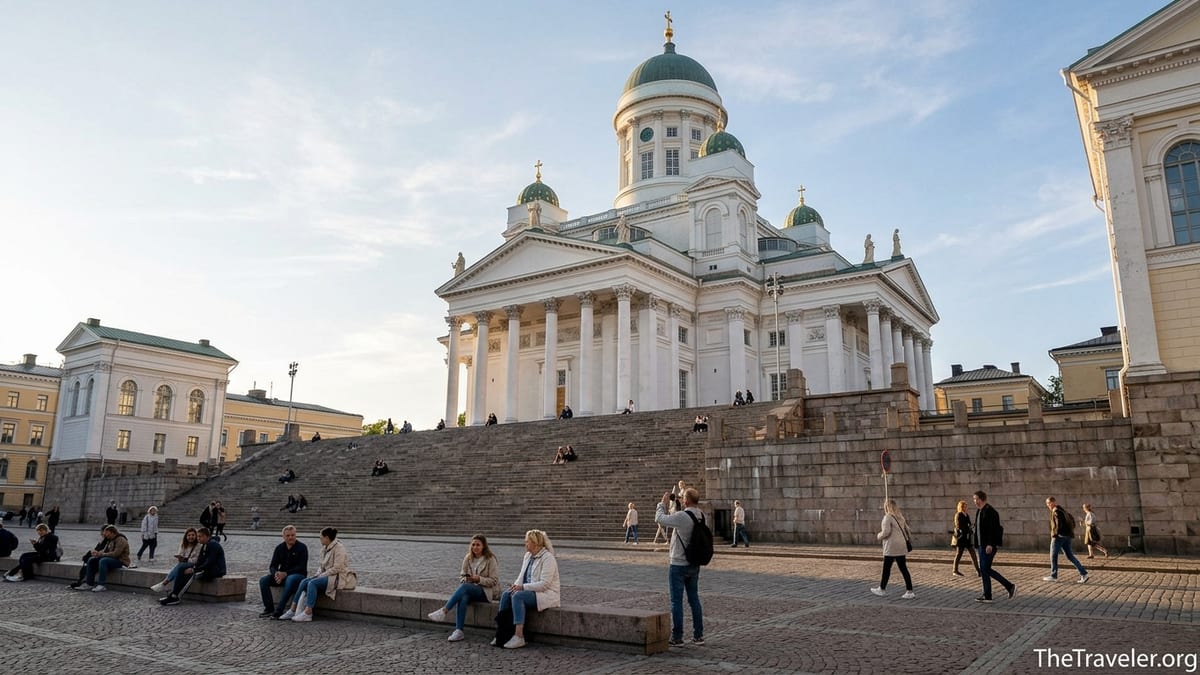
Walk across Senate Square on a bright summer evening and it is impossible to miss the white mass of Helsinki Cathedral rising above the city’s rooftops. Its green domes and long flight of granite steps dominate postcards, tourism posters and Instagram feeds in a way no other Finnish building quite does. For many visitors, the first image that comes to mind when they hear the word “Finland” is not a forest or a lakeside cabin, but this neoclassical church watching over the harbor. Understanding why this particular cathedral became Finland’s most recognizable landmark reveals a story of architecture, politics, faith and everyday city life intertwined.
Get the latest updates straight to your inbox!
From Imperial Church to National Symbol
Helsinki Cathedral did not begin its life as a national icon. When construction started in the 1830s, Finland was an autonomous Grand Duchy within the Russian Empire, and the building was originally known as St Nicholas Church, dedicated to Tsar Nicholas I. It rose on the northern edge of Senate Square, a new ceremonial center planned after Helsinki replaced Turku as capital in 1812. The church crowned a carefully designed ensemble of state buildings meant to project imperial authority as much as local identity.
Over time, though, meanings shifted. After Finland declared independence in 1917, the name “Great Church” gradually gave way to “Helsinki Cathedral,” and the building’s association with a Russian emperor faded from public consciousness. Today, Finnish government tourism material and university research alike describe it as one of the country’s principal national symbols and its most photographed structure. If you pick up a free city map from a hotel lobby or a Visit Finland brochure at Helsinki Airport, the stylized silhouette that marks the city center is almost always the cathedral rather than the parliament or presidential palace.
The building’s changing role becomes obvious during major national events. On Finland’s Independence Day in early December, television broadcasts often cut to live images of the cathedral floodlit against the winter darkness, bells ringing as people gather on the steps and in the square below. During the 2017 centenary celebrations, the green domes frequently appeared in international media coverage as shorthand for the Finnish capital, underlining how much the church has come to stand for Helsinki and the nation far beyond its original religious purpose.
Engel’s Neoclassical Masterpiece Above Senate Square
The reason the cathedral dominates the cityscape so powerfully lies in its architecture and topography. Designed by German-born architect Carl Ludvig Engel as the climax of his plan for the new capital, the church occupies the highest point of the historic center, raised on a terrace above Senate Square. Engel’s vision arranged political power, learning and religion around a single urban stage: the Government Palace to the east, the University of Helsinki to the west, and the main Lutheran church presiding from the north.
The building itself is a textbook example of northern neoclassicism. Its Greek-cross plan, tall Corinthian colonnades and temple-like pediments deliberately echo classical antiquity and the great churches of St Petersburg. The main dome, painted a muted green and ringed by smaller corner domes, creates a profile that is easy to recognize even from far out in the harbor. On a clear day, travelers approaching by ferry from Tallinn or Stockholm can often pick out the cathedral’s silhouette long before they see the rest of the city.
For visitors on the ground, the experience is no less striking. Stand at the center of Senate Square and look north and your eye is pulled upward along the long flight of granite steps to the vast white facade. In winter, when the low sun bounces off snow on the steps, the building seems to glow; in summer, its walls take on a warm cream tone in the evening light. The contrast with surrounding 19th century buildings in pale yellow and light ochre only heightens the effect. It is an environment that encourages photography, and it explains why travel magazines so often choose this exact vantage point for cover shots of Helsinki.
Daily Life on the Cathedral Steps
What keeps Helsinki Cathedral from feeling like a remote monument is the way it functions as an everyday gathering place. The broad steps leading up from Senate Square form a kind of outdoor amphitheater, busy in all seasons. On a sunny August afternoon, you will find Erasmus exchange students from the nearby university eating ice cream on the steps, cruise ship passengers catching their breath after the climb, and local office workers using the cathedral as a meeting point after work.
The space also adapts readily to citywide celebrations. During Helsinki Day in June and New Year’s Eve festivities, temporary stages and sound systems often appear in front of the building, turning the steps into spectator stands for concerts and fireworks. When Finland’s national ice hockey team wins a world championship, television cameras frequently capture jubilant fans in blue and white jerseys packing the square, with the cathedral forming a dramatic backdrop to the celebrations.
Even in foul weather, the landmark shapes daily routines. In November, when sleet blows in from the Baltic, commuters walking across the square tend to cut diagonally toward the sheltered arcades of the surrounding buildings. Yet they still instinctively orient themselves by the cathedral’s mass above them. Guides leading small-group walking tours in English, German or Japanese will gesture upward with umbrellas to explain the city’s history, using the church as a visual anchor. The building’s constant presence in such everyday scenes makes it more than a postcard subject; it is part of the lived experience of Helsinki.
Where Faith, Tourism and Culture Meet
Despite its fame as a tourist attraction, Helsinki Cathedral remains an active Lutheran parish church. Regular Sunday services, weddings and confirmations are held beneath its high vaulted ceilings, and during the Christmas season the interior fills with candles and music for traditional carol services. For visitors who slip in quietly during a weekday, the contrast between the hushed, pale interior and the bustle outside on the steps can be striking.
This blend of sacred function and secular visibility is managed carefully. Entrance to the main space is free, although donations are encouraged to support upkeep. A small charge is typically levied for access to the crypt, which hosts exhibitions and events, particularly in summer. Information boards in Finnish, Swedish and English explain the building’s history and architecture in unobtrusive terms, while discreet staff keep an eye on visitor behavior during services. Most tourists come in small, steady waves, often timed to cruise ship arrivals in the nearby South Harbor, giving the place a rhythm that locals have grown accustomed to.
The cathedral also acts as a cultural canvas. Every January, the Lux Helsinki light festival projects large-scale artworks onto its facade, transforming the familiar white surfaces into shifting fields of color. Families visit after work to walk the illuminated route through the city, and the cathedral is usually the point where crowds linger longest, phones raised to capture slow-moving animations crossing the domes and columns. For many residents, these temporary transformations reinforce how central the building is to their mental map of the city; each new light installation is judged against memories of previous years.
Competing Landmarks and the Question of Recognition
Helsinki is not short of striking architecture. The copper-domed Uspenski Orthodox Cathedral on nearby Katajanokka island, the granite Helsinki Central Railway Station with its distinctive stone figures, and Alvar Aalto’s modernist Finlandia Hall all attract strong architectural interest. Elsewhere in the country, Turku Cathedral holds the title of Finland’s most historically important church, and the medieval fortress of Suomenlinna at the entrance to Helsinki’s harbor enjoys UNESCO World Heritage status. Yet when international media outlets need a single image to represent Finland’s capital, it is most often the Lutheran cathedral that appears.
This dominance stems from a combination of visibility, simplicity and branding. The cathedral’s clean white geometry photographs well in almost any weather, whether against blue summer skies or dark winter afternoons. Unlike the more intricate brickwork of Uspenski, its outline reduces easily to graphic form, which suits logos, stylized maps and the small icons used on mobile booking apps. Tourism campaigns by both the City of Helsinki and Visit Finland regularly feature aerial shots of Senate Square crowned by the church, reinforcing its status in the global imagination.
Traveler behavior then amplifies this recognition. A quick search of social media posts tagged with Helsinki shows a disproportionate number of images taken from the cathedral steps or the middle of the square below. Travel bloggers writing 24-hour or 48-hour Helsinki itineraries almost invariably place a stop at the cathedral near the top of their lists, right alongside the nearby Old Market Hall and a ferry trip to Suomenlinna. This feedback loop between promotion and personal documentation has helped cement the building’s primacy among Finnish landmarks in the eyes of international visitors.
Planning Your Visit: Practical Details
For travelers, one of the cathedral’s advantages is how easy it is to include in almost any itinerary. It stands barely ten minutes on foot from Helsinki Central Railway Station, and around the same distance from the main ferry terminals serving Tallinn and Stockholm. Most visitors reach it by walking up from the harbor via the cobbled streets lining Market Square, letting the green dome act as a navigational beacon.
Opening hours vary slightly by season and special events, but in practice the church is open during most daytime hours. In summer, doors are typically open from late morning to early evening, while in winter closing can be earlier in the afternoon. Services, weddings or rehearsals may restrict access briefly; signs at the entrance usually indicate such closures. Visitors do not pay an entrance fee for the main space, but should budget a small sum if they wish to explore the crypt exhibitions or purchase a guide leaflet or postcard from the modest shop area.
Experiencing the cathedral at different times of day offers varied impressions. Early in the morning, when cruise excursion groups have not yet arrived, the steps can be almost empty, creating a sense of calm rare in a capital city center. By midday in July, the square below hums with guided tours in multiple languages, and the steps buzz with people photographing each other against the skyline. On clear evenings from May to August, the long northern twilight casts soft side light on the facade, ideal for photography that captures both architectural detail and the glow of nearby streetlamps.
The Cathedral in the Helsinki Skyline
Part of what makes Helsinki Cathedral so recognizable is how often it appears, even indirectly, in views of the city. From the ferries that shuttle between the mainland and the island fortress of Suomenlinna, passengers repeatedly see its dome rising above the red-tiled roofs and modern office blocks. Visitors climbing the ramparts of Suomenlinna often turn their cameras back toward the capital, framing the cathedral between old stone walls and artillery batteries, visually connecting Finland’s maritime defenses with its civic heart.
Within the city center, the building serves as a constant point of orientation. Stroll along the Esplanade, Helsinki’s principal promenade lined with cafes and department stores, and glimpses of the green dome appear between trees and rooftops whenever the street subtly rises. From higher vantage points such as hotel rooftop bars or public observation decks, the cathedral punctuates the otherwise low, flat skyline that characterizes central Helsinki. In a city with relatively few tall structures, its vertical emphasis has outsized impact.
The cathedral’s image also travels widely in printed and digital form. It appears on souvenir mugs and snow globes in gift shops around Market Square, on the covers of city guidebooks in airport bookstores, and in the background of televised concerts or public addresses staged on Senate Square. Each of these reproductions reinforces the link between building and place in the minds of viewers, so that even those who have never set foot in Finland can often recognize the structure instantly.
The Takeaway
Helsinki Cathedral’s rise to become Finland’s most recognizable landmark is not simply the result of its handsome architecture, although that certainly helps. Its commanding position above Senate Square, woven into the city’s political and intellectual heart, has made it a backdrop for nearly two centuries of national history. The building’s neoclassical clarity and high visibility in the skyline translate well into the visual language of tourism marketing and social media, ensuring that images of its white walls and green domes circulate far beyond Finland’s borders.
Equally important is the way the cathedral functions in everyday life. Its steps are a place to meet friends, watch concerts, celebrate sporting victories or simply rest between sightseeing stops. Inside, it remains a working parish church, quietly hosting baptisms and Sunday services even as coaches of tourists come and go outside. For travelers, this combination of monumental presence and lived-in atmosphere makes a visit feel both significant and accessible.
Whether you first encounter Helsinki Cathedral from the deck of a ferry, the window of a tram or the center of Senate Square, it is likely to be one of the sights that stays with you long after you leave. In a country known for landscapes of forest and water, this building of stone still manages to capture something essential about Finland: a blend of austerity and warmth, tradition and modernity, local life and global attention.
FAQ
Q1. Where is Helsinki Cathedral located?
Helsinki Cathedral stands on the northern side of Senate Square in central Helsinki, within easy walking distance of the main railway station and harbor.
Q2. Do I have to pay to enter Helsinki Cathedral?
Entrance to the main church is generally free of charge, though donations are appreciated, and a small fee may apply for access to exhibitions in the crypt.
Q3. What are the typical opening hours of the cathedral?
Opening hours vary by season, but the cathedral is usually open during daytime, with longer hours in summer and shorter ones in the darker winter months.
Q4. Can I attend a church service there as a visitor?
Yes. Regular Lutheran services are open to the public, and visitors are welcome to join respectfully; service times are posted at the entrance and on local information boards.
Q5. Is Helsinki Cathedral accessible for people with limited mobility?
While the main facade is reached by a large staircase, accessible routes without steps are available at the sides, and staff can advise on the easiest way in.
Q6. What is the best time of day to photograph the cathedral?
Early morning offers quieter scenes and soft light, while late evening in summer provides warm, angled sunlight that highlights the white facade and green domes.
Q7. How long should I plan to spend at Helsinki Cathedral?
A brief visit can take 30 to 45 minutes, but many travelers allow an hour or more to explore the interior, sit on the steps and enjoy views over Senate Square.
Q8. Are guided tours of the cathedral available?
Guided city walks often include the cathedral as a key stop, and at busy times of year short guided visits or audio guides may be available through local tour providers.
Q9. What else can I see near Helsinki Cathedral?
Nearby highlights include Senate Square itself, the Government Palace, the University of Helsinki’s historic buildings, Market Square and the ferry departure point for Suomenlinna.
Q10. Why is Helsinki Cathedral considered Finland’s most recognizable landmark?
Its commanding hilltop location, striking neoclassical design and constant appearance in tourism images, TV broadcasts and social media have made it a visual symbol of Helsinki and Finland.