


More news on this day
The United States has reissued a heightened travel warning for the Middle East, renewing a worldwide caution advisory and urging Americans to exercise increased vigilance or reconsider trips to the region as conflict with Iran fuels a volatile security environment and mounting disruption across key air corridors.
Get the latest news straight to your inbox!
Worldwide caution updated as Iran conflict escalates
According to publicly available information from the U.S. Department of State, the renewed advisory, updated in mid-July 2026, reflects what officials describe as a complex and fast-changing security landscape centered on the Middle East. The worldwide caution notice specifically highlights heightened tensions linked to ongoing hostilities involving Iran and U.S. and Israeli forces, with the potential for sudden escalation.
Recent published coverage indicates that the advisory urges Americans worldwide, and particularly those in the Middle East, to remain alert to the risk of missile and drone attacks, localized unrest, and opportunistic violence targeting locations associated with U.S. interests. The language emphasizes that threats may materialize with little warning and that risk is not confined to active combat zones.
Media reports note that this is one of the most prominent worldwide alerts issued by Washington in recent years, coming on top of already elevated, country-specific advisories across the region. The move signals that the government now views the cumulative risk from overlapping crises as significant enough to affect leisure travelers, business visitors, and long-term residents alike.
The updated caution follows months of sustained U.S. military activity in and around the Gulf and the Red Sea, as well as a series of Iranian missile and drone launches at targets in Bahrain, Kuwait, Jordan, and other states. Analysts cited in international coverage link the new alert directly to the risk that any further clashes could spill over into civilian areas, air routes, and major transport hubs.
Multiple Middle East destinations at elevated advisory levels
Country-level travel advisories across the Middle East were already stringent before the latest worldwide caution was reissued. Publicly accessible State Department notices show that Iran, Iraq, Lebanon, Syria, Gaza, and Yemen remain under “do not travel” guidance, reflecting widespread conflict, terrorism, and the possibility of arbitrary detention and disruption to basic services.
Neighboring states that traditionally receive large numbers of international visitors, including Bahrain, Jordan, Kuwait, Oman, Qatar, Saudi Arabia, Israel and the West Bank, and the United Arab Emirates, are generally listed at “reconsider travel” levels. These advisories reference the threat of missile and drone attacks, terrorism, and the broader risk of being caught in regional crossfire or sudden unrest.
Individual country pages also flag issues that go beyond the battlefield. Available documentation points to concerns about local laws governing expression and social media use in some states, strict rules around photography and public gatherings, and the potential for exit bans or travel restrictions to be imposed during periods of tension. Travelers who might once have treated these destinations as straightforward stopovers or holiday spots are now urged to conduct detailed risk assessments before departure.
International government advisories from partners such as Australia and others mirror this message, often matching or exceeding U.S. caution levels. Together, these notices contribute to a picture of a region where security conditions are fragile, and where even destinations that remain open to visitors can carry elevated personal and logistical risk.
Airspace closures and flight disruptions ripple through the region
The reissued warning places particular emphasis on the potential for aviation and transport disruption. Recent reports from regional and travel industry outlets describe short-notice airspace closures and route changes across parts of the Gulf as Iran-linked attacks have targeted infrastructure in Kuwait, Bahrain, and along key maritime corridors.
According to published coverage, airlines serving the Middle East have already had to reroute or temporarily suspend certain services following missile and drone activity and changing overflight restrictions. In parallel, Europe’s aviation safety authorities have reinstated guidance urging carriers to avoid some Middle Eastern airspace segments due to the risk of miscalculation or accidental targeting of civilian aircraft.
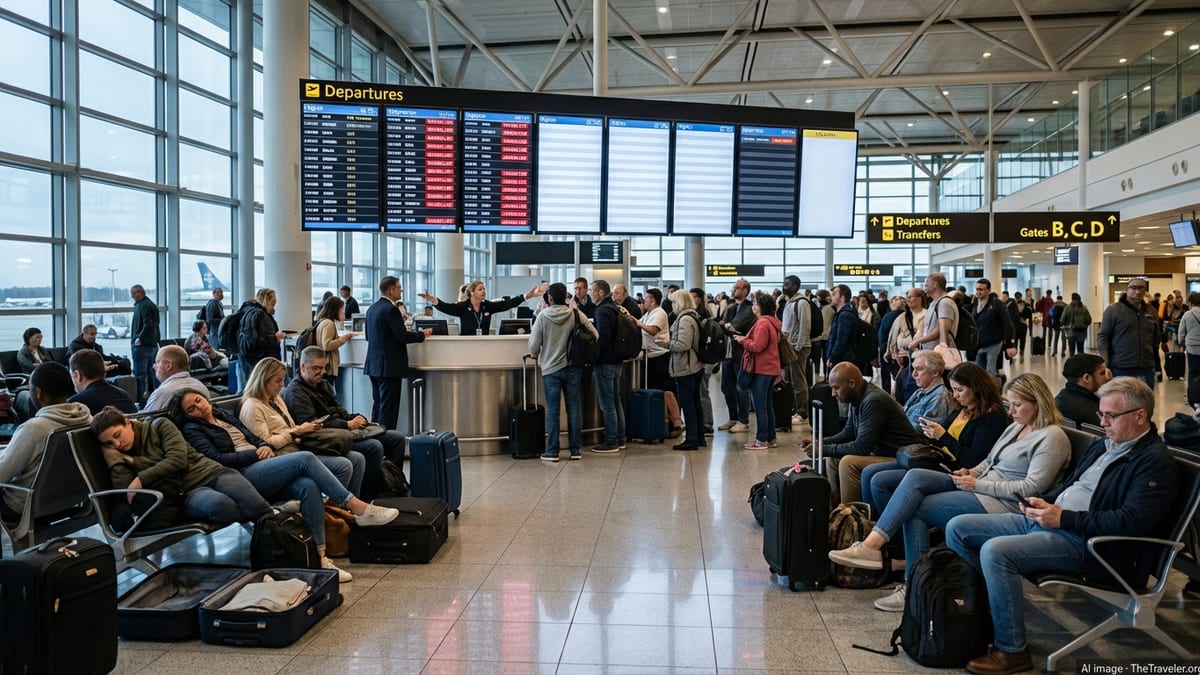
The U.S. advisory warns that Americans in or transiting the region should be prepared for flight cancellations, airport closures, or diversions that may occur with minimal notice. Travel specialists following the situation recommend that passengers build flexibility into itineraries, avoid tight connections through regional hubs, and consider alternative routing that does not depend on a single gateway airport.
Beyond direct flight changes, the heightened tension has contributed to longer flight times, higher operating costs, and, in some cases, a reduction in capacity on specific routes. Industry observers note that these pressures could translate into more expensive last-minute fares and constrained options for travelers trying to adjust plans on the fly.
Guidance for Americans planning or continuing travel
Travel risk consultancies and publicly available government guidance indicate that the first step for Americans contemplating travel to or through the Middle East is a sober assessment of whether the journey is essential. For many destinations currently listed at “reconsider travel” or “do not travel,” the recommendation is to postpone non-urgent trips until the situation stabilizes.
For those who decide to proceed, security experts advise maintaining a low profile, avoiding demonstrations and political gatherings, and closely tracking local news and official announcements. Travelers are encouraged to keep flexible accommodation and ticketing arrangements where possible, retain copies of key documents, and share detailed itineraries with family or trusted contacts outside the region.
Business travelers and organizations with staff in high-risk locations are being urged to review evacuation and shelter-in-place plans, confirm communication protocols, and identify alternative routes out of the region in case of sudden border or airport closures. Risk management firms underscore that contingency planning is no longer optional in many Middle Eastern markets but a baseline requirement.
At the same time, travel professionals caution against assuming uniform conditions across the entire region. Security levels can vary sharply between countries and even within individual cities. As a result, trip planning now often involves granular, destination-specific analysis rather than broad judgments about the Middle East as a single travel market.
Impact on tourism, expatriates, and regional travel demand
The reissued U.S. warning arrives at the height of the northern hemisphere summer travel period, a timing that analysts say could weigh on tourism bookings and regional stopover traffic. Gulf hubs that have built their business on long-haul connections between Europe, Asia, and the Americas face the prospect of some travelers choosing alternative routings to bypass perceived risk.
Tourism boards and hospitality companies across the region had already been navigating a more uncertain landscape in 2026 as the Iran conflict unfolded and maritime security incidents in the Red Sea and Gulf of Oman unsettled cruise and shipping itineraries. The latest worldwide caution is likely to reinforce a tendency among some leisure travelers to delay bucket-list trips or seek destinations viewed as more predictable.
For expatriate communities in the Gulf and Levant, the advisory functions more as a signal to review personal risk tolerance and preparedness than as a direct instruction to depart. Reports from the region suggest that many long-term residents are accustomed to periodic spikes in alert levels, but that the combination of military escalation and global warnings in mid-2026 has led to renewed attention to emergency planning and documentation.
Industry observers note that while headline advisories can dampen demand in the short term, actual travel responses vary widely. Some travelers may simply shift plans within the region, focusing on areas perceived as comparatively stable, while others may take advantage of lower prices that occasionally follow periods of heightened concern. The latest U.S. warning, however, underscores that for the moment, any itinerary touching the Middle East comes with added layers of uncertainty that travelers will need to weigh carefully.