


Visiting the Sagrada Família in 2026 is more intense than ever. Gaudí’s basilica is nearing completion, ticket demand is at record levels, and new rules mean you have to plan ahead. The good news: whether you prefer an in-depth guided tour, a flexible audio guide, or exploring on your own, there is an excellent way to experience this landmark that fits your style and budget. This guide walks you through the main options, with real-world examples of prices, time slots, and tour formats so you can decide exactly how to visit.
Get the latest updates straight to your inbox!
Understanding Tickets, Tours and the 2026 Booking Reality
Before choosing between a guided tour and independent visit, you need to understand how tickets work in 2026. There is no separate “queue” ticket and “skip the line” ticket. The key is the timed-entry ticket you buy in advance. On the official booking system, a standard adult ticket for the basilica with the official audio guide app is about 26 euros, while adding tower access brings the total to about 36 euros. Guided tours purchased directly through the basilica start around 30 euros including the same app-based audio guide, with slightly higher prices if you add tower access.
In 2026, demand is unusually high because of the Gaudí centenary and the recent inauguration of the main tower. Many days in May, June and July sell out weeks in advance, especially tower slots and mid-morning entries. Travelers routinely report that official tickets at 26 euros are gone while only reseller options remain at significantly higher prices. Unlike in past years, there is now no on-site ticket office; tickets must be purchased online and are nominative, which means your name is printed on the ticket and checked against your ID at the entrance.
On top of that, the basilica has introduced a daily “Quiet Hour” from 9:00 to 10:00 in the morning. You can still enter during this time if you have a ticket, but you are expected to keep silence and use headphones for any audio guide. General opening hours run roughly from 9:00 to 20:00 in spring and summer and until about 18:00 in winter, with Sunday mornings reserved for services and a later public opening. All of these factors make it essential to think about not just whether you want a guide, but also what time of day and what ticket combination best fits your visit.
Because so many third-party sites now advertise Sagrada Família tickets, it is easy to overpay or misunderstand what you are booking. Some resellers bundle basic entrance with an external-walking tour and present it as a premium product, while others sell “skip-the-line” access that is essentially the same timed-entry you would get on the official system at a lower cost. When deciding between guided and unguided experiences, always verify whether the ticket includes entrance to the basilica, whether tower access is part of the package, and how long you will actually spend inside.
Experiencing Sagrada Família With a Guided Tour
A guided tour is the most structured and information-rich way to experience the Sagrada Família. The basilica itself sells official guided tours in several languages, typically lasting about 50 to 60 minutes inside the nave. These tours generally cost only a few euros more than the standard entrance with audio guide. Once the guided portion ends, you are free to remain inside and continue exploring on your own for as long as you like until closing time. For many visitors who enjoy architecture or history, that combination of expert context followed by independent wandering offers strong value.
Beyond the official tours, there are numerous independent operators offering Sagrada Família packages. For example, well-known companies like City Wonders or Take Walks sell small-group tours that combine timed-entry, a licensed local guide, and often a second Gaudí site such as Park Güell in the same half day. These tours can run from roughly 70 to 110 US dollars per person depending on season and inclusions. A typical format might involve meeting the guide outside a nearby cafe, entering through the group entrance with headsets so you can hear commentary clearly, spending about 90 minutes in and around the basilica, and then being escorted to a bus or taxi for the next stop.
Travelers who have taken guided tours frequently mention that a good guide transforms what could be a beautiful but overwhelming building into a coherent story. A guide might point out how the Nativity Façade’s dense sculptures contrast with the stark Passion Façade, draw your attention to the mathematical symbolism in the columns, or explain how Gaudí’s models were reconstructed after the Spanish Civil War. Many guests say they would have walked past key details if they had not been explained on the spot. If you are visiting only once and want to fully understand what you are seeing, this depth can easily justify the extra cost.
Guided tours do have limitations. You need to adapt to a fixed time and pace, which may not suit very young children, older relatives who walk slowly, or photographers who like to linger over every angle. Group sizes vary widely: some budget tours include 20 or more people, which can feel rushed during busy midday slots. If you are considering a third-party tour, look closely at recent reviews and pay attention not just to star ratings, but also to comments about group size, pace, and how much time was actually spent inside versus outside explaining the facades.
Experiencing Sagrada Família Independently With the Audio Guide
For visitors who prefer flexibility, the official audio guide is an excellent middle ground between a fully guided tour and wandering without context. Standard basilica tickets now include access to an app-based audio guide available in several languages. You download the app to your own phone, plug in your earphones, and follow the suggested route at your own rhythm. The commentary explains the main façades, the nave, the stained glass, and the crypt areas open to visitors, mixing history, religious symbolism, and Gaudí’s design approach.
Using the audio guide can be particularly comfortable during the new Quiet Hour from 9:00 to 10:00, when live tour commentary is restricted but personal audio devices with headphones are allowed. Many travelers choose a 9:00 or 9:15 entry, walk through the more contemplative early section with the audio guide, and then return to favorite spots around 10:00 once general noise levels rise. The early slots also tend to be less crowded than the late morning peak, so you might find more space to absorb the atmosphere and take photographs.
Another advantage of the audio guide is cost and availability. If guided tours in your preferred language are sold out for a particular day, the basic entrance with audio guide is often still available longer. For a solo traveler or a couple trying to keep expenses down, paying roughly 26 euros for this ticket instead of 30 or more for a group tour can save a meaningful amount. The app also allows you to pause, repeat sections, or skip ahead, which is ideal if you already know some of the history or have specific interests such as the stained glass program or the structural engineering.
There are, however, trade-offs. An app cannot answer your questions or react to your curiosity in real time. If you notice a small detail in a capital or a carved animal in a corner, the commentary may not cover it. Technical aspects, such as how Gaudí’s catenary models translated into modern construction techniques, are often simplified. For some visitors that is a plus; for others who crave depth, it can feel thin. Also, you need to ensure your phone is charged and bring your own wired or Bluetooth headphones, since the basilica does not typically provide devices to every visitor.
Going Completely Self-Guided: When It Works and When It Does Not
Some travelers are happiest exploring major monuments entirely on their own, without guided commentary in their ear. At the Sagrada Família, this is a workable option if you are prepared. That usually means reading a short guide in advance, printing a floor plan, or saving a few reliable articles about the building to your phone. Once inside, you can follow the natural progression from the Nativity Façade entrance, through the nave and side aisles, down to the museum area in the basement, and out by the Passion Façade and gift shop, stopping wherever something catches your eye.
The building rewards slow looking. You might spend fifteen minutes simply watching how the colored light moves across the pillars as clouds pass outside, or trace the evolution of Gaudí’s ideas in the scale models downstairs. Independent visitors often say that without scheduled commentary, they feel more able to treat the basilica as a living place of worship rather than only a tourist attraction. You can sit in a pew during a quiet moment, absorb the choral music if a rehearsal is underway, or notice small scenes in the sculpture that resonate personally.
However, a fully self-guided visit works best for people who either have prior knowledge or are comfortable doing research. Without context, some parts of the experience can be confusing. It may not be immediately obvious where the visitor route continues, why certain areas are roped off, or how to access the towers. If you are traveling with someone who has never heard of Gaudí, they might come away impressed by the shapes and colors but with only a vague sense of what makes this building so significant. For a once-in-a-lifetime visit, many people decide that at least the official audio guide is worth using, even if they largely wander at will.
One practical point to keep in mind is timing. Independent visitors are at the mercy of general crowd patterns. The busiest period inside the basilica is usually between 10:30 and 14:00, especially in late spring and summer. If you book your entry for late morning without a guide or structured plan, you may find it harder to move around and see details. Early morning outside the Quiet Hour or late afternoon from around 16:00 onward are generally more comfortable. During winter months and rainy days, mid-afternoon can also be pleasantly calm, making self-guided exploration more enjoyable.
Adding Tower Access: Nativity vs Passion and How Tours Affect the Experience
For many visitors, the most memorable part of the Sagrada Família is not only the nave but the towers. Tower access is not included automatically; you need a special ticket combination that adds the elevator ride to one or sometimes both sets of towers. In 2026, the basic rule is that a standard basilica ticket costs about 26 euros and the tower supplement adds about 10 euros, for a total of around 36 euros to visit one tower. A smaller number of premium tickets allow access to both tower groups at a higher price and sell out especially quickly in peak months.
You must choose between the Nativity and Passion towers when booking. The Nativity Tower, on the eastern side, showcases some of Gaudí’s original stonework and offers softer morning light with views over the older Eixample neighborhoods and the sea. The Passion Tower, on the western side, tends to have slightly broader panoramas towards Montjuïc, the Gothic Quarter, and the distant Tibidabo hills. The experience in both cases combines taking a lift up most of the way and then descending via narrow spiral staircases, so it is not recommended for visitors with significant mobility issues or vertigo.
Guided tours that include tower access can be convenient because the logistics are handled for you. A typical arrangement from a reputable operator might be: guided tour of the basilica and facades lasting about 90 minutes, followed by timed entry for the Passion Tower that you visit at the end of the guided portion, often without the guide accompanying you up. You then make your way down at your own pace and exit through the designated path. Official basilica tours with towers work similarly, with the staff directing you to the correct elevator at your slot time.
If you visit independently, tower tickets require more advance planning. In busy periods, especially May through September and during holidays, these slots can sell out 8 to 12 weeks in advance. If towers matter to you, book them as soon as you know your Barcelona dates, and avoid counting on last-minute resale platforms. Keep in mind that bad weather or high winds can lead to tower closures on the day, sometimes with little notice. In that case, the basilica typically allows you to enter the nave on schedule but may refund or rebook the tower portion. It is wise to read the latest terms on tower visits before booking so you are not surprised by last-minute changes.
Comparing Costs, Depth and Flexibility: Which Option Fits You?
Choosing the best way to experience the Sagrada Família is ultimately a trade-off between cost, depth of information, and flexibility. On the lower-cost end, a basic timed-entry ticket with the included audio guide app is usually the most economical option. For a solo traveler or a couple, paying about 26 euros each for a 60 to 90 minute exploration can feel like good value, especially compared with tours that may cost three or four times as much for a family of four. This option still provides solid context and the freedom to move at your own pace.
In the mid-range, an official guided tour from the basilica adds only a modest supplement over the base ticket yet offers the expertise of an accredited guide. For visitors who appreciate architecture, design, or religious history, this small extra cost can significantly enrich the experience. A family might choose this option if they want their teenagers to engage more actively with what they are seeing, since a live guide often knows how to keep a group interested through stories and anecdotes that an audio track cannot match.
On the higher-cost end, premium small-group or private tours from independent companies can exceed 80 or 90 US dollars per person but offer the most personalized experience. These are particularly attractive if your time in Barcelona is very limited and you want a curated half-day that includes the Sagrada Família, Park Güell, and perhaps a walking segment through Passeig de Gràcia. For travelers who might be overwhelmed by logistics, the convenience of hotel pickup, pre-arranged transport, and a consistent guide throughout several sites can be worth the price.
As you compare options, consider how you like to travel elsewhere. If you usually skip museum tours and prefer to read panels on your own, the audio guide or even a fully self-guided visit will probably suit you. If you often leave big sites wishing you understood them better, or if you are traveling with companions who will enjoy stories and explanations, a guided tour is likely the better investment. There is no single best way to see the Sagrada Família; the goal is to choose the format that aligns with your interests, energy level, and budget.
Practical Tips to Make Any Type of Visit Better
Regardless of whether you opt for a guided tour or an independent visit, a few practical steps will significantly improve your experience. First, book as early as is reasonable once your travel dates are set, especially for tower access and high season. Many travelers in 2026 report that they cannot find any official tickets within their travel window and are forced to resort to more expensive third-party bundles or give up on visiting altogether. Aim for at least two weeks’ advance booking in summer and around major holidays, more if your schedule is inflexible.
Second, pay close attention to your chosen time slot. Light plays an enormous role in how the interior feels. Late morning, around 10:00 to 11:00, often brings warm light through the stained glass on the Nativity side of the nave, while late afternoon from about 16:00 to 18:00 fills the Passion side with cooler blues and greens. If you are serious about photography, this choice matters more than whether you have a guide. Early morning Quiet Hour can be excellent if you value calm above all, as long as you are comfortable keeping silent and relying on a headset-based audio guide.
Third, double-check current rules on identification, clothing, and security. As of 2026, nominative tickets mean every adult visitor should carry a passport or official photo ID that matches the name printed on the ticket. Security screening at the entrance is similar to an airport-style check, with bags scanned and larger items discouraged. Dress codes are enforced more strictly on days with religious services: shoulders should be covered, and very short skirts or swimwear are not appropriate. Being prepared avoids awkward conversations or delays at the door.
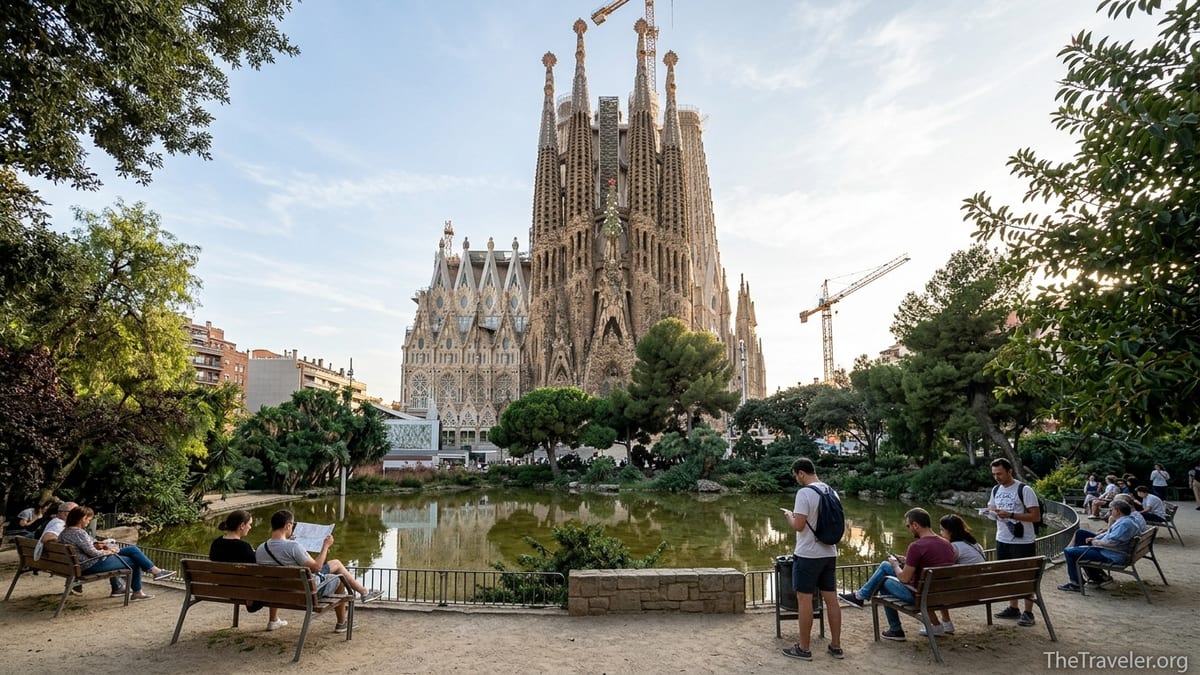
Finally, build in time around your visit rather than sprinting from another attraction. The immediate area can be crowded with souvenir shops and aggressive ticket resellers, so it helps to arrive at least 20 to 30 minutes before your slot, find your meeting point or entrance calmly, and perhaps enjoy a quick coffee on a side street away from the main square. Afterward, consider crossing to the small park in front of the Nativity Façade, where you can step back and appreciate the whole silhouette reflected in the pond, a perspective you do not get inside.
The Takeaway
Experiencing the Sagrada Família in 2026 is not a simple walk-up visit. Limited tower capacity, nominative tickets, and intense centenary demand mean you must choose your approach carefully. The core decision is whether you want a structured, story-driven experience with a live guide, a flexible yet informative audio-guided visit, or a fully self-directed exploration supported by your own research. Each path has real advantages and clearer trade-offs than many visitors realize.
If budget allows and you value deep understanding, a guided tour through the official basilica or a well-reviewed small-group provider can turn a beautiful building into an unforgettable narrative of faith, innovation, and resilience. If you prioritize autonomy and savings, the standard ticket with audio guide remains a strong choice and works especially well in combination with early or late time slots. For some, a quiet, largely self-guided visit focused on atmosphere and reflection will be the most meaningful of all, even if they miss some historical details.
Whatever option you choose, the most important step is to secure a legitimate timed-entry ticket well in advance and match your visit time to the kind of experience you want. Do that, and you will be free to step into the forest of stone columns, watch the colored light wash across the nave, and decide for yourself how best to meet Gaudí’s unfinished masterpiece.
FAQ
Q1. Is a guided tour of the Sagrada Família worth the extra cost?
A guided tour is usually worth it if you care about history and architecture or are visiting only once. The price difference over a standard ticket is modest for official tours, and a knowledgeable guide can explain symbolism, point out hidden details, and answer questions in a way an audio guide cannot. If you mainly want to admire the space visually and prefer to move completely at your own rhythm, you may be satisfied with the audio guide alone.
Q2. How far in advance should I book tickets in 2026?
In 2026, it is wise to treat tickets as something you book as soon as your Barcelona dates are fixed, especially in May, June and July. For basic entrance without towers, one to two weeks in advance is often enough in high season, though popular late-morning slots may sell out earlier. For tower access or premium tours, aim for several weeks in advance, and do not rely on last-minute availability during peak periods or holidays.
Q3. What is the best time of day to visit: morning or afternoon?
Both can be excellent, but they feel different. Late morning offers warm, golden light through the Nativity-side stained glass and is a favorite for photographers, though also one of the busiest periods. Late afternoon tends to be slightly calmer and bathes the Passion side in cooler blue and green tones. The early Quiet Hour from 9:00 to 10:00 is ideal if you value calm and do not mind keeping silent and using headphones.
Q4. Should I choose the Nativity or Passion tower?
The Nativity Tower is best if you want to see more of Gaudí’s original sculptural style up close and prefer softer morning light and views towards the sea. The Passion Tower is typically chosen for broader city panoramas towards Montjuïc and the hills, particularly in late afternoon light. Both require walking down narrow spiral staircases and are not suitable for people with serious mobility issues or vertigo. Most visitors are happy with either tower if they simply choose the side that matches their preferred time of day.
Q5. Are there real “skip-the-line” benefits with guided tours?
All properly booked timed-entry tickets, with or without a guide, effectively function as skip-the-line access because you enter during a specific 15-minute window instead of joining an open queue. Many guided tours emphasize “skip-the-line” in their marketing, but they are using the same timed-entry system. The main added benefit of a guided tour is the commentary and organization, not a fundamentally different entrance privilege compared with an official ticket purchased directly.
Q6. Can I stay inside after my guided tour ends?
Yes, in most cases you can remain inside the basilica after the guided portion finishes. Official tours typically last around one hour, after which the guide concludes near the museum or side aisles and you are free to keep exploring independently until closing time. Some third-party tours that bundle multiple attractions may have tighter schedules, so if lingering is important to you, confirm in advance that you are not required to leave immediately with the group.
Q7. What if the guided tour I want is not available in my language?
If guided tours in your preferred language are sold out, consider booking a standard ticket with audio guide in your language instead. The official app covers the main highlights and allows you to move at your own pace. Another option is to join a tour in a language you understand reasonably well and supplement it with your own reading or audio content afterward. Some travelers deliberately mix approaches: a guided tour in a second language for overall context one day and then a quieter, self-guided return visit another morning.
Q8. How can I avoid ticket scams and overpaying?
To avoid problems, focus on purchasing tickets only through the official channel or well-established operators you have researched. Be wary of sites whose names closely imitate the basilica or that show prices significantly higher than the known official rates. Scams often involve reselling basic entrance at a heavy markup or bundling tickets with minimal services labelled as “premium.” If you see a deal that seems dramatically more expensive or urgent than others, pause and compare before entering your payment details.
Q9. Is the audio guide enough for a first-time visitor?
For many first-time visitors, the audio guide is more than sufficient, especially if combined with a bit of reading beforehand. It covers the main façades, the nave, the stained glass and museum space in clear, concise segments. If you typically enjoy exploring museums and churches on your own with some basic context, you will likely find it satisfying. Travelers who crave deeper architectural or theological insight will get more from a guided tour but can still use the audio guide to reinforce what they have learned.
Q10. What should I do if tower access is sold out for my dates?
If tower slots are sold out during your stay, focus on making the most of the nave and museum rather than chasing overpriced third-party resales. You might choose an especially good time slot for light, such as late morning or late afternoon, and invest in a guided tour or detailed audio-guided visit instead. The interior experience alone is extraordinary, and many travelers leave feeling fully satisfied despite not going up the towers. If a future visit to Barcelona is likely, you can plan further ahead next time with tower access as a priority.