


Few cities in Europe force you into a tougher sightseeing dilemma than Barcelona: if you only have time or budget for one of Antoni Gaudí’s masterpieces, should you visit the Sagrada Família or Park Güell? Both are world‑famous, recently refreshed with new developments and higher ticket prices, and both are unforgettable in very different ways. This guide breaks down how each experience actually feels in 2026, with concrete details on costs, crowds, access and atmosphere so you can decide which Gaudí icon truly fits you best.
Get the latest updates straight to your inbox!
Gaudí in 2026: Two Icons, Two Very Different Experiences
In 2026, Gaudí’s presence in Barcelona feels more current than ever. The Sagrada Família has finally reached its full planned height and is now the tallest religious building in the world, crowned earlier this year when the main Jesus tower was completed and inaugurated during a high‑profile papal visit. At the same time, Park Güell has tightened crowd control and raised ticket prices, transforming what was once an almost casual city park visit into a carefully timed, ticketed experience.
Yet despite both being UNESCO‑listed Gaudí creations, what you live inside each space could not be more different. Sagrada Família is an intense, enclosed, spiritual and architectural immersion that feels closer to a once‑in‑a‑lifetime cathedral visit. Park Güell, set high on the hillside, is open‑air, playful and panoramic, with Gaudí’s organic architecture scattered through pine trees and city views that stretch from Tibidabo to the Mediterranean.
For travelers planning a first Barcelona trip in 2026, time and money are often limited. A typical three‑day itinerary might realistically include just one major Gaudí site at full price, especially for families. That makes the choice between basilica and park more than theoretical. It is about which side of Gaudí you want to meet: the visionary engineer‑mystic in stone and stained glass, or the whimsical urban planner who turned a failed garden city into a fantastical public space.
The good news is that there is no wrong answer. The better news is that by understanding what each place is really like to visit now, rather than how it appears in filtered Instagram photos, you can choose the experience that matches your interests, mobility, attention span and tolerance for crowds.
Costs, Tickets and Practicalities: What Your Budget Needs to Know
The most immediate difference visitors feel is on their wallets. Both sites have seen price rises, but they are structured differently. As of mid‑2026, a standard adult ticket to Sagrada Família purchased on the official site typically costs a little under 30 euros for basic entry with the official audio guide app included. Adding access to one of the towers, which many visitors consider essential for the full experience, usually pushes the price into the mid‑30s or higher. Families with teenagers can quickly find themselves spending over 100 euros for a single basilica visit.
Park Güell, historically the cheaper option, is still less expensive than the basilica but no longer feels like a budget secret. Since January 2026, the basic adult ticket to the regulated Monumental Zone has risen to around 18 euros when purchased through the official channels. Third‑party agencies may charge a few euros more, especially if they bundle in guided commentary or timed shuttle transfers up the hill. Children and seniors pay slightly reduced rates, and entry for local residents remains free, but for a short‑stay visitor it is now a significant line item.
Both attractions sell timed tickets online and strongly encourage advance purchase. At busy times of year such as Easter, late spring weekends and the peak summer months, walk‑up tickets for Sagrada Família often sell out entirely for the day, and same‑day options at Park Güell can mean very awkward entry times. Practical travelers now treat both the way they would a major museum in Paris or Rome: they choose a specific day and slot weeks in advance and plan the rest of their Barcelona sightseeing around it.
If budget is the deciding factor and you need the most Gaudí per euro, Park Güell usually comes out ahead. Two adults and two children might pay around 60 to 70 euros total to visit the Monumental Zone with a simple audio guide, compared with perhaps 120 euros or more for Sagrada Família with tower access. On the other hand, Sagrada Família is indoors and weather‑proof, and some travelers feel that its intensity and the sheer ambition of the interior justify the higher cost for a single, unforgettable highlight.
Atmosphere & Emotion: How Each Place Actually Feels
The emotional tone of Sagrada Família is unlike any other modern tourist site. Once you pass security and step into the nave, the noise of traffic and selfie chatter melts into a hushed, almost otherworldly glow. Gaudí designed the interior columns like trees in a stone forest, and the changing Mediterranean light poured through the stained glass creates broad bands of color that move slowly across the floor. In 2026 a new daily quiet hour between 9 and 10 a.m. emphasizes the basilica’s spiritual character; during this time announcements and noise are minimized and many visitors simply sit and look upward.
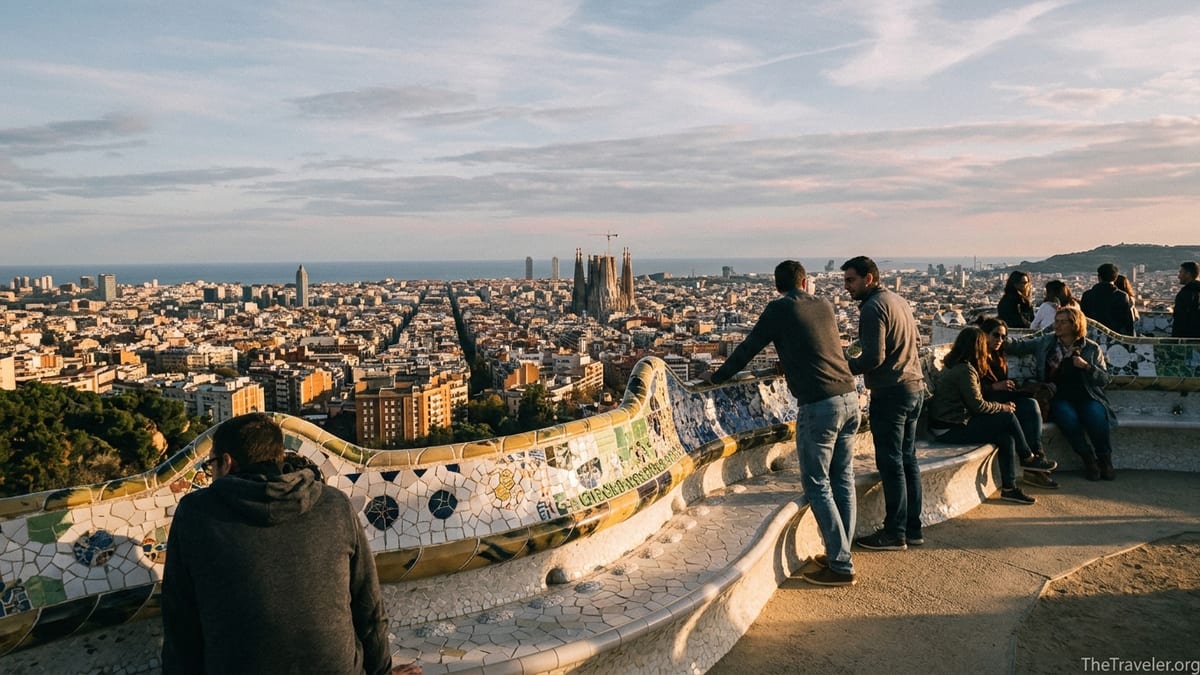
Park Güell, by contrast, is noisy, social and often joyful. Children run up and down mosaic staircases chasing the famous tiled lizard, street musicians play guitars under viaducts or on the terrace, and groups of friends stand in line to take photos on the sinuous ceramic bench along the main viewing platform. The feel is more like a public festival than a religious space, especially in the late afternoon when the light softens and both tourists and locals come up to catch the sunset over the city.
If you are drawn to contemplative experiences, have an interest in architecture as a near‑spiritual art form, or simply want one overwhelming, awe‑inducing interior on your trip, Sagrada Família is likely to suit you better. Travelers often report spending far longer inside than they expected, just watching the light change or studying the intricate sculpted facades from different angles. It can be a powerful place even for non‑believers.
If you prefer relaxed, informal spaces where you can sit on a bench, snack, chat, take your time and enjoy wide horizons, Park Güell offers that atmosphere in abundance. It is one of the best places in Barcelona to feel that you are simultaneously inside a work of art and in a lived city, with the grid of the Eixample, the Sagrada Família’s towers and the sea all visible below.
Crowds, Timing and Logistics: When Each Shines
Both sites are extremely popular in 2026, and crowd management has become central to the experience. Sagrada Família operates long hours, generally opening around 9 a.m. and closing in the early evening depending on the season, with last entry usually an hour before closing. The early morning quiet hour is the calmest time inside, especially on weekdays outside school holidays. Late afternoon slots can also feel slightly less hectic, with beautiful light slanting in through the west‑facing stained glass.
Park Güell’s hours vary with the season but typically run from early morning into the evening, with final access times posted on the official site. In recent years, dedicated slots have been set aside for local residents, and ticketed tourist entry is concentrated into the main part of the day. For visitors, mid‑morning to mid‑afternoon is usually the busiest period, with tour groups clustering at the grand staircase and under the famous terrace. Early morning entry, before the city heats up, offers a calmer atmosphere and softer light, though the angle of the sun means the sea views are often hazier.
From a logistics perspective, Sagrada Família is dramatically easier to reach. The basilica sits in the heart of the Eixample district, directly above a metro station that shares its name, and multiple bus lines stop nearby. Many visitors simply walk there from central neighborhoods such as Gràcia or Passeig de Gràcia. Park Güell sits on a hillside and, while reachable by metro plus a 15 to 20 minute uphill walk or by local buses, can feel more demanding, especially in summer heat or for travelers with limited mobility.
If you are traveling in high season and dislike crowds, the best compromise is often to book Sagrada Família for the earliest slot of the day and Park Güell either right after opening or in the last entry window before closing. Travelers in shoulder seasons such as March or November may find that even mid‑day visits feel manageable, but in July and August careful timing makes the difference between an inspiring outing and an exhausting one.
Architecture, Design and Story: What You Will Actually Learn
Sagrada Família is the place to go if you want to understand how far Gaudí pushed structural innovation. Inside, there are almost no straight lines. The branching stone columns use complex geometric forms that anticipated modern engineering software decades before it existed. The facades tell dense biblical narratives in sculpture, from the chaotic, almost gothic Nativity facade that Gaudí himself oversaw to the sharper, modern Passion facade carved by later artists in an intentionally more brutal style.
Informative displays and models at Sagrada Família make this story accessible. Even a basic audio guide explains how Gaudí used hanging chains and gravity models to test complex vaults, and how current architects interpret the fragments of his surviving drawings after the originals were largely destroyed during the Spanish Civil War. In 2026, temporary exhibitions also reflect on the completion of the main tower and on Gaudí’s legacy in contemporary Barcelona, with short films and scale models that appeal even to casual visitors.
Park Güell, on the other hand, is where Gaudí’s ideas about urban planning and landscape design come into focus. The park began as a speculative garden city project funded by industrialist Eusebi Güell, intended to create a healthy, semi‑rural neighborhood for wealthy residents. Only a handful of houses were ever built, and the project failed commercially. Yet in the process, Gaudí created a series of structural and decorative elements that feel remarkably modern: sloping stone viaducts that blend into the hillside, a huge artificial terrace supported by a forest of columns, curved benches ergonomically designed to support the human body and tiled with broken ceramics in brilliant colors.
Visitors curious about sustainability and water management often find Park Güell especially interesting. The terrace, for example, doubles as a rainwater collection surface, with water filtered and channeled to cisterns below. Explanatory panels in the Monumental Zone describe this system in simple terms, and some guided tours point out how similar ideas reappear in contemporary eco‑architecture around the world. If you enjoy seeing how design can be both playful and practical at once, the park is the better classroom.
Views, Photography and Weather: Where Your Camera Loves You Back
In purely photographic terms, Park Güell is the more obviously photogenic choice. The wide terrace with its serpentine mosaic bench frames some of the best skyline views in the city. On clear days you can see the Sagrada Família’s completed towers rising from the Eixample grid, the Mediterranean glittering in the background and, at certain angles, Montjuïc and the port. Sunrise and late afternoon are especially beautiful, with warm light on the colored tiles and long shadows across the terrace.
Park Güell is also forgiving for photographers who like to wander. Side paths under stone viaducts, quieter viewpoints hidden among pines and cacti, and the quirky gingerbread‑like gatehouses at the entrance all offer strong visual compositions. Even with crowds, it is often possible to step a few meters away and frame a shot that feels personal. Tripods are discouraged in busy areas, but handheld photography is easy, and the open air makes it safer in terms of health and comfort during hot months.
Sagrada Família’s best images are less about wide city panoramas and more about dramatic interiors and sculptural detail. Inside the nave, even smartphone cameras can capture striking images of light beams and color gradients on the columns. Tower visits provide tight views over the surrounding neighborhood rather than full‑city sweeps; you will photograph stone pinnacles at close range and look down on the basilica’s ongoing exterior work. Outside, the facades are dense and intricate, rewarding close‑up shots of individual sculptures or decorative elements rather than broad exteriors that are often partly covered with scaffolding.
Weather also plays a big role. Sagrada Família is largely independent of climate. Rainy winter days, summer heatwaves and windy spring afternoons do not significantly change the interior experience, so many travelers deliberately schedule their basilica visit for a day with uncertain forecasts and keep open‑air sites for clear days. Park Güell, in contrast, can be dazzlingly hot in midday summer sun, with limited shade on the main terrace, and windy or cool in winter. On a grey, rainy day, much of its charm fades and paths can be slippery, so rescheduling may be wise if your dates are flexible.
Which One Fits Your Travel Style? Profiles & Real‑World Scenarios
Imagine a couple visiting Barcelona for a winter city break, staying in the Eixample near Passeig de Gràcia. They enjoy art museums and long dinners but dislike climbing hills and are traveling in January, when sunset arrives early. For them, Sagrada Família is the natural fit. They can book a late‑morning slot, stroll over from their hotel, spend two or three unhurried hours inside and then warm up in a nearby café. The experience is weatherproof, requires minimal physical effort and aligns with their interest in serious architecture.
Now picture a family visiting in late May with two energetic children aged eight and twelve. They stay in a rental apartment in Gràcia, a short taxi ride from Park Güell, and want a half‑day activity that lets the kids move freely. Here the park shines. They book a morning entry, take a bus or short ride up the hill, let the kids explore the staircases and tunnels, take plenty of photos on the terrace and perhaps bring light snacks to enjoy on one of the quieter benches. Later that evening, when the adults want a more grown‑up cultural highlight, one of them might slip away for an early‑evening Sagrada Família visit alone or with the older child.
Solo travelers often gravitate to Sagrada Família if they enjoy introspective experiences and to Park Güell if they prefer people‑watching and casual encounters. A backpacker staying near Plaça Catalunya with a tight budget might choose Park Güell as their single paid Gaudí site, combining it with free exterior views of other modernist buildings in town. A business traveler with half a free day between meetings might prioritize Sagrada Família because it is central, easy to reach by metro and delivers a powerful impression in just 90 minutes.
Accessibility and mobility are also key. Sagrada Família has elevators for tower access, although staircases are still involved, and the main nave floor is flat, making it relatively manageable for many visitors with limited mobility. Park Güell, by contrast, involves slopes, stairs and occasionally uneven paths. There are accessible routes, but the park’s hillside setting means travelers using wheelchairs or those sensitive to steep climbs should research entry points and plan for taxis rather than walking up from the nearest metro.
The Takeaway
If you are choosing strictly one Gaudí icon for your first Barcelona visit in 2026, the simplest rule of thumb is this: choose Sagrada Família if you want to be awed, and Park Güell if you want to breathe. The basilica delivers a concentrated dose of wonder, complexity and symbolism in an indoor environment that feels almost like stepping into another world. The park offers space, air and playfulness, with Gaudí’s imagination expressed through mosaics, curves and viewpoints rather than vaults and stained glass.
Budget and timing will naturally shape your decision. Travelers with limited funds who still want a headline Gaudí experience are likely to feel that Park Güell offers the best value, as long as the weather cooperates. Those willing to invest more in a single, unforgettable landmark tend to emerge from Sagrada Família grateful they made space for it, even if it meant cutting another museum or attraction.
Ultimately, the ideal solution is still to experience both, on different days and in different moods. Visit Sagrada Família in the morning, when the light is clear and your mind is fresh enough to absorb detail. Visit Park Güell in the late afternoon, when the city spreads out below you like a living map and Gaudí’s playful forms glow in the golden light. Together they tell the full story of an architect who shaped Barcelona’s skyline and imagination, from its sacred heart to its open hillside.
If you do have to choose, let your own travel personality decide. Are you a seeker of quiet astonishment or of open‑air joy? Once you answer that question honestly, the right Gaudí experience for you will usually be obvious.
FAQ
Q1. If I can only visit one, should I choose Sagrada Família or Park Güell?
Sagrada Família is the better choice if you value intense architecture, indoor comfort and a once‑in‑a‑lifetime landmark. Park Güell is better if you prefer open air, views and a more relaxed, playful vibe.
Q2. How much time do I need at each site?
Most visitors spend 1.5 to 3 hours inside Sagrada Família, especially if they use the audio guide or visit a tower. Park Güell usually takes 1.5 to 2.5 hours to explore the Monumental Zone and a few side paths at a comfortable pace.
Q3. Which is more expensive to visit in 2026?
Sagrada Família is significantly more expensive. A standard adult ticket with audio guide is typically just under 30 euros, and adding tower access costs more. Park Güell’s adult ticket to the Monumental Zone is usually around 18 euros when bought from the official source.
Q4. Do I need to buy tickets in advance for both?
Yes. In busy months, same‑day tickets for Sagrada Família often sell out entirely, and Park Güell time slots can be limited. Booking online several days or weeks ahead is strongly recommended, especially for weekends, holidays and summer.
Q5. Which site is easier to reach by public transport?
Sagrada Família is easier. It has its own metro stop and multiple bus lines nearby, and many central hotels are within walking distance. Park Güell requires a combination of metro or bus plus an uphill walk or a short taxi ride to avoid the steepest sections.
Q6. Which is better for families with children?
Park Güell generally suits children better because it is outdoors, has space to move and feels like a giant, imaginative playground. Sagrada Família can still be impressive for older kids but requires more patience, quiet and care around delicate interiors.
Q7. What if the weather is bad during my visit?
Sagrada Família is largely weather‑proof, so it is the safer choice on rainy or very hot days. Park Güell is at its best in pleasant, dry weather and can be uncomfortable in heavy rain, strong wind or midday summer heat.
Q8. Is either site suitable for visitors with limited mobility?
The main nave of Sagrada Família is relatively flat and accessible, although tower access involves stairs. Park Güell is built on a hillside with slopes and steps; there are accessible routes, but many areas can be challenging without advance planning and possibly taxi access to higher entrances.
Q9. Where will I get better photos?
Park Güell offers better wide views and classic city panoramas, especially from the terrace with its mosaic bench. Sagrada Família is better for dramatic interior shots, stained glass light and sculptural details, though exterior shots can be partially obstructed by ongoing works.
Q10. Can I realistically visit both in one day?
Yes, but it makes for a very full day. A common strategy is to visit Sagrada Família early in the morning, have lunch nearby, then head to Park Güell for a late‑afternoon or early‑evening slot. If you prefer a slower pace, dedicate one landmark to each day instead.