


Few attractions in Europe divide travelers quite like the Sagrada Família. Some visitors walk out of Gaudí’s basilica in Barcelona stunned into silence, calling it a once-in-a-lifetime masterpiece. Others leave feeling they paid a steep price to shuffle through crowds for a quick photo. With ticket prices rising and attendance booming in 2026, first-time visitors understandably ask: is Sagrada Família really worth the cost, or should you admire it from the outside and spend your euros elsewhere?
Get the latest updates straight to your inbox!
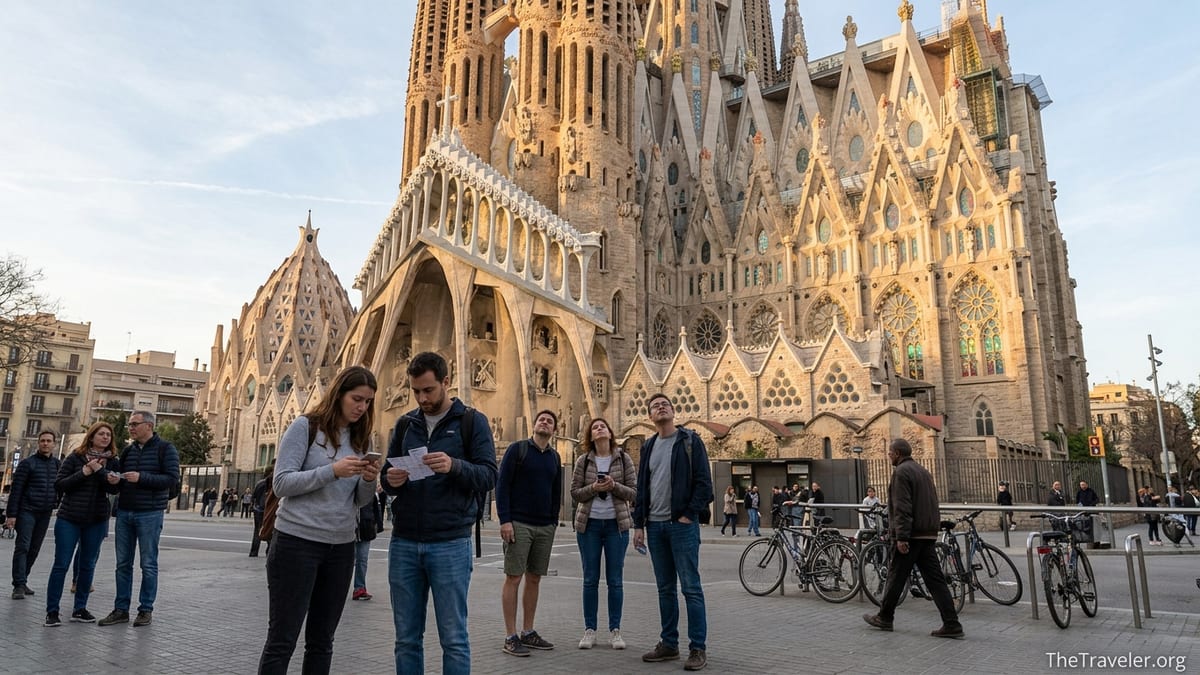
What Tickets Actually Cost in 2026
For a realistic sense of value, you first need to understand what you will pay. In mid 2026, official online prices for individual adult tickets to Sagrada Família typically start in the mid-20 euro range for basic entry to the basilica with the official audio guide app. Tower access tickets, which allow you to go up either the Nativity or Passion tower via elevator, usually add roughly another 10 to 15 euros per person on top of the base price. Guided group tours in English through reputable operators generally sit around the high-30 to mid-40 euro range, including skip-the-line entry and headsets, with small-group or premium options climbing higher.
Those prices put Sagrada Família in the same bracket as other flagship European monuments. A basic ticket to Paris’s Eiffel Tower with summit access can easily exceed 30 euros in high season, while Rome’s Colosseum and Forum combination tickets with guided tour often land in the 30 to 40 euro range. When you factor in that the basilica is now the tallest religious building on the planet and the defining symbol of Barcelona after the completion and inauguration of the central Jesus tower in early 2026, the ticket sits squarely among Europe’s headline experiences rather than feeling like an outlier.
It is also important to remember that Sagrada Família’s construction is still funded primarily by ticket revenue rather than by the state or the Vatican. Recent Spanish coverage notes that visitor income reached well over one hundred million euros in 2025, directly supporting the final push to complete Gaudí’s vision. When you buy a ticket, you are not just paying for access: you are contributing to an ongoing architectural project that has been under construction since 1882 and only reached its full height in 2026.
For budget travelers, those numbers can still feel intimidating, especially if you are planning for a family of four. Two adults and two teenagers on a basic audio-guide ticket can quickly surpass 80 euros, and adding tower access might nudge that close to 140 euros. That is precisely why thinking through what you personally value, and where Sagrada Família fits in your overall Barcelona trip, is essential.
What You Actually Get for Your Money
A standard ticket grants access to the basilica interior, the museum and crypt area, and the school building designed by Gaudí, plus use of the official audio guide app on your phone. For many first-time visitors, the moment that justifies the entire fee happens as you step through the door and look up. The interior forest of hyperbolic columns, stained glass that floods the nave with color, and the play of light across the stone are unlike any other European church. Even travelers who have toured dozens of cathedrals in France or Italy frequently describe the interior as feeling closer to walking inside a living organism than a traditional religious building.
The audio guide, which you listen to on your own device with earbuds, walks you through Gaudí’s ideas in approachable language. It points out details that are easy to miss on a hurried walk: the way the ceiling vaults mimic tree canopies, how the colors shift from cool blues and greens in the east to warm ambers and reds in the west, and why the structure does not follow the usual east-west alignment of other churches. First-time visitors who arrive without any background often come out saying the audio guide transformed what could have been a quick photo stop into a coherent story they were part of for an hour.
The included museum space beneath the basilica adds another layer of value that first-timers sometimes underestimate. Here you can see Gaudí’s original plaster models, early photographs of the site, and side-by-side comparisons of the innovative structural solutions that modern architects had to invent to interpret his unfinished plans. Panels explain, for example, how computer modeling was needed to realize certain catenary arch structures that Gaudí could only explore with physical models. If you are the sort of traveler who likes to understand how something was built, this museum can easily absorb another 30 to 45 minutes and make the cost feel more reasonable.
Finally, simply being inside at this specific point in history has its own intangible value. In early 2026, the central tower of Jesus was completed and crowned with a large illuminated cross, making Sagrada Família officially the tallest church building in the world. A few months later, a dramatic light and drone show and public ceremonies marked its inauguration, with global media coverage reinforcing the basilica’s status as an icon of Barcelona. As a first-time visitor, you are seeing the building at the moment it has finally reached its full intended height after almost a century and a half of work, something no previous generation could experience.
Are the Towers Worth the Extra Cost?
One of the hardest calls for first-time visitors is whether to pay extra for tower access. On paper, the upgrade seems obvious: elevator ride, panoramic views, dramatic photos. In reality, the value is more nuanced. The towers are narrow, and once you exit the small observation points you descend via a spiral staircase that some people find tight or dizzying. Views are partially framed by stone tracery and sculptural elements, which gives them character but means they are not the open, 360-degree vistas you might imagine from a conventional observation deck.
Travelers’ accounts from recent years echo this mixed picture. Some visitors rave about standing at the small balconies of the Nativity tower, with the mosaic-topped spires in the foreground and Barcelona’s Eixample grid stretching toward the Mediterranean. Others, especially those who are prone to vertigo or who were expecting an Eiffel Tower–style experience, come back saying they preferred city viewpoints like the Bunkers del Carmel or Montjuïc for wide-open views and sunset photos. The Passion tower tends to offer a more contemporary skyline, including the towers of Glòries and the seafront, while the Nativity side feels more intimate and older in spirit.
The extra ten to fifteen euros per person is easiest to justify if you know you love viewpoints and you are comfortable with heights and stairs. If your budget is tight, or if members of your group are uneasy with enclosed spaces, tower tickets are one of the simplest add-ons to skip without feeling that you have missed the essence of Sagrada Família. A common compromise for first-time visitors is to purchase one tower ticket shared between the most enthusiastic members of the group while others remain inside the basilica, exploring the museum more slowly or photographing the play of light on the columns.
It is also worth noting that tower access is timed and strictly controlled. Elevators operate in specific time slots, and staff can turn visitors away if they arrive late for safety reasons. If you are the sort who runs behind schedule or you are visiting on a tightly packed day when you might be delayed at security or by public transport, consider whether a timed tower entry will add stress that undermines the experience.
Time, Crowds and the Hidden Cost of Visiting
The financial cost of a Sagrada Família ticket is only part of the story. The other major investment is your time and energy. Since 2026 the basilica has introduced a daily quiet hour from 9 to 10 in the morning, which keeps internal noise down but does not necessarily reduce crowd levels. Official schedules and ticketing partners show that opening hours typically run from morning to early evening, with slightly shorter days in winter and extended hours around summer and major religious events.
In high season, especially from late May through early October, prime entry slots in late morning and mid-afternoon often sell out days in advance. That means a first-time visitor who arrives in Barcelona on a whim and hopes to buy tickets at the door risks being turned away or forced into a late, rushed time slot. For many travelers, the real cost is not the 25 or 35 euros they pay, but the half day of sightseeing that ends up revolving around a single timed visit.
The best strategy to protect both your wallet and your sanity is to reserve a morning or late-afternoon slot several days ahead, then plan your day around it. For example, if you book a 9:15 entry on a July weekday, you can arrive a bit before 9, benefit from softer morning light inside, and then continue to stroll through the Eixample or head to nearby Sant Pau Recinte Modernista afterward. Conversely, a 5:00 or 6:00 entry allows you to explore the rest of the city earlier, then watch the interior shift into golden tones as the sun lowers.
Keep in mind that security lines are similar to airport screening. Bags are scanned, large backpacks are discouraged, and certain items may be refused. While the process is usually efficient, it can still add 10 to 20 minutes during busy periods. If you have booked a guided tour, the meeting point is often outside in the nearby streets or plaza, and late arrivals may lose their spot with no refund. For a first-time visitor, leaving a generous buffer of 30 minutes around your entry time is a wise way to protect the value of the ticket.
Who Will Find the Ticket Price Worth It?
Not every traveler values the same things, so whether Sagrada Família feels worth its ticket price depends heavily on your interests. If you are passionate about architecture, design, or engineering, the basilica is almost guaranteed to feel like money well spent. Gaudí’s combination of organic forms, mathematical precision, and religious symbolism has inspired architects around the world, and standing inside the completed-height nave in 2026 offers context that cannot be gained from photos or models. Many architects and students schedule entire research trips around seeing the building at this stage.
Travelers who are drawn to spiritual or contemplative experiences, regardless of their faith, often find special value too. The daily quiet hour in the morning was introduced partly to preserve the basilica’s character as a place of prayer even as visitor numbers rise. If you visit during these early slots and step to the side aisles or the apse, you may catch pockets of real calm where the stained glass floods the space with colored light and the hum of tours fades away. For some first-timers, those 15 or 20 minutes of stillness are the most memorable part of the trip.
Families with older children or teenagers typically respond surprisingly well to Sagrada Família compared with traditional museums. The shapes are striking and almost otherworldly, the colors are vivid, and the story of a building that has taken more than 140 years to complete is easy to grasp. Many parents report that even kids who have grown bored of European churches perk up here, counting the animal carvings on the Nativity facade or spotting details in the stained glass. In this context, a family ticket can deliver more engagement per euro than a standard art museum where young travelers might tire quickly.
On the other hand, ultra-budget backpackers, short-stay cruise passengers, or visitors who feel indifferent to churches and architecture may not perceive the same value. If your idea of a great Barcelona day is entirely beach bars and tapas, with minimal interest in history or design, you may find that the ticket feels like a high-priced detour from the rest of your priorities. In those cases, admiring Sagrada Família’s facades from the outside, walking around the surrounding streets, and spending your ticket money on neighborhood food experiences might be a more satisfying choice.
Alternatives and Opportunity Cost in Barcelona
Part of judging whether Sagrada Família is worth it is comparing it to what else you could do with the same time and money in Barcelona. For roughly the price of a basic basilica ticket, you could instead book a timed entry to Casa Batlló or Casa Milà (La Pedrera), two of Gaudí’s other most famous works on Passeig de Gràcia. These houses provide a deep dive into his domestic architecture and rooftop designs, and some visitors ultimately prefer the more human-scale experience there to the monumental feel of Sagrada Família.
Another alternative is to invest in a high-quality food or history tour. A three-hour small-group tapas and wine walk through neighborhoods like Poble-sec or Sant Antoni may cost a similar amount per person, but it includes multiple food tastings and local insight that can shape the rest of your stay. Likewise, a guided walk through the Gothic Quarter and El Born with a knowledgeable historian can help you interpret the city’s medieval past and political history, giving texture to everything you see afterward.
There are also free or low-cost viewpoints and architectural experiences that offer impressive visuals without major ticket fees. The Bunkers del Carmel provide a superb sunset panorama across the city and out to sea, though the walk up can be steep and regulations are stricter than they used to be. The terraces of Montjuïc, Parc Güell’s free-access areas, and even the beach promenade at Barceloneta all provide memorable perspectives on Barcelona’s skyline, some of which include distant views of Sagrada Família’s now-completed towers.
When you frame Sagrada Família’s ticket against these choices, the core question becomes not “Is it expensive?” but “Is this how I most want to experience Barcelona?” For many first-time visitors, the answer remains yes: the basilica is the city’s single most distinctive symbol and a powerful introduction to Catalan modernisme. For others who are returning to Barcelona, who have limited time, or who are traveling on a strict daily budget, it may make sense to prioritize different experiences this time and view the basilica from the outside only.
The Takeaway
For most first-time visitors with at least a moderate interest in architecture, culture, or photography, Sagrada Família is worth the ticket price in 2026. The interior experience, the quality of the official audio guide, and the museum context combine to deliver far more than a quick photo stop. The fact that you are seeing the basilica just as it reaches its final planned height, crowned by the central Jesus tower and recognized across Spanish media as a new global icon of Barcelona, adds an unrepeatable historical dimension.
At the same time, the ticket price is not trivial, especially for families and budget-conscious travelers. You will need to plan around timed entry, navigate crowds, and potentially pass on other experiences to make space for it. If you care little for churches, dislike interior sightseeing, or simply have very limited time in the city, admiring Sagrada Família’s dramatic facades from the surrounding streets and parks can still give you a strong sense of its presence without the financial commitment.
If you decide to go inside, book in advance, choose a morning or late-afternoon slot, download the official audio guide, and give yourself at least an hour and a half to move slowly and let the building reveal itself. Consider tower access only if you genuinely enjoy heights and viewpoints and are prepared for narrow spaces and stairs. Approached thoughtfully, Sagrada Família can be more than just a line on a checklist: it can become the experience that anchors your first encounter with Barcelona, making the ticket feel not just justified but unforgettable.
FAQ
Q1: How much does a basic Sagrada Família ticket cost in 2026?
In mid 2026, adult tickets bought online for basilica entry with the official audio guide app usually sit in the mid-20 euro range, with discounts available for students, seniors, and children.
Q2: Do I need to book Sagrada Família tickets in advance?
Yes, booking ahead is strongly recommended, especially from late spring through early autumn, when popular time slots often sell out several days in advance and same-day tickets can be limited or unavailable.
Q3: How long should a first-time visitor plan to spend inside?
Most first-time visitors are comfortable with 60 to 90 minutes, which allows time to follow the audio guide in the nave, explore the museum exhibits, and take photos without feeling rushed.
Q4: Are the tower tickets worth the extra money?
Tower access can be very rewarding if you love viewpoints and do not mind heights or spiral staircases, but it is not essential to appreciate Sagrada Família; many first-time visitors feel the interior and museum alone justify the cost.
Q5: Which tower is better for views, Nativity or Passion?
The Nativity tower offers more intimate views and closer looks at Gaudí’s original sculptural details, while the Passion tower tends to give a wider, more modern city panorama; both are good, but Nativity is often preferred for first-timers.
Q6: Is Sagrada Família suitable for visitors with mobility issues?
The main basilica and museum areas are largely accessible by ramps and elevators, but tower access is restricted for those with reduced mobility due to narrow staircases and safety rules, so you should check current accessibility guidelines before booking.
Q7: What is the best time of day to visit for a first-timer?
Early morning and late afternoon generally offer softer light and slightly calmer conditions, making it easier to appreciate the stained glass and architecture; midday visits can feel more crowded and intense.
Q8: Can I attend a religious service instead of buying a ticket?
Yes, there are regular masses and special liturgical events that are free to attend, but access is limited to specific areas, and you will not have the same freedom to wander, photograph, or use the audio guide as standard ticket holders do.
Q9: Is it worth going inside if I have already seen many European cathedrals?
Most travelers who have toured other major cathedrals still find Sagrada Família unique because of its modernist design, organic shapes, and colored light, so it often feels less like another gothic church and more like a different category of space.
Q10: What should I wear when visiting Sagrada Família?
As an active basilica, Sagrada Família asks visitors to dress respectfully, avoiding swimwear, very short shorts, and tops that leave the torso uncovered, though typical casual summer clothing with covered midriff and chest is generally accepted.