


I arrived in Pisa expecting a quick cliché: hop off the train, snap the leaning-tower photo, and be on my way to somewhere "more interesting." Instead, the city quietly insisted that I slow down. Over two days of wandering between student bars, Romanesque churches, Arno-side promenades, and even a Tuscan beach reached by city bus, my biggest surprise in Pisa was how much more it offered than I ever expected.
Get the latest updates straight to your inbox!
First Impressions: More Than a One-Photo Stop
Like many visitors, I first saw Pisa through a train window. From Florence, regional trains roll into Pisa Centrale in about an hour, usually for under 15 euros if you book a standard regionale ticket. Step out of the station and the stereotype still seems to hold: luggage wheels clatter, day-trippers follow umbrellas held high by guides, and everyone appears to be marching in the same direction, straight toward the Leaning Tower.
As I followed the crowd, my assumptions started to crack. The walk from Pisa Centrale to Piazza dei Miracoli takes around 20 to 25 minutes through the old town, and those streets tell a very different story from the one-photo stop I expected. Past the souvenir stands, I found students from the University of Pisa biking across cobblestones, locals shopping at tiny alimentari, and handwritten signs advertising lunchtime "menu del giorno" for under 15 euros, house wine included.
Then there was the scale of Piazza dei Miracoli itself. I knew, in theory, that the Leaning Tower was part of a larger complex, but no photo prepared me for the shock of stepping through the gate and seeing four monumental structures: the cathedral, the baptistery, the tower, and the long cloister of the Camposanto set on perfect green lawns. This walled square is a UNESCO World Heritage Site, and viewed in person it feels less like a backdrop for a gag photo and more like a complete medieval world.
Most people I watched stayed in the square for less than an hour. Many did not go inside anything at all. That was my second surprise in Pisa: how much of its best detail is hidden just beyond the obvious, if you are willing to climb a bell tower, push open a church door, or simply keep walking when everyone else turns back toward the station.
Inside the Square of Miracles: Depth Behind the Postcards
I had reserved a timed ticket to climb the Leaning Tower, which is wise in high season because daily visitor numbers are limited and slots often sell out. Climbing the tower is expensive by Italian standards, so it is worth making the most of the rest of the square. Combination tickets that include the tower plus access to other monuments cost notably more than a simple field entrance, but if you skip at least one Aperol spritz you can justify the extra euros.
Inside the cathedral, which many visitors never enter, the atmosphere changes entirely. The striped marble columns, the gilded coffered ceiling, and the cool, dim light give the sense of a building that has anchored this city for centuries. The Baptistery offers another surprise: at certain times, attendants demonstrate its eerie acoustics by singing a few notes that echo around the circular interior, turning a quick look inside into a mini concert. The Camposanto, a monumental cemetery along the edge of the square, was one of the most moving places I visited in Pisa, with long cloisters, fresco fragments, and stone sarcophagi. For the cost of a modest museum ticket, you can spend an unhurried hour exploring art and architecture that many people on a rushed schedule never realize is there.
My favorite vantage point, however, was not from the tower but from Pisa’s ancient city walls. Accessed by a discreet staircase near the square, the Mura di Pisa walkway runs above the rooftops and offers a surprisingly peaceful 40-minute stroll overlooking the Duomo, the Baptistery, and the back gardens of residential streets. Locals told me they use it as an urban walking route or jogging track, and for roughly the price of a gelato it gave me one of the best panoramas of the city.
By the time I descended from the walls, the square was filling up with tour groups arriving from cruise ships and nearby cities. Many would see nothing of Pisa beyond this field. I decided to walk in the opposite direction, back toward the Arno, determined to discover what else lay behind the cliché.
Borgo Stretto and the Everyday Heart of the City
The turn from Piazza dei Miracoli down toward the river feels like stepping backstage. Within ten minutes I had swapped selfie sticks for arcades, narrow alleys, and an almost theatrical row of pastel facades. This is Borgo Stretto, the medieval spine of Pisa and, in many ways, its living room. The arcaded street is one of the hidden stars of the city, filled with independent boutiques, bookstores, and cafés that serve a largely local, student-heavy crowd.
Under one set of arches I found a café where an espresso at the counter cost little more than one euro, and a fresh-baked slice of crostata about two euros. A few doors down, a historic pastry shop was selling still-warm rice donuts and fragrant almond cookies by weight. Up a side alley, a university stationery store stocked notebooks, exam guides, and shelves of Pisan history that clearly cater more to residents than to tourists chasing magnets with leaning towers on them.
On a late afternoon, the piazzas off Borgo Stretto fill with a social ritual that surprised me: the early-evening aperitivo. Instead of the high prices you might find in more famous Tuscan cities, several bars here offered a generous buffet of simple snacks included with a drink for around 7 to 9 euros. I joined students balancing plates of bruschetta, olives, and small slices of focaccia while they compared exam schedules and weekend plans. It was here, not in the square of miracles, that I first felt like I had briefly stepped into local life.
Even the churches along Borgo Stretto turned out to be part of this texture. At San Michele in Borgo, a Gothic-fronted church tucked almost into the street itself, I pushed on a heavy wooden door and stepped into an interior that smelled faintly of wax and stone dust. A handful of worshippers sat in silence. No one tried to sell me a ticket or a tour. It was quiet, unexpected, and quintessentially Pisan: the sort of unspectacular moment that rarely makes it into guidebooks but shapes how you remember a place.
The Arno Riverside: A Different Kind of Tuscan Beauty
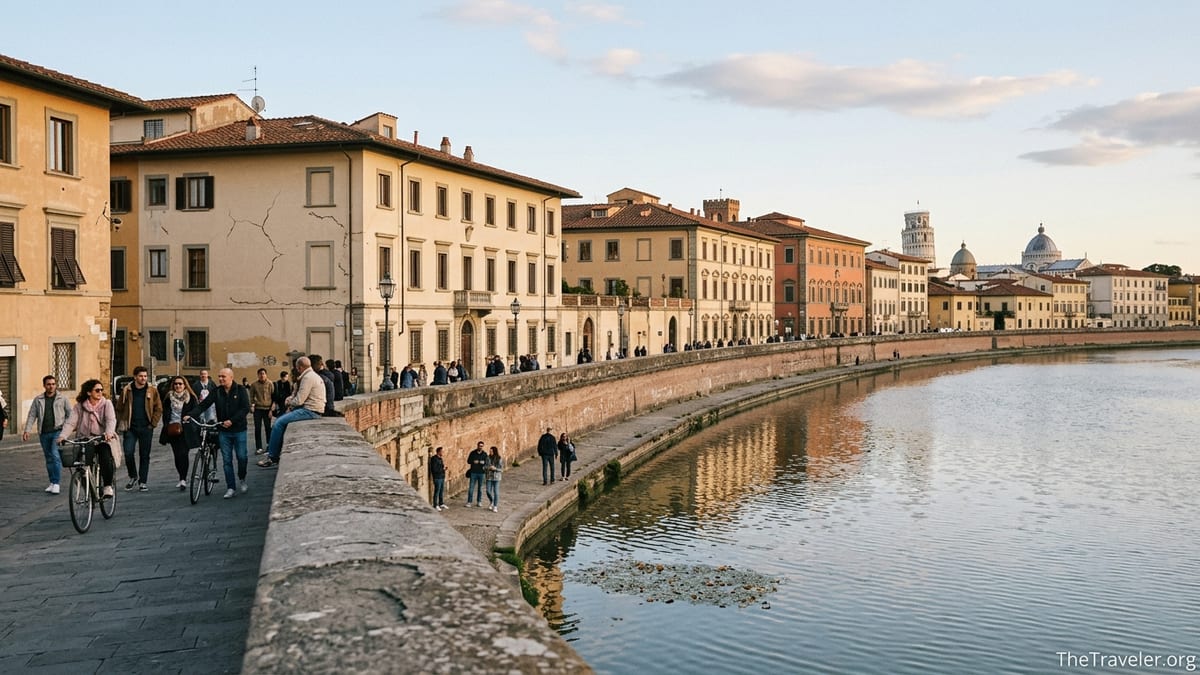
Another surprise in Pisa was how much time I wanted to spend simply walking along the river. The Lungarni, the promenades that line both banks of the Arno, form one of the city’s most atmospheric spaces, especially around sunset. Locals walk dogs, couples lean on the stone parapets, and the painted facades reflected in the water look more like a Renaissance painting than a real city scene.
One of the most striking sights along the river is Santa Maria della Spina, a tiny Gothic church that seems almost too delicate to be real, perched right on the embankment. Its elaborate spires and statues are visible from the opposite bank, and in the soft light of evening the marble glows slightly pink. Inside, when it is open, the space is intimate and quiet. Standing there, I realized how skewed my expectations had been: I had pictured Pisa as a single tower on a plain, not as a river city with its own brand of waterfront beauty.
The Lungarno Mediceo, on the north bank, is also where you find some of Pisa’s most interesting cultural stops. The National Museum of San Matteo, housed in a former convent, holds an impressive collection of medieval sculpture and painting from churches throughout the region. Tickets cost only a few euros, and when I visited on a weekday morning there were perhaps three other people inside. Being alone with centuries-old altarpieces in a quiet brick cloister, minutes from the crowded tower, felt almost like a secret.
Across the river, the Lungarno Galilei and Lungarno Gambacorti offer a more residential feel. Laundry hung from high windows, children’s voices echoed from inner courtyards, and at a small neighborhood bar, a glass of local white wine and a simple plate of crostini cost less than it would have in most big Italian cities. Sitting there, watching the evening traffic roll over the Ponte di Mezzo bridge, I began to understand why some Italians defend Pisa’s riverfront as one of the most pleasant in Tuscany.
Museums, City Walls, and Uncrowded Corners
My image of Pisa before arriving was entirely outdoors: the tower, the grass, the photo. The reality is that the city has enough indoor culture to fill a rainy day and then some. One standout is the Museum of Ancient Ships, housed in the old Medici arsenals near the river. Here, archaeologists have reconstructed Roman-era vessels discovered in the area, along with cargo and everyday objects that bring ancient maritime life to life. It is the kind of specific, place-based museum that rewards curious travelers; you are surrounded by real boats, not replicas, in a historic industrial space.
In the historic center, Palazzo Blu stands out with its vivid blue facade along the south bank of the Arno. Inside, rotating exhibitions showcase everything from modern art to themed shows on major Italian painters, while the permanent collection includes works linked to local history. Admission prices are moderate compared with big-city museums, and the building itself is a reminder that Pisa’s story did not stop in the Middle Ages.
Then there are the city walls. Many visitors do not realize that it is possible to walk along long stretches of Pisa’s medieval fortifications. Access points around the city lead up to an elevated path where, for a modest ticket fee, you can look down into gardens, cloisters, and back streets otherwise hidden from view. It is a perspective that ties the whole city together, connecting the famous monuments with the more ordinary neighborhoods where life goes on largely unchanged by tourism.
Smaller churches also reward attention. South of the river, the church of San Martino faces a quiet square and contains artworks that once belonged to other Pisan churches now lost or transformed. Far from the souvenir stalls, this is where you find the deeper layers of the city’s religious and artistic history. None of these corners demand long lines or advance reservation; you can simply show up, pay a small ticket or donation if required, and explore at your own pace.
A Gateway to Sea Air and Tuscan Countryside
One of Pisa’s biggest surprises is how close it lies to the sea. On a clear day from the city walls or from certain stretches of the riverfront, you can glimpse the outline of mountains and imagine the coast just beyond. In practical terms, Marina di Pisa, the city’s seaside suburb, is only about 30 to 40 minutes away by local bus from Pisa Centrale, with tickets usually costing just a few euros each way.
Marina di Pisa itself is a compact resort with a mix of pebble and small sandy beaches, breakwaters, and a seafront promenade. On summer weekends, Pisans head here with beach bags and folding chairs, staking out a spot on the free spiaggia libera or paying for a sunbed and umbrella at a stabilimento balneare. Prices for a daily umbrella rental vary, but you can often find a basic setup for less than what you might pay on the more famous Ligurian coast. For a traveler based in Pisa, it means you can gaze at medieval marble in the morning and swim in the Tyrrhenian Sea in the afternoon.
The countryside around Pisa offers other easy excursions. The Natural Park of Migliarino, San Rossore and Massaciuccoli lies west of the city and preserves a swathe of coastal pine forest and wetlands historically used as a royal hunting estate. Guided horseback rides and cycling routes depart from visitor centers within the park, and a simple picnic on the edge of the woods can be a peaceful contrast to the crowds around the Piazza dei Miracoli.
Even if you stay in the city, Pisa functions as a rail hub. Direct regional trains connect it with nearby Lucca in about half an hour, making a combined two-city day trip very feasible for travelers based elsewhere in Tuscany. Yet my strongest recommendation, after discovering how much Pisa itself offers, is to resist turning it into a checklist item on your way to somewhere else. Use the transport links to enhance your stay, not to downgrade Pisa into a layover.
Surprisingly Easy Logistics and Budget-Friendly Moments
Pisa’s airport may be small, but it sits remarkably close to the city. A driver pulling away from the terminal can reach the historic center by taxi in roughly 10 to 15 minutes under normal traffic, with typical fares starting around 10 to 15 euros. For most visitors, however, the PisaMover automated shuttle is the smarter option: it links the airport with Pisa Centrale in about five minutes, runs frequently throughout the day, and costs only a handful of euros per person. Contactless payments, including mobile wallets, are increasingly accepted, turning the transfer into a nearly frictionless hop.
Within the city, you can walk almost everywhere. From the station to Borgo Stretto, from Borgo Stretto to the tower, from the tower to the river: each leg is about 15 to 20 minutes, and the flat terrain makes it manageable even with modest luggage. Public buses connect outlying neighborhoods and the coast, but in the compact historic center comfortable shoes are more useful than transit passes.
Prices in Pisa can be another pleasant surprise, especially if you are arriving from high-profile Italian destinations where every espresso feels inflated. Away from the immediate perimeter of the tower, you can still find sit-down pizzerias where a generous margherita and a small draught beer total under 15 euros. Street markets such as the Mercato delle Vettovaglie sell fresh fruit, cheese, and cured meats at local prices; put together an impromptu picnic and you can lunch for the cost of a single gelato in some tourist hotspots.
Accommodation options also reflect Pisa’s in-between status. Because many travelers treat it as a day-trip stop, hotel demand for multi-night stays can be softer than in cities like Florence. That means attentive mid-range guesthouses and small hotels in the historic center may cost less than their equivalents in more famous destinations, especially outside peak summer months. For independent travelers, Pisa can make an economical and enjoyable base for a few nights, rather than just a brief detour.
The Takeaway
Before I visited Pisa, I thought I already knew it. I had seen the leaning tower on postcards and in films, read the inevitable jokes, and mentally filed the city under "quick stop if I happen to be nearby." What I discovered instead was a place where daily life and tourism coexist on a human scale: a university town with deep medieval roots, a riverfront worth lingering along, and quiet museums that reward unhurried curiosity.
My biggest surprise in Pisa was not the angle of its famous tower, but the way the city around it opened up once I allowed myself to look beyond that single icon. The arcades of Borgo Stretto, the low sun on the Lungarni, the silence inside hidden churches, the easy bus ride to a local beach: none of these appeared in my mental picture of Pisa beforehand, yet they are what I remember most clearly now.
If you arrive expecting only a quick photo opportunity, you will certainly find it. But give Pisa a full day or two, walk without a rigid plan, and you may leave with a very different story to tell. Like me, you might find that this small Tuscan city offers far more than you ever imagined, and that its greatest miracle is not a leaning tower, but the simple pleasure of being pleasantly, quietly surprised.
FAQ
Q1. Is Pisa worth more than a quick stop just to see the Leaning Tower?
Pisa rewards a longer stay. Beyond the Leaning Tower and Piazza dei Miracoli, the city has a lively university atmosphere, riverside walks, museums, and easy access to the coast, all of which justify at least one full day and often an overnight.
Q2. How long do I really need in Pisa to see more than the basics?
With a full day you can visit the tower complex, walk the medieval walls, explore Borgo Stretto, and stroll the Arno riverfront. With two days you can add museums, quieter churches, and even a half-day trip to Marina di Pisa or the nearby countryside.
Q3. Are there interesting things to do in Pisa if I am not climbing the tower?
Yes. You can visit the cathedral, baptistery, Camposanto, walk the city walls, browse local markets, explore the National Museum of San Matteo and Palazzo Blu, and wander the Lungarni promenades along the river without ever setting foot on the tower steps.
Q4. Is Pisa expensive compared with other Italian cities?
Outside the immediate area around the Leaning Tower, Pisa is relatively budget-friendly. Coffee at the counter, simple trattoria meals, and local buses are often cheaper than in major tourist centers like Florence or Venice, making it a good value base.
Q5. Can I use Pisa as a base for exploring other parts of Tuscany?
Yes. Pisa’s central train station connects directly to cities like Florence and Lucca, and local buses reach coastal areas such as Marina di Pisa. If you prefer a smaller, quieter base with good transport links, Pisa can work well for several nights.
Q6. What is the best way to get from Pisa Airport to the city center?
The PisaMover automated shuttle links the airport with Pisa Centrale station in about five minutes and runs frequently throughout the day. It is usually the quickest and most convenient option for most travelers, with contactless payment making the process simple.
Q7. Are there less crowded times to visit the Leaning Tower and Piazza dei Miracoli?
Early morning and late afternoon are generally quieter, especially outside peak summer months. If you book a timed ticket for the tower, choosing one of the earliest or latest slots can mean fewer crowds in the square and shorter lines for security checks.
Q8. Is Pisa walkable, or will I need to rely on public transport?
Pisa’s historic center is compact and largely flat. Most visitors walk between the station, the tower area, Borgo Stretto, and the riverfront. Buses are useful for reaching the coast or outlying neighborhoods, but within the central area comfortable shoes are more important than passes.
Q9. What should I wear to visit churches and religious sites in Pisa?
Like elsewhere in Italy, modest dress is appreciated in churches. Shoulders and knees should be covered, especially in the cathedral and smaller parish churches. A light scarf or shawl is useful in warmer months if you are wearing sleeveless tops.
Q10. Is Pisa suitable for families with children?
Yes. The grassy area around Piazza dei Miracoli, the riverside promenades, the interactive elements in museums such as the ancient ships exhibition, and the easy bus trip to the beach at Marina di Pisa all give families varied, low-stress ways to enjoy the city together.