


Bridal Veil Falls is not just one waterfall. From the roar of Niagara to the alpine cliffs of Telluride and the granite walls of Yosemite, this romantic name is shared by some of North America’s most photogenic cascades. Each one has its own "top view" that travelers dream about, and each one is surprisingly easy to miss if you do not know exactly where to go and how to time your visit. This guide focuses on the three most popular Bridal Veil viewpoints in the United States and shows you, step by step, how to experience their best angles without wasting time, money, or energy.
Understanding Which Bridal Veil Falls You Are Going To See
The first secret to getting the best views is knowing which Bridal Veil you are actually traveling to. The name appears at dozens of waterfalls around the world, but three in particular draw the most visitors in the United States: Bridalveil Fall in Yosemite National Park in California, Bridal Veil Falls at Niagara Falls State Park in New York, and Bridal Veil Falls above Telluride in Colorado. Each has a different character, access pattern and peak viewpoint, so mixing up information between them can lead to disappointment on the ground.
In Yosemite Valley, Bridalveil Fall plunges around 600 feet from a hanging canyon into the valley near the park’s western entrance. It is one of the very first waterfalls most drivers see as they drop into the valley, and for many visitors the postcard image is not from the base at all but from iconic Tunnel View, where Bridalveil is framed by El Capitan and Half Dome in a single sweeping scene. By contrast, the Niagara version is the smallest of the three main Niagara Falls, perched on Luna Island between the American Falls and the Canadian Horseshoe Falls, where the most memorable “top view” is from just above the brink or down at the Cave of the Winds boardwalks.
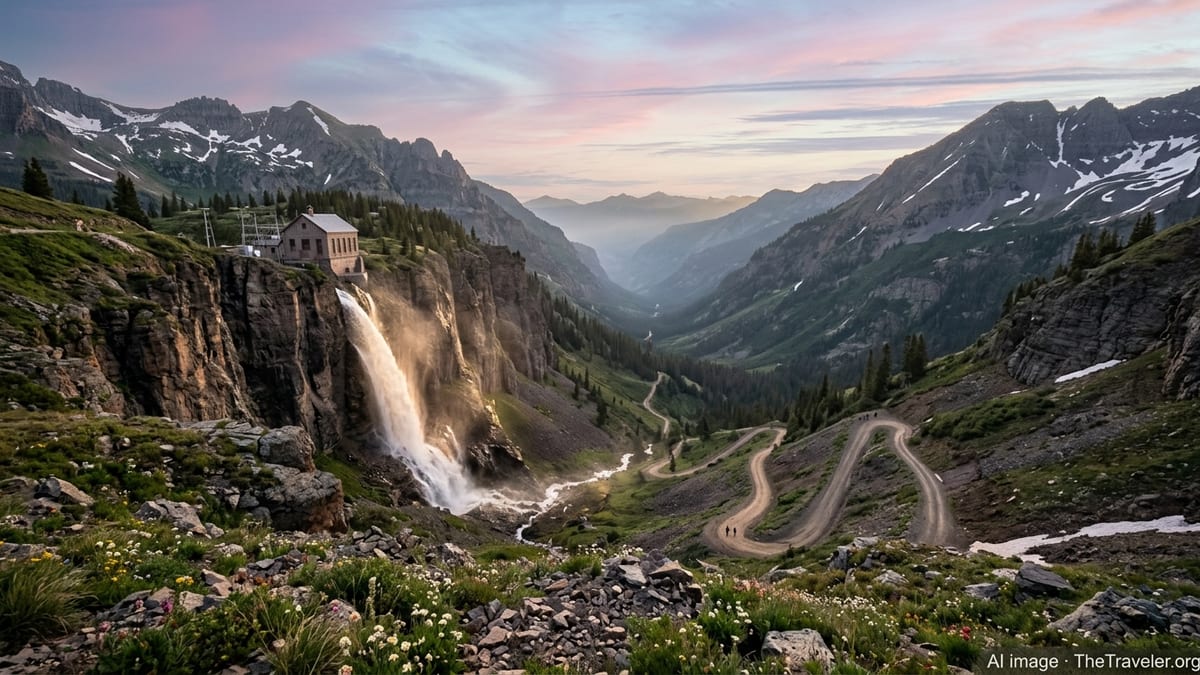
In Colorado, Telluride’s Bridal Veil Falls is a tall free falling alpine cascade at the head of a box canyon with a historic power plant sitting improbably on the cliff edge above the drop. Here, the best vantage points are scattered along a rough jeep road and hiking trail that switchback up the canyon wall, offering shifting perspectives of both the waterfall and the town framed far below. Understanding these distinctions will help you plan with the right expectations, especially when building an itinerary that might combine more than one of these destinations in a single larger trip.
Bridalveil Fall, Yosemite: How To Capture the Classic Tunnel View
For Yosemite’s Bridalveil Fall, the single most unforgettable vantage point is Tunnel View, the overlook you reach immediately after driving through the Wawona Tunnel on State Route 41. From here the entire valley opens up beneath you, with El Capitan on the left, Bridalveil Fall cascading on the right and the distant crest of Half Dome in the center. Because most travelers arrive in Yosemite during the middle of the day, they often see this view in flat, harsh light and walk away underwhelmed. If your goal is the best possible version of this scene, plan your timing and logistics around sunrise or late golden hour instead.
From Yosemite Valley Lodge, Tunnel View is roughly a 20 to 30 minute drive without heavy traffic, and during peak season the small parking area can fill up quickly after sunrise. If you are staying in the valley, the simplest strategy is to leave before dawn, bring a thermos of coffee and park at Tunnel View while it is still dim. Photographers with a tripod will often be in place 30 to 45 minutes before sunrise; casual visitors only need to arrive around 10 to 15 minutes before first light to enjoy the gradual reveal as colors build behind Half Dome. In late spring, when Bridalveil Fall usually runs strongest, you can expect to feel a chill despite the sun, so pack a light down jacket or fleece, even if it was warm in the valley campgrounds when you left.
If early mornings are not realistic for your group, the other excellent time is late afternoon into sunset, when the sun begins to angle into the valley and side light hits the cliffs. Traffic is heavier then, especially on weekends, and patience helps. Build at least an hour into your schedule for the round trip drive plus time at the overlook. The experience is low cost: there is no extra fee beyond the Yosemite entrance pass, and no special permit is required just to stop. Once there, consider walking a short distance away from the main pavement to find a quieter spot along the stone walls; even a few meters of separation can make the scene feel far less crowded, particularly in summer.
Getting Close to Bridalveil Fall in Yosemite Without Losing the Bigger Picture
After you have seen Tunnel View, the temptation is to rush to the base of Bridalveil Fall itself. In high water, especially in May and early June, the mist here is so intense that visitors can be soaked within minutes, and wind often swirls the spray unexpectedly. The short paved trail from the parking lot to the viewpoint is less than half a mile round trip, with a moderate incline that most reasonably fit visitors can handle. However, during busy afternoons, the narrow path becomes a bottleneck with families, strollers and people sheltering under ponchos. To avoid spending precious time in a slow moving crowd, aim to visit either early in the morning before most tour buses arrive or in the quieter window just before sunset.
It is also worth recognizing that the base viewpoint actually offers a very foreshortened view of Bridalveil Fall. You look up at a steep angle, seeing the water shoot off the lip but losing much of the context of the surrounding cliffs. Many repeat visitors feel that the waterfall is far more photogenic from pullouts along Southside Drive and Northside Drive, where the full height is visible at a comfortable distance. These roadside stops allow you to see how the fall fits into the broader valley scenery and to experiment with different foregrounds, from meadows to clusters of pines. If you are serious about photography, a mid range zoom lens around 24 to 70 millimeters on a full frame camera covers both wide landscapes and tighter compositions that isolate Bridalveil against the granite wall.
To balance your time, consider pairing a quick early morning walk to the base with an unhurried loop of the valley floor by car or shuttle later in the day, stopping wherever the waterfall looks most dramatic from afar. In years when Yosemite infrastructure projects or trail work affect access to the Bridalveil area, park rangers at the valley visitor center can give up to date advice on which viewpoints are open. Conditions vary with rockfall and snow; in late summer, flow can diminish significantly, turning Bridalveil into a light ribbon rather than a roaring torrent, which makes the wider landscape perspectives even more valuable than the close up view.
Niagara’s Bridal Veil Falls: Overlooks, Luna Island and Cave of the Winds
At Niagara, Bridal Veil Falls is part of a tightly packed cluster of viewpoints within Niagara Falls State Park on the American side. Because the area can feel overwhelming at first glance, with crowds, tour operators and noise, it pays to approach it with a simple plan: see the upper viewpoints from above, then decide whether to descend into the mist for the Cave of the Winds experience. The key “top view” most people picture is from the fenced overlook on Luna Island, where you stand between the American Falls and Bridal Veil Falls and look straight over their brinks.
To reach Luna Island, most visitors start from the main park area near Prospect Point and follow clearly marked pathways across pedestrian bridges over the American Rapids. The walk is short, often less than 10 minutes at a relaxed pace, but you might spend much longer pausing at railings along the way. At the edge of Luna Island, you can lean over the rails and watch the river accelerate toward the drop, with the Canadian skyline and Horseshoe Falls in the distance. This is an excellent time to simply observe water patterns and rainbows, and early morning often brings softer light and fewer people compared with midday, when tour groups concentrate on the area.
If you want an even more immersive perspective without splurging on a full day tour, consider budgeting for the Cave of the Winds attraction, which takes you by elevator down to the base of Bridal Veil Falls. After picking up a souvenir poncho and sandals, you follow wooden walkways that bring you within a few meters of the thundering water. This is where you feel the raw force of the falls most intensely, but it does mean getting wet and potentially queuing during peak season. For many travelers, especially families, combining Luna Island’s serene top view with the dramatic closeness of Cave of the Winds in a single morning gives a satisfying sense of having truly “seen” Niagara’s Bridal Veil without overplanning.
When planning your day, remember that Niagara Falls State Park is open year round, but some attractions, particularly boat tours and certain sections of Cave of the Winds, operate seasonally and may have adjusted hours in spring and fall. Weather plays a major role in comfort; on cooler days the mist at the base can feel surprisingly cold, so bringing a change of socks and a light layer to wear under the poncho can keep the experience enjoyable. If you prefer to avoid both crowds and the strongest midday sun shining directly into your eyes as you look over the brink, try to schedule your main overlook time for either just after opening or in the evening a couple of hours before sunset.
Telluride’s Bridal Veil Falls: Earning the Views on the Switchbacks
In Telluride, Colorado, Bridal Veil Falls is a destination where the journey is as much a part of the experience as the waterfall itself. Located at the back of a dramatic box canyon just a short drive east of town, this 365 foot free falling cascade is visible from the road as you approach, but its best viewpoints require either a hike or a trip up a rough four wheel drive road. The classic view that travelers seek combines a close look at the waterfall and its cliff edge power plant with a partial panorama back down canyon toward Telluride and the surrounding peaks.
The most accessible approach for most visitors is to park near the end of the paved road and then walk up the jeep track that climbs toward the base of the falls. The hike itself is only a couple of miles one way, but it gains substantial elevation on a rocky surface, so even fit travelers should plan for slow, steady progress at altitude. Along the way, broad switchbacks open up changing vistas: at one bend you might look straight across at the waterfall, at another you can frame it with wildflowers or late season snow patches in the basin above. Because the road is shared with off road vehicles and mountain bikes in summer, staying to the inside of curves and remaining alert to traffic is important, especially when stopping to take photos.
For those comfortable with backcountry driving and equipped with a suitable high clearance 4x4 vehicle, it is possible in dry summer conditions to drive up to a parking area near the base of the falls. However, local tourism offices strongly recommend that only experienced mountain drivers attempt this, both for safety and to reduce conflicts with hikers on the road. Many visitors find that walking actually yields better photographic opportunities and a more relaxed feel. Whichever mode you choose, start early in the day if possible, when the canyon is quieter and afternoon thunderstorms have not yet built over the San Juan peaks. During winter and early spring, sections of the road may be closed due to avalanche danger, and the falls can transform into a frozen curtain popular with expert ice climbers rather than casual hikers.
If your goal is to capture the power plant perched at the brink and the full sweep of the falls in one composition, bring a moderate wide angle lens and be ready to explore small side paths that lead to informal viewpoints just off the main track. The air is thin, often above 8,000 feet, so even short detours can feel taxing. Carry plenty of water, and treat the climb as a half day outing rather than a quick roadside stop. Many travelers combine the Bridal Veil hike with a ride on the free gondola that links Telluride with Mountain Village, using the gondola’s aerial views to appreciate the larger topography that channels snowmelt into the waterfall you just visited.
Planning Around Seasons, Water Flow and Crowds
Although each Bridal Veil destination has its own character, they share one universal truth: timing matters. In Yosemite, peak flow for Bridalveil Fall usually occurs in late spring and early summer, when snowmelt from higher elevations surges through the creek. At this time of year, the waterfall can be a white roar visible from almost every bend in the valley road, but it also coincides with the heaviest crowds of the year. If you visit in July or August of a low snow year, you might find a much lighter flow, which makes intimate roadside viewpoints with foreground trees more appealing than standing in heavy mist at the base.
At Niagara, water volume is controlled partly by hydropower management but remains impressive year round. Winter brings freezing temperatures that crust the edges of Bridal Veil Falls and the adjacent American Falls with ice, creating a stark beauty that is very different from the lush greenery of summer. Some observation platforms may be snowy or icy then, and certain lower level walkways can close for safety. Shoulder seasons like late April, May, September and October often offer a sweet spot when temperatures are comfortable and visitor numbers are lower than in peak summer vacation weeks.
Telluride’s Bridal Veil is strongly shaped by Colorado’s high altitude climate. Late spring through early fall is generally considered the best time for most travelers, as snow blocks higher sections of road and trail for much of the rest of the year. In June, the falls often thunder with snowmelt, wildflowers begin to emerge and long daylight hours give hikers flexibility. By late September, aspen leaves turn gold and the waterfall’s volume typically decreases but remains photogenic. Regardless of season, mountain weather can shift rapidly; starting a morning under blue skies is no guarantee that you will not encounter a sudden thunderstorm by afternoon, so it is wise to carry a light waterproof shell even if the day begins warm.
Across all three destinations, arriving early or staying late in the day is the most reliable way to secure elbow room at the best viewpoints. In popular national parks and state parks, midday is when tour buses and day trippers peak. Planning your main Bridal Veil viewpoint sessions for the first two hours after sunrise or the last two before sunset not only improves light for photography but also reduces the frustration of jockeying for space along railings or narrow trails. Building flexibility into your schedule allows you to return to a viewpoint at a different time if the first attempt is marred by harsh light, fog or, in the mountains, an afternoon storm.
Practical Tips to Make the Most of Each Viewpoint
Beyond choosing when and where to look at each Bridal Veil, a few practical strategies can dramatically improve your experience. Footwear is one of the most important details: even though some viewpoints are technically roadside, surfaces can be slick with mist or uneven with rocks and roots. At Yosemite’s Bridalveil Fall trail, water on the pavement and granite can make ordinary sneakers slide, so footwear with decent grip pays off. At Niagara’s Cave of the Winds, you are given sandals, but having secure, quick drying clothing and a place to stash your phone in a waterproof pouch keeps you focused on the view instead of on staying dry.
Photography minded travelers should also think ahead about equipment and expectations. A small microfiber cloth or lens wipe is invaluable near any waterfall, as droplets build up quickly on camera lenses and smartphone screens. At Telluride’s Bridal Veil, dust from the jeep road combines with occasional spray to create a challenging environment for gear; simple protective filters on interchangeable lenses and a lightweight camera bag that can zip completely closed will help. For travelers who are not interested in heavy equipment, modern smartphones are more than capable of capturing dramatic images at all three locations if you take a moment to steady your shot and avoid pointing directly into the sun when possible.
Finally, factor in the human experience. The most celebrated viewpoints tend to attract crowds, and it is easy to spend your limited time battling for the “perfect” angle instead of stepping back to enjoy the sensation of water, light and landscape. Consider designating one visit purely for being present, perhaps leaving cameras and phones in your bag, and another for slowly working through photos. Many travelers report that some of their strongest memories at these waterfalls come not from the iconic overlook itself but from quieter moments: sitting on a rock watching mist drift in Yosemite, leaning on a railing and feeling vibration from the rushing river at Niagara, or resting on a switchback above Telluride as evening light glows on the cliffs.
The Takeaway
Seeing Bridal Veil Falls at its best is less about ticking off a checklist and more about aligning timing, location and expectations. In Yosemite, that usually means committing to at least one early or late trip to Tunnel View and pairing it with a thoughtful loop of valley pullouts and a short walk to the base of Bridalveil Fall. At Niagara, it means combining the high, airy perspectives of Luna Island and nearby overlooks with the visceral power of Cave of the Winds, while leaving enough time to move at your own pace among the crowds. In Telluride, it means treating the hike or drive up to Bridal Veil Falls as a proper mountain outing, rewarding yourself with layered views back toward town and up toward the alpine basin above the cliffs.
Whichever Bridal Veil you visit, the underlying strategy remains consistent: do a bit of advance research on access and seasonal conditions, arrive outside of midday rush when you can, and give yourself permission to slow down once you are in front of the water. The falls themselves change from hour to hour with light, weather and flow, and by resisting the urge to hurry, you give them room to reveal their character. With a flexible plan and realistic expectations, you can leave each Bridal Veil not only with photographs but with a clear memory of having truly seen it from its finest vantage points.
FAQ
Q1. Which Bridal Veil Falls is best for first time visitors who want dramatic views with easy access?
Niagara’s Bridal Veil Falls is typically the easiest for first timers: short walks to multiple overlooks, frequent signage, and the option to add Cave of the Winds or boat tours without needing strenuous hiking.
Q2. If I only have one day in Yosemite, how should I plan to see Bridalveil Fall without missing Tunnel View?
Enter or exit the valley via the road that passes through Wawona Tunnel and schedule a stop at Tunnel View near sunrise or late afternoon, then drive down into the valley and take the short trail from the Bridalveil parking area to the base when crowds are lighter.
Q3. Do I need special hiking gear to reach Telluride’s Bridal Veil Falls viewpoints?
You do not need technical equipment in summer, but sturdy hiking shoes, sun protection, water and a light jacket are important because of the rocky jeep road, elevation and quickly changing mountain weather.
Q4. Are there good views of Bridal Veil Falls at Niagara that do not involve getting wet?
Yes, Luna Island and nearby overlooks provide excellent top down perspectives of Bridal Veil Falls and the American Falls with only light mist, and you can enjoy them without doing Cave of the Winds or boat rides.
Q5. What is the best time of year to see Bridalveil Fall in Yosemite at full flow?
Late spring, generally from May into early June in a typical snow year, is when Bridalveil Fall is most powerful, though this can vary depending on winter snowfall and spring temperatures.
Q6. Can I visit Telluride’s Bridal Veil Falls in winter?
Access is limited in winter because the road toward the falls can close due to snow and avalanche danger, and the waterfall often freezes into ice that is suitable only for experienced climbers rather than casual hikers.
Q7. Is parking difficult near the main Bridal Veil viewpoints?
At peak times parking lots can fill quickly at Yosemite’s Bridalveil Fall trailhead, Niagara’s central area, and the road end near Telluride, so arriving early in the morning or later in the afternoon greatly improves your chances.
Q8. Are there costs beyond park entry fees to see the top views?
The overlooks themselves are typically included in general park access, but premium experiences like Cave of the Winds at Niagara or guided off road tours near Telluride carry separate fees that you should factor into your budget.
Q9. How can I avoid crowds at the most popular Bridal Veil overlooks?
The most effective tactics are to visit outside of holiday periods, aim for the first two hours after sunrise or near sunset, and be flexible enough to return to a viewpoint later in the day if it feels too busy at first.
Q10. Is it safe for children to visit these Bridal Veil viewpoints?
Most official overlooks and maintained trails are designed with families in mind, but parents should keep children close near railings, on wet or uneven surfaces, and along shared jeep roads, especially in Telluride’s canyon where vehicles and hikers share space.