


The Uffizi Gallery is one of Europe’s great art museums and a highlight of almost every trip to Florence. It is also one of the easiest places to get wrong. From buying the wrong ticket and turning up on the wrong day, to racing past masterpieces in a jet-lagged blur, many visitors leave thinking more about the crowds than the Botticellis. With some up-to-date, on-the-ground knowledge, you can sidestep the most common pitfalls and experience the Uffizi at its best.
Get the latest updates straight to your inbox!
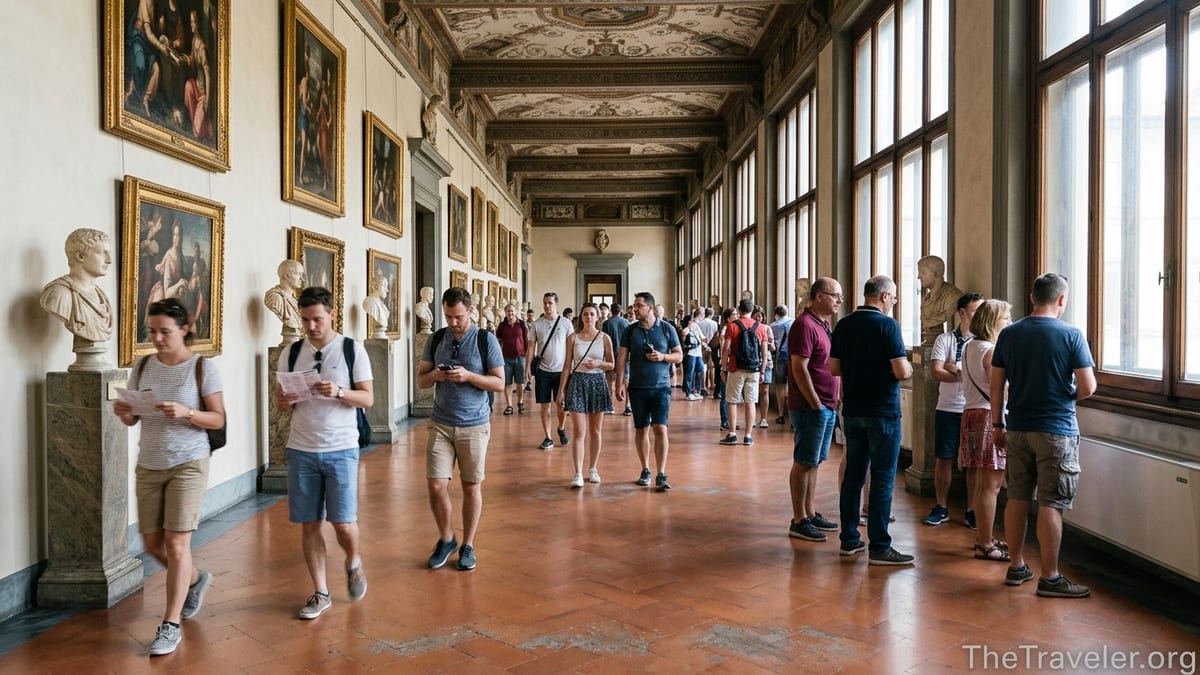
Arriving Without Timed Tickets or on the Wrong Day
One of the biggest mistakes visitors still make in 2026 is assuming they can simply walk up to the Uffizi, buy a ticket, and stroll straight in. In high season from roughly April to October, same-day buyers often face a ticket line of 45 minutes or more, plus a separate security queue once they finally have a ticket in hand. Official guidance and local operators note that the gallery now welcomes thousands of visitors per day, which means that on busy weekends and holidays queues can easily stretch along the Loggia dei Lanzi and well into Piazza della Signoria.
Compounding the problem, many travelers forget that the Uffizi is closed every Monday. A common scenario: a short Florence stay running Sunday to Tuesday, with plans to visit the Duomo Sunday, Uffizi Monday, and day-trip Tuesday. Only later do they discover that Monday is the weekly closing day, Tuesday is the first day after closure when crowds spike, and all the best early time slots are sold out. Checking the official calendar before you lock in hotel and train reservations and booking a timed ticket as soon as you confirm your dates is the simplest way to avoid this very expensive scheduling error.
Even those who understand the need for timed tickets sometimes arrive late, assuming they can drift in at any time that afternoon. In reality, tickets are tied to a specific 15- or 30-minute window, and during busy periods late arrivals may be asked to rebook or queue in the same-day line. If you have an 8:45 a.m. slot, be at Door 3 at least 15 to 20 minutes early to account for finding the right entrance and clearing security. Treat the time on your voucher as a firm appointment, not a loose suggestion.
Another subtle mistake is forgetting that special days, such as the nationwide free-entry first Sunday of the month, dramatically change the dynamic. On those Sundays, advance purchase does not grant priority since everyone enters free. You may save money, but you often trade it for long, slow-moving lines that can eat up half your day. If your time in Florence is short, it is usually better to visit on a paid day when a pre-booked slot truly helps you skip the worst of the queues.
Buying the Wrong Ticket or Overpaying Through Resellers
Ticketing for the Uffizi has grown more complex, and that confusion feeds some of the most frustrating visitor mistakes. Many people buy an expensive third-party “skip the line” ticket from a reseller that charges 35 to 50 euros for what is essentially a 19 euro timed entrance plus a booking fee. Others discover only after purchase that a slightly more expensive combined pass would have covered not only the Uffizi, but also the Pitti Palace and Boboli Gardens over several days, for just a bit more than the single-museum ticket.
As of mid 2026, the official tariff for a standard pre-booked Uffizi entrance is around 19 euros, with an additional reservation fee when purchased online. There is also a popular five-day “Passepartout” combined ticket priced around 40 euros that includes one timed visit to the Uffizi and then flexible entry to Pitti Palace and the Boboli Gardens within five consecutive days. The key detail many people miss is that you must visit the Uffizi first on the day and time printed on the ticket, and only after that can you use the same pass to enter the other sites. Travelers who buy a standard Uffizi ticket and then a separate garden or palace ticket often end up spending significantly more than necessary simply through lack of planning.
Overpaying is another avoidable issue. A common example: a family of four standing outside the gallery, searching “Uffizi tickets” on a smartphone and clicking a sponsored result that appears first. That reseller site might list “Fast-track entry Uffizi Gallery” for 49 euros per adult, with vague language about “priority access” and “expert host.” In reality, the host simply meets the group in Piazza della Signoria to collect their passports and walk them to the official entrance where everyone still passes standard security. If you truly want a guided visit, a reputable tour operator can be good value, especially for a two-hour highlights tour. If you just want a ticket, buy direct from the official channel or an authorized partner where the base price is clearly stated and fees are transparent.
Flexibility is where the combined ticket really shines, particularly in hot weather. For example, a June visitor might book their Uffizi entry for a cool 9:00 a.m. time slot, then wander Pitti Palace on a cloudy afternoon the next day and explore Boboli Gardens in the early evening later that same week. By checking official pricing before purchase and thinking through your broader Florence plans, you avoid duplicate tickets, inflated reseller costs, and frustrating misunderstandings at the door.
Underestimating Crowds, Timing, and Museum Fatigue
Another major mistake is cramming the Uffizi into an overstuffed sightseeing day. The gallery is extensive, spread over long corridors, multiple staircases, and dozens of rooms filled with works by Botticelli, Leonardo da Vinci, Michelangelo, Raphael, Caravaggio, and many others. A focused highlights visit still takes around two hours at a brisk pace, while a more relaxed experience can easily fill three or more. Visitors who try to “do” the Uffizi, the Accademia Gallery, and the Duomo complex all in one day often end up exhausted and overwhelmed, barely remembering what they saw.
Peak crowd times are predictable but often ignored. Most sources agree that mid-morning from about 10:30 a.m. to 1:00 p.m. and mid-afternoon from 2:30 p.m. to 4:30 p.m. are the busiest windows, particularly on Tuesdays, Fridays, weekends, and around major holidays. Between Easter and early October, group tours from cruise ships and coach companies funnel in during those same time bands, filling the Botticelli rooms and narrowing movement along the main corridors. If you have flexibility, book the first available slot of the day around 8:15 or 8:45 a.m., or choose a late afternoon time after 4:00 p.m., when family groups with small children often start to leave.
Museum fatigue is a more subtle but very real problem. Jet-lagged travelers, or those trekking in from hill towns for a single day, sometimes arrive at the Uffizi tired, dehydrated, and overloaded from a morning sightseeing sprint. They then spend the first half hour fighting through crowds, only to realize they are too drained to appreciate the detail in works like Botticelli’s “Primavera” or the gentle light of Raphael’s “Madonna of the Goldfinch.” Planning a slower day with the Uffizi as your main indoor activity and leaving open-air attractions such as the Arno riverfront or Piazzale Michelangelo for later gives you the mental space to enjoy what you are seeing.
It also helps to plan short breaks. There is a simple café with a terrace looking onto Palazzo Vecchio where you can sit down, sip a coffee, and rest your legs for 20 minutes before tackling the remaining rooms. Many visitors rush past this option in their rush “to see everything,” when a brief pause can be the difference between absorbing the masterpieces on the second level and simply shuffling past them.
Rushing the Masterpieces and Skipping Basic Preparation
Perhaps the most poignant mistake is treating the Uffizi as a checklist rather than an experience. This usually happens when visitors arrive with no sense of what they most want to see. They follow the flow of the crowd through the long corridors, stop for a quick photo at Botticelli’s “The Birth of Venus,” and then drift from room to room without context. Two or three hours later, they emerge with a camera roll full of images but only a vague memory of what stood out.
Spending even 30 minutes the night before your visit reading about a handful of key works can transform your experience. Choose a few must-see pieces such as Botticelli’s “Primavera,” Leonardo’s “Annunciation,” Michelangelo’s “Doni Tondo,” Caravaggio’s “Medusa,” and a couple of your favorite Renaissance portraits. Mark where they appear on a current Uffizi floor plan, which is available from official planning resources and the gallery’s own materials. When you arrive, you will know which rooms to prioritize, and you can allow yourself time to linger instead of worrying about whether you are “missing something” around the next corner.
A practical example: many first-time visitors spend 25 minutes in the early medieval rooms near the entrance because they feel obliged to go in order, then rush through the Botticelli rooms because they are anxious about time, only to realize that they are too tired by the time they reach the Caravaggios. A better approach is to walk briskly through the first sections, note anything that catches your eye for a possible return, and then slow down as you approach your personal highlights. If you discover that you are particularly drawn to Florentine portraits or Northern European works, you can always double back later.
Another variation of this mistake is neglecting audio or guided support when you would genuinely benefit from it. A well-reviewed group tour, often capped at around 15 to 20 people, can provide engaging stories about the Medici family, rivalries between artists, and how the building itself evolved from administrative offices to a museum. Self-guided visitors might prefer a downloadable audio tour or a carefully chosen printed guidebook that focuses on a curated set of highlights instead of exhaustive catalogues. The goal is not to become an art historian in an afternoon but to give some shape to your visit so that the sea of masterpieces feels navigable.
Ignoring Practical Comfort: Bags, Dress, and Logistics
Many frustrations at the Uffizi are not artistic at all, but purely practical. Visitors often arrive carrying large backpacks, shopping bags, or even small suitcases after checking out of their accommodation. Security staff strictly control bag size, and anything too bulky must be stored in the cloakroom, where queues form at both drop-off and pick-up, especially during peak times. It adds unnecessary waiting and cuts into your time with the art. Whenever possible, leave large items at your hotel and bring only a small day bag with your essentials.
Comfortable footwear is essential. Floors are hard, corridors are long, and you will likely be on your feet for hours. Choosing fashion-forward shoes with thin soles or heels for photographs on the Piazza della Signoria might seem appealing in the morning, but by the second hour on marble and stone floors your feet and lower back will protest. Light, breathable clothing is also important in warm months, as some rooms can feel stuffy when the galleries are crowded, even though climate control is in place for the artworks.
Water and snacks require some thought. While you cannot eat inside the exhibition rooms or bring in glass containers, you can carry a small plastic water bottle and refill it later at public fountains in Florence. Having water at hand is particularly helpful if you visit in the afternoon when rooms can feel warm. Plan meals around your visit: a late morning entrance works well if you have a good breakfast beforehand and then sit down for lunch nearby after you finish, while a mid-afternoon slot pairs with a proper Tuscan lunch, followed by a gentle walk to the Uffizi.
Finally, think about how you will arrive and leave. Driving to the Uffizi is strongly discouraged, as the museum is inside Florence’s limited-traffic zone, which is actively enforced. Arriving on foot from a central hotel, or via local buses that stop near the historic center, avoids fines and the stress of parking. After your visit, it is an easy stroll to the Arno, Ponte Vecchio, or the cafés around Piazza della Repubblica, all of which make pleasant spots to decompress and reflect on what you have seen.
Misjudging Photography, Etiquette, and Accessibility
Another frequent source of frustration is misunderstanding the rules around photography and general museum etiquette. Visitors who plan to take professional-looking portraits or video reels with tripods, lights, or bulky camera rigs are often disappointed when staff ask them to pack equipment away. While personal, non-flash photography is generally allowed in many parts of the Uffizi, anything that might disturb other visitors or threaten the safety of the artworks can draw attention from guards. Flash is particularly discouraged because of both conservation concerns and the distraction it causes in crowded rooms.
Etiquette matters in more subtle ways, too. Many travelers do not realize how quickly bottlenecks form when people stand directly in front of major works to take multiple selfies. For instance, the Botticelli rooms can become almost impassable when several groups cluster shoulder-to-shoulder in front of “The Birth of Venus” for extended photo sessions. A more considerate approach is to take a quick shot from a reasonable distance, then move to the side to make room for others and spend time looking at the painting away from the central traffic flow. Keeping voices low and avoiding phone calls in the galleries also improves the experience for everyone.
Accessibility planning is often an afterthought, which can make the visit much harder for those with mobility challenges. The Uffizi occupies a historic building with stairs, ramps, and changes of level, but there are elevators and adapted routes for visitors who need them. Without prior planning, guests with limited mobility may end up tackling unnecessary stairs or long detours when a more direct lift or accessible corridor is available. Checking the latest accessibility information from official sources before you arrive and asking staff at the entrance which route is best can make a big difference.
Families with young children sometimes misjudge how much their kids will enjoy a dense art museum. The mistake is treating the visit like an adult checklist rather than adapting it to the family’s pace. Instead of insisting on seeing everything, parents might choose a short highlights route, mixing in a treasure-hunt style game such as spotting certain animals or colors in paintings, or breaking for gelato afterward as a reward. Managing expectations and planning for shorter attention spans keeps both adults and children happier and reduces tension inside the museum.
Forgetting the Bigger Picture: Combining Uffizi With Pitti Palace and Boboli Gardens
A final strategic mistake is thinking of the Uffizi in isolation rather than as part of a trio of major sights managed by the same institution: the Uffizi Gallery itself, Pitti Palace, and the Boboli Gardens behind it. The five-day combined ticket exists precisely because many visitors want to experience more than one of these places without rushing. Yet travelers often book a single Uffizi slot through a reseller without ever learning about this more flexible option, only to pay again for Pitti Palace or skip the gardens altogether due to cost or confusion.
In practice, the combined pass can shape a rich mini-itinerary within Florence. For example, on day one you might visit the Uffizi in the morning, then cross the Ponte Vecchio in the evening for dinner in the Oltrarno neighborhood. On day two or three, you could explore the opulent rooms of Pitti Palace, including the Palatine Gallery, and then wander out into the Boboli Gardens for sweeping views over the city and a bit of green respite from the crowds. Because the ticket is valid over five consecutive days, you can choose cooler or clearer weather for the gardens instead of forcing everything into a single, exhausting day.
Planning the sequence correctly is essential. The rules require that you enter the Uffizi first, on the reserved day and time, to activate the pass. Only after this activation can you use the same ticket for Pitti Palace and the Boboli Gardens without additional reservations, within the validity period. Travelers who misunderstand this sometimes attempt to start at Pitti Palace or the gardens and are refused entry with a ticket that has not yet been activated at the Uffizi. Reading the conditions of use carefully when you book avoids an awkward conversation at the gate and ensures you can enjoy all three venues with minimal administrative friction.
Thinking of the Uffizi as part of a broader Medici story also makes the art more vivid. Many works in the galleries once hung in the private rooms of the Medici family or decorated the very palace you will later visit across the river. Tracing this thread over several days, rather than sprinting through everything in a single afternoon, turns Florence from a series of famous names into a more coherent narrative.
The Takeaway
For all its complexity and crowds, the Uffizi rewards thoughtful planning. The main mistakes visitors make are practical and predictable: arriving without a timed ticket or on a Monday, buying overpriced or unsuitable passes, underestimating how much time and energy the museum requires, neglecting basic comfort and logistics, and treating the visit as an indiscriminate checklist rather than a focused encounter with some of the world’s great artworks.
If you secure official timed tickets well in advance, consider the combined five-day pass if it suits your plans, choose an early or late time slot, and give yourself at least two to three unhurried hours, you are already ahead of most first-time visitors. Add a little preparation about the key masterpieces you want to see, wear comfortable shoes, travel light, and respect the rhythms of the museum, and your visit becomes less about lines and logistics and more about quietly standing in front of Botticelli, Raphael, or Caravaggio in one of the Renaissance’s defining spaces.
Florence will always be busy, and the Uffizi will never be empty, but the difference between a frustrating ordeal and a memorable highlight often comes down to choices made weeks before you walk through the doors. With the right information and realistic expectations, this landmark of European art can be exactly what you hoped for when you first decided to come to Tuscany.
FAQ
Q1. Do I really need to book Uffizi tickets in advance?
Yes, especially from roughly April to October and on weekends. Advance timed tickets significantly reduce waiting at the ticket office, although you will still pass standard security checks.
Q2. What is the best time of day to visit the Uffizi Gallery?
The first slots of the day, around 8:15 or 8:45 a.m., and late afternoon entries after about 4:00 p.m. are usually less crowded than mid-morning and mid-afternoon.
Q3. Is the five-day combined ticket for Uffizi, Pitti Palace, and Boboli Gardens worth it?
It is good value if you plan to visit at least two of the three sites. The pass typically costs only a bit more than a single Uffizi ticket and gives you five consecutive days to see everything.
Q4. Can I visit Pitti Palace or Boboli Gardens before the Uffizi with the combined ticket?
No. You must activate the combined ticket by entering the Uffizi first, at the reserved day and time. After that, you can visit Pitti Palace and Boboli Gardens within the ticket’s validity period.
Q5. How long should I plan for a visit to the Uffizi?
Plan at least two hours for a highlights visit and closer to three hours if you want a more relaxed pace with time for breaks and a café stop.
Q6. Are guided tours of the Uffizi worth the extra cost?
For many visitors, yes. A well-reviewed guided tour can provide context, stories, and a clear route through the museum, which helps avoid aimless wandering and highlights the most significant works.
Q7. What should I wear and bring to the Uffizi Gallery?
Wear comfortable shoes and breathable clothing, and bring a small day bag only. Large backpacks or luggage must be checked, which can add waiting time at the cloakroom.
Q8. Can I take photos inside the Uffizi?
Non-flash, personal photography is generally permitted in many areas, but flash, tripods, and bulky equipment are not allowed. Always follow staff instructions and avoid blocking others while taking pictures.
Q9. Is the Uffizi accessible for visitors with limited mobility?
The historic building has elevators and adapted routes, but some planning is needed. It is wise to check the latest accessibility details before your visit and ask staff at the entrance for the best route.
Q10. Can I combine the Uffizi with the Accademia Gallery on the same day?
It is possible, but it makes for a long, museum-heavy day. If you choose to do both, allow at least two hours for each and schedule a proper meal and rest between visits to avoid fatigue.