


For many travelers, the Uffizi Gallery is not a once-in-a-lifetime visit but a ritual. Art lovers plan entire trips around a few unhurried hours in its long corridors, coming back to Florence every few years to see what has changed, what has been rediscovered, and what familiar masterpiece feels different this time. With new rooms, refreshed installations, and fresh ways of seeing the Renaissance, the Uffizi in 2026 is more compelling than ever.
Get the latest updates straight to your inbox!
Masterpieces You Cannot Finish in One Visit
Even the most focused art lover cannot truly “do” the Uffizi in a single afternoon. The museum holds one of the world’s richest collections of Italian Renaissance painting, from Giotto to Caravaggio, and it takes multiple visits for individual works to sink in. Many repeat visitors talk about returning to see just a handful of pieces with fresh eyes, rather than racing through every room.
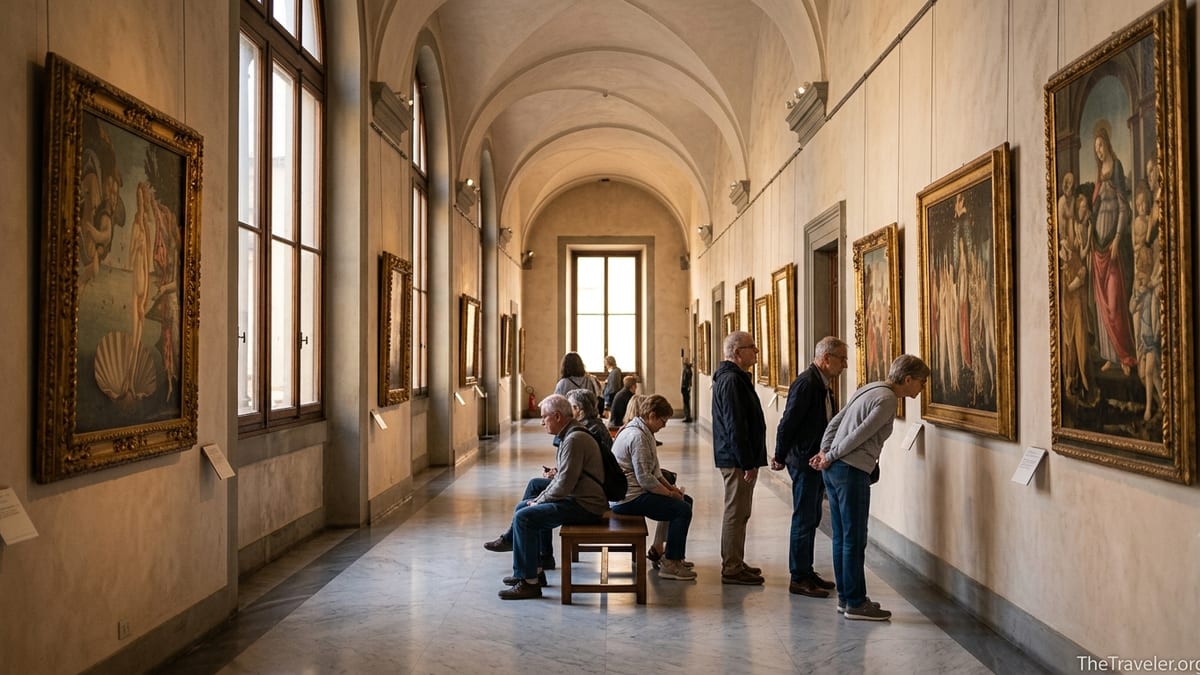
Sandro Botticelli’s “The Birth of Venus” and “Primavera” are a perfect example. In June 2026 the gallery unveiled a new arrangement that places the two paintings in adjoining spaces, giving each more breathing room and reshaping how visitors encounter them. Regulars who saw them in their previous, more crowded setup now return specifically to experience the quieter, more contemplative viewing that the rehang allows, sometimes timing their visit for early morning to enjoy a few unhurried minutes with Venus before the tour groups arrive.
The same is true for lesser-known but equally powerful works. A fan of Caravaggio might return just to stand again in front of “Medusa” or “Bacchus,” noticing details that were missed the first, second, or even third time. Travelers who first encountered Piero della Francesca’s “Duke and Duchess of Urbino” on a rushed group tour often plan a second trip to Florence simply to sit in front of it without a guide’s stopwatch ticking in the background.
Because the Uffizi is dense and visually overwhelming, repeat visitors learn to build itineraries around individual artists or themes. One year, a traveler may decide to trace only Simone Martini, Gentile da Fabriano, and other Gothic painters. On another visit, the focus might be on portraits or on works that explore religious doubt. The museum’s depth rewards this kind of slow, serial exploration.
A Living, Evolving Museum Experience
Part of the reason art lovers keep coming back is that the Uffizi itself keeps changing. After years of renovations, the museum has been unveiling new rooms and reimagined displays that shift the narrative of European art. In 2024, for example, the gallery opened new spaces dedicated to Flemish painting and a reconstructed Cabinet of Ancient Marbles, placing works by Dürer, Cranach, and Memling in a historical arrangement that echoes how 18th and 19th century visitors would have seen them.
These changes are not cosmetic. They alter the way you move through the building and the stories the collection tells. Recent additions such as a major canvas by the French painter Pierre Subleyras help fill gaps in the historical sequence, encouraging visitors who thought they “knew” the Uffizi to walk the route again and notice new connections between Italian and northern European art. Many regulars now plan repeat visits specifically to see how the new director’s curatorial vision is unfolding room by room.
Temporary exhibitions offer another reason to return. In late 2024 and 2025, the museum highlighted new acquisitions such as Salvator Rosa’s unsettling painting known as “The Witch,” giving this once-obscure work a prominent place in the 17th century galleries. Forthcoming shows, including an ambitious exhibition on wax sculpture planned for 2025, are already on the radar of art-focused travelers who book Florence flights as soon as dates are announced.
Even small operational changes shape the repeat-visitor experience. The gallery has introduced longer opening hours on some days and continues to refine timed-entry systems, so someone who last came in 2018 will encounter a museum that feels calmer, more regulated, and ultimately easier to navigate. For many art lovers, seeing a beloved institution modernize without losing its soul is reason enough to keep returning.
New Perspectives: The Vasari Corridor and Beyond
For years, the Vasari Corridor was one of Florence’s semi-mythical experiences: a raised passageway built in the 16th century for the Medici that ran from the Uffizi, over the Ponte Vecchio, to the Pitti Palace. After being closed to ordinary visitors for most of the 2010s, it reopened to the public in late 2024 following an extensive restoration, creating an entirely new way to experience the city and the museum’s collections.
Today, art lovers can book dedicated time slots to walk this elevated route, gazing out over the Arno River through its distinctive small windows while also encountering a curated selection of works that complement the main Uffizi displays. The corridor offers a rare combination of architectural history, urban views, and painting, which is why people who had already visited the gallery multiple times are now making specific return trips just to add the Vasari experience to their mental map of Florence.
The reopening has also changed how seasoned visitors plan their days. A traveler might spend the morning in the main Uffizi galleries, pause for an espresso in the rooftop café with its view over the Duomo, then take an afternoon corridor tour that delivers them near the Pitti Palace across the river. This allows a seamless progression from Medici offices to private residences to gardens, turning what used to be three separate visits into a single, coherent story of power and patronage.
Beyond the corridor, new circulation routes and clearer signage inside the Uffizi have improved the feel of the galleries. Repeat visitors who remember bottlenecks near the Botticelli rooms or chaotic flows on the top floor often comment on how much easier it is now to follow a logical itinerary. That smoother movement makes it more appealing to return, knowing that their next encounter with a favorite painting is less likely to be overshadowed by crowd frustration.
Florence as an Extended Uffizi: Pitti Palace and Boboli Gardens
Many art lovers do not think of the Uffizi as a single building but as part of a wider constellation that includes the Pitti Palace and the Boboli Gardens across the Arno. The ticketing system reinforces this idea. Alongside standard single-entry tickets, the museum offers combined passes, including a multi-day option that covers the Uffizi, the Pitti Palace museums, and the Boboli Gardens over five consecutive days. This pass, priced in the upper tens of euros, appeals to travelers who want to live with the collections rather than rush through them.
In practice, this means someone might visit the Uffizi for two or three hours in the morning, then retreat to the Boboli Gardens in the afternoon to decompress among fountains and cypress alleys, returning to the palace’s costume galleries or the Palatine collection the following day. Many regulars build entire weeks around this rhythm, using the combined ticket to sample different parts of the Medici world at a humane pace. Because the pass is valid over several days, it encourages slow travel and repeat encounters with favorite rooms.
Prices fluctuate by season, but as of 2026 a standard Uffizi ticket bought on the day generally falls in the mid-teens to mid-twenties in euros, with an extra reservation fee for timed entry. The multi-site pass costs more, often just under 40 euros, but offers significant value for those planning repeat or extended visits. Experienced travelers often advise first-time visitors who suspect they will want “just one more morning” in front of Botticelli or Raphael to invest in this kind of pass from the start.
For art lovers comparing cities, the combined experience of Uffizi, Pitti, and Boboli is a strong reason to choose Florence over a shorter stop in Rome or Venice. The chance to see Titian and Raphael indoors in the morning, then stand in the Boboli amphitheater or at the Belvedere overlook in the afternoon, keeps many travelers returning to the same city rather than chasing new destinations.
Practical Ease: Timed Tickets, Better Flows, and Smart Timing
People do not return to a museum that feels exhausting and chaotic. One underappreciated reason art lovers keep coming back to the Uffizi is that visiting has quietly become more manageable. Timed-entry tickets, which can be reserved in advance through the official system, have reduced the once-notorious courtyard lines. While there is still a short security queue, regular visitors describe waits of 10 to 30 minutes with a reservation, compared with the hour or more that was common in peak seasons a decade ago.
That convenience does carry a small premium. Third-party platforms often charge several euros more than the basic ticket price for a “skip the line” timeslot, and even the official site adds a modest reservation fee. Yet many repeat visitors happily pay the difference, knowing it buys them more precious time in front of artworks and less time shuffling under the arches in the Tuscan sun. Some regulars now book an 8:15 a.m. or late-afternoon entry months ahead, building the rest of their Florence itinerary around those windows.
Frequent visitors also learn the museum’s rhythms. Early Tuesday evenings, when extended hours are in effect, can feel dramatically quieter than a Saturday morning in May. Winter months, especially January, are calmer than the Easter period or the height of summer. Art lovers planning a repeat trip often choose shoulder-season dates and midweek time slots specifically to reclaim the contemplative atmosphere they remember from their first encounter with the galleries.
Inside, wayfinding has improved. A clearer numbering system and updated maps mean that returning visitors can be more strategic, heading straight to specific rooms before looping back to explore secondary interests. This practical ease encourages art fans to treat the Uffizi the way they might treat a beloved neighborhood cinema or bookshop in their home city: as a place they can drop into again and again, not a once-in-a-lifetime logistical challenge.
Deepening Connections: Returning to the Same Works Over Time
Art lovers often speak of “relationships” with certain paintings, and the Uffizi is particularly well suited to that kind of long-term engagement. Because so many canonical works live under the same roof, it becomes possible to revisit them at different stages of life and notice how they change in response to one’s own experiences. Someone who first saw Caravaggio’s “Sacrifice of Isaac” at 22 may return at 45, now seeing the father’s hesitation rather than the drama of the angel’s intervention.
Regular visitors also use the Uffizi as a laboratory for looking. On one trip, a traveler might decide to study only hands in portraits for an entire morning, comparing slender Botticelli fingers with the powerful, almost sculptural hands in Titian and Bronzino. On another visit, the focus might be on backgrounds and landscapes, tracing how distant mountains or cityscapes evolve from Gothic gold grounds to the air-filled spaces of the High Renaissance.
This kind of focused looking is easier when practical questions like “How do I get in?” or “Which floor am I on?” have already been answered on previous trips. The familiarity that comes with repeat visits frees mental bandwidth for deeper engagement. Many art lovers describe the Uffizi as a place where they can measure the passage of time in their own lives, returning every five or ten years to see not only what has changed in the galleries but what has changed in themselves.
Florence as a whole reinforces that feeling. A traveler who returns to the Uffizi might stay again in a small hotel near Santa Croce, eat once more at a favorite trattoria, and walk across the same stretch of the Arno at dusk. The museum becomes part of a personal ritual, a fixed point in a city that otherwise continues to evolve.
The Takeaway
The Uffizi Gallery keeps drawing art lovers back because it refuses to stand still. New installations, reopened spaces such as the Vasari Corridor, and evolving temporary exhibitions ensure that even seasoned visitors encounter something unexpected on every visit. At the same time, the core masterpieces remain, offering the comfort of familiarity and the thrill of rediscovery.
Practical improvements, from timed-entry tickets to clearer routes and combined passes with the Pitti Palace and Boboli Gardens, make it easier than ever to build a Florence trip around slow, repeated encounters with the collection. This balance of continuity and change is what transforms the Uffizi from a single bucket-list stop into a lifelong destination, a place that rewards returning year after year as your relationship with art deepens.
FAQ
Q1. How far in advance should I book Uffizi tickets?
For peak months like April through October, aim to book timed-entry tickets at least two to four weeks in advance. In quieter winter months, a few days ahead is often enough, but popular morning slots can still sell out quickly.
Q2. Is the Vasari Corridor included in a standard Uffizi ticket?
No. The Vasari Corridor requires a specific add-on or dedicated ticket on top of a regular Uffizi entry. It operates with separate time slots and limited capacity, so you should book well ahead if this walk over the Ponte Vecchio is a priority.
Q3. How much time should I plan for a repeat visit?
Many returning visitors plan two to three hours for the main galleries when they already know what they want to see. If you also book the Vasari Corridor or plan to linger in the rooftop café, allow at least half a day to avoid feeling rushed.
Q4. Are combined tickets with Pitti Palace and Boboli Gardens worth it?
If you enjoy art and plan to spend at least two or three days in Florence, the multi-day combined ticket is usually excellent value. It costs more than a single Uffizi ticket but gives you flexible access to the palace museums and gardens over several consecutive days.
Q5. What is the best time of day to avoid crowds?
Early morning entries around opening time and late afternoon slots on weekdays are generally the calmest. Evening openings, when available on certain days, can also be pleasantly quiet compared with late-morning and midday peak hours.
Q6. Can I visit the Uffizi and Accademia Gallery on the same day?
Yes, many travelers do both in one day, especially with timed-entry tickets. For a more relaxed pace, plan the Uffizi in the morning, take a long lunch break, and schedule the Accademia for mid-afternoon.
Q7. Do I need a guided tour if I have already visited once?
Not necessarily, but a focused tour can add new layers to a repeat visit. Some art lovers book a specialist guide to explore one theme, such as Medici patronage or northern European painting, then spend the rest of the time wandering on their own.
Q8. How much do Uffizi tickets cost in 2026?
Standard adult tickets bought directly typically fall in the mid-teens to mid-twenties in euros, depending on season, plus a small fee for reservations. Third-party “skip the line” options can cost several euros more in exchange for extra convenience.
Q9. Is the Uffizi suitable for children who like art?
Yes, especially if you plan around their interests and energy. Many families focus on a few highlights such as Botticelli and Caravaggio, take breaks in the café, and pair the visit with open-air time in the Boboli Gardens.
Q10. Why do so many people return instead of trying new museums?
Because the Uffizi changes over time and its masterpieces reveal new details with each encounter. For many art lovers, revisiting its galleries every few years feels less like repeating an old trip and more like meeting an old friend with something new to say.