


Cap d’Antibes is the kind of name that comes preloaded with expectation. You picture billionaire villas hidden behind high hedges, mega-yachts anchored offshore and beach clubs charging the price of a short-haul flight for a sun lounger. All of that exists. Yet what surprised me most when I finally stayed on this fabled peninsula was not the glamour or the money, but how peaceful it felt in between the headlines. Away from the spotlight, Cap d’Antibes turns out to be one of the Riviera’s gentlest corners, with pine-scented lanes, small local beaches and an everyday rhythm that encourages you to slow down.
Get the latest updates straight to your inbox!
First Impressions: A Peninsula That Exhales
Arriving in Antibes by train from Nice, the platform felt like any busy stop along the Riviera, full of commuters, students and beach bags. It is only a 20 minute walk from the old town ramparts to the gateway of Cap d’Antibes at Plage de la Salis, but the mood changes almost step by step. The noise of scooters fades, the streets narrow, and suddenly you are walking under a canopy of umbrella pines with the sea quietly lapping at a long arc of sand on your left.
Plage de la Salis is technically the first beach of the peninsula. It faces back toward Antibes’ medieval walls, yet it already feels more relaxed than the compact town beaches. The promenade is simple: a low wall, a few benches, families spreading towels on the public section. Even in early summer, when the Riviera starts to fill, there is usually space to breathe here if you arrive before late morning. Local residents come down with folding chairs, a paperback and a thermos of coffee, prepared to stay until the light turns pink in the evening.
Beyond Salis, Cap d’Antibes narrows into a rocky finger of land that stretches between Antibes and Juan les Pins. Guides describe it as a 1.6 square kilometre headland laced with coves, forest and old villas, tucked between two of the liveliest resorts on this stretch of coast. That geography is part of the surprise. You are never far from a busy town, yet once you start along the quiet side streets of the Cap, the background buzz dissolves into birdsong and the scrape of cicadas in the pines.
Walking the Sentier du Littoral: Silence on the Edge of the Sea
If there is a single experience that captures how peaceful Cap d’Antibes can be, it is the Sentier du Littoral, also called the Tirepoil coastal path. Beginning at Plage de la Garoupe on the eastern shore, this narrow trail threads around the base of the peninsula for just under 3 kilometres, close enough to the sea that you sometimes feel the spray at your ankles. Officially it takes around 90 minutes each way, but you could spend half a day on it if you stop for swims and photo breaks along the rocks.
There are no beach clubs or kiosks along this section, no loud music, and very little development in sight apart from the distant outline of villas set back above the cliffs. Instead you have the soundscape of waves hitting limestone, the crunch of gravel underfoot and occasional snatches of conversation as you pass other walkers. Outside of peak August weekends, the path sees a steady trickle of people rather than crowds: couples with small daypacks, local joggers using the steps as their morning workout, older residents in wide-brimmed hats taking it slowly between viewpoints.
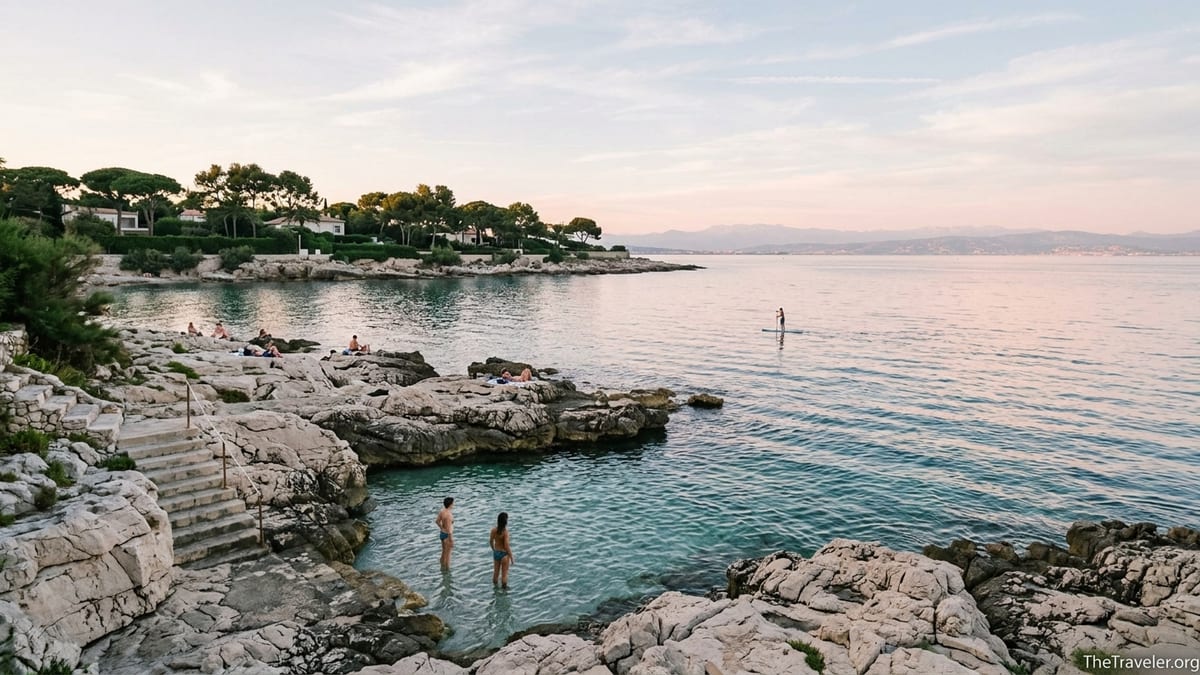
Concrete staircases lead down from the trail to tiny coves and flat rocks carved decades ago as bathing platforms. At one of these, a group of teenagers were practising cliff jumps during my visit, cheering each other on. A few metres further along, an older man floated on his back in a sheltered pool, eyes closed, anchored in place by the calm water of a natural inlet. It is these small, unscripted moments that make the Cap feel more like a shared local secret than a high-security playground.
Practicalities reinforce that sense of quiet. There are warning signs about slippery rocks and the path can be closed in rough weather, but there are no ticket booths or turnstiles. Good walking shoes, a refillable water bottle and a small backpack for your towel and mask are all you really need. For many visitors used to heavily commercialised seafronts elsewhere on the Riviera, the absence of infrastructure here feels almost old-fashioned in the best way.
Hidden Beaches and Everyday Swims
The famous beaches of Cap d’Antibes, like Plage de la Garoupe, still carry an aura of literary glamour. This sheltered cove hosted expatriate Americans in the 1920s and helped define the idea of the Riviera summer. Today there are smart private beach clubs with crisp white parasols and waiter service, but there is also a public section at the eastern end where you can simply lay a towel on the sand. The trick, locals say, is to arrive around 9 am in July or August, when parking along Boulevard de la Garoupe is still available and the sea is at its clearest.
What surprised me more than Garoupe’s history, though, were the smaller, quieter beaches tucked along the western side of the peninsula. Plage des Ondes is a good example: a compact crescent of pale sand with a simple stone jetty and views across to the Îles de Lérins. It has a reputation as one of the calmer spots in the area, with shallow water that stays glassy on days when stronger winds ruffle the open bay. Facilities are basic, usually limited to seasonal lifeguards and a handful of public showers along the road, which keeps the atmosphere low key.
Further north, small spots like Plage du Crouton and Plage de la Gallice sit just off the main coastal road, serving mainly the surrounding neighbourhoods rather than day-trippers. You will see grandparents teaching toddlers to paddle, neighbours greeting each other in the shallows and people popping down from nearby apartment blocks for a quick ten-minute swim between errands. It is everyday life on a backdrop that travel brochures usually cast as once-in-a-lifetime.
Prices reflect this mix. Renting a pair of sun loungers and an umbrella at a private section of Garoupe in high season can easily reach the kind of figure you might expect from the Riviera: a splurge rather than a casual choice. At the public beaches, by contrast, the main expense is whatever you pick up from a bakery or supermarket in Antibes before you walk over. Many visitors pack a baguette, some olives and fruit, and treat the day as an extended seaside picnic rather than a polished beach club experience.
Pines, Villas and the Soft Sound of Residential Life
Cap d’Antibes is famous for its extravagant villas, some of which you glimpse through ornate gates or behind long driveways as you wander its interior lanes. Yet the residential character of the peninsula is part of what keeps things quiet. There are no large shopping streets here, no late-night bar strips or clusters of noisy clubs. Instead you find a small selection of hotels, discreet restaurants and corner shops that close on the early side, leaving most of the peninsula to light and birdsong after dark.
Walking inland from the coast, the roads rise gently toward the Garoupe plateau, where a white lighthouse and chapel stand above the trees. The climb is rewarded with wide views over the Mediterranean on both sides, but even up here the mood is contemplative. People speak in hushed voices as they wander the grounds or sit on low walls looking out toward the Alps and the long curve of the Baie des Anges. It feels far from the bustle of Cannes, which is in fact only a short drive to the southwest.
The pine forests and gardens that blanket much of the Cap add to the sense of retreat. Streets are often lined with stone walls overgrown with bougainvillea and jasmine, and the mixture of sea breeze and resinous pine scent is one of the enduring sensory memories visitors take home. In early summer, you can hear bees working quietly in garden borders, competing only with the rattle of cicadas that begins in late morning and hums until dusk.
That softness carries through to the sound of ordinary life. On an evening walk in June you might pass a group of residents setting a simple table on a terrace, someone tuning a guitar on a balcony, or an elderly couple returning from the small supermarket with a rolling trolley. For all its grand addresses, the Cap is not sealed off from reality; its calmness is built on lived-in streets and year-round households as much as on seasonal visitors.
A Different Rhythm Between Antibes and Juan les Pins
Part of what makes Cap d’Antibes feel so peaceful is the contrast with its neighbours. To the east, Antibes’ old town is animated and compact, full of narrow lanes, a covered market and a harbour where superyachts sit beside modest fishing boats. To the west, Juan les Pins has a long sweep of sand, nightlife and a jazz festival that fills the resort with music each summer. Cap d’Antibes sits quite literally in the middle, less than 10 minutes by car from either side, yet its rhythm is distinctly slower.
Public transport underlines this difference. Local buses loop around the peninsula from Antibes, but not as frequently as the services that run along the main coastal road between Nice and Cannes. This slight inconvenience for partygoers becomes a gift for those seeking quiet. Fewer drop-in visitors means that most people on the Cap have chosen to be there, whether they are staying at a small hotel, renting an apartment for a week or living there year-round.
Day trippers who take the time to walk or cycle from Antibes tend to spread out between coves and viewpoints rather than clustering in one place. Even in busy months, you can usually step off the main road and find a bench overlooking the water where you are alone with your thoughts. Fitness-minded locals use the peninsula as an outdoor gym, jogging early along Boulevard de Bacon or swimming laps parallel to the shore before work, then disappearing back into town while visitors are still lingering over breakfast.
In the shoulder seasons of May, June, September and early October, the contrast grows stronger. Hotel rates on the Cap generally ease compared with peak August, and the beaches thin out, yet sea temperatures remain pleasantly swimmable much of the time. It is during these months that Cap d’Antibes fully reveals its quiet character, turning into a place of long lunches on shaded terraces and unhurried walks along nearly empty paths.
Small Moments That Stay With You
Looking back, the most vivid memories of Cap d’Antibes are not the grand villas or famous names associated with them, but the small, peaceful details that stitched each day together. There was the early morning I watched a paddleboarder cross the glassy surface of Baie des Milliardaires, the board leaving a single silver line on the water that vanished as quickly as it appeared. A fisherman nearby tended two small rods wedged into the rocks, barely moving except to pour himself another cup from a small thermos.
On another afternoon, I followed a side path down from the road and emerged onto a rocky cove where a handful of people had found their own private corners. A woman in her seventies had brought an old wooden deckchair and a radio tuned low to classical music; she sat reading a paperback, pausing every few pages to look up at the horizon. There were no facilities, no loudspeakers announcing safety messages, just salt on the air and the occasional plop as someone slid quietly into the sea.
Even mundane errands took on a different flavour. Picking up supplies at a small grocery on the Cap involved a short wait behind neighbours greeting each other, exchanging quick updates about children and upcoming holidays. The cashier might comment on the weather and recommend a particular local rosé that had just arrived from inland vineyards. These tiny interactions, repeated over a few days, gave the area the feel of a village, despite its international reputation.
Perhaps the most telling moment came on my last evening, sitting on the low wall at Plage de la Salis with a takeaway pizza from a local pizzeria boxed on my lap. Families were still scattered along the sand, children trying to squeeze in one last swim before dark. Behind us, the old town of Antibes glowed in the sunset; in front, the water was almost completely still. It was hard to reconcile this quiet scene with the notion of the Riviera as a place of nonstop spectacle. On Cap d’Antibes, tranquillity is not a luxury extra. It is the default setting whenever you step away from the headlines.
The Takeaway
Cap d’Antibes will continue to appear in news items about record-breaking villa sales and high-profile hotel openings, and for many travellers that may be the first association. Yet spending real time on the peninsula reveals a different story. Between the grand properties and the storied hotels lies a landscape of pine forests, small local beaches and a coastal path where you can walk for an hour with nothing more dramatic than the sound of waves for company.
For visitors looking for high-energy nightlife or dense clusters of shops, the Cap may feel too quiet. But for those who want to balance easy access to Antibes and Juan les Pins with days that unfold at a gentler pace, it is an ideal base. The key is to embrace the simplicity that locals take for granted: early swims before the heat builds, bakery picnics on public beaches, and unhurried evenings watching the light change from one of the peninsula’s many viewpoints.
In a region known for its crowds and constant motion, the most surprising thing about Cap d’Antibes is how easy it is to find stillness. You do not have to book a private yacht or reserve the most exclusive restaurant table to experience it. You simply have to arrive, slow your step and let the peninsula’s quiet rhythm catch up with you.
FAQ
Q1. When is the quietest time of year to visit Cap d’Antibes?
May, June, September and early October are usually the most peaceful months, with fewer visitors than peak summer but still generally pleasant weather and swimmable seas.
Q2. Is Cap d’Antibes suitable for travellers without a car?
Yes, it is manageable without a car if you are comfortable walking and using local buses. You can reach Plage de la Salis and some smaller beaches on foot from Antibes, and buses loop around the peninsula, though services are less frequent in the evening.
Q3. Are there genuinely quiet beaches on Cap d’Antibes in summer?
Completely empty beaches are rare in high season, but smaller spots like Plage des Ondes, Plage du Crouton and some of the coves along the Sentier du Littoral often feel calmer than the main resort beaches, especially early in the morning or at sunset.
Q4. Do I need to pay to access the coastal path around Cap d’Antibes?
No, the Sentier du Littoral coastal path is free to access. You should wear sturdy shoes and check local notices, as sections can close temporarily in rough seas or for maintenance.
Q5. Is Cap d’Antibes family friendly?
Yes, it suits families who prefer quieter surroundings. Many beaches have shallow, relatively calm water, and the overall pace is slower than in nearby nightlife hubs, though entertainment options for teenagers are more limited.
Q6. How expensive is it to stay on Cap d’Antibes compared with Antibes town?
Accommodation on the Cap tends to be pricier on average, particularly at waterfront hotels and villas. Budget conscious travellers often stay in Antibes or Juan les Pins and visit the peninsula by bus, on foot or by bike for the day.
Q7. Are there supermarkets and everyday services on the peninsula?
There are a few small supermarkets, bakeries and convenience stores scattered around Cap d’Antibes, sufficient for basic groceries and picnic supplies. For larger shops and markets, most people head into Antibes.
Q8. Can you swim directly from the rocks on Cap d’Antibes?
Yes, in many places. Along the coastal path there are steps and flat rocks used as informal bathing platforms. You should only enter the water where conditions look safe and always pay attention to any local warnings.
Q9. Is Cap d’Antibes noisy at night?
Generally no. Apart from a few restaurants and hotel bars, nightlife is limited and residential streets quieten early. Those seeking late-night venues usually go to Juan les Pins or Antibes and return by taxi.
Q10. How long should I plan to stay to appreciate the peaceful side of Cap d’Antibes?
A minimum of two or three full days allows time for coastal walks, a mix of beaches and a few slow evenings. A week gives you space to alternate lazy days on the Cap with outings to Antibes, Juan les Pins, Cannes or Nice while still keeping a relaxed base.