


Few museums feel as overwhelming and unforgettable as Florence’s Uffizi Gallery. For a first-time visitor, the mix of Botticelli, Leonardo, Michelangelo and crowds can be equal parts thrilling and confusing. This guide breaks the experience into clear steps, using up-to-date 2026 information so you can book the right ticket, choose the best time of day, and actually enjoy the masterpieces instead of just surviving the lines.
Get the latest updates straight to your inbox!
Understanding the Uffizi in 2026: What First-Time Visitors Should Know
The Uffizi Gallery sits in the heart of Florence, beside the Arno River and a short walk from the Duomo, and it remains one of Italy’s busiest museums. On a typical spring or autumn day, tens of thousands of people pass through its long corridors of Renaissance art. For a first visit, that means you should assume crowds, security checks and timed entry, not a casual walk-in experience.
Inside, the Uffizi is spread over multiple floors of a 16th century palace built by the Medici family. The most famous paintings, including Botticelli’s "The Birth of Venus" and "Primavera," are on the upper levels, reached by a climb of several flights of stairs or an elevator that staff reserve primarily for visitors with mobility needs. Even a focused visit usually takes at least two to three hours, while art lovers can easily spend half a day moving slowly from room to room.
In 2026 the museum continues to tweak its ticketing system, add temporary exhibitions and adjust opening hours for special events such as European Museum Night in May, when late openings and symbolic 1 euro evening tickets may appear for specific areas. Because of these changes it is essential to check official information again shortly before you travel, especially if your visit falls on Italian public holidays or during major events.
For most travelers, the Uffizi will be a highlight of a Florence itinerary that also includes the Accademia (for Michelangelo’s "David"), the Duomo complex, and perhaps the Pitti Palace and Boboli Gardens across the river. Knowing how the Uffizi fits into your overall schedule helps you decide whether a simple single entry, a combined multi-day ticket, or a guided tour offers the best value and least stress.
Tickets, Prices and Reservations: How to Get In Smoothly
In 2026, the standard adult single ticket for the Uffizi costs about 25 euros at the ticket office, with an online ticket priced around 29 euros because of a mandatory reservation fee. That online ticket is essentially a timed reservation for a specific entry window, and for most first-time visitors it is the simplest way to avoid standing in the longest lines outside. EU visitors between 18 and 25 can often access reduced tickets for a few euros, and children and teens under 18 typically enter free, though you will still need to reserve their slots.
The museum also offers more complex options. A popular one is a five-day "Passepartout" style pass that covers the Uffizi, Pitti Palace and Boboli Gardens. In 2026, the basic version of this pass is roughly 40 euros, with a higher tier that includes access to the Vasari Corridor priced noticeably above that. For travelers spending several days in Florence and planning to visit more than one state museum, this kind of pass can be significantly cheaper than buying everything separately.
Booking directly through the official Uffizi ticket portal remains the safest choice. Many first-time visitors accidentally use reseller sites that charge higher prices for the same timed ticket. A typical sign you are on a reseller site is a base Uffizi entry priced well above 29 euros before any extras, or heavily packaged "priority" tickets that simply mirror standard skip-the-line reservations. If you prefer an organized experience, consider a reputable guided tour that clearly states it includes the official ticket; for instance, several well-known tour operators in Florence offer three-hour Uffizi group tours that pair the ticket with an art historian guide for around 60 to 80 euros per person, depending on the season and group size.
Be aware that same-day tickets sometimes remain available at the official ticket office, especially early in the morning outside peak months, but relying on this approach in June, September or holiday weekends is a gamble. Online timed tickets for popular slots such as 10:00 or 11:00 often sell out weeks in advance, particularly on Fridays and Saturdays. When planning, treat your Uffizi time slot like a fixed anchor in your Florence schedule and build other activities around it.
Opening Hours, Best Times to Visit and How Long to Stay
The Uffizi generally opens in the morning around 8:15 and closes in the early evening, with last entry well before closing time. Mondays are usually the weekly closure day, so if Florence is part of a weekend trip from Friday to Monday, you will likely need to schedule the Uffizi on Saturday or Sunday. Around major Italian holidays, such as April 25 or May 1, special opening hours are often announced just a few weeks ahead, so re-check close to your travel dates.
For a first-time visit, the two most comfortable time slots are the first entry of the day and the later afternoon. If you book the opening window, you can arrive 30 minutes early, clear security and walk fairly quickly to the Botticelli rooms before the bulk of group tours arrive. Many travelers describe stepping into the "Birth of Venus" room around 8:45, sharing it with only a small cluster of visitors instead of shoulder-to-shoulder crowds. Late afternoon, after 4:00, can also be calmer, especially outside peak summer, and it comes with warm light pouring through the corridor windows toward the Arno.
Plan at least two to three hours inside. A compact visit that focuses on highlights and moves at a steady pace might run about two hours, while a slower self-guided experience, with time for breaks at the cafe and souvenir photos in the loggia overlooking Piazza della Signoria, can stretch to three or four hours. Visitors with mobility concerns should budget extra time for elevator waits, rests on benches, and slower progress through the stairwells.
During special evenings such as European Museum Night in late May, the Uffizi sometimes extends its opening hours with symbolic 1 euro tickets for partial access, such as only the second floor. These events can be a memorable way to experience the museum in a different atmosphere, but they do not replace a full daytime visit, as large sections of the galleries may remain closed. If your trip coincides with such an event, consider an evening visit as a bonus rather than your only time in the museum.
What to See: Essential Masterpieces for First-Time Visitors
For a first visit, it helps to treat the Uffizi like a carefully chosen playlist rather than trying to see every work. One of the most important stops is the room dedicated to Sandro Botticelli, where "The Birth of Venus" and "Primavera" hang just a few meters apart. These are among the most photographed paintings in the museum, and at busy times you may need to wait your turn to stand directly in front of them. Spend at least ten minutes here; details such as Venus’s shell or the flowers scattered across the meadow reward slow looking.
A bit further along you will find works by Leonardo da Vinci, including the "Annunciation" and "Adoration of the Magi," which show his early development and meticulous attention to landscape. Nearby rooms often display paintings by Michelangelo, like the "Doni Tondo," and Raphael. For many visitors, seeing the evolution of style from the more rigid early Renaissance panels to the confident humanism of the High Renaissance is one of the museum’s quiet highlights.
Another cluster of must-see works features the great Florentine and Venetian masters: Cimabue and Giotto’s altarpieces, Fra Angelico’s luminous panels, and Titian’s rich, dramatic canvases. The Uffizi holdings offer an almost textbook-like walk through the Italian Renaissance, making it an excellent companion to any previous reading or audio guide you might use. If you enter with a short list of artists or paintings you care about, note their approximate room numbers before you go; this prevents you from wandering aimlessly and then realizing you missed something important as you exit through the gift shop.
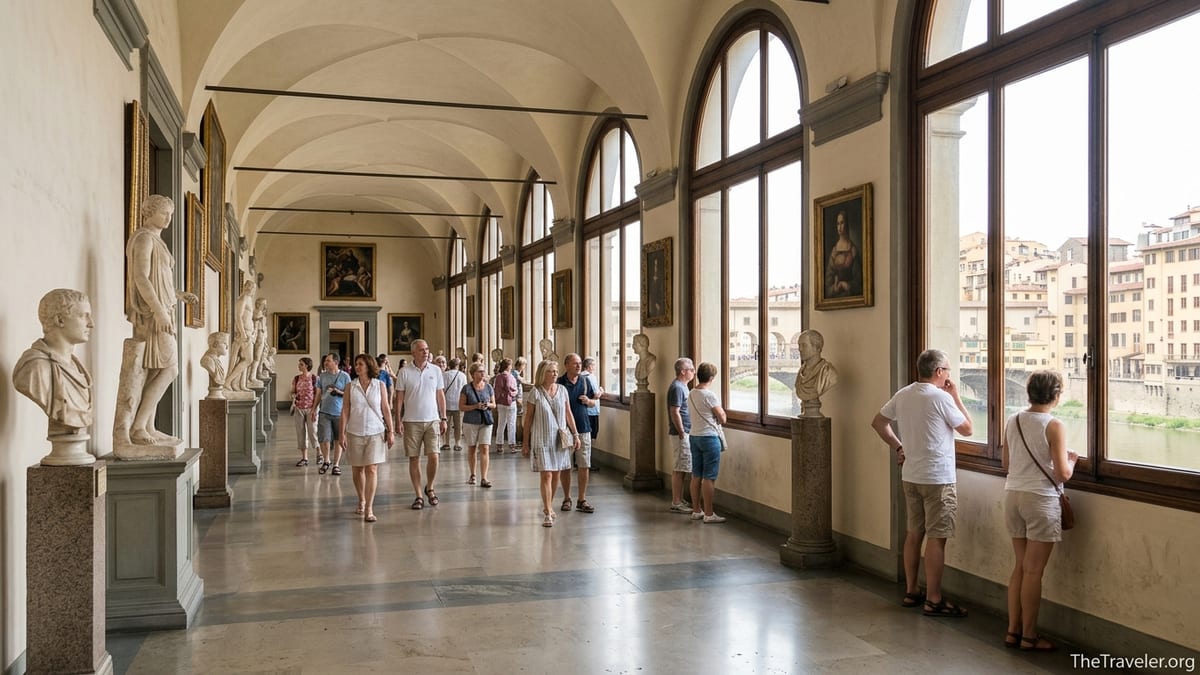
Do not overlook the building itself. The long top-floor corridor lined with busts and statues offers framed views of Florence through its arched windows. One window looks directly out at the Ponte Vecchio and the Arno, while another frames the Palazzo Vecchio tower. First-time visitors are often surprised by how much these views, combined with the sculptures and coffered ceilings, contribute to the experience. It can be worth pausing here for several minutes just to look out over the city.
Suggested Routes, Audio Guides and Guided Tours
The Uffizi’s layout can be confusing for newcomers, especially during busy hours when some doors are closed or when special exhibitions alter the usual flow. A practical strategy is to follow a simple route: from the entrance on the ground floor, climb to the top level first, walk the main corridor and side rooms in a U-shape, then descend to see selected areas on the lower floor as time and energy allow. Many guided tours follow this general pattern because it front-loads the major masterpieces and Botticelli rooms, then offers flexibility later.
If you prefer to explore independently, consider renting the museum’s official audio guide or downloading a reputable audio app before your visit. On-site audio guides typically cost a modest fee per device, often around 6 to 8 euros, and require leaving an ID document as a deposit. Third-party smartphone apps may bundle an offline map of the museum and short commentaries on key works for a similar price, although you should download content over Wi-Fi before arriving, since mobile data coverage inside thick stone walls is often unreliable.
First-time visitors who feel overwhelmed by Renaissance art might benefit from a small-group tour with an art historian guide. In Florence, many such tours limit groups to about 10 to 15 people and run for roughly two to three hours. A typical itinerary might start with the origins of the Medici family in the early rooms, build up to Botticelli and Leonardo, and then finish in front of the loggia windows with a short explanation of how the Uffizi collection survived wars and floods. While a tour costs more than an entry ticket alone, it can dramatically increase your understanding of what you are seeing.
Whatever route you choose, be realistic about your energy levels. The stone floors and long corridors can be tiring, especially in summer heat. Many first-time visitors report that their attention dips after about two hours, no matter how enthusiastic they are at the start. It is perfectly acceptable to prioritize a shorter, high-quality experience focused on a few rooms rather than forcing yourself to see everything.
Practical Tips: Security, Dress, Bags and Photography
The Uffizi operates airport-style security at the entrance. All bags go through an X-ray scanner, and visitors pass through metal detectors. Items considered dangerous, such as large knives or tools, are not allowed inside. You cannot bring large umbrellas into the galleries, and bulky backpacks are usually required to be left in the free cloakroom located near the entrance. A typical daypack or small shoulder bag is generally acceptable, but if you arrive with something the size of a hiking backpack, expect to check it.
Official rules ban food and open drinks in the galleries. You can usually carry a closed water bottle and sip it discreetly in permitted areas, but full picnics or snacks must stay in your bag until you reach the cafe or exit. Chewing gum is formally prohibited in many Italian museums, although enforcement varies; assuming it is not allowed is the safest choice. The cloakroom is free, but you will be given a ticket that you must keep to retrieve your belongings, so store it somewhere you will not lose while moving between rooms.
There is no formal "dress code" in the strict sense that some churches or religious sites apply, but smart casual, respectful clothing is recommended. Practically, this means comfortable shoes for several hours of walking, and clothing that covers at least shoulders and midriff. In summer, lightweight trousers, skirts or knee-length shorts with a breathable top work well. Some visitors arrive in elaborate fashion outfits and are admitted without problems, but overly revealing or costume-like attire may attract unwanted attention from staff and other visitors.
Photography is allowed throughout most of the Uffizi, but flash, tripods and selfie sticks are prohibited. Phone cameras and small mirrorless or DSLR cameras are common, and staff mainly intervene if you use bright lights, block pathways, or create hazards. The most crowded rooms, such as those with Botticelli’s works, can become congested with people taking photos; after taking your images, it is courteous to step back quickly so others can move forward. For serious photographers, keep in mind that low light and crowds make fast prime lenses and steady hands more valuable than bulky gear that may end up spending the visit in the cloakroom.
Accessibility, Facilities and Visiting With Children
The Uffizi provides several services for visitors who need support. Elevators connect the main floors, and staff can assist wheelchair users and people with limited mobility with alternative routes that avoid long staircases. The museum can often lend wheelchairs, though these are subject to availability on the day, so if accessibility is crucial, mention your needs at the time of booking and again on arrival. Some corridors may still feel narrow and crowded at peak times, so traveling with a companion who can help navigate is advisable.
Toilets are available on multiple levels, usually near stairways and the cafe. Queues can form for the women’s restrooms during very busy periods, so it is wise not to wait until the last moment. The cafe, typically located on an upper floor near a terrace, offers drinks and light snacks at prices that reflect the museum setting: expect to pay noticeably more for a cappuccino than at a bar in a side street. However, the cafe’s terrace often provides attractive views over Florence’s rooftops and the Palazzo Vecchio, which many first-time visitors consider worth the premium for a short break.
Families with children are welcome, and strollers are generally allowed, although very large or heavy models may need to be parked in the cloakroom. Young children can tire quickly, so consider focusing on a few visually engaging rooms, such as those with bright colors or mythological scenes, and then taking a break outside in the nearby Piazza della Signoria, where they can move more freely. Some parents bring simple sketch pads to keep kids engaged by drawing details from paintings or statues.
If you are visiting with a mixed-age group or anyone who may become restless, agree on a meeting point in advance, such as the cafe or a recognizable statue in the main corridor. Mobile phone reception is inconsistent inside the thick walls, and Wi-Fi coverage does not reach every corner, so relying solely on messaging apps to find each other is not ideal. Having a clear rendezvous plan reduces stress if someone moves more quickly or slowly than expected through the galleries.
The Takeaway
A successful first visit to the Uffizi Gallery starts long before you step into its 16th century corridors. Booking the right ticket on the official platform, choosing a time slot that avoids the worst crowds, and deciding whether you want the structure of a guided tour or the freedom of your own audio guide will shape your entire experience. Treat your visit as a curated encounter with a few dozen masterpieces rather than a rush to see everything, and you will leave with clearer memories and less fatigue.
Once inside, simple habits make a big difference: travel light, use the free cloakroom for bulky bags, wear comfortable shoes, keep water handy, and take short breaks to reset your attention. Give yourself permission to linger in front of Botticelli, Leonardo and Michelangelo, and to spend a few extra minutes just looking out the windows at the Arno and Florence’s rooftops. The combination of world-famous paintings, Medici history and real city views is what makes the Uffizi unique.
By approaching your visit with realistic expectations, a bit of planning and a flexible mindset, the Uffizi transforms from an intimidating must-see into a deeply rewarding highlight of your time in Florence. Whether you stay for two hours or four, your first glimpse of "The Birth of Venus" in its home gallery is likely to become one of the enduring images you carry home from Italy.
FAQ
Q1. Do I really need to book Uffizi tickets in advance?
Booking in advance is strongly recommended, especially from April to October and on weekends. Same-day tickets sometimes exist but popular morning slots often sell out weeks ahead.
Q2. How much does a standard Uffizi ticket cost in 2026?
The standard adult ticket costs about 25 euros at the ticket office and around 29 euros online due to a reservation fee, with reductions for EU visitors aged 18 to 25 and free entry for under-18s.
Q3. How long should I plan for a first visit?
Most first-time visitors should plan two to three hours inside the galleries. Art lovers who want to read labels carefully or use an audio guide may prefer three to four hours.
Q4. What is the best time of day to visit?
The first entry of the morning and late afternoon are usually the most pleasant. Mid-morning and the early afternoon tend to be the most crowded, especially in peak season.
Q5. Is there a dress code at the Uffizi Gallery?
There is no strict formal dress code, but smart casual, respectful clothing is expected. Comfortable shoes and outfits that cover shoulders and midriff are the most practical choices.
Q6. Can I bring a backpack or camera inside?
Small bags and standard cameras are allowed after security checks, but large backpacks, bulky gear, umbrellas, tripods and selfie sticks usually must be left in the free cloakroom near the entrance.
Q7. Are photos allowed in front of famous paintings like “The Birth of Venus”?
Yes, non-flash photography is generally allowed, including in the Botticelli rooms. Flash, tripods, lights and anything that blocks pathways or disturbs other visitors are prohibited.
Q8. Is the Uffizi suitable for children?
Yes, but it helps to plan a shorter, more focused route and build in breaks. Strollers are typically allowed, and many families limit their time inside to around two hours to avoid fatigue.
Q9. What if I have mobility issues or use a wheelchair?
The Uffizi has elevators and staff who can assist with alternative routes. Wheelchairs may be available to borrow, but it is best to mention your needs when you arrive and allow extra time to move between floors.
Q10. Is it worth buying a combined ticket with Pitti Palace and Boboli Gardens?
If you plan to spend several days in Florence and visit more than one state museum, a multi-day combined ticket can offer good value compared to separate entries, especially in peak season.