


Begin your Monfragüe birdwatching trip at Salto del Gitano. This roadside viewpoint is the most accessible place to watch griffon vultures gliding past the cliffs above the River Tagus, and it sets the tone for a park designed around viewpoints, short walks and big skies. From here you can build anything from a relaxed one day visit to a focused photography trip or a two day itinerary linking several of Spain’s most famous raptor lookouts.
Get the latest updates straight to your inbox!
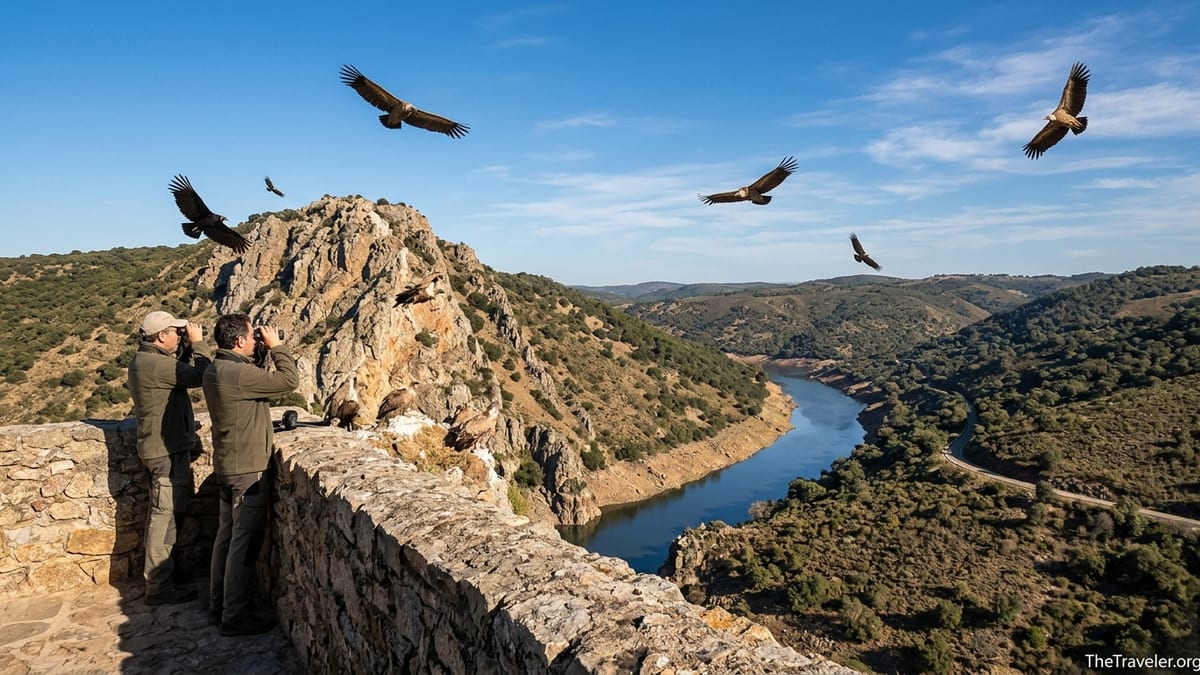
Key vulture viewpoints and how to reach them
Salto del Gitano, sometimes marked as Peña Falcón, is the classic Monfragüe balcony over the Tagus gorge. The EX 208 main road runs directly past the viewpoint and there is a tarmac parking area on the Castle side of the road, so you step out of your car or bus and walk only a few metres to the stone parapet. From here you are almost eye level with breeding cliffs used by griffon vultures, and on a typical spring day dozens of birds circle overhead or roost on the rock ledges. Black vultures can be picked out by their broader wings and darker appearance, and Spanish imperial eagles are occasionally seen hunting along the ridge.
Portilla del Tiétar lies at the far eastern end of the main park road, where the EX 208 approaches the Tiétar reservoir. Here too a small parking area leads directly to a low stone wall and interpretive panel, so there is no significant walking. This is a key spot for Spanish imperial eagle, Egyptian vulture and especially black stork, which nests in crevices on the opposite cliff in spring. The view is narrower than Salto del Gitano, but patient scanning often rewards you with close views of raptors crossing the gorge or perching in the oaks by the water.
La Tajadilla is a quieter lay by viewpoint along the EX 208 south of Villarreal de San Carlos. A picnic area and parking sit virtually beside the river, again with no need for a formal hike. It gives a more open, river and dehesa panorama, good for watching soaring griffon and black vultures as they commute along the valley and for scanning for deer in the surrounding hills. Puerto de la Serrana, reached on the road between Torrejón el Rubio and the EX 208, is another roadside mirador where you park almost directly at the viewpoint. Rather than a gorge, you look over rolling dehesa and Mediterranean scrub, often productive for short toed snake eagle and kites in spring and summer.
Monfragüe Castle is the one major viewpoint that does require a climb. You can park either at the lower car park just off the EX 208 or continue up the narrow access road to a higher parking area when allowed. From the lower area the walk to the castle and hermitage is roughly 1.5 kilometres each way, with a sustained but not extreme ascent on a paved path and steps. From the upper parking spot the climb is shorter but still steep enough to feel like a small hike rather than a viewpoint at the roadside. The reward is a 360 degree panorama over the Tagus and Tiétar valleys, a favourite place to watch vultures cruising past at eye level or slightly below.
Official routes from Villarreal de San Carlos
Villarreal de San Carlos, a tiny settlement on the EX 208, is the main gateway for visitors and the starting point for several signed walking routes. Official information from Spain’s National Parks system lists four colour coded routes beginning here, including the Red Route, Purple Route, Blue Route and Brown Route, each with defined distances, approximate walking times and waymarking. The village also holds the main visitor centre, information panels and, at certain times of year, exhibition spaces and small eateries.
The Red Route links Villarreal de San Carlos with Monfragüe Castle and back. Current official data describe it as approximately 11.9 to 12.1 kilometres in total, with a walking time of about three and a half to six hours depending on pace and stops, and a moderate difficulty rating. The route combines stretches along the roadside verge, a path up through cork oak woodland, and the final stepped climb to the castle. Elevation gain is in the order of a few hundred metres, concentrated on the approach to the castle. Waymarking uses red paint flashes and posts, and the walk can easily be integrated with long observation stops at Salto del Gitano and the castle viewpoints.
Shorter alternatives leave from the same village. The Yellow Route between Mirador del Serrano and La Tajadilla, for example, is listed at approximately 8.8 kilometres return with an estimated time near two and a half to three hours. It is usually rated easy to moderate, with gentler gradients that make it a good family option for older children. Because both ends of this route coincide with accessible roadside viewpoints, many visitors drive to one or both miradores and only walk the section that best suits their group.
Other routes from Villarreal de San Carlos, such as the Green Route around Arroyo Malvecino and Cerro Gimio and the Purple Route towards Torrejón el Rubio, provide quieter dehesa and woodland environments with fewer cars and more chances of spotting songbirds, deer and, in spring, orchids. Distances range roughly from 8 to 11 kilometres with waymarked paths and estimated times between two and three and a half hours. None of these walks include technical terrain, but summer heat and exposure can make even modest gradients feel demanding, so water and sun protection are essential.
Visitor centre, access and why the train station is not enough
The main reception and information centre for Monfragüe National Park stands in Villarreal de San Carlos. According to the latest official schedule, it opens every day of the year except 24, 25 and 31 December and 1 January. Winter hours are approximately 09:30 to 18:00, and summer hours extend to around 19:00. Staff provide up to date details on trail conditions, any temporary restrictions in breeding areas, and maps of the viewpoints and routes. For groups, the park authority recommends contacting the centre in advance to coordinate visits.
Arriving by private vehicle remains the simplest option. From Cáceres you can drive north on the A 66 and then east on the EX A1 before exiting for the EX 208 towards Villarreal de San Carlos. From Trujillo a direct route along the EX 208 leads north towards the park. From Plasencia you again connect to the EX 208 either via the EX A1 or local roads. The EX 208 forms the spine of most birding itineraries, linking Villarreal de San Carlos with Salto del Gitano, La Tajadilla, Monfragüe Castle access and Portilla del Tiétar, with signed parking lay bys at the main miradores.
There is limited bus service between Plasencia, Torrejón el Rubio, Villarreal de San Carlos and Trujillo on weekdays, usually one or two services per day. Schedules can change and buses do not run late into the evening, so day trippers who rely solely on public transport must plan carefully around departure and return times. Within the park there is no regular internal shuttle outside special events, so most visitors who arrive by bus end up walking stretches of the EX 208 or joining a pre arranged guided excursion from Torrejón el Rubio.
The Monfragüe railway station, despite its name, is not at the park’s viewpoints. It lies at Malpartida de Plasencia, roughly 16 kilometres by road from the EX 208 access towards Villarreal de San Carlos. There is no dedicated rail to park shuttle, and onward travel involves arranging a taxi, hiring a car in Plasencia or using infrequent regional buses. For independent birdwatchers without a rental car, travelling directly to Plasencia by rail or coach and then using buses or guided tours into the park is more practical than relying on Monfragüe station as a gateway.
Seasonal wildlife: what to expect without guarantees
Monfragüe is productive year round, but bird activity and species mix change markedly with the seasons. Winter, from roughly December to February, brings low sun and cool, often crisp days. Griffon and black vultures are resident, using thermals whenever sunlight allows, and on colder mornings they can be seen sunning on cliff ledges near Salto del Gitano and Portilla del Tiétar. Winter can also bring large numbers of cranes feeding in dehesa fields outside the core viewpoints, and raptors such as red kite and common buzzard are conspicuous along the access roads.
Spring, especially March to May, is the peak season for many visiting birdwatchers. Griffon vultures are already breeding on the cliffs around Salto del Gitano and the castle, black vultures commute from nesting areas in the surrounding dehesa, and Egyptian vultures return to the Tagus and Tiétar gorges. Black storks occupy a handful of secluded nest sites in rocky crevices, most readily scanned from Portilla del Tiétar under guidance from local birders or park staff. This is also when Spanish imperial eagles display and call near traditional territories on the fringes of the park, though sightings from standard viewpoints depend heavily on luck and patient scanning.
Summer, from June through August, sees high temperatures that can rise above 35 degrees Celsius in the middle of the day. Early mornings and late afternoons are therefore the most comfortable and productive times for observation. Griffon and black vultures take advantage of powerful thermals to soar extremely high, so photography often benefits from the castle or Salto del Gitano where birds pass closer. Short toed snake eagles and booted eagles are relatively regular over dehesa viewpoints such as Puerto de la Serrana. Midday heat reduces visible activity and walking longer routes becomes challenging, so many visitors focus on shaded picnic areas and short strolls between parking and viewpoints.
Autumn offers a quieter but rewarding mix. September and October retain some summer warmth but with softer light and more moderate temperatures. Passage migrants such as honey buzzards and some storks can appear overhead, and deer rutting in the hills around La Tajadilla and towards the castle adds atmospheric sound at dawn and dusk. By November many summer species have departed, but resident vultures, eagles and forest birds remain, and the park feels much less crowded outside major events.
Conecta con Monfragüe and guided tour options
The park authority runs a programme of free activities known as Conecta con Monfragüe. Official information indicates that activities are scheduled in selected months, typically outside the very hottest period, and can include short guided walks from Villarreal de San Carlos, interpretation outings focused on geology or vegetation, and basic birdwatching introductions at viewpoints such as Salto del Gitano or the castle access path. Places are limited and advance online registration is required, usually opening on the last Friday of the preceding month and closing at midday on the Friday before each activity.
These free outings are designed for a broad public rather than specialist birders. Groups are often mixed, with families, casual nature travellers and some birdwatchers. The pace tends to be gentle and the routes relatively short, for example two or three hour circuits that include frequent stops to explain the landscape and wildlife. The main advantage is that park staff or contracted guides point out species such as vultures, black storks or raptors using telescopes and help visitors of all ages interpret what they are seeing without any additional cost beyond travel.
Alongside the official programme, several private companies based in Torrejón el Rubio, Plasencia and elsewhere offer paid birdwatching tours. These range from half day shared excursions in minibuses to full day private guiding with hotel pickup. Recent examples advertised in the region quote prices in the approximate range of 40 to 70 euros per person for small group outings, and 150 to 250 euros for fully private day tours for one or two people, with discounts for additional participants. Tours often include telescopes, field guides and flexible timing, for instance starting at dawn at Portilla del Tiétar or finishing at sunset at Salto del Gitano for photography.
The principal advantage of a professional bird guide is their familiarity with current territories and behaviour. A good local guide will know which side of the road at Salto del Gitano is producing the closest flybys for griffon vulture shots, where Spanish imperial eagles are most likely to be seen hunting, or the exact rock ledge where a black stork pair has been nesting from year to year, while always respecting legal distances and closures. For visitors with limited time or without their own vehicle, booking at least one guided day can make the difference between a pleasant scenic visit and a genuinely productive birdwatching experience.
Independent travel, budgets and practical equipment
Independent visitors with a rental car can plan a full day in Monfragüe on a modest budget. Fuel costs depend on starting point, but once in the park there are no entrance fees and roadside parking at viewpoints like Salto del Gitano, La Tajadilla, Portilla del Tiétar and Puerto de la Serrana is currently free. A simple picnic purchased in Cáceres, Plasencia or Trujillo keeps costs low. For coffee or basic meals, small establishments in Villarreal de San Carlos and Torrejón el Rubio open most days in spring and at weekends in other seasons, though opening hours vary, so carrying water and snacks is wise.
Guided excursions naturally add to the budget. A realistic plan for a couple might involve one day of independent exploration using their own car and one day dedicated to a private or small group tour. With indicative local prices, that could mean spending perhaps 80 to 140 euros on two nights of mid range accommodation in Torrejón el Rubio or Plasencia, around 40 to 70 euros per person for a shared guided excursion, plus meals and fuel. Travellers on tighter budgets can base themselves in larger towns such as Cáceres or Plasencia where accommodation options include simple pensiones and self catering apartments, then dedicate one full day to Monfragüe with an early start.
In terms of optics, a pair of 8x32 or 8x42 binoculars offers a good balance between field of view and brightness for most visitors. Brands widely available in Spain, such as Nikon, Olympus or mid range models from Vortex or Bushnell, are perfectly adequate for general birdwatching at the main viewpoints. For photography, a lens reach of at least 300 millimetres on APS C or full frame cameras helps capture vultures in flight from Salto del Gitano or the castle. Many guided tours bring telescopes, so if you are joining one it is not essential to carry your own scope unless you are an experienced birder aiming for prolonged seawatching style sessions.
Heat and sun are major considerations from late spring to early autumn. Even short walks from roadside parking to the castle can feel demanding under direct sun, so a broad brimmed hat, high factor sunscreen, at least one and a half litres of water per person and light coloured clothing are more than comfort items; they are safety essentials. Outside peak summer, sudden showers and cool winds at exposed viewpoints also justify carrying a light waterproof and an extra layer, especially if you plan to remain still behind a camera and tripod for long periods.
Conservation rules, nesting protection and accessible alternatives
Monfragüe is a highly protected area, and visitors are expected to follow strict regulations to protect nesting birds and sensitive habitats. Off trail walking in cliff and gorge areas is prohibited, and seasonal closures or restricted access zones can be imposed around breeding colonies of vultures, eagles and black storks. Drones are not permitted, and approaching nests or using playback calls to attract birds is forbidden. Noise should be kept to a minimum at viewpoints, particularly in spring when adults are incubating or feeding chicks.
Dogs, where allowed outside specific events, must be kept on a lead to avoid disturbance to wildlife and grazing livestock. Picnics are welcome in designated areas such as La Tajadilla, but fires and camping are not allowed in the park. Litter must always be carried out, including organic leftovers that might attract opportunistic species or degrade the visitor experience. At busy times, particularly during festivals or bank holiday weekends, park staff and Civil Guard agents monitor parking and visitor behaviour at Salto del Gitano and the castle access road, and instructions should be followed at all times.
For visitors with reduced mobility or those sensitive to heat, roadside viewpoints offer an accessible way to experience Monfragüe’s birdlife without long hikes. Salto del Gitano, La Tajadilla, Portilla del Tiétar and Puerto de la Serrana all have tarmac or compacted surfaces from parking to parapet, and it is possible to watch vultures and storks from near the vehicle. The Villarreal de San Carlos visitor centre itself is designed as an accessible building where exhibits explain the park’s geology, flora and fauna in multiple languages, providing context for anyone unable to reach the castle or walk the longer routes.
Families with young children or older travellers can combine very short walks with frequent viewpoint stops. For example, a morning might involve a brief exploratory stroll along a shaded section of the Red Route from Villarreal de San Carlos followed by an hour at Salto del Gitano, then a picnic at La Tajadilla and an afternoon drive to Portilla del Tiétar. This approach keeps total walking under four or five kilometres spread throughout the day, while still offering realistic chances to see griffon and black vultures, Egyptian vultures and, with patience, perhaps a distant Spanish imperial eagle.
Suggested one day and two day itineraries
A focused one day birdwatching itinerary for an independent visitor with a car could start at sunrise at Portilla del Tiétar, where early light often hits the cliffs and black storks or raptors may be active before temperatures rise. After mid morning scanning, you could drive back along the EX 208 to stop at La Tajadilla for a late breakfast or picnic and to watch griffon and black vultures soaring along the river. Midday, when heat and glare are strongest, is a good time to visit the Villarreal de San Carlos visitor centre, refill water and rest in the shade. By late afternoon you can drive to Salto del Gitano to spend the final two or three hours watching vultures and photographing them in golden light from the roadside parapet.
For those wanting a richer experience, an optional two day plan allows more walking and a guided element. On day one, follow the one day itinerary but add the ascent to Monfragüe Castle either mid morning or late afternoon, accepting the climb in exchange for panoramic views and close vulture flybys. On day two, book a morning half day guided tour that starts at dawn and focuses on less obvious sites on the edges of the park, perhaps targeting Spanish imperial eagle territories or dehesa specialities. After the tour you can revisit your favourite viewpoints independently, or explore a quieter official route such as the Green Route around Arroyo Malvecino if temperatures and fitness allow.
Beginners will benefit from starting with accessible viewpoints and, ideally, joining at least one Conecta con Monfragüe activity or commercial guided outing to learn basic raptor identification and picking up birds in flight through binoculars. Photographers should plan for the best light by aiming to be at Salto del Gitano or the castle early and late in the day, using the middle hours for rest or for scouting compositions at La Tajadilla and Puerto de la Serrana. Experienced birdwatchers, especially those with their own vehicles and optics, might dedicate more time to scanning distant ridges for eagles, exploring longer park routes and making repeat visits in different seasons to build a fuller picture of Monfragüe’s raptor and stork populations.
Whether you have just one day or several, anchoring your visit around Salto del Gitano as the most convenient griffon vulture viewpoint, then linking Portilla del Tiétar, La Tajadilla, La Serrana and the castle, gives you a structured framework. From there you can add guided experiences, longer walks or simply more time on your favourite parapet, watching the sky above Extremadura fill with some of Europe’s most impressive birds.