


More news on this day
Black smoke and flames were reported near Riyadh’s King Khalid International Airport on September 19, 2026, disrupting traffic at one of Saudi Arabia’s busiest hubs as flight trackers showed widespread delays and some cancellations.
Get the latest news straight to your inbox!
What travelers saw and when disruption began
Published coverage from multiple outlets described a dark plume rising from the airport area on Saturday, September 19, after overnight public alerts in the Riyadh region warned residents to take precautions. Images and videos shared publicly showed thick smoke and visible flames from a site near the airport complex.
Several reports tied the smoke to a fire in the vicinity of airport fuel infrastructure. Some coverage described firefighters working to contain a blaze involving a fuel tank marked with the branding of Saudi oil company Aramco at a depot near the airport, while other reporting noted that the exact cause had not been publicly established in the immediate aftermath.
The smoke and fire reports circulated during a period of heightened regional security attention, with published reporting linking the timing to warnings issued earlier that day for Riyadh and the nearby area of Al-Kharj. Separately, international coverage also referenced attempted attacks aimed at the capital, adding to uncertainty among passengers trying to assess what the incident meant for airport operations.
Flight cancellations and delays at King Khalid International Airport
Flight-tracking data showed significant disruption at King Khalid International Airport (RUH) as the situation unfolded. Flightradar24, which compiles delay and cancellation patterns across airports worldwide, indicated “major problems” during the peak of the disruption, a label it uses when long delays and multiple cancellations are occurring.
Travelers reported rapidly shifting departure times, gate changes, and rolling delays as aircraft rotations and crew schedules were impacted. Even when flights were not canceled, irregular operations at a hub can create knock-on effects across the day’s schedule, particularly for aircraft and crews arriving late and then operating onward sectors.
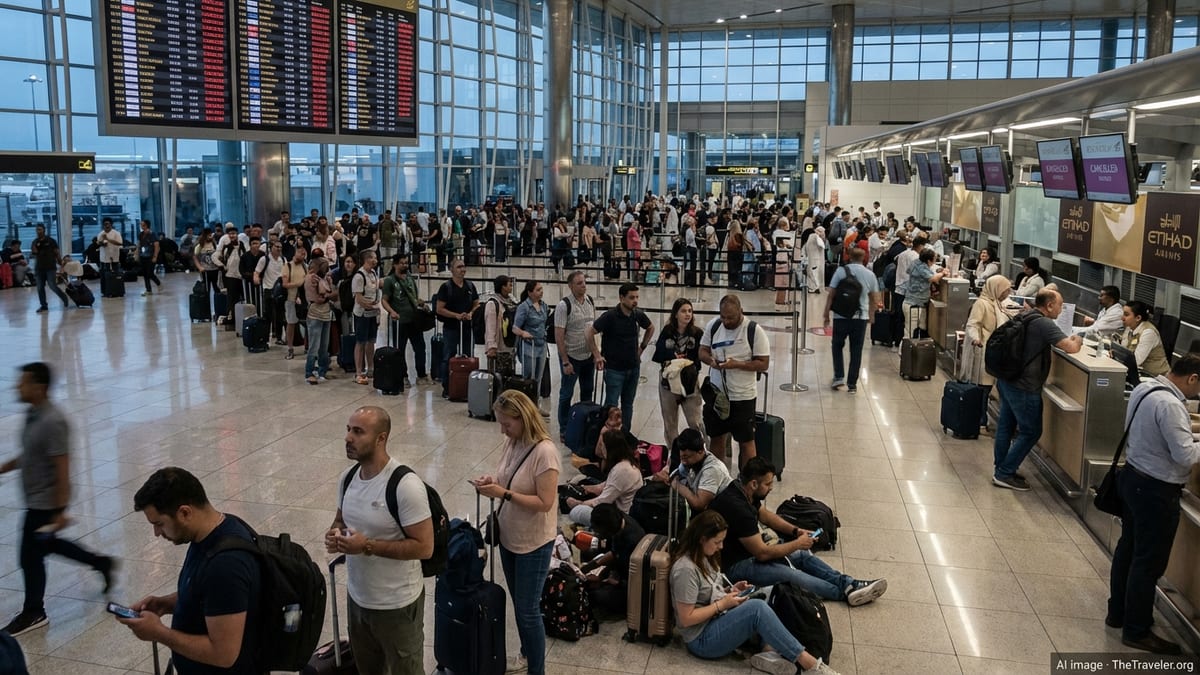
Later in the day, disruption indicators appeared to fluctuate as operations adjusted, but published coverage suggested the overall traffic picture remained strained. For passengers, that can translate into crowded check-in areas and longer waits as airlines and airport teams work through backlogs.
Why Riyadh disruptions ripple across the region
King Khalid International Airport is a key node for domestic travel within Saudi Arabia and for international connections across the Gulf, South Asia, North Africa, and Europe. When the airport’s arrival and departure banks are interrupted, missed connections can quickly increase, especially for travelers on tight itineraries.
Disruption at RUH can also spill over to other airports through aircraft positioning and scheduling constraints. A single delayed inbound flight can delay an outbound flight hours later, and a cluster of late arrivals can lead airlines to consolidate passengers onto later departures or reroute aircraft to maintain network integrity.
For travelers transiting Riyadh, the biggest immediate risk is a misconnect when a first flight is delayed and the onward flight departs on time or closes boarding earlier than expected. Those holding separate tickets face added exposure because protection and rebooking options can differ significantly compared with a single through-ticket itinerary.
What passengers should do if they are flying to or through RUH
Passengers with travel plans involving Riyadh are likely to see the fastest status changes inside airline apps and booking portals, which typically reflect the controlling operational decisions for each specific flight. Flight trackers can help provide a broad picture of congestion, but they do not replace the airline’s own live status for check-in, boarding, and reaccommodation.
Travelers should also monitor messages from their carrier regarding same-day changes, rebooking options, and any advisories on airport arrival times. During irregular operations, schedules can change repeatedly, and a flight that shows as delayed may still have an earlier revised departure time later if aircraft and crew availability improves.
For those already at the airport, practical priorities include confirming the latest gate assignment, verifying baggage acceptance cutoffs, and keeping receipts for essential expenses if an airline instructs passengers to arrange their own meals or accommodation during a long delay. Published coverage did not consistently detail passenger care measures across carriers, so travelers may need to rely on their airline’s written policies and on-the-ground instructions.
What is known and what remains unclear
As of Sunday, September 20, 2026, widely circulated reporting had not converged on a single, fully detailed public explanation for the smoke and flames near the airport, and descriptions varied by outlet. Some reports described a fuel-tank fire at a depot near the airport and firefighting activity to bring the blaze under control.
Other reporting emphasized the broader context of regional security alerts and attempted attacks aimed at Riyadh around the same time, which contributed to traveler concern and uncertainty about the cause. In the absence of a unified public account across major outlets, travelers are left with a clear operational takeaway: a significant but evolving disruption event affected flights at RUH on September 19, and ripple effects can continue into subsequent schedules.
For most passengers, the most reliable next step remains checking the airline’s latest flight status before heading to the airport and allowing extra time for check-in and security processes while airlines work to normalize operations after the disruption.