


More news on this day
The US Mission to the United Arab Emirates has issued a new security alert urging Americans outside the Middle East to seriously reconsider travel to and through the region, citing heightened tensions that could escalate quickly and disrupt air travel with little notice.
Get the latest news straight to your inbox!
What the new alert says and why it matters
Published coverage indicates the advisory language focuses on uncertainty and speed: regional conditions could change rapidly, potentially triggering flight cancellations, temporary airspace closures, and disrupted connections for travelers using major Gulf hubs. The alert also encourages heightened vigilance for Americans already in the region, particularly around transit plans and everyday movements.
While the message was distributed by the US Mission in the UAE, its scope is broader than a single destination. For many US travelers, routing through Dubai or Abu Dhabi is a common way to reach South Asia, East Africa, and parts of Asia and Europe, which means even travelers who are not planning to stay in the Middle East may be affected if they are transiting through the region.
It also lands in a period when US travel guidance for the region has featured repeated reminders about the potential for unforeseen escalation. The State Department’s broader “Worldwide Caution” page has previously advised Americans to reconsider travel to and through the Middle East amid heightened tensions, underscoring that the current warning is part of an ongoing pattern of risk messaging rather than a one-off notice.
How US travel advisories for the UAE fit into the picture
For travelers trying to translate an alert into practical risk, it helps to distinguish between a security alert and a country travel advisory. Security alerts are time-sensitive notices that emphasize changing conditions and immediate precautions. Travel advisories, by contrast, describe an overall risk level for a destination and are updated as conditions evolve.
As of late August 2026, the US State Department’s travel advisory for the United Arab Emirates is listed at Level 3, “Reconsider Travel,” citing terrorism and armed conflict, and noting ongoing risk concerns and the possibility of disruptions to commercial flights following earlier hostilities in 2026. For travelers, Level 3 does not automatically mean travel is impossible, but it does signal that the US government considers conditions significantly elevated compared with routine travel environments.
In practical terms, that means travelers should expect less margin for error. A trip that relies on tight connections, nonrefundable segments, or complex multi-country itineraries is more vulnerable to cascading disruption when airspace restrictions or schedule changes occur suddenly.
Air travel disruption is already showing up in schedules
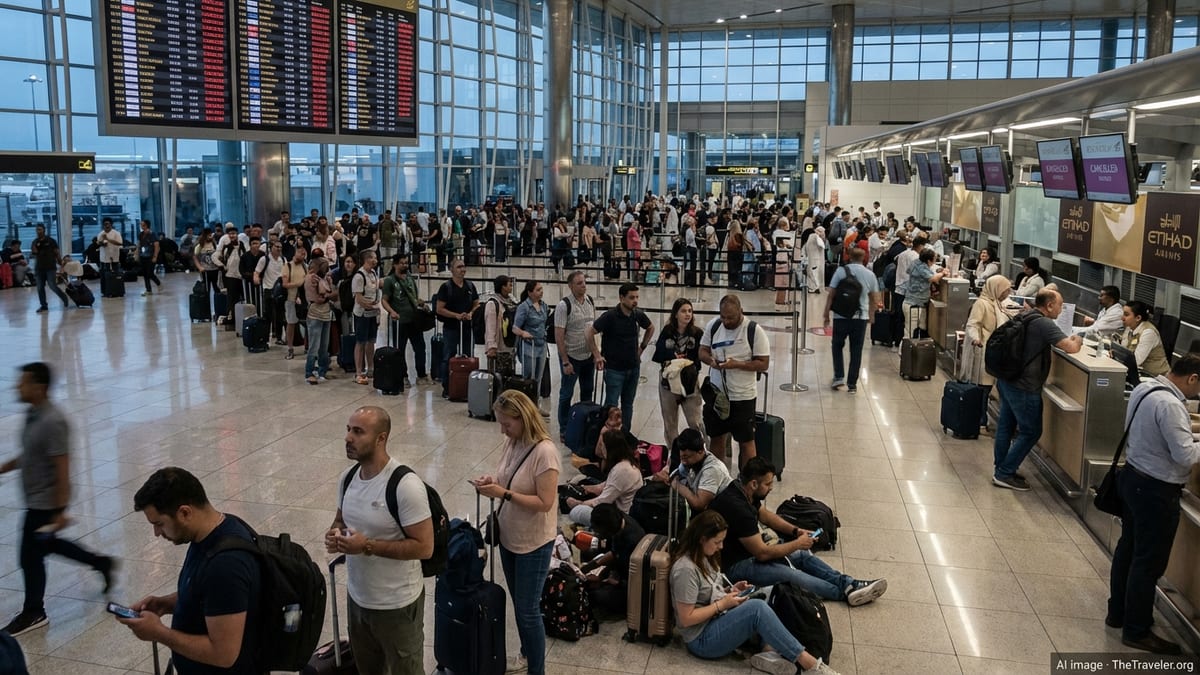
Recent travel reporting in the UAE has documented periods of delays and cancellations at both Dubai International Airport and Zayed International Airport in Abu Dhabi, with ripple effects across carriers and routes. Separate coverage has pointed to stop-and-go disruptions tied to evolving conditions, including route suspensions on certain city pairs and short-notice cancellations.
For US travelers, the operational takeaway is straightforward: even if an itinerary looks stable at booking, day-of-travel conditions can change quickly. Travelers connecting through the Gulf may face rebookings that shift them onto longer routings, require overnight stays, or reroute through alternative hubs depending on which air corridors are open at a given time.
Some airlines have publicly posted that they are monitoring regional airspace in real time and that additional cancellations may occur. That type of messaging is a signal that operational plans can change within hours, not days, and that travelers should be prepared for rapid itinerary adjustments.
What travelers can do now: planning steps and documentation checks
For Americans who have not departed yet, the simplest risk-reduction step is itinerary flexibility. Choosing refundable fares where feasible, avoiding ultra-tight connections, and building buffer time between international segments can reduce stress and cost if rerouting becomes necessary. Travelers may also want to consider alternate routings that do not depend on a single Middle East transit point, especially for time-sensitive trips.
For travelers already in the region or committed to near-term travel, publicly available State Department guidance encourages enrolling in the Smart Traveler Enrollment Program (STEP) to receive security updates tied to the nearest US embassy or consulate. Keeping travel documents current is also important, including ensuring passports are valid for the full duration of travel and beyond any required validity windows.
Travelers should also plan for practical contingencies that are common during major flight disruptions: the ability to access funds, charge devices, and maintain proof of onward travel and accommodation. When flight schedules become unstable, airlines often prioritize rebooking in stages, and travelers who can quickly respond to changes are better positioned to secure workable alternatives.
What to watch next for US travelers and frequent flyers
Because the warning emphasizes unpredictability, the next key indicator will be whether airlines expand, extend, or roll back route suspensions and whether additional airspace restrictions are announced. Travelers should monitor their airline’s official flight status channels and airport notices closely in the 48 to 72 hours before departure, and again on the day of travel.
For those planning trips that touch multiple Middle East countries, it is also worth tracking destination-specific State Department updates rather than relying on a single regional headline. Conditions, advisories, and operational impacts can vary sharply between neighboring countries, and the most useful signals often come from a combination of official advisories and real-world airline schedule changes.
For now, the message from the US Mission to the UAE is focused on caution and optionality: reconsider nonessential travel to and through the region, anticipate disruptions, and be prepared to adjust plans quickly if conditions shift.