


Few travel debates in the Canadian Rockies get people as animated as the question of which scenic drive delivers the bigger wow factor: the intimate, wildlife-rich Bow Valley Parkway between Banff and Lake Louise, or the vast, glacier-studded Icefields Parkway that runs from Lake Louise to Jasper. Both are certified world-class road trips, yet they serve up very different kinds of magic. Choosing between them is less about which road is “better” and more about what kind of Rocky Mountain experience you want most from your precious vacation days.
Get the latest updates straight to your inbox!
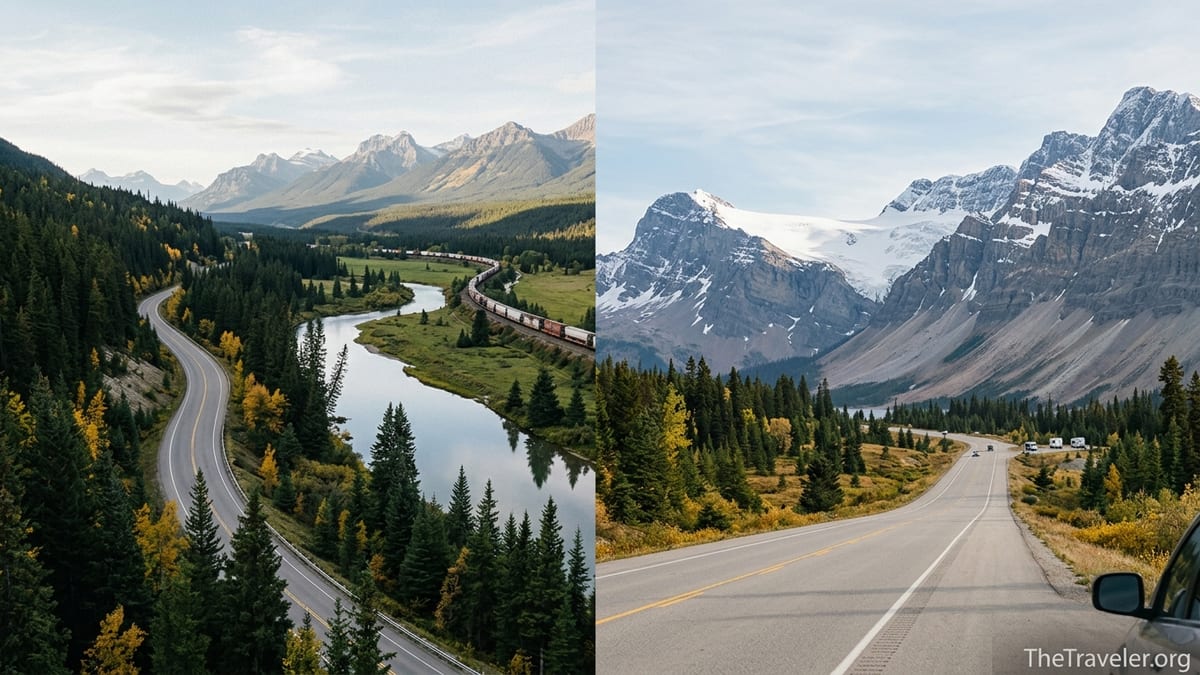
Setting the Scene: Two Legendary Roads, Two Very Different Moods
The Bow Valley Parkway, officially Highway 1A, covers roughly 48 kilometers between Banff and Lake Louise, threading through a quiet montane valley of forest, meadows and river views. It runs parallel to the busy Trans-Canada Highway but feels like a different world: slower, narrower, and designed less for getting somewhere fast than for lingering at pullouts and trailheads. Wildlife sightings are common, especially elk and black bears, and the atmosphere is relaxed and low-key compared with the main highway traffic.
The Icefields Parkway, Highway 93 North, is a far grander proposition. Stretching about 227 kilometers from Lake Louise to Jasper, it has been repeatedly named among the most beautiful drives on earth by publications such as Condé Nast Traveller. The road climbs into a high mountain corridor flanked by more than a hundred glaciers, jagged peaks and sweeping valleys. You pass major sights like Bow Lake, Peyto Lake, the Columbia Icefield and Athabasca Falls, often with no cell service and only a handful of places to refuel or eat along the way.
In practical terms, most visitors experience the Bow Valley Parkway as a half-day or relaxed day trip from a base in Banff or Lake Louise. The Icefields Parkway takes substantially longer. Driving it one way from Lake Louise to the Columbia Icefield with photo stops can easily fill six to eight hours, and continuing all the way to Jasper usually warrants at least one full travel day each direction. That alone makes the wow factor feel different: one is an easily digestible scenic side road, the other is a full-blown expedition.
When locals weigh in, you often hear variations of the same theme: Bow Valley is where you go to soak up classic Banff wildlife and forest vibes in a compact package, while the Icefields Parkway is where you go to feel dwarfed by the scale of the Rockies. Understanding that contrast is the key to deciding which is likely to impress you more.
Scenery Showdown: Intimate Valley vs Glacier Highway
If you measure wow factor strictly by the scale of the scenery, the Icefields Parkway wins almost by default. Within the first hour north of Lake Louise you are driving past the turquoise waters of Bow Lake beneath Bow Glacier, then climbing toward Bow Summit and the famous viewpoint above Peyto Lake, where the lake’s improbable teal color and fox-shaped outline stop even jaded travelers in their tracks. Farther north, the road winds past the dramatic Big Bend hairpin, the Columbia Icefield and the hanging glaciers and waterfalls of the Sunwapta and Athabasca valleys.
Much of the Parkway’s wow comes from how relentlessly the landscape changes. One minute you are coasting beside a wide river valley; the next you are rounding a curve to see a wall of ice cascading down from a high plateau. Even pullouts that might feel minor elsewhere, such as the roadside views of Tangle Falls or unnamed glaciers, become photography stops for travelers who rarely see icefields from their car window. On a clear day in September, with yellow larch trees dotting the dark conifer slopes, the whole corridor looks like a moving postcard.
The Bow Valley Parkway’s scenery is quieter and more intimate. You still see substantial peaks and, in places, the wide Bow River, but the perspective is closer in. A classic stop is Morant’s Curve, a viewpoint where the Canadian Pacific Railway line sweeps around a bend with the Bow River and peaks behind. Another highlight is the Johnston Canyon area, where a short walk from the road leads into a narrow limestone gorge with turquoise pools and waterfalls. In autumn, the forest glows with golden leaves and the valley feels sheltering rather than overwhelming.
Many travelers report that when they first drive the Bow Valley Parkway after a day at Lake Louise or on the Icefields Parkway, it feels gentler, even modest. Yet for some, that is exactly why its scenery resonates. If your ideal mountain moment is an early-morning mist over the river, a quiet picnic at a pullout, or the sight of a freight train threading through the forest, Bow Valley’s subtler palette can deliver a different kind of wow that lingers longer than a single jaw-dropping glacier view.
Wildlife & Atmosphere: Close Encounters vs Big Horizons
When it comes to wildlife, the Bow Valley Parkway has a strong claim to the bigger wow, especially for first-time visitors. This corridor is famous for its animal activity, and Parks Canada has introduced seasonal travel restrictions partly to protect bears and other species moving through the valley. In spring and early summer, it is not unusual to encounter elk grazing roadside meadows, black bears foraging dandelions or occasionally a grizzly in the distance. Because the speed limit is lower and there are frequent pullouts, you have more time to notice what is moving in the trees.
The quieter traffic also means the atmosphere is more contemplative. Many visitors choose to cycle the eastern 17 kilometer stretch when it operates car-free in spring and fall, pedaling between Banff and Johnston Canyon on an almost silent road. Experiencing elk bugling in September while you roll past on a bike, or hearing nothing but birdsong and the whirr of your wheels, can feel as impressive as any glacier. Even if you are driving, the sense of being immersed in a living landscape defines the Parkway’s character.
The Icefields Parkway has plenty of wildlife too, from bighorn sheep and mountain goats on rocky slopes to occasional bears and caribou. However, the distances are longer and many travelers are focused on reaching specific sights, which can make wildlife viewing less predictable. You might encounter a classic “bear jam” near Saskatchewan Crossing or spot goats near the Columbia Icefield, but you are just as likely to drive an hour with only distant silhouettes on a hillside. For some visitors that element of chance is thrilling; for others, it makes the Bow Valley’s more consistent encounters feel more rewarding.
Atmospherically, the Icefields Parkway is defined less by animals and more by space and silence. Once you leave Lake Louise or Jasper, services thin out quickly, cell coverage disappears and the road becomes a ribbon in a very large landscape. On a quiet shoulder-season day, you might drive for ten minutes without seeing another car, the only sound the rush of rivers and occasional wind gusts. That sense of remoteness can feel like a profound wow moment, especially if you live in a crowded city and rarely experience true quiet.
Accessibility, Time & Logistics: Which Fits Your Itinerary Better?
From a logistics standpoint, the Bow Valley Parkway is the easier scenic drive to weave into a standard Banff itinerary. The road has two junctions with the Trans-Canada Highway, and you can access it from either Banff or Lake Louise. Driving the entire route without stops might take just under an hour, but most visitors allow three to six hours to incorporate viewpoints, short walks and perhaps a café stop at a historic lodge if it is operating for the season. Fuel and food are readily available in Banff and Lake Louise on either end.
There are, however, important seasonal rules. A 17 kilometer section between Johnston Canyon Campground and Fireside Day Use Area is subject to a nightly closure from 8 pm to 8 am between March 1 and June 25 each year to protect wildlife. During certain spring and fall periods, Parks Canada also closes that same stretch to public vehicles during the day to create a car-free cycling experience. Practically, that means an early-morning wildlife drive in late May may not be possible by car on that segment, while a mid-morning bike ride could be the highlight of your trip.
The Icefields Parkway requires more commitment. There are no fuel stations between Lake Louise and Saskatchewan Crossing, and then nothing again until you near Jasper. Travelers are advised to fill up in Lake Louise or Banff before heading north and to carry snacks, water and warm clothing even in summer because weather can change quickly at high elevations. In winter and early spring, sections of the Parkway can be icy or affected by avalanche control, and while it is generally open year-round, short-term closures or travel warnings are not uncommon.
Time-wise, a popular option for visitors based in Banff is to drive from Banff to the Columbia Icefield and back in one long day. With a 7 am departure, you might reach Bow Lake around 8:30, Peyto Lake viewpoint closer to 9, then roll into the Columbia Icefield Discovery Centre by late morning for lunch and a walk to the Athabasca Glacier viewpoint. Add multiple photo stops and a return drive, and you are often looking at a 10 to 12 hour outing. Continuing all the way to Jasper usually works best when you are changing bases and have booked at least one night in Jasper or at a lodge along the Parkway.
Experiences & Activities: Pullouts, Trails and Signature Stops
On the Bow Valley Parkway, the wow factor is tightly linked to classic short walks and pullouts. Johnston Canyon is the marquee attraction, with a paved or well-graded trail leading through a narrow canyon to Lower and Upper Falls. Families with strollers, casual walkers and serious hikers all use this route, and in peak summer it can feel busy, but the payoff of turquoise pools boiling in limestone pots is undeniable. Other short walks and picnic spots, such as the trails near Moose Meadows or the viewpoints along the river, offer quieter alternatives.
The Parkway also has a distinct sense of history. You pass heritage lodges and motor-court style accommodations that date back to early automobile tourism, and interpretive signs tell stories of internment camps and early park development. For travelers who appreciate context as much as scenery, pulling into a small parking area to read about how the valley has been managed for wildlife and people can add depth to the drive.
On the Icefields Parkway, the signature experiences are more overtly dramatic. Stopping at Bow Lake allows for a short shoreline walk with glacier reflections. Peyto Lake’s main viewpoint involves a short but often crowded walk uphill to a platform overlooking one of the Rockies’ most photogenic lakes. Farther north, Parker Ridge offers a half-day hike that climbs to a ridge with sweeping views of the Saskatchewan Glacier, delivering one of the most accessible big-glacier panoramas in the region.
The Columbia Icefield is the emotional high point for many visitors. The Discovery Centre functions as a services hub, with washrooms, a cafeteria-style restaurant and tour departures. Some travelers book guided experiences onto the Athabasca Glacier or visit a cliffside glass-floored viewing platform farther north. Even if you skip paid tours, simply standing at the roadside viewpoint and seeing how far the glacier has retreated since the markers from the early 1900s can be a sobering and memorable moment. It is a different kind of wow, rooted in geology and climate rather than postcard prettiness.
Seasonality, Weather & Crowds: When Each Drive Shines
Both roads are driveable year-round, but their personalities change dramatically with the seasons. On the Bow Valley Parkway, late May and June are prime wildlife months, with lush green meadows and young animals more visible. The car-free cycling periods in spring and fall have quickly become bucket-list experiences for road cyclists and families with e-bikes, who can rent bikes in Banff and ride out of town without worrying about sharing the pavement with RVs.
Summer brings longer daylight and warmer temperatures but also more traffic. Even then, the Parkway remains a calmer alternative to the Trans-Canada, especially at off-peak times such as early afternoon or after dinner in July and August. Autumn might be the Parkway’s most atmospheric season, with golden aspens and a crisp chill in the air. Winter transforms it into a corridor of snow-laden trees, and while some pullouts and trails are less accessible, the sense of solitude increases.
The Icefields Parkway’s wow factor is highly seasonal as well. Late June through September offers the most reliable access to major stops like Peyto Lake, Parker Ridge and higher-elevation parking areas, with wildflowers blooming in July and early August. Early autumn is particularly photogenic as larch trees near treeline turn yellow. In shoulder seasons, especially April and early May, the road can be open but many side trails and parking areas remain under snow or avalanche control, so your experience might be more of a through-drive with selective, cautious stops.
Winter driving on the Icefields Parkway is a serious undertaking that requires proper tires, familiarity with winter conditions and flexibility. The reward for those prepared is stark beauty: low winter sun glowing on white peaks, frozen waterfalls and almost empty pullouts. For most holidaymakers, though, the bigger wow will come from a summer or early fall visit, when you can safely combine roadside scenery with short hikes and lakeshore walks without snowshoes.
Cost, Comfort & Travel Style: Matching the Drive to the Traveler
Neither road has a separate toll, but both sit inside national parks, so you will need a valid Parks Canada pass. Beyond that, the main costs relate to fuel, food and optional activities. The Bow Valley Parkway is relatively budget-friendly: you can pack a picnic from a Banff supermarket, drive the route, walk Johnston Canyon and be back at your hotel without spending more than fuel and snacks.
The Icefields Parkway tends to invite more spending simply because it is longer and more remote. Fuel at the limited stations en route is usually more expensive than in Calgary or Canmore. Meals at lodges, cafés near Bow or Peyto Lake or the Columbia Icefield Discovery Centre are convenient but rarely cheap. If you book guided glacier experiences or sightseeing platforms, costs climb further, which can be worth it for many visitors looking for a once-in-a-lifetime encounter with ice but may nudge budget travelers toward a more DIY approach.
Comfort-wise, consider how much driving you actually enjoy. If you or your travel companions start to fade after two or three hours behind the wheel, the Bow Valley Parkway may deliver a higher wow-per-minute ratio. You could, for instance, spend a morning at Johnston Canyon, enjoy lunch at a lodge or café, then meander back to Banff with ample time for a sunset walk around Vermilion Lakes. By contrast, a full Icefields Parkway day from Banff to the Columbia Icefield and back can feel like an endurance event for drivers unaccustomed to long, twisty mountain roads.
Your travel style matters too. Photographers and landscape lovers who relish big vistas and can happily spend an hour waiting for clouds to shift at Bow Summit will naturally gravitate toward the Icefields Parkway. Families with younger kids, couples who enjoy leisurely cafés and short walks, or travelers who prioritize accessible wildlife encounters may find the Bow Valley Parkway more satisfying overall, even if individual Icefields sights look more dramatic on Instagram.
The Takeaway
If your priority is sheer, knock-you-back-in-your-seat scenery, the Icefields Parkway almost certainly delivers the bigger immediate wow factor. Nowhere else in the Canadian Rockies can you drive for hours through an almost continuous corridor of glaciers, hanging valleys and towering peaks, punctuated by bucket-list stops like Bow Lake, Peyto Lake and the Columbia Icefield. For many visitors, this road alone justifies the trip to Alberta.
Yet the Bow Valley Parkway quietly excels in ways that matter deeply once the initial rush of big scenery fades. It offers more frequent wildlife sightings, a gentler pace, rich human and natural history, and experiences such as car-free cycling that make you feel part of the landscape rather than just a spectator. For families, casual travelers and anyone with limited time, it can deliver a more relaxed and emotionally resonant day than a long, ambitious Icefields run.
In an ideal world, you carve out time for both. One realistic strategy is to dedicate a full day to the Icefields Parkway as far as the Columbia Icefield and another half day to the Bow Valley Parkway, giving yourself permission to move slowly, stop often and let each road reveal its personality. If you must choose only one, let your own definition of wow guide you. If you crave grandeur and can handle long drives, choose the Icefields Parkway. If you value intimacy, wildlife and a slower rhythm, commit to the Bow Valley Parkway and savor every kilometer.
Either way, the bigger wow factor may ultimately come less from which road you pick and more from how present you are once you are on it: pulling over for that unscheduled view, lowering your voice when you spot a bear in the distance, or simply turning off the car at a quiet pullout and listening to the Rockies breathe.
FAQ
Q1. Can I drive both the Bow Valley Parkway and the Icefields Parkway in one day?
It is technically possible from a base in Banff, but it would be rushed and exhausting. Most travelers enjoy them more by dedicating a separate day to the Icefields Parkway and a half or full day to the Bow Valley Parkway.
Q2. Which road is better for seeing wildlife, Bow Valley or the Icefields Parkway?
The Bow Valley Parkway usually offers more reliable roadside wildlife sightings because speeds are lower, the road is narrower and the valley is a key movement corridor. The Icefields Parkway also has wildlife, but encounters are more sporadic over longer distances.
Q3. Do I need a special vehicle or 4x4 to drive the Icefields Parkway?
No. In summer a standard car is sufficient for both roads, provided it is in good condition and you have enough fuel. In winter and early spring, winter-rated tires and mountain driving experience become more important on the Icefields Parkway.
Q4. Is the Bow Valley Parkway open early in the morning for sunrise drives?
Part of it is, but a 17 kilometer section between Johnston Canyon Campground and Fireside Day Use Area is closed nightly from 8 pm to 8 am between March 1 and June 25. Outside those dates and sections, you can usually drive for sunrise, subject to any temporary restrictions.
Q5. How much time should I allow for the Icefields Parkway if I am not staying in Jasper?
If you are driving from Banff or Lake Louise to the Columbia Icefield and back with photo stops and a simple lunch, plan on 10 to 12 hours. Going all the way to Jasper is best combined with an overnight stay.
Q6. Are there places to buy food and fuel along the Icefields Parkway?
Yes, but they are limited. Fuel is available at Lake Louise and Saskatchewan Crossing, with more options near Jasper. You will find cafés, lodges and the Columbia Icefield Discovery Centre for meals and snacks, but prices are typically higher than in larger towns.
Q7. Which drive is better for families with young children?
The Bow Valley Parkway generally suits families better, with shorter driving distances, easy walks like Johnston Canyon and more frequent chances to stop. The Icefields Parkway can be fantastic too, but long stretches between services may be challenging with very young kids.
Q8. Can I cycle both the Bow Valley Parkway and the Icefields Parkway?
Yes. The Bow Valley Parkway is especially popular for cycling, with designated car-free periods on its eastern section in spring and fall. The Icefields Parkway is also a classic multi-day touring route for experienced cyclists comfortable with traffic, hills and mountain weather.
Q9. If I only have one full day in Banff, which road should I prioritize?
With just one day and a base in Banff, many travelers get more out of the Bow Valley Parkway because it pairs well with other nearby sights like Lake Louise or Moraine Lake. The Icefields Parkway is best when you can spare a very long day or add an overnight stay.
Q10. Is the scenery still worth it on cloudy or rainy days?
Yes. On the Bow Valley Parkway, low cloud can add mood to the forest and river views. On the Icefields Parkway, partial cloud sometimes makes glaciers and peaks look more dramatic. In heavy rain or low visibility, it is wise to slow down and focus on the safer, more accessible viewpoints.