


Framed by grey limestone walls and the glacial blue Bow River, Alberta’s Bow Valley is one of the Canadian Rockies’ most rewarding regions to explore slowly. Between Canmore, Banff and Lake Louise, two parallel highways – the fast Trans Canada Highway 1 and the quieter Bow Valley Parkway / Highway 1A – thread through prime wildlife habitat, historic sites and a string of short hikes and roadside viewpoints. With new seasonal closures, busy summer traffic and very active wildlife, it pays to arrive with a plan. This guide focuses on how to explore Bow Valley specifically for wildlife viewing, day hikes and the best scenic pullouts, with current information and concrete examples to help you make the most of your time.
Get the latest updates straight to your inbox!
Understanding the Bow Valley: Layout, Seasons and Closures
Bow Valley runs roughly east–west along the Bow River between the town of Canmore and the village of Lake Louise in Banff National Park. Most visitors experience it along two corridors. Highway 1 is the four-lane Trans Canada, built for speed, with higher limits and wildlife fences guiding animals toward underpasses and overpasses. Running roughly parallel on the north side of the river is Highway 1A, known inside the park as the Bow Valley Parkway, a two-lane scenic road with a slower speed limit around 60 km/h and frequent pullouts for views and trailheads.
Before you plan wildlife drives or hikes, check how Parks Canada is managing traffic on the Bow Valley Parkway for your dates. As of 2026, a 17 kilometre eastern section between the Trans Canada interchange west of Banff and Johnston Canyon is part of a pilot seasonal closure to public vehicles from early May to June 25, and again for parts of September. During those periods, it becomes a popular car free cycling route while still allowing some Parks Canada and service vehicles. The western section between Castle Junction and Lake Louise remains open to cars in summer, providing access to viewpoints and trailheads.
Seasonal rules are designed primarily for wildlife. Spring in particular is critical for bears, wolves and elk moving through the montane forests and meadows along the valley floor. From March 1 to June 25, there is also an evening and overnight travel restriction on a broader portion of the parkway, typically 8 pm to 8 am, to give animals undisturbed foraging time. Exact dates and hours can shift slightly each year, so confirm close to your visit at a Parks Canada information centre in Banff or Lake Louise or by checking the current road bulletin before you set out.
Timing your visit also matters for the experience you want. May and June often have the most wildlife activity along the lower valley, but snow can linger on higher hiking trails and the car free cycling section is in effect. July and August bring warmer temperatures, fully melted trails and the highest visitor numbers. September often combines quieter roads, fall larch color in side valleys and good chances of seeing elk during the rut, especially around the Banff townsite and the Minnewanka Loop just outside the main Bow Valley corridor.
Wildlife Viewing Strategy: Where, When and How
Bow Valley is considered one of the best wildlife corridors in the Canadian Rockies, but you will only see animals consistently if you adapt your schedule and behavior. The highest odds come at dawn and dusk, when traffic is lighter and animals are typically more active. On days when the Parkway is fully open, a slow pre-breakfast drive between Castle Junction and Lake Louise can turn up elk, deer and occasionally black bears grazing on roadside vegetation. When the eastern stretch is closed to vehicles in spring, you can still drive the Trans Canada and detour onto open secondary roads like the Vermilion Lakes Road near Banff, which locals regularly mention as a productive early-morning elk and bird-watching route.
Think of the car as a mobile blind rather than a way to get from A to B as fast as possible. Driving at or below the 60 km/h parkway limit and pulling fully into signed viewpoints lets you scan edges of meadows, river flats and avalanche paths safely. Common sightings along the Bow Valley Parkway include elk, white tailed deer, mule deer and occasionally bighorn sheep near rocky outcrops. Both black bears and grizzly bears use the valley. In recent years Parks Canada has emphasized that visitors must stay inside their vehicle when bears are roadside, avoiding “bear jams” that can stress animals and create hazards for cyclists and other drivers.
If you want more deliberate viewing, plan a short walk from a pullout rather than stopping randomly on the shoulder. Pullouts near Moose Meadows, for example, open onto meadows and river flats that sometimes attract elk in early summer. Around the Castle Mountain viewpoints you may see bighorn sheep along the steep slopes or hear birdsong in the mature forest. Bring binoculars and be prepared to enjoy long stretches without charismatic megafauna; Bow Valley also rewards patient watchers with smaller species like pine martens, ground squirrels, Clark’s nutcrackers and varied thrushes in the understory.
Finally, build safety habits into your routine. Carry bear spray within quick reach, not buried in a backpack in the trunk, and know how to use it. Make noise when you are on foot away from the car, particularly in shrubby areas along the river or any area with limited visibility. Never feed wildlife, even birds or squirrels at picnic areas. If you do encounter an animal on the road or trail, give it the right of way and a wide berth, backing up or detouring if necessary. These small decisions collectively help maintain the very wildlife behavior that makes Bow Valley so compelling to visit.
Iconic Scenic Pullouts and Viewpoints
One of the easiest ways to experience Bow Valley is to link its viewpoint pullouts into a loose driving circuit. Many stops are unsigned from a distance, so if you are serious about photography or birding, plan to drive the route once during the day to note which pullouts appeal to you, then return for better light early or late in the day. Gas is not available on the Bow Valley Parkway itself, so fill up in Canmore, Banff or Lake Louise before you start.
Coming from Banff, one classic stop sits just west of town where a rest area off the Trans Canada overlooks the Bow River, Mount Rundle and the Vermilion Lakes. From here you can appreciate how the river braids through wetlands that attract waterfowl, especially in spring and early summer. Farther along, once you are on the Bow Valley Parkway, a small wetland viewpoint sometimes called Backswamp or Sawback area offers still water reflections of surrounding peaks and is a quiet place to listen for loons and watch for beavers at dusk.
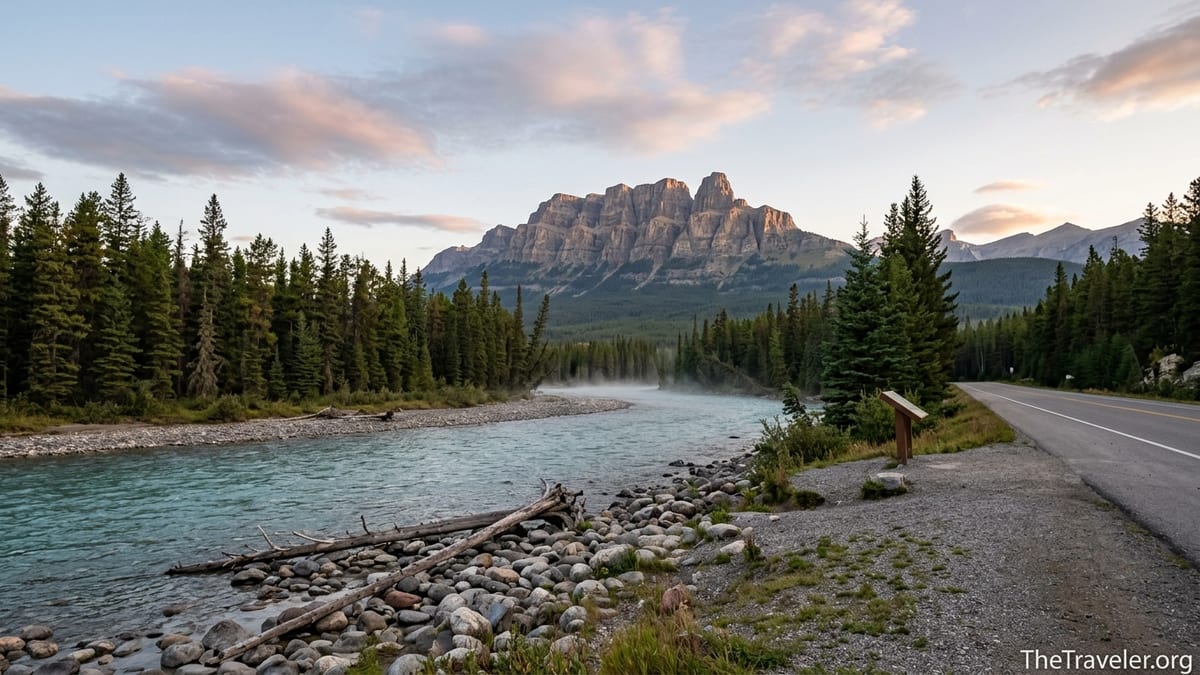
Near the midpoint between Banff and Lake Louise, the Castle Mountain viewpoints are among the most photographed stops in Bow Valley. Castle Mountain’s layered cliffs rise almost sheer above the forest, with a south facing pullout giving a clear view of the peak that glows warm orange in evening light. Practical amenities such as washrooms and a small general store at nearby Castle Mountain Chalets make this a useful rest stop as well as a scenic one. On many summer evenings, visitors set up tripods here to capture time lapses of clouds sliding over the summit.
Closer to Lake Louise, pullouts near Morant’s Curve and Baker Creek provide classic views of the Bow River sweeping alongside the Canadian Pacific Railway line. While the postcard angle often shows a train curving through the frame, the scene is equally appealing when the river is quiet and the track empty. This section is especially photogenic in winter and early spring when low sun and snow on the banks emphasize the curve of the valley, but even in summer it is worth a brief stop. Parking is limited, so arrive early or be prepared to pass by if it is full and return later.
Day Hikes and Short Walks off the Parkway
Along with roadside viewpoints, Bow Valley offers numerous hikes ranging from fully accessible boardwalks to full-day mountain routes. The star attraction is Johnston Canyon, roughly midway along the parkway. Here a well developed trail with catwalks bolted into limestone walls leads 1.1 kilometres to the Lower Falls and about 2.5 kilometres to the Upper Falls. Most visitors take 1.5 to 2 hours for the round trip to the Upper Falls, longer if they photograph every turn in the gorge. In summer it can feel crowded by mid-morning, so aim to arrive before 9 am or later in the evening once tour buses thin out.
Beyond Johnston Canyon, the Ink Pots meadows extend the hike by another 3 kilometres each way, climbing above the forest into an open basin with turquoise cold springs bubbling through the ground. This is an excellent spot to experience a more expansive Bow Valley landscape away from the road. The return from the trailhead to the Ink Pots and back is usually a half-day outing of 4 to 5 hours for reasonably fit hikers, with moderate elevation gain and well maintained trail.
Shorter, less crowded walks start right from several pullouts. Moose Meadows has a network of unofficial paths leading through meadows and sparse forest to the Bow River. While you should always be alert for wildlife here, many visitors simply stroll a few hundred metres from their vehicle to listen to the river and watch for birds. Near Baker Creek, short riverside trails provide easy walking among spruce and pine, with occasional open views to the main range. Always stick to obvious paths or signed routes to avoid trampling fragile vegetation.
For something more strenuous, the Castle Lookout and Castle Mountain hikes rise steeply from the valley floor. Castle Lookout, accessed from a signed trailhead off the parkway, climbs roughly 450 to 500 metres over about 3.7 kilometres to an open bench with far reaching views over Bow Valley and the Bow River. Strong hikers can complete it in 3 to 4 hours round trip. The longer Castle Mountain route continues farther and higher toward the peak’s shoulder. These hikes are best attempted in mid to late summer when snow is gone and conditions are more stable; always check current trail advisories for bear activity and any closures.
Exploring Bow Valley from Canmore and Banff
Many visitors base themselves in Canmore or Banff and explore Bow Valley on a series of day trips. From Canmore, the Bow Valley Trail segment of Highway 1A runs east toward Cochrane and west to Banff, providing a slower alternative to Highway 1 that still offers glimpses of the river and surrounding peaks. While this stretch is outside the national park, you are still in good wildlife country and might see bighorn sheep on road cuts or elk grazing in meadows near Exshaw. It is a useful option on busy summer weekends when the main highway feels hectic.
From the town of Banff, you can access the Bow Valley Parkway via the Trans Canada interchange just west of town or indirectly via Vermilion Lakes Road, which leads under the highway to the parkway’s eastern gate. Many visitors combine an early-morning drive out along Vermilion Lakes, scanning for elk and waterfowl, with a longer loop that continues along whatever sections of the parkway are open and returns on the Trans Canada. This strategy exposes you to a range of habitats in a single outing, from wetlands and river flats to denser montane forest and steep valley walls.
Public transit can also be used creatively to experience parts of Bow Valley without a car. Regional shuttle services from Canmore and Banff to attractions like Johnston Canyon or Lake Louise operate seasonally. For instance, in recent years a reservation based bus from Banff has served Johnston Canyon during peak months, allowing you to hike without trying to secure a scarce parking spot at the trailhead. Check current schedules, prices and booking requirements with Banff & Lake Louise Tourism or at the Banff visitor centre, as providers and routes can change from season to season.
Whether you drive yourself or rely partly on transit, try to cluster your activities by area. A realistic day trip from Banff might start with sunrise at Vermilion Lakes, continue with a mid-morning hike at Johnston Canyon, then pause at Castle Mountain for a leisurely picnic and end with evening light at one or two pullouts near Morant’s Curve before returning along the Trans Canada. Building in this breathing room avoids turning your visit into a rushed checklist and leaves time for spontaneous wildlife stops along the way.
Cycling and Car Free Experiences in the Wildlife Corridor
One of the most distinctive ways to experience Bow Valley in recent years has been by bicycle on sections of the Bow Valley Parkway closed to regular vehicle traffic in spring and early fall. During the current pilot, the 17 kilometre eastern stretch between the interchange west of Banff and Johnston Canyon becomes a corridor where cyclists, e-bikers and pedestrians share the road with only occasional Parks Canada or service vehicles. The result is an unusually quiet atmosphere where you can hear birds, the river and even the wind in the trees instead of constant engine noise.
This car free period typically runs from May 1 to June 25 and again for the month of September, though exact dates and details should be confirmed each year. Many riders rent bikes or e-bikes in Banff for a half or full day, riding the approximate 50 kilometre round trip from town to Johnston Canyon and back. Moderately fit cyclists on standard bikes often take 3 to 4 hours of riding time plus rest and scenic stops. With an e-bike the outing feels more like a series of relaxed photo breaks, suitable even for people who do not normally ride long distances.
Even when the parkway is open to cars, cycling remains popular, but you must be more vigilant about vehicles and wildlife. Shoulders are narrow in places, and the same low traffic volume that appeals to cyclists can make wildlife less habituated to people on bikes than along busier roads. Carry bear spray within easy reach, avoid wearing headphones and try to ride with at least one partner. In shoulder seasons, carry layers, as temperatures in the valley can change quickly with passing storms or elevation shifts between Banff and Castle Junction.
Cycling also changes how you interact with scenic pullouts. Instead of parking once and walking back along the shoulder, you can roll into almost any viewpoint or picnic area. Many riders bring a compact picnic kit and stop for a late breakfast at a quiet pullout overlooking the Bow River. Others plan a longer break at Johnston Canyon, locking bikes in the racks near the trailhead before walking up to the falls. For photographers, a bike allows you to respond rapidly if clouds break or wildlife appears within view, provided you always keep a respectful distance and do not block the road or trail.
Practical Planning: Safety, Gear and Regulations
Because Bow Valley feels so close to the highway, it is easy to underestimate the wildness of the landscape. Cell coverage is inconsistent along the parkway, especially between Castle Junction and Lake Louise. Always carry enough water and snacks for more time than you think you will need, and have appropriate layers even on warm days. A light insulated jacket, hat and gloves can make a big difference if weather changes suddenly while you are at a pullout far from your vehicle or waiting out a storm at a picnic area.
Wildlife safety is central to every visit. Parks Canada regularly posts bear warnings and area closures when feeding opportunities, such as berry crops, draw bears closer to trails and roads. Recently, for example, bear warnings have been issued along Vermilion Lakes Road and other Bow Valley access routes early in the season. Respect all posted signs, even if they disrupt a planned outing. Your alternative might be as simple as choosing a different trail or focusing on scenic driving rather than hiking that day.
Legal requirements are straightforward but important. You need a valid Parks Canada entry pass for all national park areas, including the Bow Valley Parkway and day hikes like Johnston Canyon. Random roadside camping is prohibited; stay in designated campgrounds such as Johnston Canyon Campground, Protection Mountain or campgrounds nearer to Banff and Lake Louise. Fire regulations can change with conditions, so always check current rules at the entrance gate or visitor centre before lighting any campfire in approved fire pits.
Finally, think about how you will navigate. Physical maps are still useful here. While smartphone mapping apps work in towns, they can be unreliable deeper in the valley. Picking up a free park map from a visitor centre or buying a more detailed topographic map at an outdoor shop in Banff or Canmore will help you identify pullouts, trailheads and alternate routes if closures appear unexpectedly. Marking potential wildlife hotspots and desired photo locations on paper can turn a loose plan into a rewarding, flexible day in the valley.
The Takeaway
Exploring Bow Valley for wildlife, hikes and scenic viewpoints is less about checking off famous names and more about tuning into the rhythm of the landscape. The slower, more intimate Bow Valley Parkway complements the speed and efficiency of the Trans Canada, giving you options to match your schedule, abilities and interests. With seasonal closures designed to prioritize wildlife, it has become a place where you might just spot a bear from the saddle of a bike or watch elk at dawn from a quiet pullout instead of a congested roadside.
If you arrive with realistic expectations, flexible plans and a willingness to let the valley set the pace, Bow Valley will repay you with moments that feel both deeply personal and quintessentially Canadian Rockies: the sound of the Bow River below Castle Mountain, the surprise of a deer stepping from the trees near Moose Meadows, or the cool spray on your face in the depths of Johnston Canyon. All of these experiences begin with simple choices: driving a little slower, stopping a little more often and giving wildlife the space it needs to keep thriving in one of North America’s most storied mountain corridors.
FAQ
Q1. Do I need a car to explore Bow Valley and the Bow Valley Parkway?
While a car offers the most flexibility for wildlife viewing and pullouts, you can still experience key areas using regional shuttles, guided tours and bike rentals from Banff or Canmore, especially during the seasonal car free periods on the eastern Bow Valley Parkway.
Q2. When is the best time of year to see wildlife in Bow Valley?
Late May through June and again in September generally provide good chances for wildlife, with spring offering bears and elk along the valley floor and early fall featuring elk rut activity near Banff and along secondary roads like the Minnewanka Loop.
Q3. How long does it take to drive the Bow Valley Parkway from Banff to Lake Louise?
Without stops, the roughly 50 kilometre parkway can be driven in about an hour, but most visitors should allow at least half a day to enjoy multiple scenic pullouts, short walks and possible wildlife sightings along the way.
Q4. Is the Bow Valley Parkway suitable for beginner cyclists?
During car free periods between the Banff interchange and Johnston Canyon, the gentle grades and lack of regular vehicle traffic make it accessible for beginners and casual riders, especially on e-bikes, provided they are comfortable riding 30 to 50 kilometres with rest breaks.
Q5. Are there any gas stations or food stops directly on the Bow Valley Parkway?
There are no gas stations along most of the parkway, so you should fill up in Canmore, Banff or Lake Louise. Limited snacks and basic supplies are sometimes available at small businesses such as the Castle Mountain area, but you should not rely on them as your only food source.
Q6. What are the must see viewpoints for photography in Bow Valley?
Popular locations include Castle Mountain viewpoints, Morant’s Curve near Lake Louise, wetland pullouts along the Bow Valley Parkway, and the rest area west of Banff overlooking the Bow River and Mount Rundle, all of which offer classic Bow Valley compositions at sunrise or sunset.
Q7. How crowded does Johnston Canyon get, and how can I avoid the worst of it?
Johnston Canyon is one of the most visited trails in Banff National Park and can feel very busy by late morning in summer; aim to arrive before 9 am, visit in the early evening, or use a shuttle if parking is full at the trailhead.
Q8. Is bear spray really necessary if I stay close to the road and viewpoints?
Yes, bear spray is strongly recommended whenever you are walking in or near forested areas, even close to the road, because bears and other wildlife regularly cross the corridor and surprise encounters can happen near pullouts and picnic areas.
Q9. Can I visit Bow Valley and the parkway in winter?
Yes, sections of the Bow Valley Parkway remain open in winter, offering scenic drives, wildlife viewing and access to winter trails, but you will need proper winter tires, be prepared for cold temperatures and shorter daylight hours, and check road conditions before setting out.
Q10. Do I need a reservation to visit Bow Valley or drive the parkway?
You do not need a reservation simply to drive the Bow Valley Parkway, but you do need a valid Parks Canada pass, and separate reservations may be required for campgrounds, some shuttles and popular nearby attractions such as Lake Louise parking during peak season.