


Central Europe has no shortage of classic city break contenders, but a recent push by Booking.com and other platforms has quietly nudged Bratislava into the spotlight. Sitting on the Danube between heavyweight neighbors Vienna and Budapest, the Slovak capital promises compact charm, relaxed prices and easy rail connections. For travelers planning a long weekend, the question is no longer whether to visit this region, but which of these three cities should anchor a short escape.
Get the latest updates straight to your inbox!
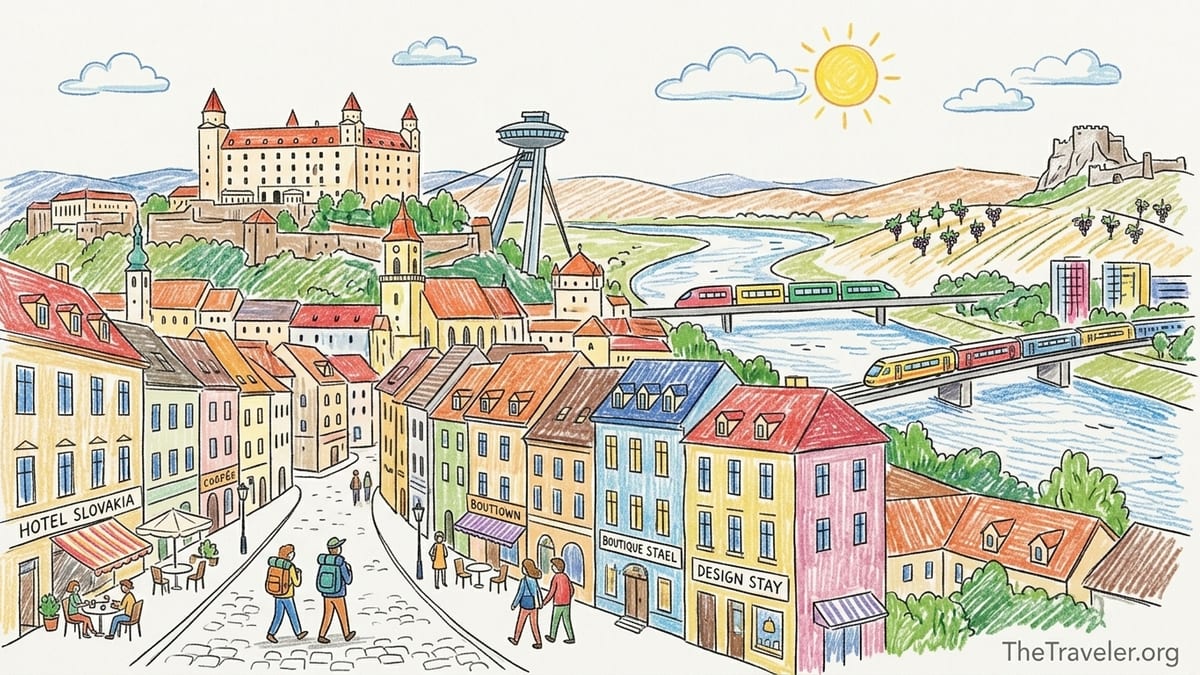
Bratislava’s New Moment in the Spotlight
Bratislava has long been a stopover between Vienna and Budapest, often visited on a rushed day trip. That is starting to change as booking platforms highlight it as a standalone city break. On Booking.com, Bratislava’s city page now showcases a dense spread of mid range and design hotels inside the historic center, many with guest ratings above 8.5 and prices that undercut Vienna by a noticeable margin on comparable dates. Travelers searching popular European city breaks increasingly see Bratislava placed alongside much larger capitals, signaling a shift in how the city is marketed.
Part of the appeal lies in scale. Bratislava’s medieval Old Town, castle hill and riverside promenade sit within a walkable core. A weekend visitor can arrive by train on Friday evening, walk from the main station or Petrzalka station to a central hotel, and be eating on Ventúrska or Panská Street within an hour. That simplicity contrasts with the sprawling urban fabric of Budapest or the ring roads and outer districts of Vienna, where first timers can spend a surprising amount of time on trams and metro lines.
Local tourism statistics underscore Bratislava’s emergence as a short break destination. The Bratislava Tourist Board reported an average accommodation price a little above 50 euros per night in the first quarter of 2024 across all categories, rising into the main season as demand climbs. More recent rate tracking for autumn 2026 shows median asking prices around 90 to 110 euros for standard double rooms across hotels, apartments and B&Bs, still well below what visitors typically see in Vienna’s inner districts or Budapest’s riverfront properties.
For many travelers, the key attraction is value for time rather than just value for money. You can land in Vienna or Budapest, transfer by direct train to Bratislava in little over an hour, and still have most of the day to explore. With few “must see” queues on the scale of Schönbrunn Palace or Budapest’s thermal baths, Bratislava offers a city break that feels unhurried while still delivering castle views, café culture and a lively evening scene.
Price Check: Hotels, Eating Out and Local Costs
Accommodation is usually the biggest line item in a city break budget, and this is where the three cities diverge most clearly. Rate monitoring in Bratislava during late 2026 finds a median asking price of roughly 94 euros per night, with an average near 110 euros across about 300 properties for a one night stay for two adults. On Booking.com, typical weekends show well reviewed 3 star hotels around 110 to 130 US dollars and 4 star properties in the 140 to 170 dollar range. Budget minded travelers can still find private hostel rooms or simple guesthouses under 80 euros if they book outside peak festival weekends.
Budapest, long marketed as a great value capital, has become noticeably pricier but still undercuts Vienna in many segments. Industry data for 2026 puts the average hotel room cost around 120 to 140 euros per night across a broad sample of properties, while budget guides that track real bookings report central guesthouses and small hotels in shoulder season for about 60 to 85 euros per night for a double. At the lower end, hostel beds in mixed dorms can still drop into the 15 to 25 euro range outside major events, though big weekends such as the Formula 1 Grand Prix or Champions League final see prices spike dramatically.
Vienna sits at the top of the price spectrum. Analyses of the city’s accommodation market in 2024 show average nightly spending by leisure visitors in the 70 to 80 euro range per person, which translates to roughly 140 to 160 euros for a double room when looking at mid range hotels. Separate tracking of short term rentals in Vienna points to average nightly rates around 140 to 150 euros over the past year. For a standard city break weekend, couples routinely see central 3 and 4 star hotels in the 150 to 220 euro bracket per night, with December’s Christmas market season often nudging rates higher.
Daily spending on food and incidentals follows a similar hierarchy. Comparative price data within the European Union places Austria’s restaurant and hotel prices significantly above Hungary’s and also higher than Slovakia’s. In practice, that might mean a casual dinner with a main course and drink coming to 20 to 25 euros per person in Bratislava, 18 to 28 euros in Budapest depending on neighborhood, and closer to 25 to 35 euros in central Vienna. A cappuccino in Bratislava’s Old Town often sits around 2.50 to 3 euros, while classic cafés on Vienna’s Ringstrasse charge nearer 4 to 5 euros for coffee with a slice of cake.
Rail Connections: How Easy Is Each City to Reach and Combine?
One of Central Europe’s great strengths is how straightforward it is to move between its capitals by rail. Here Bratislava, Vienna and Budapest function more as a triangle than separate destinations. Vienna and Bratislava lie fewer than 70 kilometers apart, linked by dense rail and bus networks. Trains between Vienna Hauptbahnhof and Bratislava’s main station or Petrzalka typically take about one hour. Advance purchase return tickets from Austrian Railways often fall in the 15 to 25 euro range, and regional tickets sold at stations remain competitively priced, making it feasible to base in one city and day trip to the other.
The Vienna Budapest axis is similarly well served. Long distance Railjet and EuroCity services link Vienna Hauptbahnhof with Budapest Keleti in roughly 2 hours 30 minutes, with multiple departures every day. When booked in advance, second class tickets can often be found from about 20 to 35 euros one way; last minute flexible fares cost more but still compare favorably with flying once airport transfers are included. Trains run at intercity standards with reserved seating, café cars and onboard Wi Fi, which turns the journey itself into part of the holiday rather than a tedious transfer.
Bratislava to Budapest is slightly slower but still straightforward. Direct trains generally take around 2 hours 30 minutes, crossing the Danube plain and arriving at Budapest’s main terminals. Sample fares purchased a few weeks ahead often fall in the 15 to 30 euro range, depending on the operator and class. For travelers building a three city itinerary, a logical route is Vienna Bratislava Budapest or the reverse, minimizing backtracking and keeping each leg under three hours by rail.
Within the cities, public transport standards are high across the board. Bratislava operates a network of trams, buses and trolleybuses, with single tickets costing a little over one euro and short term passes well under 10 euros for 24 hours of unlimited rides. Budapest’s integrated system covers metro lines, frequent trams along the Danube and buses across both banks, with day passes priced to encourage heavy use. Vienna’s transport network is the most extensive, with U Bahn lines, trams and buses; a 24 hour ticket falls in the mid single digits in euros. All three cities allow contactless ticketing in some form and are manageable for visitors who do not speak the local languages.
Iconic Sights: Castles, Churches and the Danube
In terms of headline attractions, Vienna and Budapest start with a clear numerical advantage simply because they are larger and more historic capitals. Vienna offers imperial set pieces like Schönbrunn Palace, the Hofburg, St Stephen’s Cathedral and the Kunsthistorisches Museum, each of which can absorb hours of a traveler’s time. Budapest spreads its highlights along the Danube: Buda Castle, Fisherman’s Bastion, the Hungarian Parliament building and a chain of art nouveau thermal baths, including Széchenyi and Gellért, that have become destination experiences in their own right.
Bratislava cannot match that scale, but it shines in how concentrated its sights are. Bratislava Castle, perched on a low hill above the Danube, takes perhaps 15 minutes to reach on foot from the Old Town and offers expansive views toward Austria and Hungary. The compact Old Town below is threaded with baroque palaces, pastel facades and narrow lanes like Kapitulska Street. Landmarks such as St Martin’s Cathedral, the Primatial Palace and the cathedral like Blue Church can all be visited in a single day without rushing, leaving time for long café stops or a stroll along the riverfront to the modern Eurovea quarter.
Travelers often praise Bratislava for small details that get lost in bigger capitals. A walk across the SNP Bridge to the UFO observation deck, for example, gives a sweeping perspective over both the historic core and the massive Petrzalka housing estates to the south. In under an hour by local bus or regional train, visitors can be hiking through the Small Carpathians or exploring the Devin Castle ruins where the Morava River meets the Danube. That ability to combine urban sightseeing with countryside in a single weekend is harder to achieve if you never leave central Budapest or Vienna.
For those comparing ticket prices, Bratislava generally comes out cheaper at the gate. Entry to Bratislava Castle’s museum, Devin Castle, and smaller galleries is usually quoted in the high single digits to low teens in euros, with discounts for students and combined tickets. In Vienna, admission to flagship sites like Schönbrunn or major art museums typically starts in the mid to high teens and rises past 20 euros for full experiences. Budapest sits somewhere in between, with castle district attractions, Parliament tours and thermal baths priced in a tiered structure that yields good value if you plan ahead but can feel steep if you simply walk up on the day.
Atmosphere and City “Feel”
Each of these cities offers a distinct atmosphere that shapes how a weekend feels on the ground. Bratislava’s defining traits are small scale and informality. The Old Town lanes are narrow and pedestrianized, with outdoor seating spilling into squares like Hlavné námestie and Hviezdoslavovo námestie from spring through autumn. English is widely spoken in restaurants and hotels that cater to visitors, but the city still feels more local than touristic once you step a few blocks away from the main streets. Fridays and Saturdays bring a busy bar scene, but it is compact and easy to avoid if you prefer a quieter stay.
Vienna projects formality and polish. The Ringstrasse circles the historic core with monumental architecture, from the State Opera to the Parliament building. Café culture leans toward white tablecloths, thick menus and a ritualized pace that invites lingering with newspapers rather than quick coffees on the go. Although Vienna has vibrant contemporary districts, many short break visitors spend most of their time in the Innere Stadt and nearby museums, where the atmosphere is ordered, tidy and sometimes a little restrained. It is a city that rewards slow appreciation more than frantic checklist tourism.
Budapest has historically sat somewhere between those two, mixing grand boulevards with slightly crumbling side streets, glamorous river views with traces of its socialist past. The Pest side beats with nightlife, ruin pubs and late opening cafés, while Buda offers quieter hills, residential streets and leafy viewpoints. Visitors often describe the city as dramatic, particularly at night when the Parliament building and bridges are illuminated. Recent years have brought significant price rises and heavier crowds during peak months, shifting the feel in central districts toward a more overtly tourist focused environment.
For some travelers, the right choice comes down to how intense they want their weekend to be. If you enjoy dense museum schedules, opera performances and elaborate dinners, Vienna delivers that classic capital city energy. Budapest caters to travelers who want a blend of history and nightlife with a touch of grit. Bratislava is better suited to those who value a relaxed pace, easy walking and a sense that they are visiting a lived in small capital rather than a heavily staged backdrop.
Food, Nightlife and Everyday Experiences
Food has become a decisive factor in city break choices, and all three cities have evolved well beyond traditional stereotypes. Bratislava’s restaurant scene has grown notably in the last decade, particularly in the Old Town and around the riverside Eurovea complex. Menus frequently mix Slovak dishes, such as bryndzové halušky (potato dumplings with sheep cheese), with Central European standards and international options. Mid range dinners built around mains like duck with red cabbage or grilled river fish often land near 15 to 20 euros, with house wine and beer remaining attractively priced compared with western European capitals.
Vienna offers depth and consistency rather than surprise. Classic spots serve schnitzel the size of a plate, tafelspitz and pastries under chandeliers, while modern bistros experiment more freely but keep strong ties to local producers. Budget conscious travelers can eat well at neighborhood Beisln or at Naschmarkt stalls, but formal restaurant dinners tend to start in the low 20s in euros for main courses and climb quickly when wine is added. Specialty coffee, plant based options and fine dining are all widely available, which suits travelers who place a premium on culinary experiences.
Budapest’s food scene has perhaps changed the most visibly, with a wave of bistros, wine bars and street food courts during the last decade. Market halls, burger trucks and high concept restaurants coexist within a few streets of each other. Price wise, Budapest still undercuts Vienna for equivalent meals, though recent inflation and a focus on tourist spending mean that areas around the Basilica, Andrassy Avenue and the river can feel less of a bargain than they once were. Venture a few blocks inland and you discover neighborhood spots charging much closer to local levels.
Nightlife differs sharply between the three. Budapest is renowned for its ruin pubs in formerly abandoned buildings, late opening bars and Danube river cruises, making it a magnet for groups and younger travelers. Vienna’s evenings skew toward culture, with the State Opera, classical concert halls and wine taverns in districts like Grinzing drawing more mature crowds. Bratislava’s nightlife is lively but compact, centered on a handful of streets and riverfront venues; it offers enough variety for a weekend without dominating the entire trip unless you want it to.
Who Should Choose Bratislava Over Vienna or Budapest?
Given Booking.com’s current attention on Bratislava, many travelers are asking whether they should prioritize it over Vienna or Budapest, or treat it as an add on. The answer depends on travel style, budget and time. If you are planning a short, price sensitive city break of two or three nights and want a relaxed program of cafés, castle views and river walks, Bratislava functions extremely well as a standalone base. Accommodation remains relatively affordable compared with Vienna, local transport and food do not strain the budget, and you can realistically “see” the city’s main highlights without feeling rushed.
If your budget is higher and your interests run strongly toward world class museums, opera and palatial architecture, Vienna still earns its premium. It is the city where a single afternoon might encompass Klimt at the Belvedere, a slice of Sachertorte, and an evening performance at the Staatsoper. Likewise, if you want large scale nightlife, iconic thermal baths and sweeping nighttime river views, Budapest brings a drama and breadth of experiences that neither Bratislava nor Vienna can quite match in the same concentration.
Where Bratislava shines most distinctly is as a connector city. It allows travelers to sample both Vienna and Budapest in a single trip without continually packing and unpacking. You might spend three nights in Bratislava, dedicating one day to exploring its Old Town and castle, another to a rail day trip to Vienna, and a third to Devin Castle and nearby wine villages. Because the rail legs are short and relatively inexpensive, you gain variety without the fatigue that comes from multiple hotel changes.
For repeat visitors, Bratislava can also feel more personal. Once you have ticked off major sights in Vienna and Budapest, the Slovak capital offers a chance to sink into local rhythms: Saturday mornings at neighborhood markets, evenings in small wine bars rather than headline ruin pubs, or runs along quieter sections of the Danube promenade. It is not trying to be a blockbuster destination but instead rewards those looking for a softer, more intimate city break.
Planning Your Central European City Break: Practical Takeaways
When comparing Bratislava, Vienna and Budapest for a Central European city break today, practical considerations tend to matter more than abstract rankings. On price, Bratislava generally undercuts the other two for accommodation and everyday expenses, Budapest offers a wide range with strong value outside peak events, and Vienna commands the highest rates while delivering very high standards of culture and infrastructure. On transport, direct rail links make it easy to treat them as a trio rather than isolated choices, with none of the main train journeys exceeding three hours.
In terms of attractions, Vienna and Budapest hold the headline sights, from imperial palaces to thermal baths, but Bratislava compensates with compactness and access to nearby countryside. Atmosphere is perhaps the most personal variable: Bratislava feels like a small, quietly confident capital; Vienna appears grand, ordered and cultural; Budapest pulses with contrast and nighttime energy. Each city caters to a slightly different kind of traveler and mood.
For many visitors, a sensible approach is to let logistics and prices guide the final decision. If you find a competitively priced flight into Vienna or Budapest and see that Bratislava hotels are offering especially good weekend deals on Booking.com or similar platforms, consider structuring your trip around Bratislava with one or two day trips by rail. If, however, your dream has always been Christmas markets on Vienna’s Rathausplatz or a sunset soak in Budapest’s outdoor thermal pools, it may be worth accepting higher prices for that specific experience and perhaps visiting Bratislava as a quieter add on.
Whichever base you choose, the good news is that Central Europe in late 2026 remains one of the easiest regions in the world to explore by train, with dense schedules, transparent pricing and compact historical centers that reward walking. Bratislava’s new prominence in city break rankings reflects this broader trend: travelers are no longer confined to the biggest names and can tailor their weekends to the balance of cost, comfort and character that suits them best.