


More news on this day
Travelers across Brazil are facing fresh disruption as a new wave of cancellations involving TAM, Azul and British Airways affects key domestic and international routes linking São Paulo, Brasília, Campinas and Rio de Janeiro with Porto Alegre, Belo Horizonte, London, Buenos Aires and Ribeirão Preto.
Get the latest news straight to your inbox!
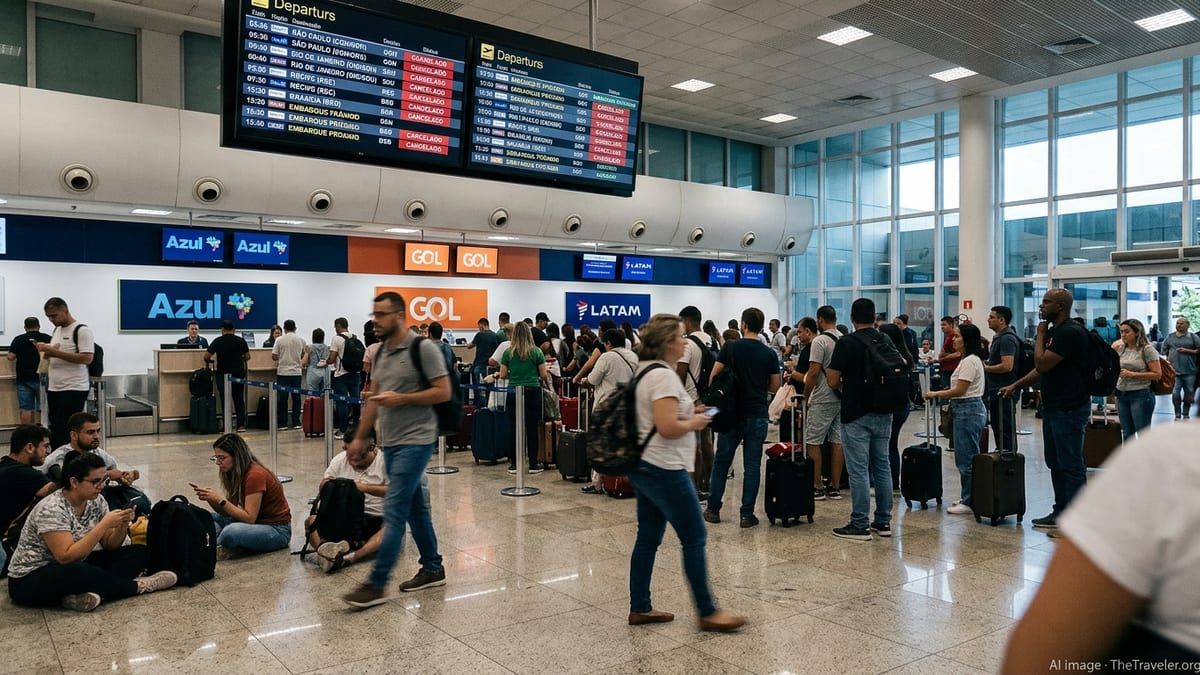
Targeted Cancellations Hit Brazil’s Busiest Corridors
Publicly available flight-tracking data and timetable information for late May 2026 point to a cluster of cancellations affecting a dozen departures on high-demand corridors, particularly those feeding into Porto Alegre and Belo Horizonte. The pattern includes domestic shuttle-type services from São Paulo and regional hubs, along with long-haul flights that connect Brazil to Europe and neighboring South American capitals.
In São Paulo, cancellations have been concentrated at Congonhas and Guarulhos, where TAM and Azul operate dense schedules to Porto Alegre, Belo Horizonte and secondary markets in the interior of São Paulo state. These routes function as vital links for business and connecting traffic, meaning that even a limited number of scrubbed flights can leave hundreds of travelers seeking last-minute alternatives.
Brasília and Campinas have also seen select Azul and TAM departures removed from schedules, particularly services that feed into Porto Alegre and Belo Horizonte. Industry coverage indicates that in several cases aircraft and crews were already operating tight rotations following earlier disruption in Brazil’s network, magnifying the effect of any further operational strain.
In Rio de Janeiro, cancellations on key departures to Porto Alegre, Belo Horizonte and onward long-haul services have added to congestion. Rio’s connections to southern Brazil are crucial for both leisure and corporate travelers, and a small number of canceled flights can quickly ripple into missed connections on international routes.
Domestic Routes to Porto Alegre, Belo Horizonte and Ribeirão Preto Disrupted
Porto Alegre, still in the process of stabilizing its air links after repeated bouts of regional disruption in recent months, has again emerged as one of the most affected endpoints. Selected TAM and Azul services from São Paulo and Brasília have been pulled from departure boards, according to real-time schedule aggregators, cutting capacity on what are normally among Brazil’s busiest city pairs.
Connections into Belo Horizonte have been similarly affected, with reports of Azul and TAM cancellations from Rio de Janeiro, São Paulo and Campinas. Publicly available data show that some of these flights were part of multi-leg journeys that also support connections toward the country’s northeast and international destinations, amplifying the number of travelers indirectly impacted.
Regional routes to Ribeirão Preto have not been spared. Coverage of the broader Brazil aviation situation in May 2026 describes Azul canceling multiple regional services that link interior cities, including Ribeirão Preto, to São Paulo and Campinas. These flights are typically operated by smaller aircraft on high-frequency schedules, so the loss of even a few rotations can significantly reduce options for same-day travel.
Airline scheduling tools suggest that in many cases the cancellations have been targeted at off-peak or duplicate frequencies, a common tactic used by carriers attempting to rebalance operations while limiting overall disruption. Even so, passengers booked on these flights are facing last-minute itinerary changes, longer connections and, in some instances, overnight stays while they wait for available seats on later departures.
International Links to London and Buenos Aires Affected
The disruption has also spilled into international markets. British Airways, which relies heavily on Brazilian feeder traffic from São Paulo and Rio de Janeiro to support its services to London, has adjusted schedules amid a wider pattern of cancellations and delays reported at its London Heathrow hub in late May 2026. Aviation news outlets covering British Airways’ operations describe several flights scrapped at Heathrow on May 23, part of a broader operational squeeze at the carrier.
According to long-term schedule data and real-time trackers, selected British Airways departures linking London with Rio de Janeiro and São Paulo have been affected at points during this period, with some flights operating under amended times and others removed from sale. For Brazilian travelers, this has meant reduced flexibility on transatlantic services and added pressure on remaining long-haul flights.
Links between Brazil and Buenos Aires have also seen indirect pressure. Trade and travel publications tracking South American aviation report Azul and TAM adjusting their regional cross-border operations as they navigate aircraft availability and crew constraints. While core links between São Paulo, Rio de Janeiro and Buenos Aires remain in place, the network reshuffle has made it harder for travelers from secondary Brazilian cities to secure smooth same-day connections into Argentina.
Aviation analysts note that international services often feel the knock-on effects of domestic cancellations, as late-arriving aircraft and out-of-position crews force schedulers to prioritize certain long-haul departures over others. In practice, this can translate into last-minute timetable changes and occasional cancellations on routes that depend heavily on inbound feeder traffic from across Brazil.
Operational Strains and Weather Leave Airlines Juggling Capacity
The cluster of cancellations comes against a backdrop of wider operational challenges in Brazil. In April 2026, national media and travel advisories documented a significant power failure at the São Paulo Area Control Centre that triggered a ground stop at Congonhas and Guarulhos and led to more than 200 cancellations and widespread delays across the country. That incident highlighted how vulnerable Brazil’s tightly interconnected air network can be to infrastructure shocks.
Since then, carriers such as TAM and Azul have been working to restore normal patterns while coping with seasonal weather disruptions, aircraft maintenance cycles and broader cost pressures. Commentary from aviation-focused outlets suggests that Brazilian airlines are increasingly resorting to tactical cancellations of selected frequencies in order to keep the remainder of their schedules running more reliably and to mitigate crew time limitations.
For British Airways, the cancellations in Brazil intersect with operational strains at its London base. Recent reporting on the carrier’s performance at Heathrow refers to a mix of technical issues, air traffic control restrictions and schedule realignments that have driven waves of cancellations and delays on both short-haul and long-haul routes. As a result, flights linking London with Brazil can be affected even when conditions in Brazilian airspace appear relatively stable.
Published analyses of airline strategy in 2026 also highlight how carriers are recalibrating capacity in response to fuel prices and demand trends. In some cases, airlines are choosing to thin out certain frequencies, consolidate passengers onto fewer flights and selectively reduce services to secondary cities, particularly where multiple daily options exist. The pattern emerging in Brazil aligns with that broader global trend.
Travelers Face Longer Delays and Limited Rerouting Options
For passengers booked on the affected TAM, Azul and British Airways flights, the immediate impact has been uncertainty and longer travel times. With multiple airlines trimming frequencies on overlapping routes, the traditional safety net of simply switching to another carrier on the same day is becoming less reliable, especially between smaller cities and major hubs.
Reports from consumer travel outlets and flight-tracking platforms show that some travelers have been rebooked onto later departures via alternative hubs, while others have opted to cancel or postpone trips altogether. In congested markets like São Paulo to Porto Alegre or Rio de Janeiro to Belo Horizonte, spare capacity on remaining flights has filled quickly, resulting in higher last-minute fares and more limited choice of departure times.
Industry guidance emphasizes the importance for travelers of monitoring their flight status frequently in the days and hours before departure, as same-day schedule changes remain a real possibility. Passengers are also being advised to allow extra connection time, particularly when linking domestic Brazilian flights with long-haul services to destinations such as London and Buenos Aires that are more vulnerable to cascading delays.
As Brazil’s aviation sector heads into the coming weeks, airlines are expected to continue making rolling adjustments to timetables while trying to stabilize operations. For now, the pattern of targeted cancellations across TAM, Azul and British Airways illustrates how even a relatively small number of scrapped flights can have outsized consequences across an already stretched domestic and international network.