


More news on this day
Austria has approved a tighter six-year rail investment framework that preserves funding for access routes to the Brenner Base Tunnel, signaling a clear commitment to shifting freight and passengers off the overburdened Brenner motorway and onto rail despite national budget consolidation.
Get the latest news straight to your inbox!
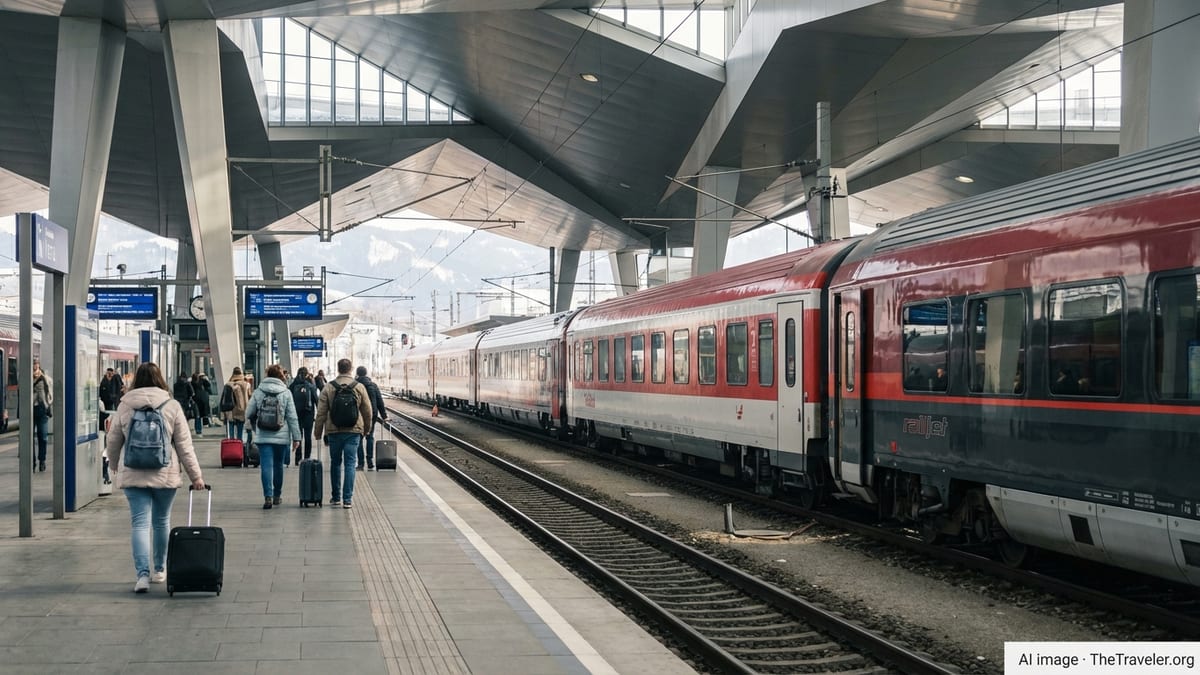
Lean framework, strong focus on key corridors
Publicly available information shows that Austrian Federal Railways has adopted a 19.5 billion euro framework plan for infrastructure investment covering the years 2027 to 2032, alongside several billion euros for maintenance and renewals. Reports indicate that the federal government, which is seeking significant savings in the national budget, has nonetheless kept rail spending at a comparatively high level.
Within this framework, the Brenner axis features as one of the country’s strategic corridors, alongside other major Alpine and east–west routes. The plan tightens priorities compared with earlier cycles, concentrating funds on projects that improve capacity, reliability and cross-border connectivity rather than dispersing investment across a wider range of smaller schemes.
According to published coverage, the consolidated approach is intended to ensure that every major project already underway will be completed, while some future works are delayed or re-sequenced. This mix of budget restraint and targeted spending has made the status of the Brenner access routes a key test of Austria’s long-term rail strategy.
Brenner access protected amid budget consolidation
Austria’s decision to safeguard Brenner-related rail investment comes at a moment of heightened debate over freight traffic in the Alps. Recent demonstrations and a one-day blockade of the Brenner motorway highlighted deep local frustration over noise, congestion and pollution from heavy trucks on the north–south corridor. At the same time, road traffic statistics underline that the route remains one of Europe’s busiest alpine crossings.
According to recent rail planning documents and corporate reporting, upgrades in the Tyrolean lowlands and along the Munich–Verona core network corridor are explicitly framed as measures to strengthen the northern approach to the Brenner Base Tunnel. These works include track expansions, passing loops, and signalling improvements designed to handle longer and heavier freight trains once the base tunnel becomes operational.
By confirming the Brenner access schemes within the new six-year framework, Austria is effectively ringfencing them from the most severe effects of fiscal consolidation. Industry observers note that projects further from international corridors have faced more scrutiny, while the Brenner route continues to be described in official material as essential for climate targets and European Union transport policy.
Alpine megaprojects advance in parallel
The safeguarding of Brenner access is part of a wider pattern in which Austria continues to prioritize large-scale rail infrastructure beneath and across the Alps. Recent reports describe steady progress on the Semmering Base Tunnel, where a first complete through passage has already taken place, and on the Koralm Railway, which has begun hosting new open-access passenger services.
Corporate disclosures for 2023 and 2024 show that the Brenner Base Tunnel, Semmering Base Tunnel and Koralm Railway remain grouped as flagship projects within Austria’s long-term rail portfolio. Together, they are intended to remove bottlenecks on both north–south and east–west axes, cut journey times, and make rail more competitive with long-distance road transport.
In this context, securing funding for the northern access to Brenner is seen as necessary to ensure that the tunnel’s eventual capacity can be fully utilized. Without upgraded approach routes on the Austrian side, the benefits of the new base tunnel for both freight and passenger traffic would be significantly reduced.
European freight flows and German delays
The Brenner Base Tunnel forms part of the Scandinavian–Mediterranean core network corridor, one of the European Union’s most important freight and passenger routes. Public information from rail infrastructure operators highlights that Austria, Italy and the EU view the tunnel and its access lines as key to shifting long-haul freight from road to rail between Germany, Austria and northern Italy.
However, published coverage and public debate frequently point to delays on the German side of the corridor, where planning for new approach lines south of Munich has been slower and more contested. This has raised concerns that, once the Brenner Base Tunnel opens, capacity constraints north of the Austrian border could limit the full potential of the investment.
Within this broader European context, the Austrian six-year framework can be seen as an effort to keep its own commitments on schedule, while relying on ongoing cross-border coordination to resolve bottlenecks further north. Maintaining momentum on the Austrian access routes is presented as a way to ensure that, once partner countries complete their sections, the corridor can offer a continuous high-capacity rail spine across the Alps.
Implications for travelers and logistics
For long-distance travelers, the confirmation of Brenner access funding indicates that future rail journeys between Austria and Italy are likely to become faster and more reliable over the next decade. While the base tunnel itself is not expected to open for several years, incremental upgrades on existing lines and related projects are already improving punctuality and capacity on some sections of the network.
For freight operators, the new framework suggests greater certainty that high-capacity rail paths through the Alps will be available once construction is complete. This is particularly relevant for logistics companies under pressure to cut emissions and reduce their reliance on road haulage along congested alpine motorways.
For communities in Tyrol and along the wider corridor, the focus on Brenner rail access is portrayed in public documents as a central part of efforts to reduce local environmental burdens. By channeling more heavy goods traffic onto rail, Austria aims to balance its role as a major north–south transit country with stronger protections for residents in sensitive mountain regions.