


Brisbane’s Airtrain is the dedicated rail link between Brisbane Airport, the city and the Gold Coast, and for many visitors it is the first piece of Australian public transport they encounter. Knowing how the airport stations work, how to pay, and when Airtrain is actually the best-value option can save both money and stress as you step off a long flight. This guide walks you through the full journey, from the Domestic and International terminals into Brisbane’s CBD and onward to the Gold Coast.
Get the latest updates straight to your inbox!
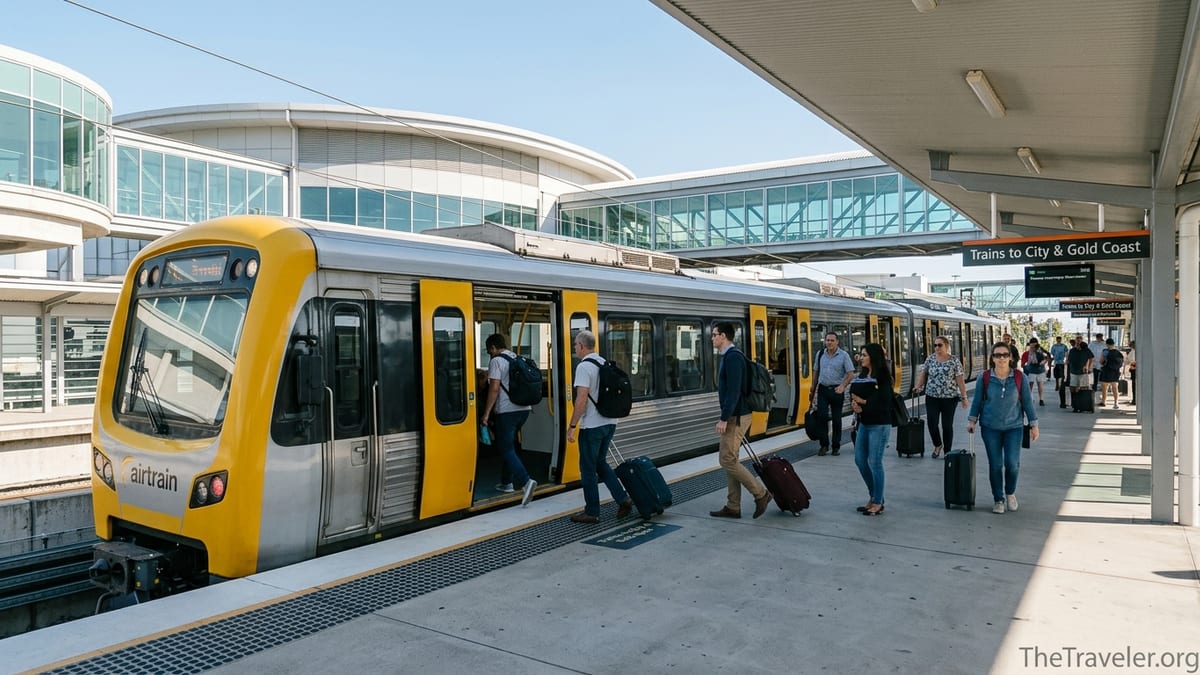
How Brisbane Airport Airtrain Works
Airtrain is a privately operated rail service that runs on Queensland Rail’s suburban tracks between Brisbane Airport and the wider network. Trains start at the Domestic and International Airport stations and continue through Brisbane’s northern suburbs into the city, before many services carry on south towards the Gold Coast. On a typical weekday, first services leave the airport in the early morning and continue into the late evening, meeting the great majority of flights arriving and departing from Brisbane.
The headline advantage is predictability. Travel time between Brisbane Airport and Central station in the CBD is around 20 minutes on an express service, compared with roughly 25 to 40 minutes by taxi or rideshare depending on traffic. Services run roughly every 15 minutes in peak times and every 30 minutes in off-peak periods, so even if you miss a train at the platform with your luggage, you are rarely waiting long for the next one.
Because Airtrain is integrated with the wider Translink network, it behaves like a regular suburban train once you leave the airport precinct. The key difference is that the two Airport stations attract a special premium fare. This means the cost from the terminals to the city is higher than a standard suburban journey of a similar distance, but once you are beyond Eagle Junction, you pay usual South East Queensland train fares for the rest of your trip.
A practical example helps illustrate this. A couple arriving at Brisbane International in the morning can board Airtrain and be at Roma Street station, adjacent to many CBD hotels and long-distance bus and train services, in around 23 minutes. From Roma Street, they can switch to a suburban train for South Bank or a bus to West End using the same payment method they tapped on with at the airport.
Brisbane Airport Stations: Domestic and International
Brisbane Airport has two separate terminals, each with its own Airtrain station: Domestic Airport station and International Airport station. Both are elevated stations connected directly to the terminals by covered walkways and lifts, so you do not need to leave the airport precinct or cross busy roads with suitcases. Signage inside each terminal clearly points to “Trains to City” or “Airtrain,” guiding you toward the station concourse.
At the International Terminal, the station sits beside the main terminal building. After clearing customs and baggage claim, you take the public arrivals exit, follow signs for “Train” and “Airtrain,” and ride the escalators or lifts up to the station. This route is short enough that travelers with roll-aboard luggage can manage it easily, and there are trolleys available in the terminal itself, though they cannot be taken onto the train platforms or into the carriages.
At the Domestic Terminal, the Airtrain station is located at the city-facing side of the building, linked by an elevated walkway. If you arrive on a Qantas, Virgin Australia or Jetstar domestic flight, you simply exit the secure area, follow signs for trains and walk a few minutes to the station. The path is step-free, with lifts provided, which is important for families with prams or travelers using wheelchairs or mobility aids.
Trains shuttle between the two airport stations and the city, so if you are transferring between Domestic and International terminals and do not want to use the free terminal transfer bus, you can ride one stop on the Airtrain instead. In practice, most people with a lot of luggage or on a tight connection choose the bus, since it is complimentary, but the train is a simple backup if the bus is crowded and you already have a valid ticket or contactless card ready to use.
Tickets, Fares and How to Pay
Airtrain uses the same ticketing system as the wider South East Queensland public transport network, which means you can pay with a go card, compatible smart ticket such as the newer Translink digital card, or by tapping on and off with a contactless Visa or Mastercard. This contactless option is particularly handy for short-stay visitors who do not want to buy and later refund or top up a dedicated transit card. You tap your card or digital wallet on the reader at the station gate before you board and tap off when you arrive at your destination.
Because the airport segment carries a premium, fares from the airport to the city are more expensive than a normal suburban trip of similar length, although occasional promotional discounts or temporary government subsidies can reduce the cost for certain periods. As a general guide, a one-way adult fare from the airport to Brisbane Central on Airtrain is typically comparable to what you might pay for a shared shuttle service, and significantly cheaper than a private taxi for a solo traveler. For two or more adults, taxis and rideshares can start to become cost-competitive, especially off-peak or late at night, though they remain exposed to traffic delays.
You can also pre-purchase Airtrain tickets online or via partner airlines and travel agencies. Advance purchase sometimes offers modest savings or bundled deals, for example return fares between the airport and Gold Coast stations that are cheaper than buying each leg separately. A typical real-world example is a family of four booking an Airtrain and tram package from Brisbane Airport to Surfers Paradise, paying one combined fare per person that covers both the train to Helensvale and the G:link tram to Cavill Avenue.
Children, pensioners and some concession card holders are generally eligible for discounted or capped fares on the network. For instance, a local Brisbane family with two school-age children might choose to use their existing go cards for the kids when heading to the airport for a holiday, tapping on at their nearest suburban station and off at Domestic Airport. They pay the standard Airtrain premium, but avoid airport parking or taxi charges altogether, and their total cost is predictable before they leave home.
Brisbane City Stations and Choosing the Best Stop
Once your Airtrain departs the airport, it heads into Brisbane’s northern suburbs before reaching the CBD. The main city stations used by visitors are Fortitude Valley, Central, Roma Street, South Brisbane and South Bank. All of these are on the Airport line and are connected to major accommodation and attractions, so it pays to know which stop lines up best with where you are staying.
Central station is the heart of Brisbane’s CBD and the default choice for many travelers. It sits under Anzac Square and is within walking distance of offices, riverside paths and a large number of business hotels. If you are staying in the Queen Street Mall or Spring Hill areas, alighting at Central usually means the shortest walk or taxi hop to your accommodation. For example, a business traveler with a bag and laptop can ride Airtrain to Central and be checking into a hotel near the mall in under 40 minutes from flight arrival, assuming a smooth exit through baggage claim.
Roma Street is particularly useful if you are continuing by long-distance train or coach, or staying in the western edge of the CBD or in the Barracks precinct. The station is directly connected to the main coach terminal and long-distance Queensland Rail platforms, so someone flying into Brisbane and catching an evening train to Rockhampton or Cairns can do the entire transfer via Airtrain and a short walk on the concourse without needing any road transport.
For leisure visitors, South Brisbane and South Bank stations put you right next to the Brisbane Convention & Exhibition Centre, Queensland Performing Arts Centre, museums and galleries, and the riverside parklands. A couple on a city break might ride Airtrain to South Brisbane, check into a hotel overlooking the river and walk to dinner in South Bank within minutes. Fortitude Valley is the best pick for nightlife and dining in the Valley and James Street precincts, as well as many boutique and budget hotels.
Luggage, Accessibility and Onboard Experience
Airtrain services are modern suburban-style trains with dedicated luggage spaces and open vestibule areas near the doors. Standard suitcases, backpacks and cabin bags fit easily in the overhead racks or luggage zones, while items like prams and golf clubs can be placed in the multi-purpose spaces. Oversized gear such as surfboards or large bicycles may not be accepted on all services or at all times, so it is wise to check the current policy before you travel if you are carrying sports equipment.
Airport trolleys are not allowed onto the Airtrain platforms or inside carriages, so you must be able to move your own bags once you leave the terminal building. This is rarely an issue for travelers with wheeled suitcases, but it is something to bear in mind if you typically rely on a trolley all the way to the curb. Lockers and paid luggage storage are available within the airport precinct if you need to store bags for a few hours before heading into the city, for example during a long daytime layover.
From an accessibility perspective, both airport stations were designed with step-free access. Lifts connect the concourse, platforms and terminal walkways, and train floors align closely with platform height, making boarding easier for people using wheelchairs or mobility devices. Onboard, there are designated wheelchair spaces and priority seating areas, as well as audio announcements that call out upcoming stations. A traveler using a wheelchair, for instance, can independently board at International Airport station, ride to South Bank and continue to the riverside precinct without needing to transfer to a taxi.
The travel experience itself is usually quiet and comfortable, particularly outside of peak commuter times. Air-conditioning is standard, and many seats are arranged in a mix of forward-facing and group bays. Unlike an airport shuttle bus, there is no luggage handling by staff, so you retain responsibility for keeping your bags near you. For safety and comfort, food and drink should be consumed with care, and pets other than registered assistance animals are generally not permitted.
Gold Coast Connections: Airtrain, Helensvale and the G:link Tram
For travelers heading straight from Brisbane Airport to the beaches of the Gold Coast, Airtrain provides a convenient rail corridor combined with the G:link light rail tram. Most airport services travel south through the city toward Helensvale station, where you can transfer directly to the Gold Coast tram network. From Helensvale, trams run through Parkwood and Southport before continuing to Surfers Paradise and terminating at Broadbeach South.
A common routing for visitors is Brisbane Airport to Helensvale by Airtrain, then G:link to Surfers Paradise, arriving at Cavill Avenue or Surfers Paradise station. In practice, this feels like a single continuous journey: you step off the train at Helensvale, walk a short distance across the shared concourse, tap on at the tram platform and board the next service. Because both modes fall under Translink ticketing, contactless payment and go cards can cover the entire trip, and packaged “Airtrain and Tram” tickets are often sold specifically for this route.
Travel time from Brisbane Airport to Surfers Paradise via Airtrain and tram is typically around 1 hour and 45 minutes to 2 hours, depending on connections at Helensvale. Compared with driving the same route, which can take anywhere from 60 minutes in light traffic to well over 90 minutes during holiday peaks, the train and tram combination offers consistent timings and removes the need to navigate the Pacific Motorway. For solo visitors or couples, the price is often significantly lower than booking a private transfer from the airport all the way to a Gold Coast hotel.
The Gold Coast line continues past Helensvale to stations such as Nerang, Robina and Varsity Lakes. Some travelers prefer to disembark at a heavy rail station closer to their final destination and connect by bus or rideshare. For example, someone staying in Burleigh Heads might ride Airtrain to Robina, then take a short taxi ride east to the coast. Families staying near Broadbeach, on the other hand, often find the Helensvale and tram combination more convenient, since the tram delivers them directly into the heart of the tourist strip without the need for a car.
When Airtrain Is Worth It – And When It Isn’t
Whether Airtrain is the best option for your trip depends on several practical factors: time of day, number of people traveling together, how much luggage you have and where exactly you are staying. For a single traveler or a couple heading to a CBD hotel during the day, Airtrain is usually a strong choice. The journey time is predictable, the cost is lower than a taxi or rideshare in most cases, and you avoid potential congestion on the roads around the airport and through the northern suburbs.
Airtrain is also compelling if you are comfortable with public transport and your accommodation is very close to a station. A backpacker staying in Fortitude Valley, for instance, can ride straight from the airport to Fortitude Valley station and walk a few blocks to a hostel, avoiding both road transfers and the need to navigate with a car after a long flight. Likewise, a delegate attending a conference at South Bank can go from Domestic Airport station to South Brisbane, walk across to the convention centre and check into a nearby hotel in a single, step-free journey.
The calculus can change for larger groups or people with substantial luggage. A family of five with three large suitcases and carry-ons, arriving late at night and staying in an inner-suburban Airbnb with no train station nearby, may find that the combined cost of Airtrain tickets plus a connecting taxi or rideshare is close to, or even higher than, simply booking one larger Uber or taxi for the entire route. Similarly, travelers with surfboards, bulky musical instruments or multiple bikes may decide that a private shuttle or rental car offers more flexibility than juggling gear on the train.
It is worth checking live service updates before you commit, particularly during major events or trackwork periods. Occasionally, weekend engineering works can temporarily affect services between the airport, the city and the Gold Coast, replacing part of the trip with buses. In those cases, Airtrain will usually advertise the changes in advance, and you can decide whether a road-based transfer might be simpler on the affected dates. As a general rule, if your priority is a fast, predictable trip and you are happy to manage your own bags on and off a train, Airtrain is often worth it. If door-to-door convenience, multiple children or mobility challenges are the main concerns, a taxi, rideshare or pre-booked shuttle can be a better fit.
The Takeaway
Brisbane’s Airtrain offers a fast, straightforward link between Brisbane Airport, the CBD and the Gold Coast, and for many visitors it strikes the right balance between cost and convenience. With clearly signposted stations at both Domestic and International terminals, regular services throughout the day and integrated ticketing with the wider transport network, it is relatively easy to step off a flight and be in the city around 20 minutes later.
Understanding your options in advance helps you decide whether the train is the right choice for your circumstances. Solo travelers, business visitors and couples staying near city or Gold Coast rail and tram stops are often well served by Airtrain, while larger groups, those with very bulky luggage or people staying far from stations may prefer a taxi or rideshare instead. By weighing your group size, baggage and final destination against fare costs and travel time, you can choose the airport transfer that best matches your trip.
FAQ
Q1. How long does the Airtrain take from Brisbane Airport to the city?
The typical journey from either Brisbane Domestic or International Airport station to Central station in the CBD takes around 20 minutes on an express service, with a few extra minutes to Roma Street, South Brisbane or South Bank depending on where you choose to get off.
Q2. How often do Airtrain services run from Brisbane Airport?
Airtrain services generally run every 15 minutes during weekday peak times and every 30 minutes at off-peak times, including weekends and public holidays, with early morning first services and late evening last services that meet most flight arrivals and departures.
Q3. Can I use a contactless credit or debit card on Airtrain?
Yes, you can usually tap on and off Airtrain with a contactless Visa or Mastercard, including many digital wallets on phones and smartwatches, making it convenient for visitors who do not want to buy a separate go card or local transport smartcard for a short stay.
Q4. Is Airtrain cheaper than a taxi from Brisbane Airport to the CBD?
For solo travelers or couples, Airtrain is often cheaper than taking a taxi or rideshare, especially during peak traffic times, though for larger groups sharing one vehicle, the total cost of a taxi or rideshare can be comparable or sometimes lower than buying individual train tickets.
Q5. How do I get from Brisbane Airport to Surfers Paradise on the Gold Coast by train?
The most common route is to take Airtrain from Brisbane Airport to Helensvale station, then transfer to the G:link tram and ride to Surfers Paradise stops such as Cavill Avenue, with the whole trip usually taking around 1 hour and 45 minutes to 2 hours.
Q6. Is there space for luggage on Airtrain?
Yes, Airtrain carriages have dedicated luggage areas and open spaces near the doors where you can store suitcases and prams, though airport trolleys are not allowed on board and you must be able to manage your own bags on and off the train.
Q7. Are the Brisbane Airport Airtrain stations accessible for wheelchairs?
Both Domestic and International Airport stations were built with accessibility in mind, offering lifts, step-free access between terminal and platforms and designated wheelchair spaces on board, so travelers using mobility aids can usually complete the journey without additional assistance.
Q8. Do I need to book Airtrain tickets in advance?
You do not need to book in advance to ride Airtrain, as you can simply tap on with contactless payment at the station, but some travelers choose to pre-purchase tickets or return fares online when they want a fixed price lined up before arrival.
Q9. Does Airtrain run late at night or early in the morning?
Airtrain operates from early morning to late evening, covering the bulk of scheduled flights, but it does not usually operate overnight, so for very early or very late flights you may need to check the timetable and consider a taxi, rideshare or shuttle if trains are not running.
Q10. What happens if there is trackwork or disruption on the Airtrain route?
When there is planned trackwork or another disruption, part of the route may be replaced by buses or have altered departure times, and in those cases checking for service updates before you travel will help you decide whether to adjust your plans or choose an alternative transfer option.