


Brisbane Airport was one of the first major Australian airports to formally embrace app-based rideshare pickups, and today it is one of the easiest places in Queensland to meet an Uber, DiDi, Ola or Shebah driver. The catch is that you must go to specific pickup zones at both the Domestic and International terminals, and there are airport access fees and local quirks that can surprise first-time visitors. This guide walks you through exactly where to go, what it typically costs, how much luggage you can realistically manage, and when a taxi or train might actually be the better choice.
Get the latest updates straight to your inbox!
Rideshare at Brisbane Airport in 2026: What You Need to Know First
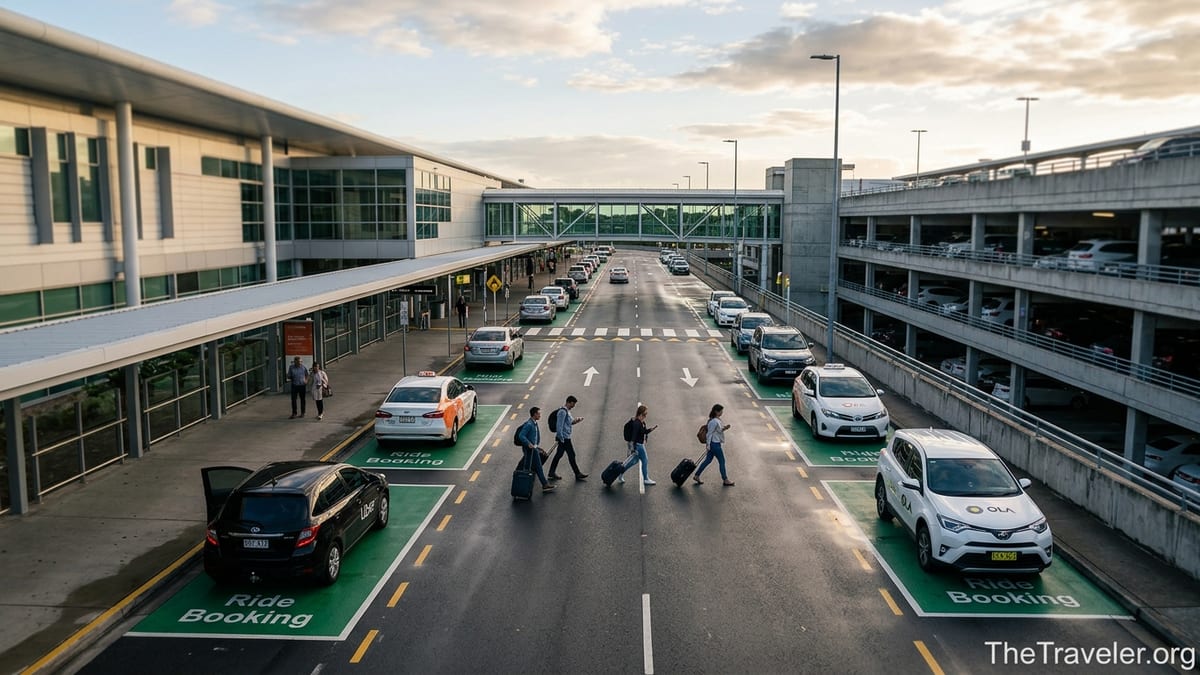
Brisbane Airport serves millions of domestic and international passengers each year, and most of them land at one of two terminals: the Domestic Terminal for flights within Australia and the International Terminal for overseas services. Both terminals have designated rideshare pickup areas for services such as Uber, DiDi, Ola and Shebah. You cannot legally meet your driver right outside the arrivals doors in the same way you might hail a taxi. Instead, you must follow the green rideshare signs to a specific zone, or your driver risks a fine and possible airport ban.
Rideshare trips from the airport attract an additional airport access fee. As of mid‑2026, Brisbane Airport advises that a rideshare fee of just under five Australian dollars is added to your fare when you are picked up at either terminal. This fee appears automatically in your app price estimate. Some travellers posting online have reported occasionally seeing the fee itemised twice in their Uber receipts, which is usually an error that can be disputed through in‑app support. In practical terms, when you request a ride quoted at around 55 Australian dollars to the central business district, you can expect to pay roughly 60 Australian dollars once the airport fee and any road tolls are applied.
All major rideshare operators are permitted to pick up at Brisbane Airport, but availability and pricing can vary by time of day. Uber remains the most widely used, particularly for airport trips, with UberX and Uber Comfort being common options. DiDi and Ola often promote slightly lower base fares but may have fewer cars late at night or early in the morning. Shebah, which focuses on women and children, operates on a pre‑booked model and can be a reassuring option for solo travellers arriving on a late flight, though you may pay more than you would for a standard UberX at off‑peak times.
For most visitors, the choice between rideshare and taxi comes down to cost versus convenience. Taxis wait directly outside the terminals and do not require you to navigate the car parks or skywalks. However, locals frequently report taxi fares from the airport to central Brisbane that are noticeably higher than Uber or DiDi for the same trip. On the other hand, if you are arriving during a major event or a summer storm when surge pricing is severe, a metered taxi or the Airtrain into the city can easily become the cheaper and faster option.
Domestic vs International: Finding the Right Pickup Zone
The Domestic Terminal at Brisbane is spread along a single long forecourt shared by Qantas, Virgin Australia and other domestic carriers. Rideshare pickups do not occur directly outside the terminal doors. Instead, you follow the green rideshare and "Ride Booking" signs towards the multi‑level car parks and central road area. Updated maps from 2025 show the rideshare zone positioned on the central road between the taxi rank and the general passenger drop‑off lanes, just beyond the covered skywalk that links the terminal to the P1 and P2 car parks. In practice, after reaching the baggage claim carousel, you walk outside, cross the road via the skywalk, then take the lift or travelator down to ground level following the rideshare signs.
At the International Terminal, the layout is vertically stacked over several levels, which can be confusing when you are jetlagged. International arrivals exit onto Level 2. From here, the official advice is to turn left at the arrivals hall and follow the signs towards buses, coaches and rideshare. You will head down a ramp or escalator towards the lower level and out towards the bus and coach bays on the terminal’s northern side. Some third‑party guides describe the official rideshare zone as being effectively alongside the bus and coach pickup area, separated from the main taxi rank that sits near the arrivals road. The walk typically takes 3 to 5 minutes from the customs exit if you have light luggage.
In both terminals, you are expected to be at or very near the pickup bay listed in your app before you request your trip. If you order your car while you are still in the immigration queue or waiting for luggage, the driver may arrive at the bay long before you and be forced to circle or exit the paid road system, which can cause cancellations or extra charges. A practical routine that Brisbane regulars use is to collect bags, walk all the way to the signed rideshare zone, check which row or lettered bay matches their app, then request the car. By the time the driver joins the airport’s internal loop road and clears the boom gate, you are usually in place, saving everyone time and frustration.
Each pickup bay at Brisbane Airport is clearly numbered or lettered, and the rideshare apps typically specify the exact bay where your driver will stop, such as "Bay 3" or "Zone B." When the area is busy, as it often is around 8 am domestic arrivals or late‑afternoon international banks, you may see long lines of rideshare vehicles. Do not attempt to jump into a random car; instead, check the license plate and car model in your app. Airport security staff routinely patrol the zone and can move on drivers who idle for too long or attempt pickups outside the authorised areas.
Uber, DiDi, Ola and Shebah: How the Apps Work at BNE
From a passenger’s perspective, using Uber, DiDi, Ola or Shebah at Brisbane Airport is the same as using them anywhere else in Australia. You open the app, set your pickup point to the correct terminal rideshare zone and request a ride. The important nuance is that the apps are tightly geofenced. If you attempt to pin your pickup at the general curbside or at a bus bay, the app will usually snap your location back to the approved rideshare zone, which is where your driver will be sent. Some locals deliberately move the pin a short distance away to avoid congestion but then message the driver with clear instructions if they are waiting at a nearby hotel shuttle stop or under a particular sign.
Uber offers several service tiers at Brisbane Airport, including UberX, Uber Comfort, UberXL and, at busier times, more premium options such as Uber Premier. A solo traveller heading from the Domestic Terminal to a hotel near Queen Street Mall in the CBD might see a mid‑afternoon UberX estimate of around 45 to 55 Australian dollars, while an Uber Comfort with a newer, roomier vehicle might be closer to 60 to 70 Australian dollars. UberXL is typically chosen by families or small groups with multiple suitcases; a group of four adults with two large checked bags and two carry‑ons can usually fit comfortably in an UberXL if they are willing to rest some bags on laps for the 20‑to‑25‑minute drive.
DiDi and Ola operate similarly, though their market share in Brisbane is smaller than Uber’s. At quiet times, both apps can undercut Uber’s price by a few dollars on a CBD trip, but vehicle availability may be patchier very late at night or in outer suburbs like Logan or Redcliffe. Many Brisbane residents keep all three apps installed and simply check which shows a driver within 5 minutes and a reasonable price. For example, at 9 pm on a Wednesday, you might see an UberX estimate of 52 Australian dollars with a 6‑minute wait, a DiDi estimate of 48 Australian dollars also with a 6‑minute wait, and Ola offering 49 Australian dollars but with no drivers visible nearby.
Shebah focuses on women and children and usually requires pre‑booking, which makes it an appealing choice if you know you will arrive on a late‑night international flight and want a consistent driver experience. A woman flying solo from the International Terminal to an inner‑west suburb like Toowong might book a Shebah ride scheduled for 45 minutes after her flight’s scheduled landing time, giving leeway for immigration and baggage. Fares may be slightly higher than a comparable UberX, but many passengers view the trade‑off as worthwhile for the additional sense of security, particularly if they are unfamiliar with Brisbane or arriving after midnight.
Pricing, Surcharges and Real‑World Trip Examples
Base pricing for rideshare trips from Brisbane Airport factors in distance, time, demand and the airport access fee. Because Queensland regulates maximum taxi fares but not rideshare pricing, the apps can adjust prices more dynamically than taxis, especially during peak demand. As a rule of thumb, a standard UberX or DiDi from the Domestic Terminal to the Brisbane CBD on a normal weekday outside of peak hours might cost around 45 to 60 Australian dollars, including the airport surcharge and any tolls. Taxi users making the same trip have reported paying upwards of 70 to 80 Australian dollars once the meter, airport access fee and optional toll road are accounted for, though exact amounts depend on traffic and route.
For longer journeys, app fares can be significantly cheaper than taxis. Travellers heading south to the Gold Coast from Brisbane Airport commonly see mid‑range UberX quotes in the 120 to 160 Australian dollar range when traffic is light, while taxis can easily run higher due to the combination of distance and time on the meter. On the other hand, a very short ride, such as from the International Terminal to a nearby airport hotel, can feel expensive in any mode. Locals have shared examples of 5‑minute taxi rides from the International Terminal to the Novotel Brisbane Airport costing over 25 Australian dollars, which is largely a function of fixed airport access charges and minimum fares.
Surge pricing is the main variable that can upend these rules of thumb. During severe storms, major concerts at venues like Suncorp Stadium, or big sporting events, multiplier pricing can drive an UberX fare from the airport to the CBD from around 55 Australian dollars up towards 90 Australian dollars or more. In those circumstances, the regulated taxi meter or the fixed‑price Airtrain can become more attractive, especially for solo travellers. If you arrive to find your rideshare app quoting unusually high prices, it is worth checking the Airtrain timetable or walking to the taxi rank to compare options before confirming.
The airport access fee itself is applied on top of the app’s base calculation. For example, if your app shows a base fare of 50 Australian dollars and the airport fee is around 5 Australian dollars, you will see a final estimated fare of about 55 Australian dollars before any tolls. Some online reports mention potential double‑charging of the fee when drivers pass certain boom gates more than once, particularly at the International Terminal where the rideshare area is integrated with bus and coach access roads. If you suspect this has happened, take a screenshot of your receipt and submit it via the app’s help section; in most reported cases, the extra fee has been refunded.
Luggage, Group Size and Choosing the Right Vehicle
Brisbane Airport is a major gateway for holidaymakers heading to the Gold Coast, Sunshine Coast and inland regions, which means many passengers arrive with surfboards, golf bags, prams and oversized suitcases. Not every rideshare vehicle can handle this volume of luggage comfortably. Standard options like UberX, basic DiDi and Ola sedans are best for one to three adults with carry‑on bags and perhaps one medium checked suitcase. If you are travelling as a family of four with two large suitcases and a stroller, you will be more comfortable requesting an UberXL or equivalent large vehicle option where available.
As a practical example, consider a family of two adults and two children arriving on a morning flight from Melbourne with two large checked bags, two carry‑ons and a folded stroller. If they book an UberX from the Domestic Terminal to a hotel in South Bank, the driver may struggle to fit everything in the boot and back seat. Upgrading to UberXL might add roughly 20 Australian dollars to the fare, but it greatly reduces the risk of having to refuse a car or repack luggage at the kerb. Similarly, a group of four adults heading straight from the International Terminal to the Sunshine Coast with three surfboard bags should look at pre‑booking a private shuttle or using an app’s "maxi" or "van" category, as many standard rideshare vehicles will not take exposed sporting gear that cannot be safely secured.
Car seats are another consideration. Queensland law requires appropriate child restraints for young passengers, but most rideshare drivers do not carry spare car seats due to space and liability issues. Shebah is one of the few services that explicitly offers child seats for pre‑booked trips, which can be invaluable for families arriving with infants or toddlers who do not wish to travel with bulky restraints. If you rely on Shebah, build in a buffer of at least 30 to 45 minutes after your scheduled landing to allow for delays through immigration and luggage collection, and confirm car seat requirements in the booking notes.
Finally, keep your own physical limits in mind. The walk from the Domestic baggage carousel to the rideshare pickup area involves escalators, lifts and occasionally crowded walkways, which can be challenging if you are juggling multiple heavy bags or have mobility restrictions. In such cases, paying slightly more for a taxi that collects you just outside arrivals may be the more comfortable and safer option, particularly late at night or in wet weather when surfaces can be slippery.
Taxi Ranks, Airtrain and Other Alternatives to Rideshare
Taxi ranks at Brisbane Airport are located directly outside both the Domestic and International terminals. They are clearly signed and typically staffed, with taxis queuing under covered areas close to the main exits. Fares are metered according to Queensland’s maximum fare regulations, and an airport surcharge is added when you depart from the airport ranks. For a solo business traveller heading to an address in the inner city during the afternoon, a taxi can be the least complicated option: you walk out of the terminal, join the taxi queue and are en route within minutes, without needing to find the rideshare zone or worry about device battery or mobile data.
For travellers focused on budget, however, taxis are often more expensive than rideshare for the same route, especially over medium distances where time-based metering accumulates quickly. Many Brisbane locals report taxi fares from the airport to inner‑south suburbs like Woolloongabba quoting around 80 Australian dollars or more, compared with rideshare quotes in the 50 to 60 Australian dollar range at similar times. On very short hops to nearby airport hotels, minimum fares and access charges can make taxis feel especially pricey, sometimes approaching 25 to 30 Australian dollars for journeys of less than ten minutes door to door.
The Airtrain offers a predictable and sometimes cheaper alternative, particularly during peaks when rideshare surge pricing is high. The train runs between the airport and central stations such as Fortitude Valley, Central and Roma Street. Fares vary by time and promotions, but for a solo traveller heading to a hotel near Central Station during the daytime, Airtrain plus a short walk or local bus can be less than half the cost of a taxi and often cheaper than Uber if surge pricing is active. For couples or families, the value calculation depends on group discounts and how many onward transfers are required after the train.
Other options include private hotel or airport parking shuttles and pre‑booked shared minibuses to destinations like the Gold Coast. Off‑airport car parks near the Domestic Terminal run frequent courtesy shuttles that collect passengers from designated pickup zones once they call or tap a "pick up" button in an app. These services are most useful for residents who have parked their cars near the airport for a trip away, but some also sell point‑to‑point transfers. If you are travelling in a group of six or more with heavy luggage, a pre‑booked private van transfer can be comparable in price to taking two separate rideshares, while offering the convenience of a single vehicle and coordinated luggage handling.
Timing, Safety and Local Tips for a Smooth Pickup
Timing your rideshare request is one of the easiest ways to improve your experience at Brisbane Airport. As a rule, request your vehicle only after you have collected your luggage and are within a couple of minutes’ walk of the rideshare bays. This avoids cancelled trips and extra waiting charges. Domestic passengers with only hand luggage can usually reach the Domestic rideshare area within five to eight minutes of stepping off the aircraft, while international passengers should allow at least 30 to 60 minutes after scheduled landing for immigration, baggage and the walk to the buses and rideshare zone.
Safety is generally strong at Brisbane Airport, but basic common sense goes a long way. Always confirm the license plate, vehicle make and driver name displayed in your app before getting into a car. If anyone approaches you in the terminal offering a "cheap ride" or asking you to cancel your app booking and pay cash, decline politely and move on. Official rideshare, taxi and train options are all regulated or monitored, whereas informal cash rides may not be insured or authorised to operate at the airport.
Weather is another practical factor. Brisbane’s subtropical climate brings sudden storms, especially in summer afternoons. The rideshare zones are partially covered, but heavy rain can still blow sideways, making it uncomfortable to wait with luggage. If you arrive during a downpour and see surge pricing climbing, it may be worth heading straight to the taxi rank under its more extensive shelter or taking the Airtrain if your destination is near a station. Conversely, on clear, mild evenings, the short walk to the rideshare pickup area from either terminal is easy and often faster than queueing at a busy taxi rank.
Local riders also suggest having a backup plan for late‑night arrivals. After midnight, especially midweek, rideshare supply can thin out. If your flight is scheduled to land at 1 am and then suffers delays, you may find yourself in the terminal around 2 or 3 am with few cars available in any app. Before you travel, check that your accommodation is comfortable with very late check‑ins and note down the location of taxi ranks and the first Airtrain departure of the morning in case your rideshare options are limited.
The Takeaway
For most travellers, rideshare is the sweet spot between cost and convenience when leaving Brisbane Airport. Uber, DiDi, Ola and Shebah are all authorised to pick up at both the Domestic and International terminals, and the airport’s dedicated pickup zones are well signed once you know to follow the green rideshare symbols rather than heading for the main curb. Typical fares to the CBD are competitive compared with taxis, especially outside surge periods, and the ability to choose larger vehicles or women‑focused services offers added flexibility for families and solo travellers.
That said, understanding the airport access fee, the sometimes lengthy walk to the pickup bays and the impact of peak‑time pricing can save you money and stress. If you arrive to find app prices unexpectedly high or car availability thin, do not hesitate to compare the taxi rank and Airtrain. By planning your route from the baggage carousel to the correct pickup zone, matching your vehicle type to your luggage and group size, and keeping one eye on the weather and time of day, you can turn what might otherwise be a confusing arrival into a straightforward, predictable start to your time in Brisbane.
FAQ
Q1. Where exactly do I meet my Uber at the Brisbane Domestic Terminal? At the Domestic Terminal, follow the green rideshare or "Ride Booking" signs from arrivals across the skywalk towards the multi‑level car parks, then down to the ground‑level rideshare bays on the central road between the taxi rank and general drop‑off area.
Q2. Where is the rideshare pickup area at the International Terminal? After exiting customs on Level 2, turn left in the arrivals hall and follow signs for buses, coaches and rideshare. You will head down a ramp or escalator towards the lower level where the rideshare zone sits near the bus and coach bays, separate from the main taxi rank.
Q3. How much does an Uber from Brisbane Airport to the CBD usually cost? Outside of surge periods, many travellers see UberX fares to the CBD in the range of roughly 45 to 60 Australian dollars including the airport access fee and any tolls, though prices can rise during peak demand.
Q4. Is rideshare cheaper than a taxi from the airport? In many cases, yes. Locals often find that Uber, DiDi or Ola to inner Brisbane suburbs costs noticeably less than a taxi making the same trip, but during extreme surge pricing a regulated taxi meter or the Airtrain can be cheaper.
Q5. Can I take rideshare with a lot of luggage or surfboards? Standard sedans such as UberX are best for light to moderate luggage. For families with multiple large suitcases or travellers carrying surfboards or golf bags, larger options like UberXL or pre‑booked vans are more suitable and safer.
Q6. Are there extra fees for rideshare pickups at Brisbane Airport? Yes. Brisbane Airport applies a rideshare access fee of roughly five Australian dollars to pickups at both terminals. This is added automatically to your app fare and shown in your trip receipt.
Q7. Is Shebah available at Brisbane Airport for women and children? Shebah operates at Brisbane Airport on a pre‑booked basis and can be a good choice for women or families wanting a female driver and optional child seats, especially for late‑night arrivals.
Q8. What is the best option if my flight lands very late at night? After midnight, rideshare availability can be patchy. It is wise to check all apps, but also be prepared to use the taxi ranks located directly outside each terminal if wait times or prices for rideshare are unreasonable.
Q9. How does the Airtrain compare with rideshare from the airport? Airtrain offers a fixed‑price rail link between the airport and central stations like Fortitude Valley and Central. For solo travellers during busy times, it can be cheaper than both taxis and surge‑priced rideshare, though you may need an additional bus, rideshare or walk to reach your final address.
Q10. When should I request my rideshare to avoid long waits or cancellations? Request your ride only after you have collected your luggage and are within a short walk of the designated rideshare bays. Being in position before the driver reaches the internal airport roads greatly reduces the risk of cancellations and extra waiting fees.