


More news on this day
The cross-border rail corridor between Bulgaria and Turkiye is moving into its home stretch, as new high-speed infrastructure on the Turkish side nears completion and Bulgaria advances plans to boost capacity at the key Svilengrad and Lesovo gateways.
Get the latest news straight to your inbox!
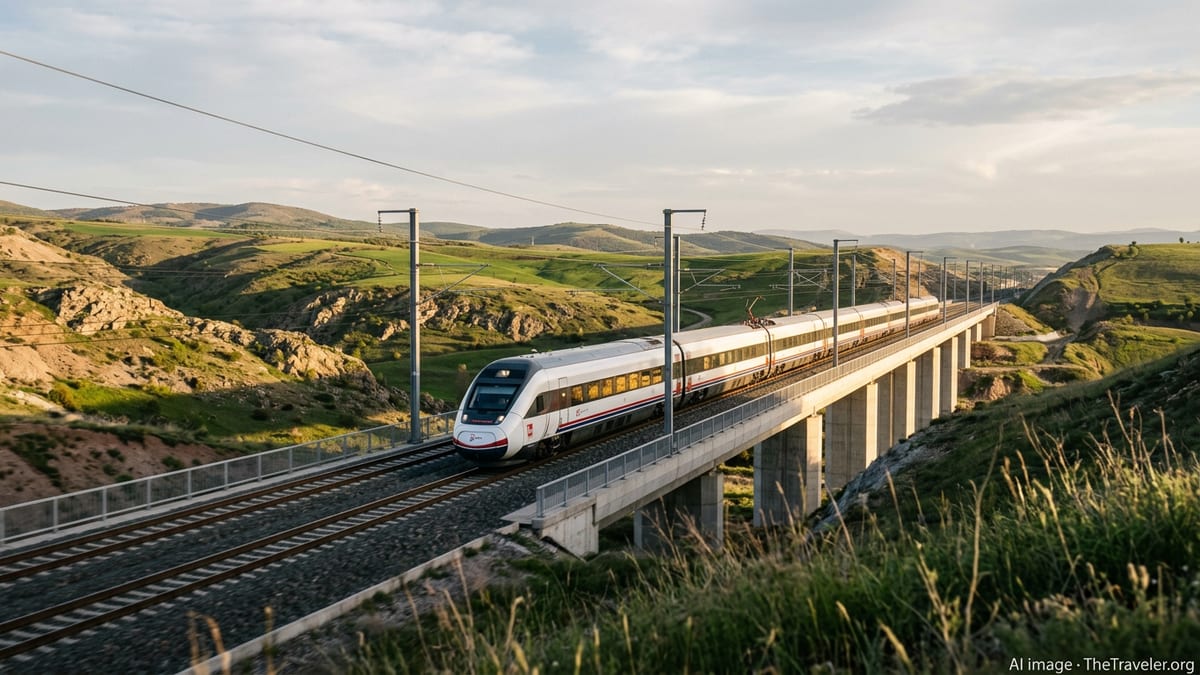
High-speed testing on Turkiye’s Halkali–Kapikule route
On the Turkish side of the border, the flagship Halkali–Kapikule railway is transitioning from construction to testing, marking one of the most visible signs that the Istanbul–Europe rail artery is entering its final phase. Recent reports from Turkiye highlight that trial operations have begun on the first completed sections, ahead of the line’s full opening to commercial traffic.
The new route is designed to support both high-speed passenger services and faster, heavier freight, linking Istanbul’s western suburbs with Kapikule, just across from Bulgaria. Publicly available information shows that the project is co-financed by European Union funds and has been conceived as a strategic bridge between the EU’s core rail network and Turkiye’s fast-growing logistics sector.
Once operational along its full length, the Halkali–Kapikule corridor is expected to significantly cut journey times between Istanbul and the Bulgarian border while providing a continuous electrified, signalled route for freight trains heading towards central and western Europe. Observers point out that this represents a major shift from the slower, capacity-constrained infrastructure that has dominated the route for decades.
Test operations typically precede a phased introduction of full service, with operators incrementally validating signalling, power systems and rolling stock performance. Taken together with Bulgaria’s own investment programme, the progress in Turkiye reinforces the perception that the cross-border rail link is moving from planning and construction into the final pre-operational stage.
Bulgaria upgrades the Plovdiv–Svilengrad–border corridor
On the Bulgarian side, the core Plovdiv–Svilengrad–Turkish border line has already been modernised to contemporary European standards and now forms part of the Orient/East–Med core network corridor. Passenger and freight trains from Sofia and Plovdiv run towards Svilengrad, the last major station before the frontier, where the route splits towards both Turkiye and Greece.
National infrastructure documents and sector reports indicate that work is shifting from basic modernisation to capacity enhancement. Bulgaria’s rail infrastructure manager has launched procedures for the doubling of selected sections along the Plovdiv–Svilengrad–Turkish border route, a move aimed at easing bottlenecks and providing greater resilience for international freight flows.
The line is single-track along large stretches, which has long limited the number of freight and passenger paths that can be offered in each direction. Plans for partial double-tracking, together with upgraded signalling and enhanced passing loops, are intended to increase reliability and reduce waiting times for cross-border trains approaching Svilengrad.
These investments fit into a broader national rail modernisation effort backed by EU funding instruments. Domestic coverage in Bulgaria highlights parallel upgrades on other strategic axes, but the Svilengrad approach remains central for trains bound for Istanbul and further into western Turkiye, making it a key beneficiary of current and planned works.
New Lesovo corridor promises a second rail gateway
Beyond upgrading the existing Svilengrad–Kapikule route, Bulgaria and Turkiye are preparing a second cross-border rail link that would open up an alternative gateway at Lesovo. According to published coverage and official Bulgarian planning documents, the proposed line would run via Yambol and Elhovo to the Lesovo border area before continuing towards Edirne on the Turkish side.
Reports from 2025 and 2026 describe the Lesovo project as a strategic response to capacity pressures at the current crossing, where freight traffic and customs processes have contributed to congestion. A second rail border point is expected to diversify flows, reduce dependence on a single corridor and create redundancy in case of disruption at Svilengrad–Kapikule.
Bulgaria has initiated preparatory work that includes route studies, traffic forecasts and capacity assessments for the new line. The project is being framed within a broader memorandum of understanding on railway cooperation between the two countries, signed earlier in the decade, which calls for closer coordination on investment, operations and border procedures.
On the Turkish side, the prospective Lesovo connection would integrate with the rail network around Edirne, complementing the new Halkali–Kapikule infrastructure and creating a more robust mesh of routes linking northwestern Turkiye with the EU. Observers in the rail freight sector view this as an important step toward building a regional logistics hub around the city.
Freight, ports and the evolving role of Black Sea gateways
The strengthening of the Bulgaria–Turkiye rail link is closely tied to shifting patterns in Eurasian trade and the search for alternatives to traditional overland routes. With maritime container flows being reconfigured and road corridors frequently congested, both countries are positioning rail as a more reliable and sustainable option for long-haul freight.
Bulgaria’s ports on the Black Sea, notably Burgas and Varna, stand to benefit from a faster inland rail connection to Turkiye, while Turkish ports and logistics centres around Istanbul and the Sea of Marmara gain improved access to central and eastern Europe. Sector analysts note that the modernised Plovdiv–Svilengrad corridor and the planned Lesovo route could funnel more intermodal traffic to and from these gateways.
The broader Orient/East–Med corridor framework, under which much of the funding is organised, seeks to integrate maritime hubs, inland terminals and key industrial zones into a coherent rail-based logistics chain. In this context, the Bulgaria–Turkiye border has become a critical hinge between EU and non-EU networks, with decisions on capacity and procedures at Svilengrad, Kapikule and Lesovo likely to resonate far beyond the immediate region.
Rail operators and logistics providers are closely watching the pace of infrastructure delivery and the development of streamlined border processes. Reduced dwell times, harmonised technical standards and improved reliability will be pivotal in persuading shippers to shift more traffic from road to rail along the corridor.
Timelines, financing and what remains to be done
Although significant milestones have been reached, the Bulgaria–Turkiye rail link is not yet fully complete in its new, higher-capacity form. Test runs on the Halkali–Kapikule line signal that Turkiye is in the advanced stages of delivery, but the full commercial timetable and freight operating patterns are still being finalised.
In Bulgaria, the existing Svilengrad corridor is already in service, yet its planned capacity enhancements, including selective double-tracking, remain in the project pipeline. Environmental assessments, financing arrangements and detailed engineering must be completed before construction can proceed at scale along the remaining single-track sections.
The second cross-border link at Lesovo is at an earlier stage, with planning and design being prepared for discussion within the joint working structures between Sofia and Ankara. Timelines will depend on funding decisions, coordination between the two countries and the pace at which supporting infrastructure, such as new stations and customs facilities, can be developed.
Despite these outstanding steps, the overall picture points to a corridor that is entering its final stretch of preparation. With modern infrastructure nearing readiness on the Turkish side, a revamped main line in Bulgaria and a second gateway moving from concept toward implementation, the Bulgaria–Turkiye rail link is on course to play a far greater role in connecting Istanbul and Europe in the coming years.