


Most travelers know Fiumicino only as the name of Rome’s Leonardo da Vinci airport, a place to sprint between gates or wait for a delayed flight. Yet a few minutes beyond the terminal buildings lies a working seaside town of fishing boats, Roman ruins, simple trattorie, and wide sandy beaches that Romans treat as their own escape hatch from the city. Stay a night here, or even just a long layover, and Fiumicino quickly stops being just an airport code and starts feeling like a real destination.
Get the latest updates straight to your inbox!
From Runway Lights to Harbor Lights
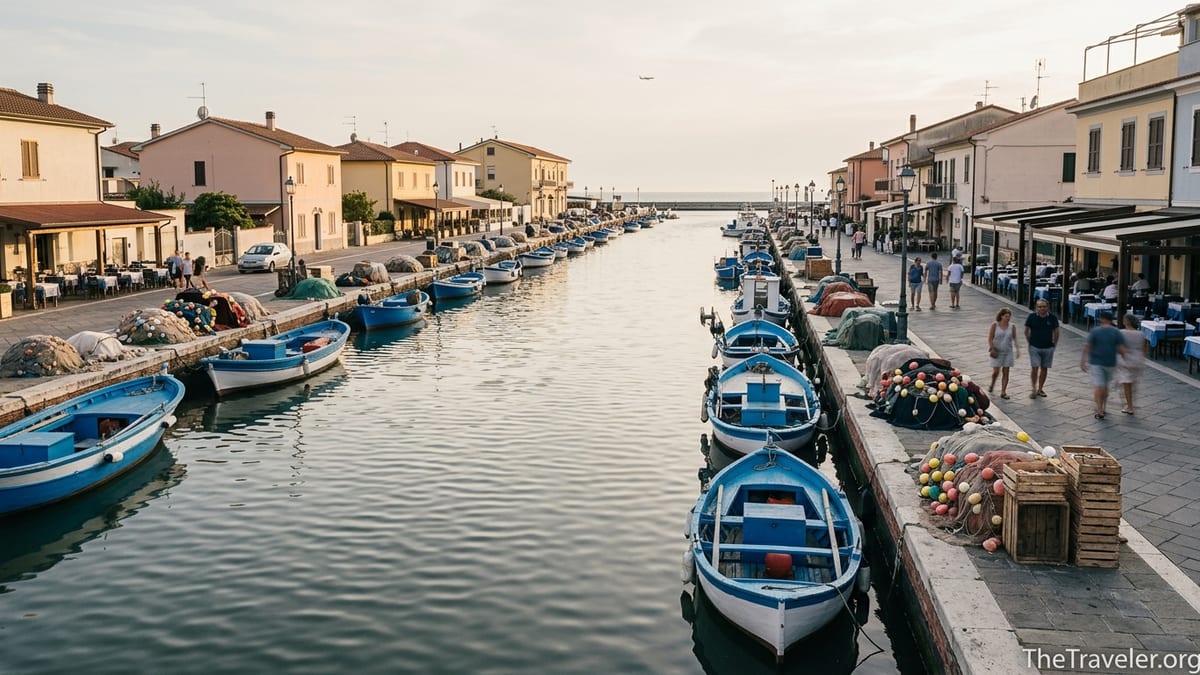
What surprises many first-time visitors is how quickly the atmosphere changes once you leave the airport ring road. Within 10 to 15 minutes by taxi or rideshare, you can be standing on the banks of the Fiumicino Canal, watching small blue-and-white fishing boats motor in from the Tyrrhenian Sea. Nets are spread to dry, gulls circle noisily overhead, and locals lean on the railings with gelato or an evening spritz as if the airport a few kilometers away did not exist.
The town’s life is oriented around this working harbor rather than tourism. In the late afternoon, you can see fishermen unloading plastic crates of shrimp, squid, and clams straight from the boats onto the quayside. Many of these are destined for the seafood restaurants lining Via Torre Clementina and the canal. Travelers who stop here instead of heading straight into central Rome often describe their first evening in Fiumicino as a reset button after a long flight, trading fluorescent terminal lighting for low sunset light over the water and the sound of rigging tapping against masts.
Practicalities are simple. From the airport, taxis run on a meter and the short hop into town is usually much cheaper than the fixed fare to central Rome. Several local buses and regional trains connect through nearby Parco Leonardo and Fiumicino’s neighborhoods, but most visitors find a short taxi or rideshare easiest, particularly with luggage. Once in town, distances along the canal and seafront are walkable, so you can explore at a strolling pace with a gelato in hand.
Seafood Straight From the Boats
If there is one thing travelers remember about Fiumicino, it is the seafood. The town still has a significant fishing fleet, and that direct link from sea to plate defines the local food scene. Along the canal, you will find everything from white-tablecloth restaurants with multi-course tasting menus to casual trattorie where lunch might be a plate of spaghetti alle vongole and a carafe of house white wine for a moderate price.
Menus here usually highlight the catch of the day, often displayed on ice at the entrance. Diners can point to whole seabream, red mullet, or cuttlefish and have them grilled simply with olive oil and lemon. Classic antipasti might include marinated anchovies, octopus salad, or fritto misto of small shrimp and calamari. At popular spots such as canalside seafood trattorie and contemporary restaurants like Banchina 100 or Docking 9, reservations are recommended on weekends, when Romans drive out from the city specifically to eat fish by the water.
Prices vary, but visitors who are used to central Rome are often pleasantly surprised. A generous plate of seafood pasta might run in the mid-teens in euros, with mixed fried fish a bit more, and full multi-course meals naturally higher if you choose premium raw platters or whole grilled fish priced by weight. House wines, largely from Lazio and neighboring regions, are usually good value and poured without fuss. Even travelers on a layover with only an hour or two to spare can hop in a taxi, enjoy a fresh seafood lunch on the canal, and be back at the terminal in time for boarding.
For something even more local, look for simple places just off the most obvious waterfront strip. Family-run trattorie a few streets inland may not have views of bobbing boats, but they often feature recipes that have been on the menu for decades, such as risotto alla crema di scampi or guazzetto di pesce, a tomato-based fish stew perfect for mopping up with bread.
Beaches and Beach Clubs Along the Tyrrhenian Coast
Another reason travelers fall for Fiumicino is its easy access to the sea. A narrow strip of land separates the airport and town from the Tyrrhenian coastline, where a string of beaches stretches from Focene down to Fregene and beyond. In warm months, especially from late spring through early autumn, local families pack cars with umbrellas, folding chairs, and coolers and head to these shores as soon as work or school lets out.
Many beach sections are run by stabilimenti balneari, private operators that rent out sun loungers and umbrellas by the day or half day. Prices vary by beach and season, but a pair of loungers and an umbrella at a mid-range stabilimento often costs a moderate amount for the day in high summer, less in shoulder seasons. In return you typically get changing cabins, showers, a bar serving espresso, soft drinks, and snacks, and sometimes a small restaurant offering plates of pasta, grilled fish, or simple panini.
There are also stretches of free public beach, particularly near Focene and along less developed parts of the shoreline. These areas are popular with younger crowds, dog owners, and anyone who prefers to bring their own towel and sit closer to the waterline. On windy days, you will often see windsurfers and kiteboarders using the steady sea breeze, especially near the more open beaches north of town.
Even in the cooler months, the seafront is a draw. A winter stroll along the promenade at Fregene or the beaches closer to Fiumicino itself offers a different atmosphere: empty chairs stacked at beach bars, long low waves breaking under a pale sky, and the faint sight of incoming planes approaching the runway in the distance. Travelers with early flights sometimes choose to sleep in Fiumicino and spend the late afternoon on the sand, watching the sun set behind lines of breakwaters.
Ancient Portus and the Isola Sacra Necropolis
For those who enjoy history, the greatest surprise around Fiumicino is how much of ancient Rome’s maritime world still lies scattered in the fields and backwaters beneath the modern flight paths. A few kilometers from the town center, near the village of Porto, are the remains of Portus, the great imperial harbor complex that once handled grain and goods arriving from across the Mediterranean. Although much of it is on restricted land, archaeological excavations and limited-access visits have revealed the outlines of vast basins, warehouses, and canal systems that helped feed ancient Rome.
Nearby, on the artificial island known as Isola Sacra between the Tiber and the Fiumicino Canal, travelers can visit the Necropolis of Porto, one of the most evocative archaeological sites in the area. The necropolis, part of the Ostia Antica Archaeological Park, contains more than 200 funerary structures along the line of an ancient road that once connected Portus with Ostia. Visitors today walk along this same route between brick-built tombs decorated with reliefs and inscriptions that shed light on the middle-class traders, freedmen, and artisans who lived and worked around the harbor nearly two thousand years ago.
Access to the necropolis is managed by the park authorities, and opening hours can vary seasonally, so checking the latest information before setting out is recommended. The site is generally quiet compared with central Rome’s archaeological attractions, and it is not unusual to share the pathways with only a handful of other visitors. The atmosphere is peaceful, with grasses growing between the tombs, birds calling from the surrounding trees, and the distant sound of modern traffic reminding you how close you are to the airport.
For a full day of ancient history, many travelers combine a visit to Isola Sacra with the better-known ruins of Ostia Antica, just across the river in the neighboring municipality. Trains and local buses can link the two, though some visitors choose a taxi for convenience, especially in summer heat. Together, these sites offer a picture of how the port and its community functioned, from the grand harbor basins to the everyday people whose names are still carved above their tomb entrances.
Oasi di Porto and Green Escapes
Beyond ruins and runways, the Fiumicino area also hides pockets of greenery and quiet where travelers can walk, birdwatch, or simply breathe fresh air between flights. One of the best-known examples is Oasi di Porto, a nature reserve located on land that once formed part of the ancient port’s basin system. Over time, changing water levels and land use have transformed parts of the former harbor into wetlands, woodlands, and small lakes that now attract migratory birds and local wildlife.
Guided visits, often by prior arrangement and sometimes only on specific days, lead visitors along paths that trace the outlines of the old harbor while introducing them to the area’s plant and bird species. Depending on the season, you might see herons, egrets, or ducks resting on the water, as well as turtles sunning themselves on logs. The combination of historical context and present-day ecology makes Oasi di Porto appealing to travelers who like both culture and nature in the same outing.
Closer to town, simple riverside and canal-side promenades offer their own small oases. Locals stroll or jog here in the early morning and at dusk, when temperatures are cooler and the low light sets the fishing boats and pastel houses aglow. For travelers staying in an airport hotel without access to a full garden, a short walk along the canal in Fiumicino’s center can provide a welcome dose of open sky and moving water before or after time spent in pressurized cabins.
Several agriturismi and rural accommodations in the wider Fiumicino municipality, particularly around Maccarese and the countryside north of the airport, also give access to fields, farm tracks, and quiet lanes suitable for cycling. Renting a bicycle from a local shop or through your accommodation, you can pedal along flat roads lined with fields of artichokes, sunflowers, or cereals, with only distant aircraft noise reminding you that Rome is nearby.
Everyday Life: Gelato, Piazzas, and Evening Passeggiate
Part of Fiumicino’s charm is simply that it functions as a real town, not a purpose-built resort. Travelers who stay overnight find themselves slipping into the daily rhythms of local life after only a few hours. In the morning, residents queue at neighborhood bars for cappuccino and cornetti, chatting with staff who know their orders by heart. Later, schoolchildren pour into small piazzas, while shopkeepers pull up metal shutters and arrange displays of fruit, fish, or household goods along the sidewalks.
In the late afternoon and early evening, especially in warmer months, the town takes on a sociable air. Families and couples head out for a passeggiata, the traditional evening stroll, moving slowly along the canal or seafront, greeting neighbors, and stopping for gelato or an aperitivo. Children ride scooters along the promenade, teenagers gather on benches, and older residents lean on railings to watch the boats. Travelers who join this gentle flow often comment that it feels like an authentic slice of small-town Lazio, only minutes from one of Europe’s busiest hubs.
Eating and drinking options mirror this everyday character. Alongside seafood specialists, there are pizzerie offering thin-crust Roman-style pizzas by the whole pie, bakeries selling slices of focaccia and sweet pastries, and small enoteche where you can sample local wines with simple plates of cheese and cured meats. Prices tend to be lower than in central Rome’s tourist districts, and English may be less widely spoken in some very local venues. A few basic Italian phrases, a smile, and a willingness to point at what looks good go a long way.
Because many travelers are in transit, opening hours can feel more flexible than in some inland towns. It is common to find bars open from early morning until late evening, and several restaurants have adapted to airport schedules by serving dinner earlier or later than typical Roman hours. Still, booking ahead for popular Saturday night tables, particularly at well-known seafood places, is wise if you have your heart set on a specific spot.
Staying Overnight: Why Not Sleep by the Sea?
A growing number of travelers are choosing to structure their itineraries so that they spend their first or last night in Italy in Fiumicino rather than in central Rome. The reasons are practical and emotional. On the practical side, being 10 to 15 minutes from the terminal means less stress about early departures and late arrivals. Many hotels and guesthouses in town offer shuttle services, early breakfasts, or flexible check-in times designed for people catching or leaving flights.
Emotionally, there is something gentle about beginning or ending a trip in a place where you can walk along the water, eat fresh fish, and watch the sky change color over the sea. Some visitors who arrive jet-lagged choose to spend their first day in Fiumicino adjusting to the time zone, napping in a seaside hotel and wandering the harbor at sunset, then taking the train or taxi into Rome the following morning. Others reverse the pattern, leaving the city a day early to decompress by the sea before flying home.
Accommodation styles range from modern airport hotels clustered near the terminal to small family-run inns, boutique hotels along the canal, and apartments rented by the night in residential streets. Prices vary widely by season, with summer weekends and Italian holiday periods understandably higher. Travelers who book well ahead and are flexible about exact location often find that a night in Fiumicino can be better value than comparable central Rome options, especially when they factor in the cost and time of airport transfers.
Wherever you stay, it is worth planning at least one unhurried meal and a walk, rather than treating Fiumicino as just somewhere to sleep. Watching the fishing boats under the glow of streetlamps, hearing Italian conversations rise and fall around you, and catching a faint whiff of salt air can all help anchor an otherwise anonymous airport night in memory.
The Takeaway
Fiumicino will probably never rival Rome itself as a bucket-list destination, and that is precisely what many travelers appreciate about it. The town offers a human scale and a slower rhythm that contrasts sharply with the speed of jet travel. Within a short taxi ride of the gates, you can be tasting clams that were in the sea that morning, tracing the route of an ancient funerary road, or feeling sand between your toes as planes approach over the water.
Whether you have a long layover, an awkward flight time, or simply a curiosity about what lies beyond the airport perimeter, Fiumicino rewards those who step outside. It is a place where history, everyday coastal life, and the global web of air routes intersect in surprisingly harmonious ways. Give it even a half day, and the name on your boarding pass starts to mean more than just a point of departure. It becomes a small slice of Lazio that you have actually seen, tasted, and walked through.
FAQ
Q1. Is Fiumicino town worth visiting if I only have a long layover?
Yes, if you have at least four to five hours between flights, you can comfortably take a taxi into town, enjoy a meal along the canal or a short walk by the sea, and return to the airport with time to clear security, provided you keep an eye on the clock and traffic conditions.
Q2. How far is Fiumicino town from Leonardo da Vinci airport?
The center of Fiumicino town and the main canal area are typically about a 10 to 15 minute drive from the airport terminals in normal traffic, making it one of the easiest seaside towns to reach directly from a major European hub.
Q3. Are there beaches close to the airport?
Yes, several stretches of sandy beach lie within a short drive of the airport, including areas near Focene and Fregene; you can reach many beach clubs and free sections in 15 to 20 minutes by taxi or car, depending on traffic and the exact spot.
Q4. Can I visit the Isola Sacra Necropolis from Fiumicino without a car?
It is possible, though it requires a bit of planning; you can use a combination of local buses and walking or arrange a taxi from town or the airport, and because opening hours can vary, it is wise to confirm current schedules before you set out.
Q5. Is seafood in Fiumicino really fresher than in central Rome?
Much of the seafood served in Fiumicino comes directly from the local fishing fleet, often landed the same day, so many travelers find the experience noticeably fresher and more maritime in atmosphere than in typical city-center restaurants.
Q6. What is the best time of year to enjoy Fiumicino’s beaches?
The main beach season usually runs from late May to early September, when stabilimenti balneari are fully operational and sea temperatures are warmer, though sunny spring and autumn days can still be pleasant for walks and seaside lunches even if the water is cooler.
Q7. Are there budget-friendly options for eating and staying in Fiumicino?
Yes, alongside more upscale seafood restaurants and boutique hotels, Fiumicino has simple pizzerie, take-away bakeries, and modest guesthouses or apartments that can be good value, especially outside peak summer weekends and major holidays.
Q8. Is Fiumicino safe to walk around at night?
Central areas along the canal and main streets are generally considered safe and remain active into the evening, with families and couples out for a stroll; as in any town, it is sensible to use normal precautions, stay in well-lit areas, and keep valuables secure.
Q9. Can I use public transportation between Fiumicino and Rome if I stay by the sea?
Yes, you can combine local buses, regional trains, and the airport rail connections to reach central Rome, though journey times vary; many visitors mix public transport for daytime sightseeing with an occasional taxi when carrying luggage or traveling late.
Q10. Is it better to spend my last night in Rome or in Fiumicino before an early flight?
Both are viable, but many travelers choose Fiumicino for very early departures to reduce transfer stress; if you value a quieter evening by the sea and a short ride to the terminal in the morning, finishing your trip in Fiumicino can be an appealing option.