


Touching down in Cairo can feel intense: the terminal is busy, the announcements echo in multiple languages, and you suddenly need a visa, cash, mobile data and a way into the city. With a little preparation, however, Cairo International Airport (CAI) is straightforward to navigate. This guide walks you through the arrival process in 2026, from visa on arrival and passport control to getting Egyptian pounds, buying a SIM card, arranging transport and the small but important tasks to complete before you step out of the terminal.
Get the latest updates straight to your inbox!
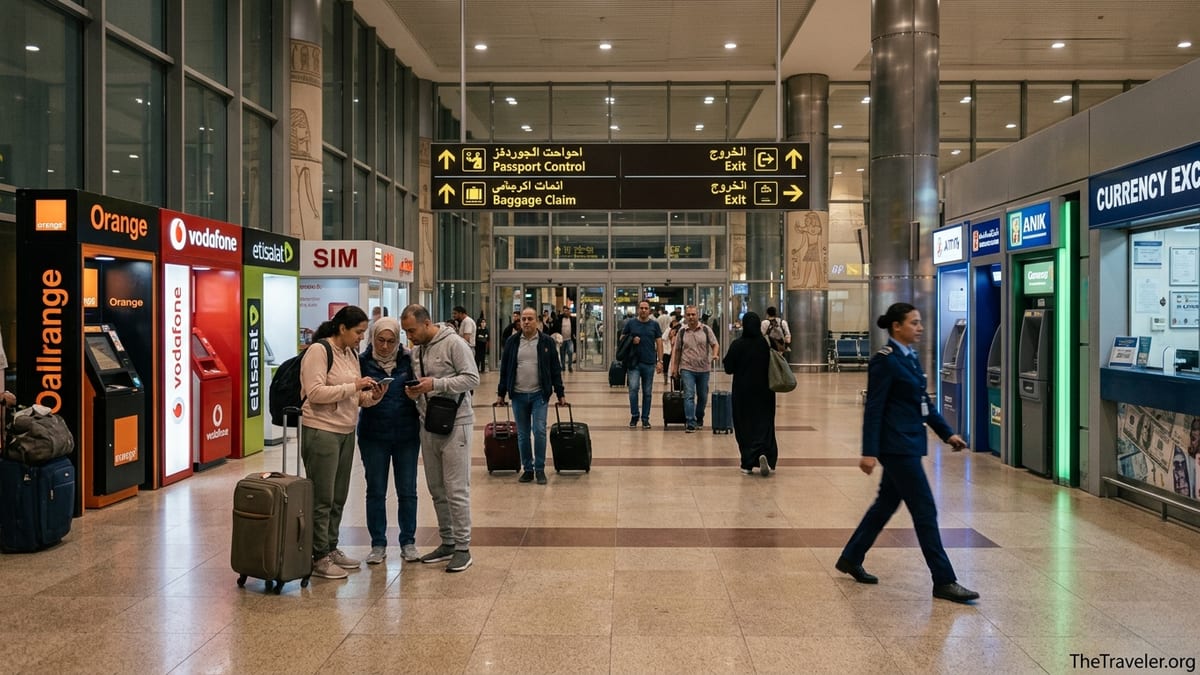
Understanding Visa on Arrival at Cairo International Airport
Many nationalities, including most visitors from Europe, North America, Australia, New Zealand and parts of Asia, can obtain a tourist visa on arrival at Cairo International Airport. In practice, this is a renewable, single entry visa valid for up to 30 days. The fee has for years been around 25 United States dollars, and recent government and tour operator notices still quote about 25 to 30 dollars for a standard tourist visa. Policies can change, so it is important to confirm your eligibility and the current fee with an official Egyptian consulate or the Egypt e‑Visa portal shortly before you travel.
In the arrivals area, the visa on arrival process happens before passport control. After disembarking and following the signs to immigration, you will see bank and visa counters along the wall just before the passport booths. They are typically branded with state and commercial banks rather than a “Visa Office” sign, which can confuse first‑timers. To get your visa, you line up at one of these counters, present your passport and pay the fee. In exchange, the clerk hands you a visa sticker that you will place in your passport.
Payment at these counters historically required crisp cash in United States dollars. In the last year or two, some travelers have reported paying with credit cards or in euros or British pounds, but card terminals are not guaranteed to work and exchange rates at the window can be poor. The most reliable method remains bringing at least 30 dollars in clean, undamaged notes. Think of this as your visa emergency fund and keep it separate from your main wallet so that it is easy to reach directly after landing.
Once you receive the visa sticker, step away from the counter and stick it into an empty page of your passport, usually near the back. You then join the passport control line. The immigration officer will scan your passport, ask a few brief questions about your stay and may check your onward plans or accommodation address. For most tourists arriving with a valid passport and a visa sticker, the process takes only a few minutes per person, but during peak evening arrivals it is wise to expect at least 30 to 45 minutes from leaving the plane to clearing passport control.
Clearing Passport Control, Baggage Claim and Customs
After you pass immigration, you enter the baggage claim hall. Cairo has several terminals, but the layout is similar: luggage carousels in the center, surrounded by services such as SIM card kiosks, bank ATMs and sometimes small currency exchange counters. Cabin baggage checks are usually minimal at this point, though random secondary screening can occur. Using the time while you wait for your suitcase, you can already take care of mobile data or locate an ATM.
Once your bags arrive, you head toward the customs exit. There are typically two channels: green for nothing to declare and red for goods that must be declared. Most tourists use the green channel and simply place their luggage through an x‑ray belt or walk through a corridor while officers monitor the flow. Random bag checks are possible, but most visitors are waved through quickly. Keep your passport and boarding pass accessible until you are completely out of the secure area, as an official may still ask to see them.
The final door after customs opens into the main arrivals hall, where you will meet hotel drivers, tour representatives and taxi touts. Before you cross that threshold, pause and mentally review what you still need from the secure side of the terminal. Inside, services such as official mobile operator booths and certain bank ATMs are typically more regulated. Once you step into the public arrivals hall, you face more sales pressure and fewer official counters.
A useful real‑world example: a traveler arriving on an evening flight from Paris recently reported that it took about 20 minutes to buy a visa sticker, 15 minutes to clear immigration and another 20 minutes to collect luggage and pass customs, for a total of roughly one hour from door opening to exiting into arrivals. Planning your onward transfer with at least an hour of buffer after scheduled landing time is therefore sensible, especially if you are booking a private driver who may charge for waiting time.
Getting Cash: ATMs and Currency Exchange at Cairo Airport
Egypt is increasingly card‑friendly in hotels and larger restaurants, but cash in Egyptian pounds is still essential for taxis, tips, small eateries and market purchases. Cairo International Airport hosts ATMs and currency exchange offices from several major Egyptian banks, including the National Bank of Egypt and Commercial International Bank. Official airport information lists bank branches or ATMs in all main terminals, with machines positioned in arrival halls and often immediately after immigration.
For most travelers, withdrawing cash from an ATM is the simplest and usually the most economical way to obtain Egyptian pounds. Machines from large banks generally accept Visa, Mastercard and Cirrus‑branded cards. A common strategy is to make one larger withdrawal, for example the equivalent of 100 to 200 dollars, rather than many small ones, as home banks and Egyptian banks often charge fixed per‑transaction fees. If your card offers fee‑free foreign withdrawals, consider using that card at the airport for your initial cash.
Currency exchange desks are another option, though their rates can be less favorable. They are useful if your bank card does not work or if you prefer to convert a fixed amount of dollars or euros into pounds. A typical scenario might be exchanging 50 or 100 dollars at the airport desk to cover your taxi and first day’s expenses, then using city‑center exchange offices with better rates for larger conversions. When changing money, count your notes carefully at the counter and keep the receipt, which can be helpful if you later need to convert remaining pounds back into foreign currency.
Be aware that some ATMs may offer to charge you in your home currency instead of Egyptian pounds. This is called dynamic currency conversion and usually comes with a worse exchange rate. Always choose to be charged in Egyptian pounds and let your own bank handle the conversion. Also, check daily withdrawal limits with your bank before travel and notify them of your trip to reduce the risk of a security block on your first transaction in Cairo.
Buying a SIM Card or eSIM: Staying Connected from the Moment You Land
Cairo International Airport is one of the easiest places in Egypt to buy a local SIM card. The main Egyptian mobile operators Orange, Vodafone, Etisalat and WE all maintain official kiosks in the arrivals areas. In some terminals, these booths are located near specific luggage belts, for example Orange close to one carousel and Vodafone and Etisalat near others, and then again in the public arrivals hall after customs. Kiosks generally display branding in English and Arabic and staff are accustomed to serving foreign visitors.
Prices and packages change frequently, but recent traveler reports suggest that a tourist SIM with around 10 to 20 gigabytes of data typically costs the equivalent of under 10 dollars if bought on a standard package, with occasional special traveler bundles costing more but including extra data or local call minutes. For instance, one visitor arriving in early 2025 mentioned an Etisalat “traveler” package of roughly a dozen gigabytes for a few hundred Egyptian pounds, while another opted for a Vodafone package with tens of gigabytes for a higher price but better coverage along the Nile and the Red Sea. These numbers are best treated as examples rather than fixed offers, yet they give a realistic sense of cost.
To purchase a SIM, you need your passport. The agent will register the SIM, insert it into your phone, configure the settings and often test a quick call or data connection before handing it back. Payment is usually accepted in Egyptian pounds and sometimes by card. At busy times or if systems are down, cash is faster and more reliable. Coverage differences between operators are modest in central Cairo, but outside the capital many travelers report slightly stronger performance from Vodafone and sometimes WE, while Orange is often praised for price promotions. If your itinerary includes remote desert or Red Sea areas, consider researching the best network for those specific destinations before choosing.
For those who prefer to land with connectivity already active, eSIMs sold online can be a convenient alternative. International providers offer Egypt data eSIMs that you can install before departure, with activation on arrival. Prices are generally higher per gigabyte than local physical SIMs, and voice calls may not be included, but the convenience of having data the moment the plane’s doors open can be attractive. A practical hybrid strategy is to use an eSIM for your first 24 hours, then buy a local SIM in town if airport kiosks are crowded or if you want a better long‑term rate.
Paying for Taxis and Transfers: How Much Cash You Really Need
Once you exit into the public arrivals hall, you will find several transport options: official airport limousines, prebooked hotel or tour transfers, metered taxis and app‑based rides such as services that operate similarly to Uber and Careem. Regardless of which option you choose, having at least some cash in Egyptian pounds makes your first ride much easier. While app rides are paid in the app by card, drivers often appreciate a small cash tip, and traditional taxis almost always expect to be paid in cash.
Taxi prices vary depending on time of day, traffic and the type of service. As a ballpark figure, a regular taxi or app ride from Cairo Airport to central districts such as Downtown, Zamalek or Dokki may cost the equivalent of 8 to 15 dollars at current exchange rates, while private hotel cars or tour company transfers can cost more but include waiting time, luggage assistance and direct drop‑off at your accommodation. When using a street taxi, agree on the fare in Egyptian pounds before you get in and have small notes ready to minimize discussion over change at the end of the ride.
One practical strategy is to withdraw or exchange enough cash at the airport to cover your first two or three rides plus basic expenses for the first day. For example, arriving passengers often take out an amount roughly equal to 1,500 to 2,000 Egyptian pounds to pay for a ride into the city, a meal, a local SIM and a modest tip budget. You can always withdraw more later from ATMs in the city, but solving these first hours with a single withdrawal reduces stress while you are jet‑lagged.
If you have prebooked a transfer through your hotel or a tour operator, confirm in advance whether payment is in cash or by card and in what currency. Some upscale hotels charge transfers in United States dollars and add the amount to your room bill, while others expect immediate payment in Egyptian pounds to the driver. Having both a modest amount of pounds and some small denomination dollars or euros in reserve gives you maximum flexibility if the prearranged plan changes.
What To Do Before Leaving the Terminal
Before you step out of the terminal into the Cairo night air or midday sun, it is worth taking five quiet minutes to check that you have everything set for the next 24 hours. First, confirm that your passport has the visa sticker and entry stamp and that the dates are legible. Take a quick photo of the visa page and the passport bio page with your phone so that you have a backup image if needed later for hotel check‑in or local SIM registration.
Second, test your phone connection. Open a browser, check a map and perhaps message your hotel to confirm your arrival. Store an offline map of Cairo and the location of your accommodation, in case the network is slow during your journey into town. If you bought a new SIM, save the local phone number in your notes or message it to a travel companion. This can be very helpful if you need to share contact details with a guide, driver or hotel receptionist.
Third, organize your money. Separate your larger notes from small change and keep taxi money accessible in a front pocket or small wallet. This reduces the need to open your main wallet in a crowded spot. If you used an ATM, store the transaction receipt in a safe place until you can verify it against your bank statement. Take a moment to check that bank cards, passports, boarding passes, baggage tags and any printed hotel or tour vouchers are all accounted for.
Finally, locate the meeting point for your onward transport. Many hotels and tour operators specify a particular pillar number, cafe or exit door where their driver will wait, often holding a sign with your name. Read your confirmation email in advance and, if uncertain, ask an airport information desk to point you toward the right section of the arrivals hall. Taking this step before you are surrounded by competing taxi offers will make your first minutes in Cairo feel calmer and more controlled.
Common Pitfalls and How to Avoid Them
A few recurring issues catch new arrivals at Cairo International Airport, and knowing them in advance can save you time and money. One is confusion about the sequence of visa and immigration. Some travelers go straight to the passport control lines without first buying the visa sticker at the bank counters. When they reach the front of the line, the officer sends them back, and they must queue twice. As you leave the aircraft, remind yourself: visa sticker first at the bank counter, then passport control.
Another pitfall is relying solely on card payments at the visa counter or SIM kiosks. Although recent visitors report that card payments are increasingly accepted, network outages or malfunctioning terminals are not rare. Arriving late at night or during a rush of flights, you may lose valuable time if you need to search for an ATM before you even have a visa. Carrying a small reserve of dollars or euros in cash, plus a backup bank card, is a simple insurance policy.
Mobile data confusion is also common. Some airport kiosks promote tourist bundles that cost significantly more than standard packages while offering only marginal benefits, such as slightly more data or local minutes that many short‑term visitors will never use. If the offered price feels high, you can politely ask if there is a smaller data bundle available or, if you are comfortable, wait and buy a SIM at a city‑center shop the next day, where prices are often posted more clearly. However, for many travelers the modest premium for buying at the airport is worth the immediate connectivity and language assistance.
Finally, be cautious about unsolicited assistance. Uniformed staff inside the secure area are generally legitimate, but individuals offering to “help” with baggage, visas or fast‑tracking immigration sometimes expect high tips. In the arrivals hall, touts may quote inflated taxi prices. A calm, polite refusal and heading straight to an official taxi stand, your prebooked driver or an app pickup point is usually the best response. If anyone insists or makes you uncomfortable, move toward a busier area or an official information desk.
FAQ
Q1. Can I get a visa on arrival at Cairo Airport and how much does it cost?
The majority of eligible tourists can still obtain a single entry visa on arrival at Cairo International Airport, with the fee commonly around 25 to 30 United States dollars, but you should verify your specific nationality’s rules and the exact fee with an Egyptian consulate or the official e‑Visa portal before traveling because policies can change.
Q2. Do I need to bring cash for the visa on arrival or can I pay by card?
Some recent travelers have reported paying the visa fee by card, but card terminals are not always reliable, so it is safest to bring at least 30 dollars in clean cash notes as your primary payment method and treat card payment as a bonus if available.
Q3. Where do I buy the visa sticker at Cairo Airport?
After landing and before you reach the passport control booths, you will see bank counters along the wall in the immigration area where you purchase the visa sticker, which you then place in your passport before joining the immigration line.
Q4. Are there ATMs and currency exchange desks in the arrivals area?
Yes, there are ATMs from major Egyptian banks and currency exchange desks in and around the arrivals halls, so you can withdraw or exchange money into Egyptian pounds immediately after passing through immigration and before leaving the terminal.
Q5. Is it better to get a SIM card at the airport or in the city?
Buying a SIM card from an official operator kiosk at the airport is more convenient and only slightly more expensive than city prices, so most short‑term visitors prefer to sort out mobile data on arrival, while budget‑focused travelers sometimes wait to visit a city‑center shop where prices may be posted more clearly.
Q6. Which mobile operator works best for tourists in Egypt?
Coverage in central Cairo is broadly similar across Orange, Vodafone, Etisalat and WE, but many travelers favor Vodafone or WE for slightly stronger coverage on intercity routes and in remote areas, while Orange is often seen as good value due to frequent data promotions, so your choice can depend on where in Egypt you plan to travel.
Q7. How much cash should I withdraw at the airport?
A practical starting point is to withdraw the equivalent of about 100 to 200 dollars in Egyptian pounds, which typically covers a taxi into the city, a local SIM, one or two meals and tips for the first day or two, after which you can adjust your cash needs using city ATMs.
Q8. Are taxis from Cairo Airport safe and how do I avoid being overcharged?
Taxis and app‑based rides from Cairo Airport are generally safe, but to avoid overcharging you should either use an app with a pre‑calculated fare or, if taking a regular taxi, agree clearly on the price in Egyptian pounds before the ride and keep small notes ready so that you are not dependent on the driver for change.
Q9. What should I check before walking out of the terminal?
Before leaving the terminal, confirm that your passport contains the visa sticker and entry stamp, test your mobile data connection, organize your cash and cards in a secure but accessible way and identify exactly where you are meeting your driver or catching your chosen transport into the city.
Q10. Is it worth getting an e‑Visa or eSIM before traveling to Cairo?
Many travelers find it convenient to apply for an e‑Visa in advance and to activate a data‑only eSIM before departure, which can reduce stress on arrival, but as long as your nationality is eligible for visa on arrival and you are comfortable completing a few formalities at the airport, you can also handle both visa and connectivity directly at Cairo International Airport without difficulty.