


More news on this day
Hundreds of travelers across China, Indonesia, Argentina and Singapore are facing extended disruptions after a wave of cancellations and delays involving China Eastern, Air China, Shanghai Airlines, Batik Air, Garuda Indonesia and Flybondi triggered at least 96 scrubbed flights and more than 600 late departures, according to live flight-tracking data and aggregated operational reports.
Get the latest news straight to your inbox!
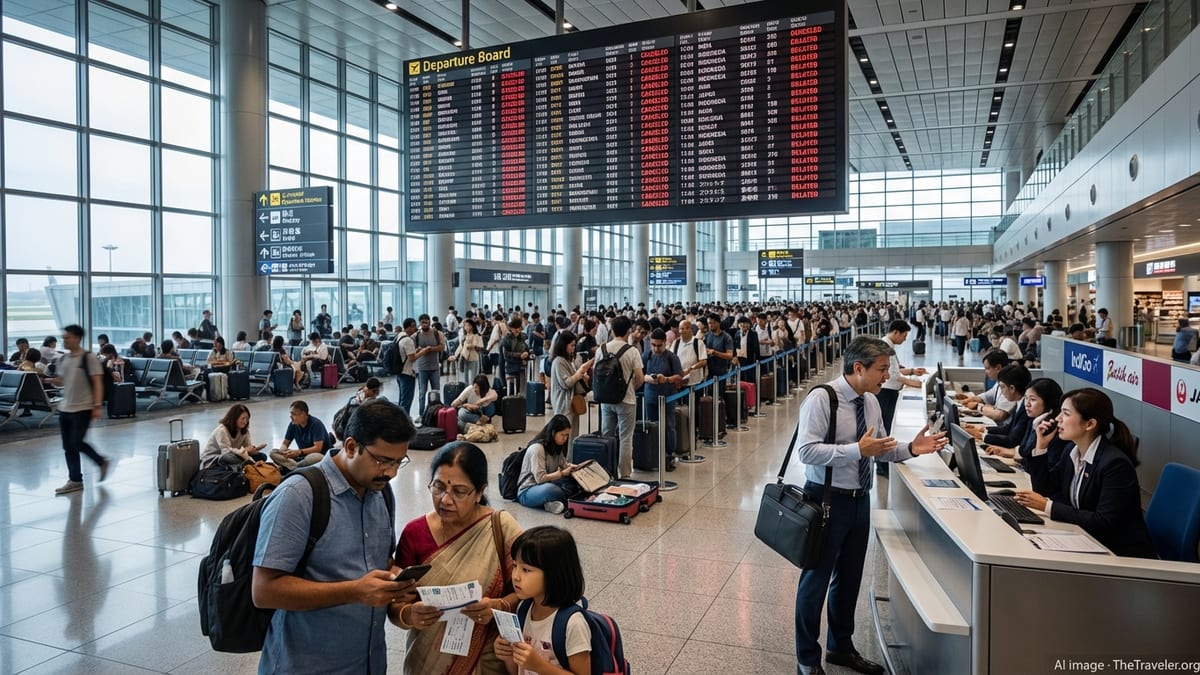
Multi-Region Disruption Hits Major Carriers
Publicly available aviation data for the current travel day indicates that a cluster of operational problems has rippled through networks operated by several prominent airlines in Asia and South America. China Eastern, Air China and Shanghai Airlines account for a significant share of the impact around Beijing and Shanghai, while Batik Air and Garuda Indonesia are facing schedule pressure in Jakarta and other Indonesian hubs. In Argentina, Flybondi’s domestic and regional services are also recording elevated disruption levels.
Across the six carriers, flight-status dashboards and airport information screens point to 96 cancellations and roughly 607 delays over the course of the day, affecting routes within China, across Southeast Asia and on key domestic corridors in Argentina. The figures are fluid as airlines continue to adjust schedules, but the pattern shows widespread knock-on effects rather than isolated route issues.
Beijing’s two primary gateways, Capital and Daxing, feature prominently in the disruption footprint, with China Eastern and Air China services among those most affected. Similar strain is visible in Jakarta, a core base for both Garuda Indonesia and Batik Air, while Singapore is again acting as a pressure point as delays on inbound regional flights push turnaround times beyond planned windows.
Although the exact trigger varies by airport and time of day, industry reporting for recent months highlights a combination of adverse weather episodes, tight air-traffic control slots and aircraft and crew imbalances as recurring drivers of multi-airline disruption across the wider Asia Pacific region.
Beijing and Shanghai Feel the Strain
Beijing, traditionally one of Air China’s strongest hubs and a key station for China Eastern and Shanghai Airlines services, has seen repeated bouts of congestion and weather-related schedule changes this year. Travel-analysis outlets and aviation-focused news sites have documented periods when storms, low visibility and airspace constraints forced carriers to compress or cancel large portions of their timetables, resulting in waves of missed connections at both Beijing Capital and Daxing.
Shanghai has experienced a similar pattern. Recent coverage of operations at Shanghai Pudong pointed to days where dozens of cancellations and hundreds of delays were recorded, with China Eastern and partner carriers prominently affected. When departure banks from secondary Chinese cities into Shanghai or Beijing run late, travelers relying on those flights to connect onward to long-haul services are particularly vulnerable to being stranded or facing extended overnight stays.
Data aggregators that track Asia Pacific performance have highlighted that domestic Chinese traffic volumes remain high, leaving little slack in aircraft utilization. When poor weather or traffic restrictions hit both Beijing and Shanghai within the same 24-hour window, airlines have limited room to swap aircraft or crew at short notice, reinforcing the chain reaction seen in today’s disruption totals.
For travelers already at the airport, the practical impact is visible in long rebooking lines and crowded customer-service counters. Passengers connecting through Beijing and Shanghai from other parts of Asia are especially exposed, as even short initial delays can erode the buffer built into tight transfer windows.
Indonesia’s Garuda and Batik Air Battle Cascading Delays
In Indonesia, Jakarta’s Soekarno Hatta International Airport is again acting as a focal point for operational stress. Earlier this season, aviation bulletins chronicled days when multiple Indonesian carriers, including Garuda Indonesia and Batik Air, faced simultaneous schedule disruptions as inbound aircraft arrived out of position from delayed routes. Today’s tally of cancellations and delays involving those airlines reflects a continuation of that pattern, with small timing slips on densely scheduled short-haul sectors compounding rapidly by afternoon and evening.
Jakarta’s role as a central hub means that even minor irregularities in early-morning flights to domestic destinations such as Surabaya, Medan or Denpasar tend to disrupt later rotations as aircraft attempt to catch up. When combined with afternoon thunderstorms that frequently affect the region at this time of year, on-time performance can deteriorate quickly, leaving cabins full of travelers waiting for new departure estimates or reassignment to alternative flights.
Publicly accessible on-time performance reports show that both Garuda Indonesia and Batik Air have historically had to manage higher levels of schedule volatility than some regional peers, in part because of Indonesia’s geography and weather patterns. The latest figures of dozens of delayed departures today underline how those structural challenges continue to test airline resilience, even as carriers try to rebuild international connectivity and stabilize domestic networks.
Travel forums and passenger accounts in recent months also point to longer connection times and less flexible reaccommodation options for budget-conscious travelers using regional and low cost operators. That context helps explain the difficulties faced by some Batik Air and Garuda Indonesia passengers who now find themselves holding separate tickets on misaligned itineraries as cancellations ripple outward.
Flybondi Disruptions Add South American Dimension
The impact of today’s disruptions is not confined to Asia. In Argentina, low cost airline Flybondi has reported elevated levels of schedule change on several domestic and regional routes, adding a South American dimension to what is otherwise a predominantly Asia Pacific event. Flight-status boards covering services from Buenos Aires to other major Argentine cities show both cancellations and extended delays, contributing to the overall tally of 96 cancellations and 607 late departures across the six carriers.
Argentina’s aviation sector has seen significant demand swings and regulatory changes over recent years, and low cost operators such as Flybondi have become essential for price-sensitive domestic travelers. When multiple flights in and out of Buenos Aires encounter delays at the same time, it can quickly result in crowded terminals and limited same-day rebooking opportunities, particularly on popular weekend and holiday patterns.
Operationally, disruptions at a point-to-point focused carrier such as Flybondi can be different from those at large hub-based airlines in China or Indonesia. Rather than cascading across intricate connection banks, the effects tend to appear as localized clusters of cancellations and delays on specific trunk routes. Nevertheless, for passengers who rely on these flights to access onward bus services or regional airports, the immediate consequences feel similar to the Asia-based disruptions.
With several of Flybondi’s aircraft committed to tight turnarounds at smaller airports, any schedule reset triggered by technical checks, crew-rest requirements or local weather can remove essential capacity from the network for hours at a time, prolonging the disruption well into the day.
What Travelers Can Do Amid Ongoing Disruption
While the total of 96 cancellations and 607 delays reflects a moving snapshot of today’s operations, experience from recent large-scale disruptions across Asia Pacific suggests that knock-on effects can linger into subsequent days. Aircraft and crews displaced from their usual patterns often require one or two full rotations to return to normal, leaving schedules vulnerable to further small shocks.
Publicly available guidance from aviation analysts and consumer advocates stresses the importance of monitoring flight status through airline apps and airport information channels rather than relying solely on printed or emailed itineraries. Travelers booked with China Eastern, Air China, Shanghai Airlines, Batik Air, Garuda Indonesia or Flybondi over the coming 24 to 48 hours are being advised in published coverage to allow added time for connections, consider earlier departures where possible and be prepared for gate or timing changes at short notice.
Passengers flying on multi-ticket itineraries or using separate bookings for long haul and regional segments may face greater exposure if one leg is disrupted. Reports from previous irregular operations events show that such travelers sometimes have fewer automatic protections when missed connections occur, making travel insurance and flexible booking options more important in complex trip planning.
As airlines continue to adjust schedules and restore regular rotations, today’s wave of cancellations and delays across China, Indonesia, Argentina, Singapore and other affected points serves as another reminder of the fragility that still exists in global networks. Even as demand recovers, carrier and airport systems remain sensitive to weather events, regulatory constraints and resource shortages that can, in a matter of hours, strand hundreds of travelers on multiple continents.