


Landing at Cancun International Airport can feel like stepping into organized chaos: blistering heat, lines of exhausted travelers and a wall of people trying to sell you rides. For many visitors, the very first impression of Mexico’s Caribbean gateway is not turquoise water or white sand, but confusion over taxis, transfer prices and aggressive sales tactics. This guide breaks down how airport taxis work in 2026, what you should expect to pay, where the pressure comes from, and which alternatives often make far more sense for your wallet and your peace of mind.
Get the latest updates straight to your inbox!
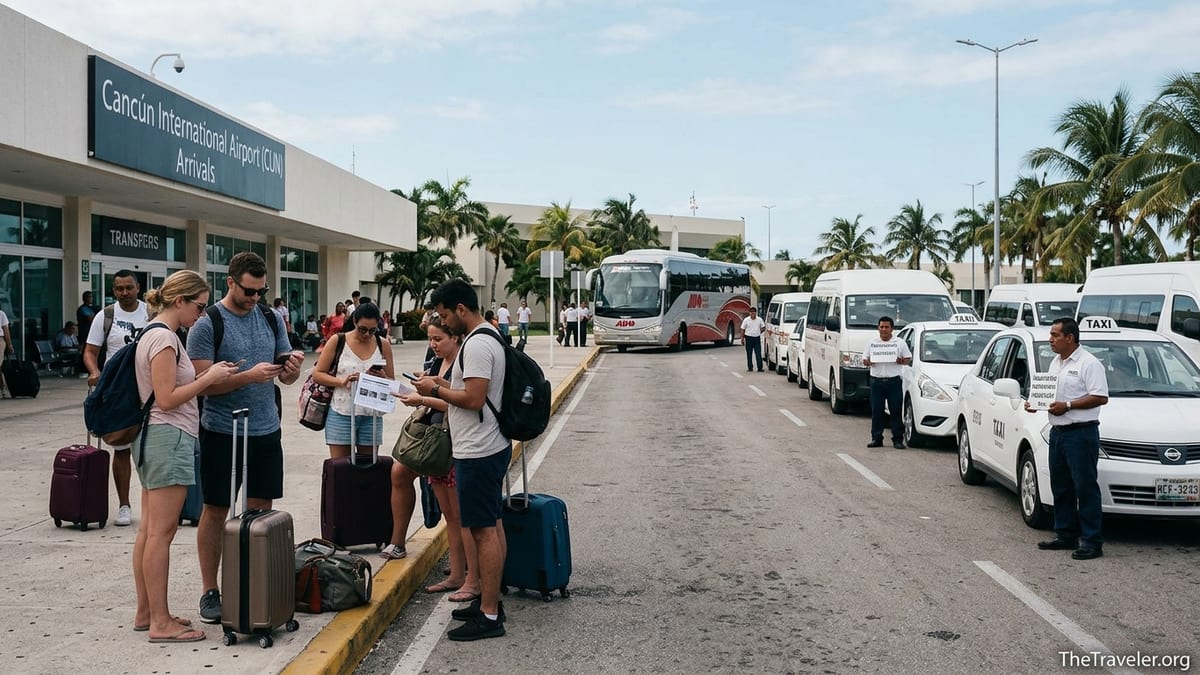
How Cancun International Airport Taxis Really Work
Cancun International Airport (CUN) sits about 18 kilometers, or 11 miles, from downtown and roughly 20 to 30 minutes by road from most hotels in the Hotel Zone, depending on traffic. There is no metro or city bus that picks up directly at the terminals, so nearly every traveler faces the same choice on arrival: official taxi, pre-booked transfer, or the intercity ADO bus combined with a local taxi or ride within town.
Inside the arrivals halls of Terminals 2, 3 and 4 you will find counters and booths selling what they describe as airport taxis or private transportation. These desks are usually just beyond customs and baggage claim. The people behind them are authorized to sell transportation, but they are also salespeople paid on commission. Their main goal is to convert tired, confused visitors into high-margin last-minute bookings.
Unlike many cities, Cancun airport taxis do not run on meters. Fares are based on a zone system agreed with the airport operator and local transport unions. In practice, what you pay at a booth can vary significantly from one counter to the next, even for the same hotel. Several recent traveler reports describe being quoted anywhere from 75 to 120 US dollars one-way to hotels in the central Hotel Zone when booking on the spot at the airport, especially late at night or during peak holiday periods.
Official taxis are allowed to pick up only in designated areas near the exits. Ride-hailing services like Uber can usually drop travelers at the airport for departures, but for arrivals they are often blocked from entering pickup zones by local regulations and informal taxi union control. That leaves newly arrived passengers very exposed to whoever controls the ground transportation desks and curbside areas.
Why Prices Feel So High When You Land
New arrivals in Cancun often express shock at the cost of an on-the-spot taxi from the airport. There are several reasons why fares feel disproportionate to the distance. The first is simple supply and demand. Cancun is one of Latin America’s busiest leisure airports, with massive peaks around Christmas, New Year, Easter and spring break. When several wide-body flights land within minutes of each other, the balance between exhausted tourists and available vehicles tilts sharply in favor of the drivers.
Second, there is limited competition inside the airport perimeter. The airport authority limits access to authorized taxi cooperatives and licensed transport companies. While that theoretically protects travelers from completely unregulated drivers, it also creates a semi-closed market with room for high markups. Local media and traveler forums have been documenting inflated rates and “special prices” for years, including recent stories of visitors paying well over 100 US dollars for what should be a short transfer to mid-Hotel Zone resorts.
Third, the quoting is opaque. You are rarely shown a clear, official rate card when you are first approached. Instead, prices are quoted verbally, sometimes in a mix of pesos and dollars, which makes comparison difficult when you are tired and may not yet have a feel for the exchange rate. Some counters will initially quote a high price and then offer a “discount” if you hesitate, creating the illusion of a bargain even though the final fare is still far above what pre-booked transfers charge for the same route.
Finally, payment dynamics contribute to the problem. Many counters nudge travelers toward paying by card, then add vague service fees, tips or foreign transaction add-ons at the last moment. There are credible recent reports of duplicate charges or unexplained extra amounts appearing later on card statements after airport taxi transactions. When travelers try to contest these charges, they often find it difficult to identify exactly which intermediary company processed the payment.
Arrival Pressure: What It Looks Like on the Ground
The most unsettling part of the Cancun airport taxi experience for many visitors is not the price itself, but the intensity of the sales pressure between customs and the exit doors. As you leave baggage claim, you walk through a gauntlet of people in uniforms or badges waving clipboards, signs and brochures. Some are legitimate tour representatives or hotel staff. Others are timeshare salespeople or independent transport vendors whose job is to keep you from reaching your actual pre-booked driver or the bus counter.
Common tactics include insisting that you must “register your transfer” at a desk even if you already booked online, or claiming that your hotel shuttle has been canceled and you should buy their service instead. Travelers in 2025 and 2026 have reported being redirected away from their meeting point and into high-priced taxis simply because they paused to ask for directions. The pressure is strongest right after customs, when many travelers are still unsure where to go and may assume anyone in a uniform is official.
Outside the terminal doors, a second layer of pressure often appears. Some drivers or touts cluster near the curb and ask where you are going. If you mention Uber, they may say ride-hailing is illegal or that your driver will never be allowed to reach you. In a few recent cases, passengers report being followed around the pickup area, repeatedly being told that the only safe or legal option is an immediate cash taxi, with warnings that it is dangerous to wait or leave the terminal area.
There are also more extreme situations, although they remain the exception rather than the rule. A handful of recent accounts describe drivers withholding luggage or even passports until passengers agree to pay a substantially higher fare than originally quoted. If you are ever in a situation where a driver refuses to return your documents or belongings, the safest response is to stay in a public, well-lit area, refuse to get into the vehicle, and contact the airport security staff or local emergency number rather than trying to negotiate alone.
When an Airport Taxi Still Makes Sense
Despite the problems, airport taxis can be the right choice in certain situations, especially when safety, time or flexibility matter more than strictly minimizing cost. For example, if your flight arrives very late at night, after the last ADO buses have departed, and you do not have a pre-booked transfer, an official airport taxi booked at a clearly identified counter may be the most straightforward way to reach a hotel in downtown Cancun. In that scenario you are paying a premium for the convenience of a direct, door-to-door ride at a difficult hour.
Taxis can also make sense if you are traveling with a small group and splitting the fare. Two or three people sharing a single vehicle to a hotel in the central Hotel Zone may find that an airport taxi cost, while still higher than a pre-booked shuttle, is acceptable when divided. Travelers with large luggage or sports equipment such as dive gear, golf bags or surfboards sometimes prefer the relative privacy and cargo space of a taxi rather than a shared shuttle with multiple stops.
Another case is last-minute itinerary changes. If your flight is severely delayed and your pre-booked transfer has already left or cannot wait any longer, arranging a taxi on arrival might be easier than rebooking your original shuttle. In that situation, take a moment to walk away from the immediate scrum at the exit, find an official-looking counter with clear company branding, ask to see the rate for your hotel in writing, and confirm whether the price is per person or per vehicle.
The key is to approach airport taxis as a backup option rather than your default plan. If you assume in advance that you will “just take a taxi when we get there,” you are almost guaranteeing that you will pay top dollar under the worst possible negotiating conditions: tired, jet-lagged and under time pressure.
Pre-booked Transfers: Often Cheaper, Usually Calmer
For most travelers in 2026, pre-booked private transfers or shuttles remain the best balance of cost, predictability and comfort. Several established operators based in Cancun specialize in pre-arranged airport transportation and publish their prices online in advance. As of mid-2026, private standard vehicles for up to 3 or 4 passengers from the airport to Cancun’s Hotel Zone commonly start in the range of roughly 30 to 45 US dollars one-way when booked ahead, with discounts for round-trip reservations. Some operators advertise rates even lower for shared shuttles to large resorts.
The main practical difference is that these services are paid and confirmed before you fly. When you land, you already know who is picking you up, what vehicle to expect, which logo to look for on the sign and exactly how much you have paid. That sharply reduces the scope for surprise surcharges or last-minute bargaining. Reputable companies also monitor incoming flights and automatically adjust pickup times if your plane is delayed, which helps if you arrive hours later than expected.
Concrete examples illustrate the gap. Travelers sharing recent experiences describe paying around 35 to 45 US dollars for a pre-booked private ride to mid-Hotel Zone resorts with a known operator, versus 80 or 90 dollars quoted for an impromptu taxi at the airport counter. For longer distances, such as Playa del Carmen or Tulum, the difference can be even larger, reaching 50 dollars or more per direction for the same basic service: an air-conditioned van, luggage assistance and a direct route to your hotel.
When choosing a transfer company, look for those that provide clear price tables by destination, specify whether fares are per vehicle or per person, and state in writing what is included, such as bottled water, baby seats or extra stops. It also helps to choose operators whose drivers carry visible company IDs and who give you a detailed confirmation with instructions on exactly where to meet your driver in the terminal, so you can walk past the timeshare and taxi desks without needing to ask for directions.
Other Options: ADO Bus, Ride-hailing and Hotel Shuttles
The ADO bus is the main budget-friendly alternative to taxis and private transfers. It departs from terminals at Cancun airport and runs to Cancun’s downtown bus station as well as Playa del Carmen and, less frequently, Tulum. Tickets to downtown Cancun typically cost only a few US dollars equivalent per person, with slightly higher fares to Playa del Carmen. Buses are modern, air conditioned and generally punctual, making them a strong option for solo travelers or couples staying in downtown hotels or comfortable with transferring to a local taxi for the final leg.
The main limitation is that the ADO bus does not deliver you to resort doors in the Hotel Zone. If you are staying at a beachfront all-inclusive, you would need to ride into downtown, then take a separate taxi or local bus out to the hotel strip. That can be time-consuming, especially after a long international flight or with large suitcases. It is also less attractive late at night when bus frequencies drop and local taxi pricing becomes more variable.
Ride-hailing apps such as Uber have a complicated relationship with Cancun airport. In much of the city, locals and visitors use app-based rides as a cheaper alternative to traditional taxis. At the airport itself, however, ride-hailing pickups are often restricted or obstructed by local taxi unions. Travelers who attempt to request an Uber directly at the terminal report being told by airport staff or taxi drivers that it is not allowed, and in some cases being physically blocked from walking to the pickup point outside the official taxi area.
Some hotels, especially higher-end resorts in the Hotel Zone and along the Riviera Maya, offer their own airport shuttle services. These may be included in package deals or available at fixed rates similar to pre-booked transfers. When booking accommodation, it is worth asking directly whether the property operates its own transfer service and, if so, at what price. Even if the hotel simply arranges transportation through a partner company, the fact that the booking goes through your accommodation often provides an extra layer of accountability if anything goes wrong.
Staying Safe and In Control: Practical Tactics
The most effective way to handle Cancun airport taxis is to prepare before you fly. Decide how you will leave the airport, estimate how much it should cost and write down or screenshot the confirmation details. That way, when you step out into the arrivals area, you are not trying to make complex decisions while tired and surrounded by competing offers. Having a firm plan also makes it easier to say “no thanks” and keep walking.
If you do need to use an airport taxi on the spot, there are still ways to reduce risk. Walk past the initial cluster of people approaching you immediately after customs and head for a counter with clear corporate branding and uniformed staff behind a desk, rather than a single person shouting prices in the corridor. Ask for the fare to your hotel in writing, confirm whether it is per person or per vehicle, and clarify whether any tolls or airport fees are extra. If you pay by card, insist on inserting the card yourself into the terminal, check the amount on the screen before authorizing it, and keep the printed receipt.
Never hand over your passport or wallet to a driver as a “deposit” or as part of payment. You may be asked to show your passport briefly at hotel security, but that should never be necessary to get into a taxi. If anyone attempts to retain your passport or luggage in order to pressure you into accepting a higher fare, stay in a public area, raise your voice to attract attention and seek help from airport security. Cancun has a heavy tourism-focused police and security presence at the airport specifically to deal with conflicts between passengers and transport providers.
Above all, trust your instincts. If a price feels wildly out of line with what you researched, if a driver becomes aggressive when you hesitate, or if you are being hurried into a vehicle without a clear explanation of the fare, you are under no obligation to get in. Step back, return to the terminal, and consider your alternatives: another taxi counter, the ADO bus or contacting your hotel’s 24-hour front desk to help you arrange a reputable transfer.
The Takeaway
Cancun International Airport is a gateway to some of the most beautiful beaches and resorts in the Americas, but its taxi scene has earned a reputation that can sour a trip before it even begins. Prices that can double between counters, intense arrival pressure and occasional outright scams have led many travelers to avoid walk-up airport taxis altogether.
Yet with realistic expectations, a bit of advance planning and a willingness to say “no,” you can navigate arrivals calmly and safely. In most cases, a pre-booked private transfer or shuttle offers better value and a smoother experience than negotiating with taxi desks after you land. Budget travelers can add the ADO bus to their toolkit, especially when staying downtown or heading toward Playa del Carmen.
If you do find yourself relying on an airport taxi, treat it as a conscious, last-resort choice, not a default. Confirm the price in advance, keep control of your documents and money, and stay alert to pressure tactics. Do that, and Cancun’s chaotic airport curb will be a brief inconvenience on the way to what really matters: the turquoise water, soft sand and warm nights that brought you to the Caribbean coast in the first place.
FAQ
Q1. Are taxis from Cancun airport safe to use in 2026?
In general, taxis operating from official counters at Cancun airport are physically safe in the sense that violent incidents are rare, but there are ongoing problems with overcharging, aggressive sales tactics and occasional reports of passengers feeling intimidated over payment disputes. Treat them as a fallback option, not your first choice, and always confirm the fare before getting in.
Q2. How much should I expect to pay for a taxi from Cancun airport to the Hotel Zone?
Prices vary by company and time of day, but it is common in 2026 to be quoted roughly the equivalent of 70 to 100 US dollars one-way when booking on the spot at the airport for a standard taxi to mid-Hotel Zone hotels. Pre-booked private transfers for the same route are often significantly cheaper.
Q3. Do Cancun airport taxis use meters?
No. Airport taxis in Cancun operate on a zone-based pricing system rather than meters. Fares are set according to your destination area, which is why it is essential to ask for the total price to your specific hotel before you accept a ride.
Q4. Is it better to pre-book a transfer or just get a taxi on arrival?
For most travelers, pre-booking a reputable private transfer or shuttle is better. You lock in a known price, avoid arrival pressure, and usually pay less than walk-up taxi rates. Taxis on arrival are best kept as a backup if your original plan falls through.
Q5. Can I use Uber or other ride-hailing apps from Cancun airport?
Ride-hailing apps are widely used in Cancun, but pickups inside the airport are often restricted by local regulations and opposed by taxi unions. In practice, it can be difficult or uncomfortable to meet an app-based driver at the airport, so most visitors rely on pre-booked transfers, the ADO bus or official taxis instead.
Q6. What is the cheapest way to get from Cancun airport to downtown?
For most visitors, the ADO bus from the airport to the downtown bus station is the cheapest option. The fare is only a few US dollars equivalent per person, and from there you can take a local taxi or bus to your hotel. It is less convenient if you are staying in the Hotel Zone, but ideal for downtown accommodations.
Q7. How can I avoid taxi scams and pressure at Cancun airport?
Plan your transport before you fly, know roughly what it should cost, and walk purposefully past anyone trying to divert you to a counter or “register” your transfer. Use only clearly identified counters or pre-booked companies, ask for the fare in writing, avoid handing over your passport or card to anyone away from a payment terminal, and do not be afraid to say “no” and walk away.
Q8. Should I pay for my airport taxi in cash or by card?
Both are possible, but each has trade-offs. Paying in pesos cash helps you avoid mysterious extra card charges, while paying by card reduces the need to carry large sums of cash immediately on arrival. If you do pay by card, check the amount on the screen carefully before authorizing, keep the receipt and monitor your statement afterward for unexpected charges.
Q9. Are there official rate cards for Cancun airport taxis?
Authorized providers are supposed to have rate cards that show standard fares by zone or destination, but travelers often report that these are not prominently displayed. You can ask to see the rate card at the counter before you agree to a ride. If staff refuse to show it or give only vague verbal quotes, consider walking away.
Q10. What should I do if a Cancun airport taxi driver tries to overcharge me or withholds my belongings?
If a driver demands more than the agreed fare, stay calm but firm, keep the conversation in a public, well-lit place, and avoid getting back into the vehicle. If your passport or luggage is being withheld, seek assistance from airport security staff or call the local emergency number rather than trying to resolve the dispute privately. Having a written confirmation of the agreed fare or a receipt from the counter can help your case.