


Landing at Cancun International Airport with Isla Mujeres on your mind is exciting, but the first practical question is always the same: what is the smartest way to get from the airport to the Puerto Juárez ferry terminal and onto the island without losing time or money? This guide walks you through every step, from the arrivals hall at Cancun Airport to stepping off the ferry in Isla Mujeres, with realistic timing, sample prices, and route options that match how travelers are actually moving in 2026.
Get the latest updates straight to your inbox!
Understanding the Route: From Runway to Ferry Dock
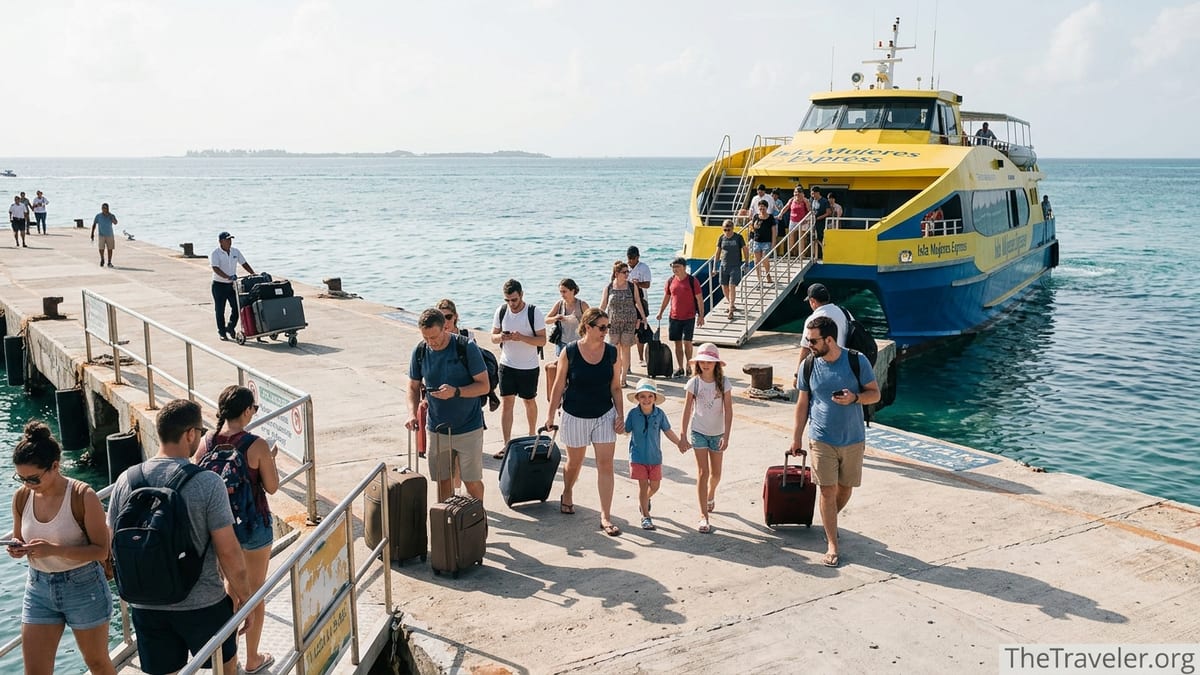
The journey from Cancun International Airport to Isla Mujeres is a two-part trip: first, you travel by road from the airport to the Puerto Juárez ferry terminal on the mainland; second, you cross by passenger ferry to Isla Mujeres. Puerto Juárez sits just north of downtown Cancun, and it is the main departure point because it offers frequent sailings and usually the best value compared with smaller piers in the Hotel Zone.
From the airport to Puerto Juárez, you are looking at roughly 30 to 45 minutes by road in normal traffic. A private transfer or taxi that drives you directly will usually take the quickest, more direct route through Cancun, while bus-plus-taxi combinations stop at the ADO bus terminal in downtown Cancun before continuing to the ferry dock. Once at Puerto Juárez, the ferry ride itself typically takes around 20 to 25 minutes dock to dock, with total time including boarding closer to 30 minutes.
Most travelers arriving in 2026 use a mix of three main options to reach Puerto Juárez: a prebooked private transfer from the airport, an official taxi from the airport, or the ADO airport bus followed by a city taxi or local bus. Which one is “best” depends on your budget, how much luggage you are carrying, and what time your flight lands relative to the ferry schedule.
If you are landing on a late evening flight, your planning should revolve around the last ferries of the night from Puerto Juárez. Daytime arrivals are much simpler, with frequent ferries and plenty of time buffers, but even then it pays to know your route in advance so you can walk past the aggressive taxi touts and head straight for the service that fits your plan.
Private Transfers: Easiest Door-to-Dock Option
The most seamless option for many visitors is a prebooked private transfer that meets you at Cancun Airport and drives you straight to the Puerto Juárez ferry terminal. Several local transportation companies offer this route specifically, often advertising a direct “Cancun Airport to Isla Mujeres ferry” service that includes a meet-and-greet in the arrivals hall and drop-off right at the Gran Puerto or Ultramar dock entrance.
For a couple or small family, one-way private transfers from the airport to Puerto Juárez typically fall in a broad range that often starts around the equivalent of 60 to 80 US dollars per vehicle, depending on season, size of vehicle, and company. A van that seats up to six or eight passengers can be cost-effective if your group shares the fare; a solo traveler will pay more per person but gains speed and simplicity. Services usually include air-conditioning, space for multiple suitcases, and prearranged return pick-up if you want a round-trip booking back to the airport at the end of your stay.
In practice, this looks like walking out of customs in Terminal 3 or 4 and spotting a driver holding a sign with your name. They guide you past the crowd of independent taxi drivers and excursion sellers to a parked van just outside. Within 10 to 15 minutes of clearing customs, you are on the road, bypassing downtown entirely and heading north to Puerto Juárez. Many travelers report arriving at the ferry in under 40 minutes from pull-out, even accounting for moderate traffic.
Private transfers are especially attractive if you are landing with young kids, surfboards or dive gear, or several big checked bags. You avoid hauling luggage onto buses or haggling over fares. For evening arrivals, a prebooked driver also reduces stress since you know someone is waiting. The main drawback is simply cost: budget-conscious travelers can often cut the ground-transport price in half by mixing bus and taxi instead.
Taxis and On-the-Spot Transport from the Airport
Official taxis and on-the-spot shuttles at Cancun International Airport offer flexibility if you have not prebooked anything. At the ground transport area outside each terminal you will find official taxi stands selling set-price rides to various zones, including downtown Cancun and the Puerto Juárez ferry terminal. Prices vary by company and season, but they tend to be similar to or slightly higher than prebooked online deals, reflecting the airport premium.
In real terms, a typical party of two or three travelers might be quoted a fare in the range of what a midrange private transfer would cost. The benefit is that you do not have to commit before travel; the downside is that you may need to shop around a bit at the counters, and haggling is limited because official fares are often posted. Independent drivers occasionally approach you in the arrivals hall offering rides. For safety and clarity, it is generally wiser to use the official desks outside customs instead of accepting unsolicited offers.
For a solo traveler with light luggage, a useful hybrid strategy is to take a taxi only for the shorter downtown-to-ferry segment. You ride the ADO airport bus to the main Cancun bus terminal for a low per-person price, then grab a city taxi to Puerto Juárez at a local rate that is often much lower than an airport taxi. Many recent visitors report taking this route and paying only a small fraction of the door-to-dock airport taxi cost while still enjoying a quick, direct ride for the final leg.
If you do take an airport taxi all the way to Puerto Juárez, confirm clearly that your destination is the Isla Mujeres ferry at Puerto Juárez and not just “the port.” In Cancun, “the port” can mean other marinas or ferry points, especially in the Hotel Zone. Showing a note that says “Puerto Juárez ferry to Isla Mujeres” in Spanish helps avoid miscommunication, particularly after a long flight.
ADO Buses, Local Buses, and Budget-Friendly Combinations
For travelers focused on value, the ADO airport bus is the key piece of the puzzle. ADO runs frequent buses from all terminals at Cancun International Airport to the main ADO bus station in downtown Cancun. In 2026, one-way fares are typically in the moderate range per person, and the ride takes around 30 to 40 minutes depending on traffic. Tickets can be booked in advance on ADO’s official channels or bought at bright red ADO counters in the arrivals area.
Once you arrive at the downtown ADO station, you have two realistic options to continue on to Puerto Juárez. The simplest is to walk outside the station and take a city taxi from the official taxi line, asking to go to “Puerto Juárez, muelle Ultramar, ferry a Isla Mujeres.” Local taxi fares are usually significantly cheaper than airport taxis because you are now paying city rates rather than airport-zone pricing. For two or three people this can still be very economical compared with a direct airport taxi, even after adding the bus fare.
Experienced budget travelers sometimes go one step further and connect to Puerto Juárez by local bus or colectivo from downtown instead of a taxi. City buses marked with routes that include Puerto Juárez or Playa del Niño depart from stops a short walk from the ADO terminal. The fare is typically just a handful of pesos per person. This is the cheapest way to reach the ferry, but it may involve standing in a crowded bus, minimal luggage space, and multiple stops through local neighborhoods. With a big suitcase, this can quickly become more effort than it is worth, particularly in the afternoon heat.
As a real-world example, a backpacker arriving alone in the afternoon might pay a small amount for the ADO bus plus a very modest local bus fare to Puerto Juárez, spending perhaps a tenth of what a private transfer would have cost. A family of four with roller bags might sensibly use the ADO bus plus a downtown taxi to split the difference, keeping costs reasonable while avoiding the hassle of squeezing multiple suitcases into a packed city bus.
Inside Puerto Juárez: Terminals, Tickets, and Luggage
Puerto Juárez is not a single building but an area on the waterfront that includes the main passenger ferry terminal to Isla Mujeres. On arrival you are usually dropped at or very close to the terminal entrance, where you will see the ferry company ticket booths, a small plaza, shade structures, and vendors selling snacks and drinks. The layout is compact enough that even first-time visitors can orient themselves quickly.
The primary ferry operator on the Puerto Juárez to Isla Mujeres route runs frequent crossings, with the first boats of the day typically leaving very early in the morning and services continuing into the late evening in both directions. The crossing time is usually timed at about 20 to 25 minutes. Published timetables change by season, but in practice departures from Puerto Juárez often run every 30 minutes or so during the daytime, tapering to less frequent sailings early in the morning and late at night.
Luggage is straightforward. Standard suitcases, backpacks, and beach bags are accepted without issue. You wheel your bags through the terminal, present your ticket at the gate, and staff may tag larger items before you board. On the vessel, smaller bags can be kept at your seat or under benches, while bigger suitcases are often stacked in designated luggage areas at the front or rear of the passenger cabin. There is no need to pre-check luggage the way you would for a flight, although very large or unusually heavy items may incur an extra charge.
Facilities at the Puerto Juárez terminal are simple but geared to short waits: restrooms, some small shops and snack stands, and shaded seating. If you have twenty minutes before boarding, it is easy to buy a cold drink, use the restroom, and reorganize your bags. It is not an airport-style terminal where you would want to spend hours, so most travelers time their arrival to be within about an hour of their chosen ferry departure.
Ferry Schedules, Timing Your Arrival, and Weather Considerations
Ferry schedules between Puerto Juárez and Isla Mujeres are frequent enough that most daytime arrivals at Cancun Airport do not need to stress about making a specific departure. Boats typically begin running early in the morning and continue into the late evening, with peak daytime frequencies around every 30 minutes. That said, using a particular departure time as a planning anchor helps you decide whether to take a slower bus route or pay extra for a direct transfer.
A good rule of thumb is to allow at least one and a half to two hours from the time your plane lands to the time you can realistically be at the ferry dock, assuming normal immigration lines and baggage delivery. For example, if your flight is scheduled to land at 2:00 p.m., planning for a ferry around 4:00 p.m. gives you a comfortable cushion. If you are arriving on a peak weekend or over holidays, consider building in extra time to account for longer lines and heavier road traffic leaving the airport.
Weather is another variable. Ferry operations are subject to the local harbor authority, and sailings can be delayed or canceled on days with high winds or rough seas. This is not common in the dry season but can occur more often during the Atlantic hurricane season. If strong winds are forecast, check the latest status of ferry operations once you land, and be prepared to wait at the terminal or, in rare cases, spend a night in Cancun if crossings are suspended.
In real terms, this means that if you are arriving on a late evening flight during stormy weather, booking a cancellable hotel in Cancun for that first night can be a smart backup. Daytime arrivals in stable weather can generally plan to reach Isla Mujeres the same day, but it is still wise to carry any urgent medications and one night of essentials in your carry-on just in case your ferry crossing is pushed back.
Choosing the Best Plan for Your Arrival Time
The best route from Cancun Airport to the Isla Mujeres ferry depends heavily on what time you land. For a morning or early afternoon arrival, you have the most flexibility. A mid-morning flight that lands around 11:00 a.m. can comfortably connect to almost any daytime ferry, leaving you free to opt for the ADO bus plus taxi strategy to save money without risking a long wait on either end.
For a late afternoon arrival, say around 5:00 p.m., it is often worth comparing the time savings of a private transfer or airport taxi directly to Puerto Juárez against the cost difference compared with the bus-plus-taxi approach. If you are traveling with family and want to be checked into your Isla Mujeres hotel by dinner, shaving 30 to 40 minutes off the ground transfer might feel worth the extra amount per person. Conversely, a solo traveler with no fixed schedule might still choose the more economical bus route even at that hour.
Late-night arrivals, after roughly 9:00 or 10:00 p.m., require more deliberate planning. Ferry schedules do include evening crossings, but the last boats are not as frequent as daytime services. If your scheduled landing time leaves little margin for immigration delays or checked-bag waits, booking an airport hotel or a simple room in downtown Cancun for one night can remove the pressure of racing for the last ferry. You then take an ADO bus or prebooked transfer to Puerto Juárez the next morning and cross to Isla Mujeres in daylight.
One practical example: a couple landing from the United States at 8:30 p.m. in the winter might choose a private transfer if they want to gamble on catching a same-night ferry, knowing that a delay of even 30 minutes at passport control could push them into a tight window. Another couple on the same flight might prebook a downtown Cancun hotel for the first night, stroll out for tacos, and catch a mid-morning ferry the next day with no time pressure at all.
Luggage, Mobility, and Traveling with Kids
Luggage and mobility issues can easily tip the balance between different transport options. If you are traveling with two small carry-ons and a backpack, the ADO bus plus local taxi route will feel quite manageable. You can wheel your bags from baggage claim to the bus, from the bus to the taxi stand, and then down the short ramp at Puerto Juárez with minimal effort. This is one reason backpackers and light travelers gravitate to this route.
On the other hand, if you are arriving with two checked suitcases per person, a stroller, and maybe a car seat, you will quickly feel the cumulative weight of lifting and maneuvering all that gear between vehicles. In those situations, paying for a direct private transfer from the airport to the ferry terminal can transform the experience from a tiring slog into a simple door-to-dock ride. Families often report that the added cost is worth it when kids are tired and the weather is hot and humid.
Older travelers or those with mobility considerations can also benefit from reducing the number of transfers. An airport shuttle or taxi that drives straight to Puerto Juárez minimizes walking and step climbing, though there will still be ramps or stairs at the ferry terminal and when boarding the boat. Seating on board is generally first-come, first-served, with a mix of indoor air-conditioned cabins and open-air upper decks. Boarding staff are usually accustomed to assisting passengers with light mobility issues, but if you use a wheelchair or walker it is worth contacting the ferry operator in advance to confirm the latest accessibility details.
As for ferry luggage limits, normal holiday baggage rarely raises eyebrows. You can expect to bring standard checked-size suitcases, carry-on bags, and even snorkel gear without issue. If you are transporting something special like dive tanks, surfboards, or large musical instruments, check ahead with your transport provider and the ferry company to clarify any extra fees or handling procedures.
The Takeaway
Making the jump from Cancun International Airport to Isla Mujeres is easier once you break the trip into simple steps: ground transport to Puerto Juárez, then a short ferry ride to the island. Private transfers and airport taxis offer the fastest and most convenient door-to-dock experience, especially for families, heavy packers, or late-night arrivals. The ADO airport bus combined with a downtown taxi or local bus remains the best budget-friendly option, particularly for solo travelers and light packers arriving during the day.
Whichever route you choose, plan your timing around two anchors: the expected time it will take to clear the airport and the current ferry schedule for Puerto Juárez. Build in a reasonable buffer, especially in peak season or during stormy weather, and travel with an overnight contingency plan if you are landing very late. With a bit of preparation and realistic expectations, you can step off your flight, move smoothly through Cancun, and be sipping something cold on Isla Mujeres’ waterfront well before the sun sets.
FAQ
Q1. How long does it take to get from Cancun Airport to the Isla Mujeres ferry at Puerto Juárez?
The total time is usually 1.5 to 2 hours from landing to reaching the ferry terminal, assuming typical immigration lines, baggage delivery, and 30 to 45 minutes of road travel plus any short waits for transport.
Q2. What is the cheapest way to reach the Isla Mujeres ferry from the airport?
The lowest-cost options typically involve taking the ADO airport bus to downtown Cancun and then a local city bus or colectivo to Puerto Juárez. This is very budget-friendly but requires more time, transfers, and comfort trade-offs compared with a taxi or private transfer.
Q3. Is it worth prebooking a private transfer to Puerto Juárez?
Prebooking is usually worth it for families, groups with lots of luggage, or travelers arriving late in the evening. A reserved driver reduces stress, shortens connection time, and avoids haggling at the airport, though it costs more than bus combinations.
Q4. How often do ferries run from Puerto Juárez to Isla Mujeres?
Ferries normally run frequently throughout the day, often around every 30 minutes during daytime hours, with early morning and late evening services operating less frequently. Exact times vary by season and can change, so always check a current timetable close to your travel date.
Q5. Can I bring large luggage or sports equipment on the ferry?
Standard suitcases, backpacks, and beach gear are widely accepted. Larger items like surfboards or bulky sports equipment may be allowed but can be subject to space, handling arrangements, and possible extra fees, so it is best to confirm with the operator before you travel.
Q6. Is it safe to arrive in Puerto Juárez after dark?
Puerto Juárez is a working port area, and many travelers arrive around dusk or later to catch evening ferries. As in any city, common-sense precautions apply: use official taxis or reputable transfers, keep valuables secure, and stay within the terminal and well-lit areas while you wait.
Q7. What should I do if my flight is delayed and I miss the last ferry?
If a delay makes it impossible to catch the last ferry, the practical solution is to spend the night in Cancun, either near the airport or in downtown, and take an early ferry the next morning. Keeping a cancellable hotel reservation as a backup can make this scenario much less stressful.
Q8. Do I need to buy ferry tickets in advance?
Many travelers buy tickets at the Puerto Juárez terminal just before boarding without issues, especially outside peak holidays. Advance purchase can be useful during very busy seasons or if you prefer to have everything arranged before arrival, but it is not strictly necessary for most dates.
Q9. How far is Puerto Juárez from downtown Cancun?
Puerto Juárez sits only a few kilometers north of downtown Cancun, usually a 10 to 15 minute drive by taxi in normal traffic. This short distance is what makes the ADO bus plus taxi combination such a popular and cost-effective choice for many visitors.
Q10. Are there other ferry terminals to Isla Mujeres besides Puerto Juárez?
There are additional departure points in Cancun’s Hotel Zone that offer services to Isla Mujeres, but Puerto Juárez remains the main hub because it usually has the most frequent departures and competitive pricing. Travelers staying in the Hotel Zone sometimes use the closer piers there, while most straight-from-airport visitors aim for Puerto Juárez.