


More news on this day
British travellers heading overseas this year are being urged to review official risk ratings, insurance cover and crisis plans, as updated Foreign, Commonwealth & Development Office (FCDO) guidance highlights heightened security concerns, regional instability and stricter conditions from travel insurers.
Get the latest news straight to your inbox!
Expanded warnings on high-risk destinations and regional tensions
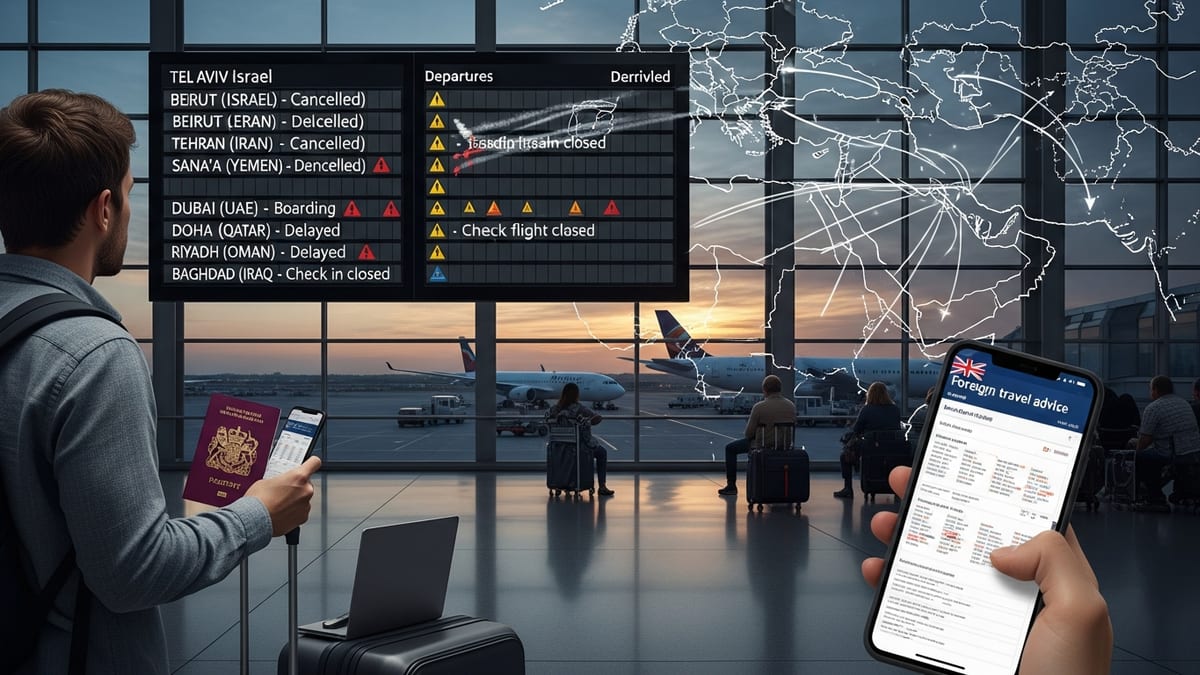
Updated FCDO travel advisories for 2026 underline that certain destinations now carry significantly higher risk levels, with advice ranging from “all but essential travel” to “do not travel” in parts of the Middle East and other politically unstable regions. Publicly available briefings for parliament and travellers highlight that guidance for Bahrain, Israel, Lebanon, Palestine, Qatar, Kuwait and the United Arab Emirates has been under close review this year due to regional volatility and airspace disruption.
Reports from travel and industry bodies show that some airlines have adjusted or paused flight schedules to affected hubs, while others have rerouted services to avoid higher-risk air corridors. According to published industry advice, the existence of a scheduled flight does not necessarily mean a trip will proceed as planned if FCDO guidance advises against all but essential travel to that destination.
Maps and summaries of current advice indicate that dozens of countries and territories worldwide are now subject to some form of warning for British nationals, driven by conflict, terrorism risk, civil unrest or the potential for sudden border closures. Travellers are being encouraged to consult the country-specific pages on the UK government website before booking, and again immediately before departure, in case the risk level has changed.
Recent commentary on FCDO guidance also notes a shift from the Covid-era focus on public health to a broader concern with security threats, detentions of foreign nationals and the impact of regional conflicts on transit routes. This means that even travellers only changing planes in higher-risk areas are advised to check for updates that might affect connecting flights or insurance coverage.
Insurance cover at risk if advice is ignored
The UK government’s foreign travel insurance guidance reiterates that many policies rely on FCDO risk ratings when determining what is covered. Publicly available information on the government site explains that if a traveller chooses to visit a country where the FCDO advises against all travel or all but essential travel, their insurance may be limited or invalid for claims linked to the reason for that advice.
This link between official guidance and private insurance policies has been in place for several years, but it is being stressed again in current online advice, as more destinations move into higher-risk categories for security or political reasons. Industry-facing summaries note that insurers routinely reference FCDO advisories when deciding whether to pay out for cancelled trips, medical emergencies or repatriation from crisis zones.
National and specialist media coverage explains that even where FCDO advice does not explicitly warn against travel, insurers may impose exclusions for particular activities or regions within a country. Travellers are therefore urged to check both the government advisory page and their own policy wording to ensure they are not inadvertently travelling without effective protection.
Government travel checklists further emphasise that European Health Insurance Cards (EHIC) and the newer UK Global Health Insurance Card (GHIC) are not substitutes for full travel insurance. These schemes provide access to state healthcare in certain countries but do not cover private treatment, repatriation costs or additional expenses such as mountain rescue, which typically fall under comprehensive insurance policies.
Passport validity, health cover and documentation checks
The latest foreign travel checklist on the UK government website, updated in June 2026, places new emphasis on passport validity rules and healthcare arrangements. The guidance reminds British nationals that many countries require at least six months’ validity on a passport from the date of arrival or departure, and that travellers can be refused boarding if their document does not meet local entry rules.
For trips to the European Union and Switzerland, the checklist encourages travellers to obtain or renew a GHIC where eligible, noting that existing EHICs remain valid until expiry. However, the information makes clear that these cards are designed for medically necessary state healthcare on the same terms as local residents and should be seen as a complement, not an alternative, to full insurance.
FCDO travel advice pages also outline local entry requirements, which may include proof of onward travel, minimum validity for passports and, in some cases, proof of financial means or specific health documentation. Travellers are advised to verify these conditions well before departure, as airline staff can deny boarding if requirements are not met.
Alongside legal and health documentation, broader FCDO messaging encourages British nationals to keep copies of important documents and to store digital versions securely. This is presented as a practical step to help replace passports, contact insurers and liaise with local authorities more quickly if documents are lost or stolen overseas.
Crisis planning, consular limits and staying informed
Recent parliamentary research briefings and official guidance highlight the importance of crisis preparedness for British nationals, particularly for those travelling to or living in regions with a higher risk of conflict or natural disasters. In early 2026, for example, the UK government encouraged British nationals in several Middle Eastern countries to register their presence so that emergency updates could be shared directly during any escalation.
Information published by the FCDO describes the scope and limits of consular assistance in crises. While support can include information on evacuation options, liaison with local authorities and updates for families in the UK, there is clear guidance that individuals remain responsible for their own safety, decisions about travel and the financial consequences of those decisions.
Historic guidance on support for British nationals abroad, which continues to be referenced in current communications, advises travellers to maintain regular contact with friends and family at home, especially when visiting remote areas or regions experiencing unrest. The same materials recommend that travellers monitor local and international media, keep mobile phones charged and enabled for international roaming, and follow any security guidance issued locally.
FCDO annual reports also underline the increasing demand for crisis response operations, including assisted departures from conflict zones in recent years. These documents emphasise that up-to-date travel advice, email alerts and registration tools are designed to help UK nationals make informed choices before and during travel, rather than to replace personal planning.
How British travellers can respond to the new warnings
Publicly available guidance suggests several practical steps for British nationals in light of the latest advisories. Travellers are encouraged to sign up for country-specific email alerts on the FCDO website so that any changes to risk levels, entry rules or security conditions are sent directly to their inbox.
The foreign travel checklist recommends confirming contact details for the nearest British embassy, high commission or consulate in the destination country before departure. It also advises checking local emergency numbers, which are recorded on many FCDO country pages, and sharing travel itineraries and accommodation details with a trusted contact in the UK.
Travel organisations and safety briefings widely recommend building extra flexibility into itineraries, including longer connection times and the possibility of rerouting if airspace restrictions or regional crises affect planned routes. For destinations under heightened alert, travellers are urged to monitor airport and airline announcements closely in the days leading up to departure and during their trip.
Overall, the latest FCDO messaging frames international travel in 2026 as still possible for most destinations but calls for a more cautious, better-informed approach. By checking official advisories regularly, reviewing insurance terms in detail and preparing basic crisis plans, British holidaymakers are being told they can reduce their exposure to disruption and make more resilient decisions about going abroad this year.