


More news on this day
Drivers using key approaches to the M5 are being warned to expect fresh delays over the coming days as two separate sets of roadworks take place on busy stretches connected to the motorway corridor.
Get the latest news straight to your inbox!
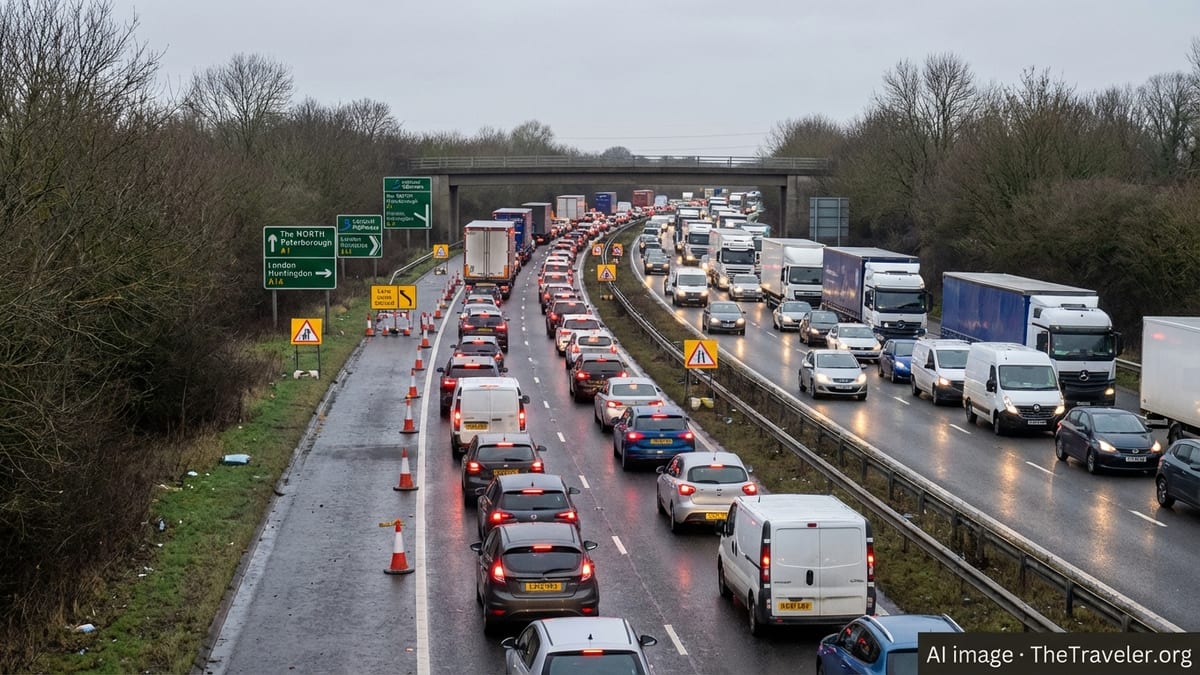
Planned lane closures on M5 between junctions 9 and 15
National traffic bulletins indicate that mobile lane closures are scheduled along parts of the M5 between junctions 9 and 15 overnight from Wednesday 21 October into Thursday 22 October 2026. The work is described in public travel updates as involving sweeping and maintenance on both northbound and southbound carriageways during off-peak hours.
The closures are expected to run between 8pm and 6am, with lanes taken out of use for short sections at a time rather than a continuous full closure. While the approach is designed to keep at least one lane open in each direction, motorists are being advised that speeds will be reduced and that passing maintenance convoys may add to journey times.
According to live travel information services, this stretch of the M5 typically carries a mix of local commuter traffic and longer distance flows between the Midlands and the South West. Any reduction in capacity is therefore likely to be most noticeable for drivers who set off late in the evening or travel through the affected area before the morning peak.
Traffic monitoring platforms also highlight the potential for short-term congestion to form around junctions, where lane closures and the merging of vehicles can cause queues even during the night. National route planners are advising drivers to allow extra time if heading through the corridor while the moving works take place.
Overnight A38 works linked to HS2 near the M5
Separate disruption is expected on the A38 where it links into the wider motorway network, as HS2-related highway works continue around Hilliard’s Cross and Swinfen Interchange in Staffordshire. Information published by National Highways shows a programme of closures and lane restrictions on this corridor in October 2026 as part of drainage upgrades, kerb installation and associated construction.
Recent local reporting from Lichfield indicates that the A38 southbound carriageway and associated slip roads have been subject to weeknight closures between 9pm and 5am until 22 October 2026 for drainage improvements and new roadside infrastructure. Publicly available HS2 briefing documents set out a longer-term pattern of disruption around this junction, including a previous full closure of the A38 between Swinfen and Hilliard’s Cross and an extended slip-road closure to accommodate the rail project’s structures.
The A38 serves as an important parallel and feeder route to the M5 and M6 for regional traffic, and also carries significant local flows between Lichfield and nearby settlements. When sections of the dual carriageway are closed, drivers are routed onto signed diversionary roads that pass through smaller communities, increasing travel times and concentrating traffic on local networks.
With the latest phase of HS2 highway works overlapping with planned maintenance on the motorway system, motorists heading towards the West Midlands and South West are being urged by travel services to check both A-road and motorway conditions before setting off. This is particularly relevant for those using the A38 as an alternative when there are problems on the M5.
Busy A38 approaches to the M5 see continued disruption
South of Birmingham, further disruption is being reported on the A38 corridor feeding into the M5 as part of the Bromsgrove Route Enhancement Programme administered by Worcestershire County Council. The authority’s latest project update confirms a rolling series of schemes along the A38, including work near Stoke Road, Buntsford Drive and the approaches to the M42 and M5 interchanges.
The most recent programme summary lists several October and November 2026 work packages involving overnight closures, temporary traffic lights and full weekend shutdowns on sections of the A38 Birmingham Road. Activities range from earthworks and drainage surveys to the removal of traffic islands and surfacing of widened carriageway sections, all intended to increase capacity and reliability in the longer term.
Local travel coverage in Bromsgrove notes that these roadworks interact with National Highways closures on the nearby M5 and M42, at times forcing drivers to divert between the motorway and A38 networks. When A38 works coincide with motorway lane restrictions, the result can be heavier traffic on suburban routes as drivers seek alternative paths through the district.
Project documents show that the enhancement programme is funded through a combination of Department for Transport allocations, local enterprise partnership support and private development contributions, with construction now expected to run into spring 2027. County communications acknowledge that unexpected utility diversions and complex service relocations have extended the timetable, prolonging the period in which drivers face reduced capacity on this key approach.
What drivers can expect on affected journeys
Route planners and traffic information services are advising that the most significant impact from the current phase of works is likely to fall on evening and early morning journeys, when the majority of closures and lane restrictions are in place. Motorway users on the M5 between junctions 9 and 15 are being warned to expect variable speeds, narrowed lanes and occasional short queues as maintenance vehicles move along the carriageway.
On the A38 corridors near both Bromsgrove and Lichfield, the combination of full overnight closures, contraflows and temporary signals is likely to extend journey times, particularly where diversions add distance through lower-speed local roads. Regular commuters, including those heading to regional business parks and logistics hubs close to the M5, may need to adjust departure times or consider alternate routes on nights when activity is heaviest.
Travel reports also highlight that some contingency nights have been built into the roadwork programmes to account for adverse weather or unforeseen site issues. This means that even if tasks are completed ahead of schedule on specific nights, traffic management measures can be reintroduced later in the week if further activity is required, leading to intermittent disruption over the wider period.
Publicly available advice from highway authorities stresses the importance of observing any temporary speed limits and lane markings, which are designed to protect both roadworkers and drivers in confined work zones. Motorists planning longer trips across the region are encouraged by journey-planning services to check live information on the day of travel, particularly where connections between the A38 and M5 form part of a cross-country route.
Implications for tourism and regional travel
The latest wave of maintenance and improvement work comes during a period when the M5 corridor remains a principal route for leisure travel to and from the South West, especially at weekends. While the current set of restrictions is concentrated overnight, late arrivals heading to coastal destinations or returning from trips could still encounter lane closures or diversion routes as they pass through the affected sections.
Tourism bodies and local media in the wider region have previously highlighted how unplanned incidents on the M5 can quickly cause congestion to spill onto the A38 and surrounding A-roads. With planned works now scheduled on both the motorway and its parallel routes, travel commentators suggest that journey-time reliability may be reduced for several nights running, even where overall traffic volumes are lower than in peak holiday periods.
For visitors using hire cars or unfamiliar with the area, the presence of temporary signage and diversion markers around major junctions including the approaches to Bromsgrove, Lichfield and the wider West Midlands can make navigation more complex. Journey-planning tools and sat-nav updates that draw on live traffic feeds are therefore likely to be particularly useful while the works are underway.
Transport planning documents for the West of England and Midlands corridors underline that the A38 and M5 carry some of the highest flows of any regional routes, with recurring congestion already recorded at key junctions even before current improvement schemes began. The latest maintenance and infrastructure projects are intended to address long-term bottlenecks, but in the short term they add another layer of disruption for drivers relying on these vital links.