


Cape Town International Airport is one of Africa’s busiest gateways and, for many visitors, the first real test of navigating South Africa’s transport. Uber, Bolt and other app-based rides are widely used and generally reliable here, but the layout of the terminal, parkades and pickup zones can confuse first-time arrivals. This guide walks you step by step through finding your driver, what to expect on pricing, how to handle luggage and late-night arrivals, and when it might be smarter to book a shuttle or use an official taxi instead.
Get the latest updates straight to your inbox!
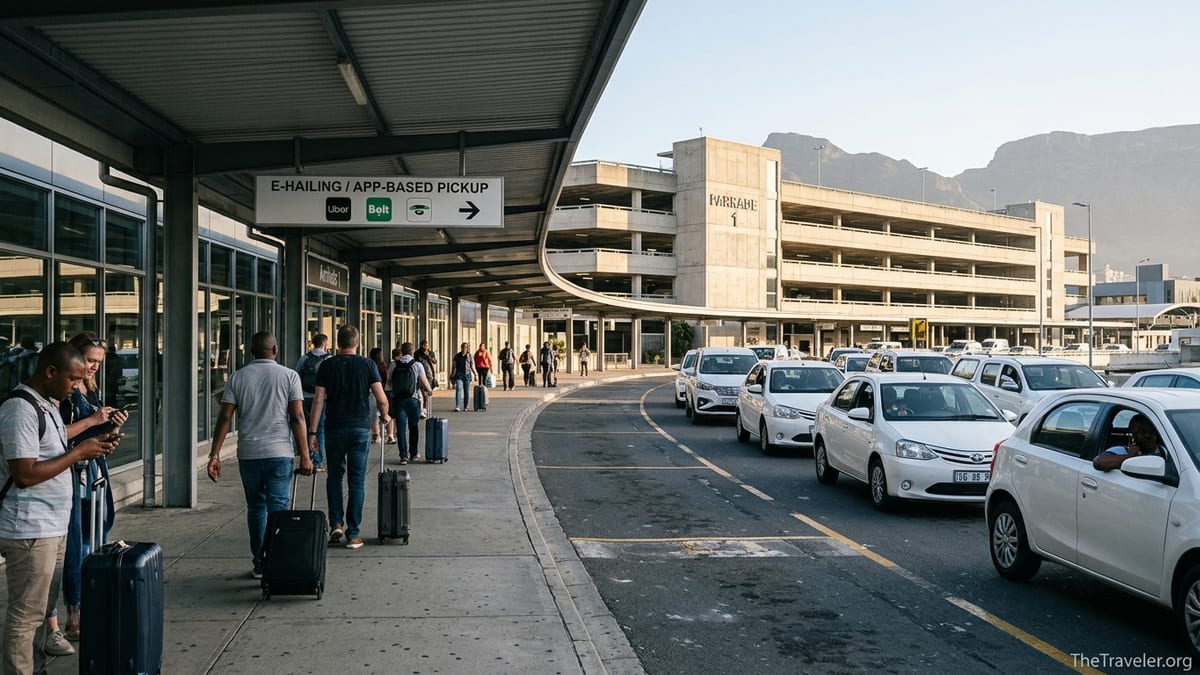
How Uber and Bolt Work at Cape Town International Airport
Uber and Bolt are fully allowed at Cape Town International Airport and are among the most popular ways for both locals and visitors to travel between the airport and the city. When you step out of arrivals you will not see a single “Uber” or “Bolt” branded stand because rides are ordered entirely through the apps, but you will see airport signage pointing you toward the e-hailing pickup area. Both apps show Cape Town International by its code, CPT, and you can request all the usual categories such as UberX, Uber Comfort, Uber XL or Bolt Go and Bolt Comfort, depending on time of day and demand.
The majority of trips from the airport are into central Cape Town areas such as the City Bowl, the V&A Waterfront, Green Point, Gardens, Sea Point and Camps Bay. The distance to the central business district is roughly 20 kilometers, and under normal traffic conditions the ride takes 20 to 30 minutes. During weekday morning rush hour or late afternoon, especially when there are accidents on the N2 highway, travel times can easily stretch beyond 40 minutes, which affects both your wait time for a driver and the final fare.
In 2026, Uber and Bolt drivers must hold the appropriate operating permits and airport access permissions to collect passengers at CPT. That has significantly reduced the tensions that existed several years ago between metered taxis and ride-hailing drivers. For travelers, that translates into a more predictable experience: you request a ride in the app, walk to the designated e-hailing area in the parkade, and meet your driver without needing to negotiate on the sidewalk or sort out payment in cash.
Even so, the airport environment is busy and can feel overwhelming after a long-haul flight. Having your chosen app installed, logged in and tested before landing makes a big difference. Many regular visitors from Europe or North America load a small amount of local currency on a travel-friendly card and link it to Uber or Bolt ahead of time so they do not have to worry about exchanging money at the airport before ordering a car.
Finding the E‑Hailing Pickup Area: Exactly Where to Go
The single most confusing part of using Uber or Bolt at Cape Town Airport is simply knowing where to meet your driver. Arrivals and departures are housed in one connected building, split into International and Domestic sides. When you exit either terminal on the ground floor, the main roadway and traditional taxi ranks are directly in front of you, while the multi-level parking structures, known as parkades, sit to your left and right.
As of mid-2026, the official e-hailing pickup zone for services like Uber and Bolt is located on the ground floor of Parkade 1, commonly signed as P1. Airport signage inside the terminal refers to “Pick Up” and “E-Hailing” and directs you toward this parkade. From International Arrivals, you typically turn left after exiting the sliding doors, follow the covered walkway toward the parkades and then cross a short skybridge or covered path into P1. From Domestic Arrivals, the walk is similar in length, usually under five minutes at a normal pace with luggage.
Once inside Parkade 1, look for the dedicated pickup and go area on the ground floor. The airport operates these bays with short free parking intervals, which is why your driver will not usually wait there long before you arrive. You will see other travelers standing near clearly marked columns, often labeled with letters or numbers. These column markers are key reference points: it helps to send your driver a message like “Standing on P1 ground floor near column B5, wearing a blue backpack” so they can spot you in the flow of cars.
If for any reason the airport temporarily shifts the e-hailing zone, the easiest real-world check is to follow the “E-Hailing / App-based rides” signs as you exit arrivals and then confirm the location in your Uber or Bolt app. Many drivers in 2026 also message guests as soon as a trip is accepted with instructions such as “Please meet in Parkade 1, ground floor, pickup area.” If you are unsure, you can always send a quick in-app question like “Is pickup at P1 or P2 today?” before you start walking.
Step‑by‑Step: Ordering Your Uber or Bolt at CPT
To keep your wait time and stress low, it is worth following a simple sequence from the moment you leave the plane. After clearing immigration and collecting your luggage, ensure your phone data is working. The Cape Town Airport terminal offers limited free Wi‑Fi, but the connection may be patchy at busy times, so many travelers purchase a local SIM or enable roaming before departure. Once you have a reliable data connection, open Uber or Bolt and check estimated wait times and fares to your destination without pressing request yet.
When you are fully ready to walk out of the secure area, set your pickup location as “Cape Town International Airport” and then adjust the pin if necessary. The apps are usually smart enough to default to the designated pickup parkade, but it is good practice to double-check that it shows the correct ground-floor pickup point, not simply “departures” or “short-term parking.” Then enter or confirm your destination, such as “V&A Waterfront” or a specific hotel like “The Table Bay Hotel” or “Radisson Blu Hotel Waterfront.” You will see a fare estimate, usually presented in South African Rand with an approximate range for standard categories such as UberX or Bolt Go.
Only tap request once you are ready to walk toward the parkade. Drivers are charged for entering the pickup area, and if you take too long they may cancel rather than incur fees. If the app shows a three- to five-minute wait, you can safely request as you exit the baggage hall. If the estimate is 10 minutes or more, you may want to wait inside the terminal for a few minutes and watch the countdown before heading outside, especially in bad weather or late at night.
After a driver accepts, check that the number plate, car model and color in the app match the actual vehicle. At Cape Town Airport, many drivers operate white Toyota Corollas, silver Hyundai Accents or dark-colored compact SUVs, which means there may be several similar cars pulling in at once. Before you get in, ask the driver to confirm your name rather than saying your own first. A quick “Hi, who are you collecting?” is a standard safety habit for locals and helps ensure you are in the correct car, not an opportunistic unregistered taxi.
Typical Fares, Surge Pricing and Payment Tips
Fares from Cape Town International Airport vary with time of day, traffic and demand. In 2026, a typical daytime UberX or Bolt Go ride from CPT to the central business district or the V&A Waterfront often comes out in a moderate range in local currency, while premium categories such as Uber Comfort or Bolt Comfort are higher. Longer trips to Atlantic Seaboard neighborhoods like Camps Bay, Clifton or Hout Bay cost more, and journeys to wine regions like Stellenbosch or Franschhoek are higher again and may approach what you would pay a private shuttle.
Surge pricing can apply during peak travel periods such as late afternoon on a summer Friday, when locals are heading home and tourists are arriving for weekend stays. Stormy winter evenings sometimes see higher multipliers as well, particularly if heavy rain or wind slows down traffic and reduces the number of active drivers. If you see a significant surge and are not in a hurry, waiting 10 to 15 minutes inside the terminal can sometimes reduce the estimate as more drivers reach the airport.
Both Uber and Bolt in Cape Town support card and in-app wallet payments, and many travelers find this the simplest option. You can also choose to pay in cash, but that is less common among international visitors, who prefer to avoid handling large amounts of local currency on arrival. If you do pay cash, it is wise to carry small notes, as drivers may not have change for big bills immediately after paying for airport parking and fuel.
Tips are not mandatory but are appreciated, especially for drivers who help with multiple heavy bags or navigate difficult traffic. Adding a modest tip in the app after a smooth, safe ride is customary among many visitors. Remember that the final fare visible when you arrive already includes the airport access and pickup fees; there is no separate surcharge you need to hand over in cash at the barrier.
Managing Luggage, Families and Special Situations
Cape Town International handles a large number of long-haul flights from Europe, the Middle East and other African hubs, so it is common to see travelers with oversized luggage carts, golf bags or surfboards in the arrivals hall. For a standard UberX or Bolt Go, two adults with two large suitcases and two carry-ons usually fit comfortably in the boot and rear seat footwells. However, if you are traveling as a family of four with several large checked bags, a stroller and hand luggage, ordering a larger category like Uber XL or its Bolt equivalent is often worth the modest extra cost.
Families with young children should note that, like in many cities, Uber and Bolt vehicles in Cape Town do not automatically carry child seats. If you need an infant or booster seat, you have three main options in practice. You can bring your own child seat and fit it quickly at the pickup area, you can pre-book a private transfer company that offers appropriate seats, or, if the child is older and local regulations permit, use a standard seatbelt in the rear. Many international parents travelling with toddlers choose to bring a compact, foldable travel seat that can be secured in seconds in an Uber at the airport.
For travelers with mobility challenges, it is a good idea to note any accessibility needs in the “message to driver” box and consider ordering a larger vehicle for easier access. Although Cape Town does not yet have a large dedicated fleet of wheelchair-adapted ride-hailing vehicles, many drivers are used to helping with collapsible wheelchairs or walkers. If you are using a motorized wheelchair that cannot be folded, an advance-booked accessible shuttle is usually a better, more predictable choice than a standard app ride.
Sporting equipment such as bicycles or surfboards can fit only in certain vehicles. Local cyclists often arrange a pre-booked transfer van when returning from cycling events, while surfers flying in for a week at Muizenberg or Bloubergstrand might order an XL category and message the driver beforehand: “I have a long surfboard bag, can your car fit it?” If the driver replies that it will not fit, cancel quickly and reorder rather than forcing the issue at the parkade entrance.
Late‑Night and Solo Traveler Safety
Many intercontinental flights arrive into Cape Town late at night or in the early hours of the morning, and solo travelers in particular often worry about getting from the airport to their accommodation safely. The good news is that Uber and Bolt are widely used by locals at all hours, and the airport is an active, monitored environment. That said, there are practical steps you can take to increase your comfort and security at night.
Inside the terminal, remain in the well-lit public area near arrivals until you have confirmed your driver’s details and seen them approaching in the app. Avoid leaving the building to wait at the curb for long periods with your luggage if your ride is still 10 or more minutes away. Once your driver is within a few minutes of the pickup point, walk directly to Parkade 1’s ground-floor pickup area rather than lingering by the roadside or at the traditional taxi rank, where touts may approach you with unsolicited offers.
Before getting into the car, double-check the number plate, driver name and photo match your app, and sit in the back seat. Many visitors share their live trip with a friend or family member using the in-app “Share trip” feature, which sends a link with the route and arrival time. If you feel uneasy about a routing choice, you can politely say something like “I would be more comfortable if we stay on the N2 into town, please, rather than cutting through side streets.” Most professional drivers will accommodate this without issue.
If anything about the situation feels wrong, it is acceptable to cancel the trip before you get in. For example, if someone claims to be your driver but the car or plate does not match exactly, walk back toward the terminal and contact support through the app. Regular Cape Town residents use these same protocols, and drivers who value their ratings generally adhere to them. Keeping your valuables out of sight in the car and avoiding displays of expensive electronics at traffic lights are also sensible habits wherever you travel in South Africa.
Communicating With Your Driver and Avoiding Common Missteps
Clear communication with your driver at Cape Town Airport can save you both time and frustration. After requesting your ride, watch the in-app messages and answer quickly if the driver asks a simple question like “International or Domestic side?” or “At P1 pickup?” If your luggage is delayed and you realize you will not reach the parkade within the usual window, send a proactive note saying “Still waiting for bags, may need 10 minutes, is that okay?” Some drivers are happy to wait at the nearby holding area before entering the paid pickup zone once you confirm timing.
Language is rarely a barrier. English is widely spoken in Cape Town, and most Uber and Bolt drivers can understand common place names such as “Camps Bay,” “Sea Point” or “Stellenbosch.” Still, it helps to ensure your destination pin is set correctly in the app, particularly for guesthouses or smaller boutique hotels that share similar names. If in doubt, show the driver the full address on your phone screen as you settle in, then let them follow the app’s navigation.
One common misstep for new arrivals is requesting a ride to the wrong pickup level, such as the departures drop-off zone on the elevated roadway rather than the e-hailing area on the ground floor of Parkade 1. If your driver sends a message asking where you are and you realize the mistake, be honest and say “I went to departures by accident, I am walking to P1 ground floor now.” Most drivers will understand; many have dealt with this confusion before.
Another avoidable issue is ordering an ordinary sedan when your group and luggage clearly need extra space. In Cape Town, a typical compact hatchback can comfortably carry two or at most three adults with light luggage. When you are four adults with multiple suitcases, it is more courteous and efficient to select a larger vehicle from the start than to arrive at the pickup zone and find that the boot will not close around your bags.
Alternatives to Uber and Bolt: Taxis, Shuttles and Transfers
While Uber and Bolt are the default choice for many travelers, they are not the only way to leave Cape Town Airport. Traditional metered taxis operate from formal ranks just outside the arrivals area. These vehicles are usually clearly marked as airport-approved taxis, and uniformed marshals often supervise the queues. Fares are generally based on distance and time, but many drivers quote a flat rate for popular routes, such as to the City Bowl or the V&A Waterfront. The convenience is that you can walk straight up and depart without using an app, which can be useful if your phone battery is dead or your data is not working.
Pre-booked shuttles and private transfer companies are also a significant part of airport transport in Cape Town. Many hotels, especially in the city center and at the Waterfront, can arrange a car and driver to meet you in the arrivals hall holding a sign with your name. These services are typically more expensive than a standard UberX or Bolt Go but can be very competitive with the higher end of surge pricing and are particularly attractive for groups, travelers with large amounts of luggage, or those who want a guaranteed meet-and-greet after a long flight.
Some travelers, especially business visitors or families on their first trip to South Africa, choose chauffeur-drive or tour companies that combine airport transfers with day tours around the Cape Peninsula or Winelands. For example, you might book a vehicle and driver who collects you at the airport, drops you at your hotel, and then takes you on a half-day city tour the next morning. The per-person cost can compare favorably to booking multiple separate Uber trips if you have three or four people in your party.
Public transport from the airport is limited. The former dedicated airport bus service has not operated with the same consistency in recent years, and there is no direct commuter rail line into the terminal. For most short-stay visitors, ride-hailing, official taxis, or pre-booked shuttles remain the most practical and secure choices. If you are renting a car instead, the major car hire companies are located in a dedicated rental area just beyond the main parkades, accessible via covered walkways from the terminal.
The Takeaway
Using Uber or Bolt at Cape Town International Airport in 2026 is straightforward once you know two key facts: pickups happen in Parkade 1 on the ground floor, and you should only request a car when you are ready to walk there. With that in mind, most travelers find ride-hailing to be a safe, cost-effective and flexible way to reach central Cape Town, the Atlantic Seaboard, or even nearby wine regions, especially outside of the highest surge periods.
For a smooth experience, prepare before you land. Ensure your phone can connect to data, have your hotel address ready in the app, and think realistically about your luggage and vehicle size. At night, stay in well-lit areas, double-check vehicle and driver details, and use in-app safety features such as trip sharing. If your circumstances make a door-to-door meet-and-greet or guaranteed larger vehicle more appealing, consider pre-booking a shuttle or private transfer instead of relying solely on on-demand apps.
Cape Town’s airport is undergoing ongoing improvements, and transport arrangements may be fine-tuned over time, but the core principles remain the same: follow airport signage to the e-hailing area, trust the information in your app, and keep communication with your driver clear and practical. Do that, and your first journey from the runway to the city’s mountain-framed skyline should be as relaxed as the rest of your stay aims to be.
FAQ
Q1. Where exactly do Uber and Bolt pick up passengers at Cape Town Airport?
They usually pick up on the ground floor of Parkade 1 in the designated e-hailing and pickup area. Follow airport signs for “Pick Up” or “E-Hailing” from the arrivals hall.
Q2. Is it safe to use Uber or Bolt late at night from Cape Town International?
Yes, many locals use Uber and Bolt at all hours. Stay inside the terminal until your driver is close, verify the car and plate in the app, sit in the back, and share your trip with a trusted contact.
Q3. How much does an Uber or Bolt from the airport to central Cape Town cost?
Prices vary by time, traffic and demand. A typical ride to the City Bowl or V&A Waterfront falls within a moderate range in local currency for standard categories, with higher fares in peak hours or for premium vehicles.
Q4. Should I order my ride before collecting my luggage?
It is better to request only once you have your bags and are ready to walk toward the parkade. If you order too early, the driver may have to wait and could cancel, leaving you to start again.
Q5. Can I pay cash for Uber or Bolt at Cape Town Airport?
Yes, cash payment is possible, but card or in-app wallet payments are more common for visitors. If you choose cash, carry smaller notes, as drivers may not have change for large bills.
Q6. What if my group has a lot of luggage or sports equipment?
In that case, select a larger vehicle category such as Uber XL or a similar Bolt option. If you have bulky items like surfboards or bikes, message the driver beforehand to confirm they will fit.
Q7. Are there child seats available in Uber or Bolt at Cape Town Airport?
Standard Uber and Bolt vehicles do not normally carry child seats. Families usually bring their own travel seats, or they pre-book a private transfer company that can provide age-appropriate restraints.
Q8. What are the alternatives if I do not want to use a rideshare app?
You can use the official metered taxis at the airport ranks or book a shuttle or private transfer through your hotel or a local operator. These options are useful if your phone has no data or you prefer a meet-and-greet service.
Q9. How long does it take to reach the city center from the airport?
In light to moderate traffic, most rides to the central business district or V&A Waterfront take around 20 to 30 minutes. During peak rush hour or in poor weather, it can take 40 minutes or more.
Q10. What should I do if someone at the curb offers me a ride outside the apps?
It is best to decline unsolicited offers and rely on an app-based ride, official taxi rank or pre-booked transfer. Using the apps ensures your trip is tracked, priced transparently and backed by support if any issues arise.