


Landing at Cape Town International Airport can feel overwhelming after a long-haul flight: bright signage, busy taxi ranks, e-hailing pickup zones and drivers holding hotel placards. Choosing the right transfer into the city or out to a safari lodge is not just about comfort. It also determines how quickly you start enjoying Table Mountain views, how smoothly your luggage travels, and whether you make that early-morning game drive. This guide walks through private and shared options, hotel pickups, family considerations, late arrivals and safari connections, with real-world examples so you can decide when it is worth pre-booking.
Get the latest updates straight to your inbox!
Understanding Cape Town International Airport and Typical Journey Times
Cape Town International Airport sits roughly 20 to 25 kilometres from the central city and the V&A Waterfront, depending on your exact hotel. In light traffic, a private car or shuttle will cover the distance in around 20 to 30 minutes. In afternoon peak traffic on weekdays, that same drive can stretch closer to 45 minutes or more, especially if you are staying along the Atlantic Seaboard in areas like Sea Point, Bantry Bay or Camps Bay.
Most transport options, from private shuttles to Uber and Bolt, use the same main arteries into town: the N2 highway for city and Waterfront hotels, and the M3 or M5 for southern suburbs like Newlands and Constantia. If you are heading directly to the Winelands around Stellenbosch or Franschhoek, expect drive times of 30 to 45 minutes and 60 to 75 minutes respectively in normal conditions. Farther-flung safari reserves such as Aquila or Sanbona are much longer journeys, typically 2.5 to 3.5 hours by road, which is why many operators bundle transfers into safari packages.
Signage in the arrivals hall is generally clear. Metered taxis, pre-booked shuttle drivers and tour operators congregate in the public arrivals area just beyond customs, while e-hailing pickups are on a different level, usually upper departures. Knowing in advance which zone your ride uses will save you wandering around with luggage after a long flight.
Because Cape Town International has grown rapidly and now ranks among the best-performing airports globally, passenger volumes can spike in December and January. At these times, long queues at public taxi ranks and busy e-hailing zones are common, and the advantages of a pre-booked transfer become more obvious, especially with children or several bags.
Private Airport Transfers: Comfort, Pricing and When They Make Sense
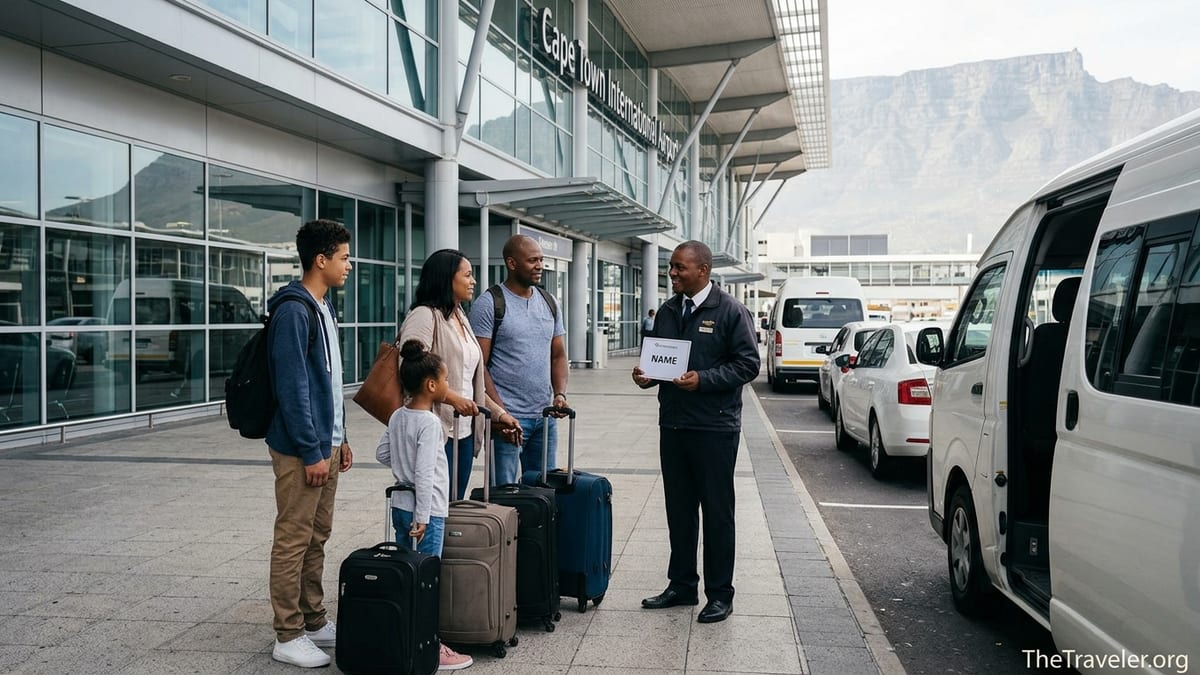
Private transfers are the most straightforward option for many visitors: a driver meets you in the arrivals hall with your name on a board, helps with luggage and walks you straight to an air-conditioned vehicle. Companies like Cape Prestige Travel, Cape Town Shuttle Services, CT Shuttles and similar operators focus on these door-to-door services, often monitoring your flight in real time so there are no extra charges if you are delayed.
Typical one-way prices in 2026 for a standard private car from Cape Town International to central hotels or the V&A Waterfront start from roughly 330 to 400 rand for one or two passengers with light luggage, increasing with distance and vehicle size. For example, some reputable transfer companies quote entry-level rates from about 330 rand for nearby suburbs and around 500 to 700 rand for Atlantic Seaboard areas such as Camps Bay, with larger vans for families or small groups costing more. Luxury vehicles like Mercedes sedans or V-Class people carriers command a premium but can be worthwhile for long road transfers to the Winelands or safari lodges.
Private transfers are especially attractive if you are arriving late at night, after 21:00, or very early in the morning. At those times there are fewer metered taxis queuing, and e-hailing prices can spike due to low driver availability. Pre-booking means a known cost, a vetted driver and less stress when you are tired. They are also helpful for travellers carrying expensive camera gear, surfboards or golf clubs, where an experienced driver who is used to handling bulky items reduces the risk of damage.
Most private shuttle firms offer add-ons like child seats on request, cold bottled water, and short grocery or ATM stops on the way to your accommodation. If you are staying in an Airbnb in a residential area where street names can be confusing, a driver who is familiar with local suburbs can also prevent you being dropped on the wrong corner late at night.
Shared Shuttles, Taxis and E-hailing: Budget-friendly Choices
Shared shuttles and e-hailing services provide more budget-conscious options while still offering a reasonable level of comfort. Several Cape Town shuttle companies run shared or multi-stop services from the airport to popular hotel zones such as the V&A Waterfront, City Bowl and Atlantic Seaboard. These are usually minivans that depart when a minimum number of passengers have booked or on a loose schedule aligned with peak flight arrivals.
Per-person prices on shared shuttles are typically lower than a private transfer, particularly for solo travellers. You might pay in the region of 150 to 250 rand per person to reach central areas, depending on operator and time of day. The trade-off is time: if you are the last drop-off in Camps Bay after stops in the Waterfront and Sea Point, the total journey can easily reach an hour, especially in traffic. Check in advance whether the shuttle runs late into the evening if your flight lands after 21:00.
E-hailing services like Uber and Bolt operate fully at Cape Town International and are popular with independent travellers. The apps show estimated fares and pickup instructions, and you will usually be directed to an upper-level or designated pickup zone. In normal daytime traffic, an UberX-type ride into central Cape Town might cost somewhere between 200 and 350 rand, depending on surge pricing. Premium categories and larger vehicles are more expensive but still generally competitive with private pre-booked services.
Traditional metered taxis wait outside arrivals, but their fares can be higher than app-based services for the same route. They remain a handy option for travellers without local SIM cards or app access, yet it is advisable to ask for an approximate fare range before departing. In all cases, keep small denominations of rand handy, as drivers sometimes struggle to make change for large notes immediately.
Hotel Pickups, Meet-and-greet Services and Family-friendly Transfers
Many of Cape Town’s higher-end hotels and some midrange properties offer their own airport transfer arrangements, either using in-house fleets or vetted third-party partners. For example, luxury hotels at the V&A Waterfront and along the Atlantic Seaboard often publish fixed-rate transfer menus valid for a specific period, with prices varying by vehicle class. A typical 2025 to 2026 hotel tariff might list a one-way airport transfer to the Waterfront for around 1500 to 2000 rand in an executive sedan, with larger vans costing more but accommodating families and groups with multiple suitcases.
The main advantage of booking through your hotel is integration. If your flight is delayed, the front desk knows immediately through the transfer provider and can adjust your check-in expectations. Drivers are familiar with hotel procedures, underground parking and luggage storage, and tipping norms are clear. Some hotels bundle round-trip transfers into special offers, which can be good value compared with booking everything separately, especially during high season.
Families in particular benefit from hotel-linked or pre-booked private transfers. Many providers can supply child seats for different age groups if requested in advance, something that can be hit-and-miss with random taxis or app rides. Vehicles such as Hyundai Staria or Toyota Quantum minivans are widely used by Cape Town shuttle companies and comfortably accommodate parents, children and several large suitcases. Confirm in writing how many suitcases and hand luggage pieces are included so you are not surprised by extra luggage fees at pickup.
Some shuttle firms go a step further with full meet-and-greet services in the arrivals hall, handheld luggage trolleys and assistance all the way to reception at your hotel. This can be a relief for older travellers, those with mobility challenges or anyone shepherding small children after an overnight flight from Europe or North America.
Late-night Arrivals, Early Departures and Handling Luggage
Late-night arrivals and dawn departures are where planning your Cape Town airport transfers really pays off. Although e-hailing services technically operate 24 hours, driver availability naturally drops between midnight and 05:00. If your flight touches down at 23:30 and then queues at immigration, you might emerge after many drivers have signed off for the night. A pre-booked private transfer or hotel car in this scenario drastically reduces waiting time and uncertainty.
For very early flights out of Cape Town, such as international departures leaving between 07:00 and 09:00, consider the combination of rush-hour traffic and airport security queues. Leaving central Cape Town around 04:30 to 05:00 is common advice for long-haul flights, and many private transfer companies are used to 24-hour operations. They will agree a pickup time and build in a margin for traffic along the N2, which can already be busy from 06:00 onwards on weekdays.
Regarding luggage, most private transfers and shuttles specify capacity per vehicle class. A standard sedan usually handles two large suitcases and two cabin bags comfortably, while minivans and minibuses can carry much more. If you are travelling with surfboards for Muizenberg, bicycle boxes for a cycling event or heavy camera gear for safari photography, inform the operator in advance. Some will allocate a trailer or a larger vehicle like a Toyota Quantum or a small coach, which is safer and more practical than trying to squeeze everything into a small hatchback ordered on an app at the last moment.
Lost or delayed luggage can also affect your transfer plans. If you have a pre-booked private shuttle and discover at the carousel that your bags have not arrived, send a quick message on WhatsApp or via the local contact number provided on your voucher. Many operators build an hour of waiting time into their pricing, especially for international arrivals, and will usually be flexible if you keep them updated while dealing with the airline desk.
Connecting to Safaris and the Winelands from Cape Town Airport
Cape Town is one of the few cities where you can fly in the morning and be on a Big Five game drive later that same day. Popular reserves like Aquila Private Game Reserve and Inverdoorn lie roughly 170 to 200 kilometres from the city in the direction of the Karoo, while other lodges such as Sanbona or Grootbos are farther east along the garden route and Overberg regions. Road transfers from the airport to these lodges typically take between 2.5 and 4 hours, depending on distance and stops along the way.
Many safari operators and collection brands allow you to add transport as an optional extra when booking. For example, day-trip and overnight packages to nearby Big Five reserves commonly offer return transfers from central Cape Town hotels by coach or minibus, often departing early in the morning to make mid-morning game drives. In most cases, direct airport pickups for these bus-style transfers are not standard, because flight arrival times vary so widely. Instead, travellers either spend a night in the city first or book a dedicated private transfer from the airport to their lodge or to a central hotel where the safari bus departs.
Pricing for private road transfers from Cape Town International to safari lodges naturally sits much higher than city transfers. As a broad example, luxury hotel and chauffeur rate sheets for the 2025 to 2026 period list one-way transfers from the airport to the Winelands region around Stellenbosch or Franschhoek from roughly 2800 to 4600 rand per vehicle in an executive car, with larger vans and luxury minibuses costing more. Routes to more distant lodges such as Aquila, Grootbos or Sanbona can start around 5200 to 7000 rand or higher per vehicle, reflecting both distance and the higher-class vehicles typically used.
For travellers with limited time, scenic air transfers are another possibility. Several reserves and air charter services operate light aircraft or helicopter flights from Cape Town International or from small city helipads to private airstrips near the lodges. These options are significantly more expensive than road transfers but cut travel time dramatically, sometimes to under an hour from city to reserve, and often include hotel pickup and drop-off around the flights as part of the package.
When Pre-booking is Worth It vs Booking on Arrival
Deciding whether to pre-book your Cape Town airport transfer depends on your priorities, travel style and timing. In shoulder and low seasons, independent travellers with hand luggage only may be comfortable relying on e-hailing services on arrival, especially if they are familiar with ride-hailing in other countries and their accommodation is in a central area. In this scenario, you can compare live Uber and Bolt prices after collecting your bags and choose the cheaper or faster option.
However, pre-booking is strongly recommended in several circumstances. If you are arriving during peak tourist season in December and January, with children, elderly relatives, multiple heavy bags or valuable equipment, the convenience of walking out to a named driver can easily justify the modest premium over a last-minute ride. The same applies to arrivals after 21:00 or before 06:00, when both traffic patterns and driver availability are more unpredictable, and to travellers staying in outlying areas where e-hailing drivers are less common.
Pre-booking is also advisable for long-distance road connections to the Winelands or safari lodges. These journeys involve higher costs and more complex logistics, such as fuel stops and rest breaks, and reputable transfer companies will quote clearly for the full route. Locking in a price weeks before travel helps you budget and removes the risk of negotiating with individual drivers at the airport for a three-hour drive into the countryside.
For hotel-based stays, it can be worth comparing a hotel’s published transfer rates with independent providers. Sometimes the hotel’s executive car will be more expensive than an external shuttle operator, but may include little extras like cold towels, onboard Wi-Fi or guaranteed early check-in coordination that are valuable after a long flight. For budget-conscious travellers, a compromise approach works well: pre-book your arrival transfer for peace of mind, then use e-hailing or the hotel’s concierge to arrange a cheaper ride back to the airport once you are rested and familiar with the city.
The Takeaway
Cape Town offers a wide spectrum of airport transfer options, from budget-friendly shared shuttles and app-based rides to premium private cars, hotel limousines and even air transfers to safari lodges. The best choice for you depends on when you land, where you are staying, who you are travelling with and how much luggage you are carrying. Solo travellers on flexible schedules may lean towards e-hailing services and shared shuttles, while families, older travellers and those on tight safari itineraries will often appreciate the certainty of pre-booked private transfers.
In practical terms, think of your Cape Town airport transfer as the first chapter of your trip rather than an afterthought. A reliable door-to-door ride into the city can mean arriving at your hotel calm, hydrated and ready to explore, instead of stressed after haggling at a taxi rank. For longer connections into the Winelands or the Karoo, a well-planned transfer can be part of the experience in its own right, with mountain and vineyard views along the way. By weighing up the real-world examples and scenarios outlined here, you can choose the option that fits your budget and comfort level, and start your time in the Mother City on the right note.
FAQ
Q1. Do I need to pre-book an airport transfer in Cape Town?
Pre-booking is not mandatory, but it is highly recommended if you arrive late at night, during December and January, with children or heavy luggage, or if you need to connect directly to the Winelands or a safari lodge.
Q2. How much does a private transfer from Cape Town Airport to the city cost?
As a broad guide in 2026, a standard private car for up to two people into central Cape Town or the V&A Waterfront typically costs around 330 to 700 rand one way, with prices increasing for larger vehicles and more distant suburbs.
Q3. Are Uber and Bolt reliable from Cape Town International Airport?
Yes, both Uber and Bolt operate at Cape Town International and are widely used. They are generally reliable in the daytime and evening, although driver availability can dip in the very early morning hours.
Q4. What is the best option for families with young children?
For families, a pre-booked private shuttle or hotel-arranged transfer is usually best, as you can request child seats in advance, guarantee enough luggage space and avoid queuing or juggling children in busy taxi areas.
Q5. Can I get a transfer directly from the airport to a safari lodge?
Yes, many safari lodges or partner transfer companies can arrange private road transfers directly from the airport, and some offer air transfers by light aircraft or helicopter, although these options are more expensive and usually must be booked in advance.
Q6. How long does it take to drive from Cape Town Airport to the Winelands?
Under normal conditions, transfers from the airport to Stellenbosch usually take about 30 to 45 minutes, while Franschhoek is closer to 60 to 75 minutes by road, depending on traffic and your exact destination.
Q7. Is it safe to use taxis and shuttles at Cape Town Airport?
Reputable shuttle companies, hotel cars and established metered taxis are generally considered safe, as are well-rated Uber and Bolt drivers. As in any large city, it is wise to use recognised services, keep valuables out of sight and confirm the driver and vehicle details before getting in.
Q8. What should I do if my flight is delayed but I have a pre-booked transfer?
Most reputable transfer companies monitor incoming flights and adjust pickup times automatically, but it is still a good idea to send a quick message via WhatsApp or email if you know you will be significantly delayed.
Q9. Are there affordable options for solo travellers?
Solo travellers often find that shared shuttles or e-hailing services like Uber and Bolt are the most economical, with per-person costs usually lower than a private transfer if you are travelling alone with light luggage.
Q10. How far in advance should I book a transfer during peak season?
During the busy summer period in December and January, booking your arrival transfer at least one to two weeks ahead is sensible, and even earlier if you need a larger vehicle for a group or are planning a long-distance transfer to a safari lodge or the Winelands.