


More news on this day
Cargo airlines are entering the 2026 peak shipping cycles with a growing gap between aging freighter fleets and the new widebody aircraft they expected to be flying by now, as shifting emissions rules, industrial bottlenecks and delayed aircraft programs converge to limit capacity growth just as demand for cross-border e-commerce remains resilient.
Get the latest news straight to your inbox!
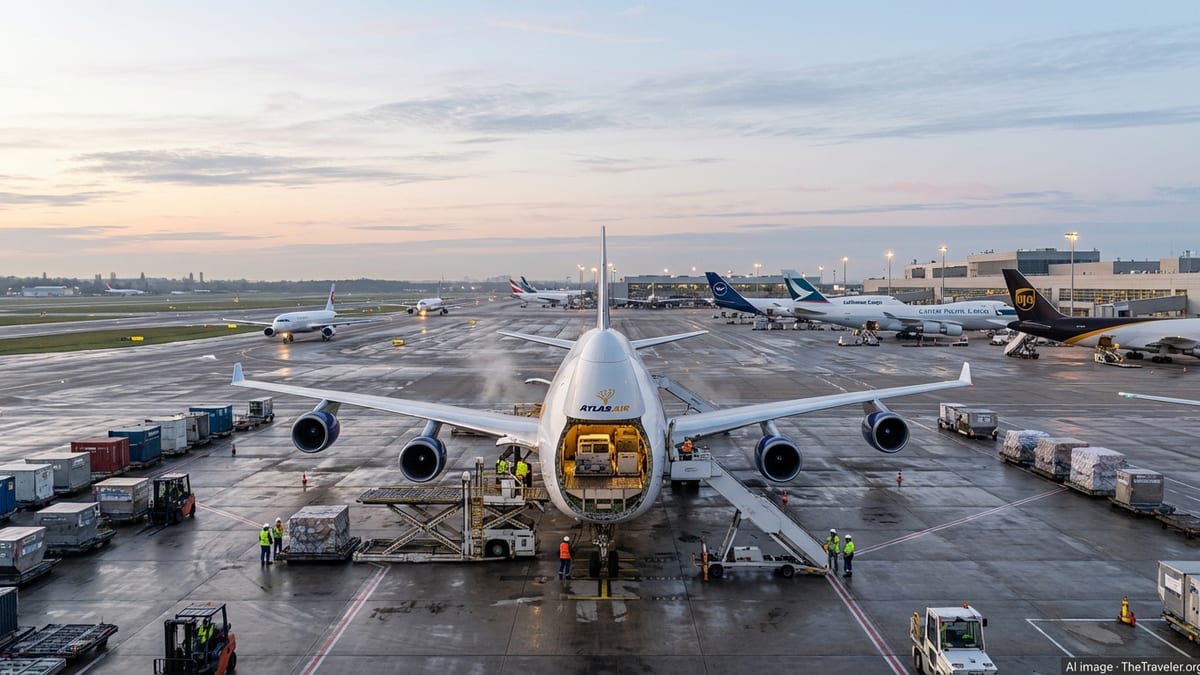
Regulatory deadlines collide with aging freighter fleets
The roots of the current fleet crunch lie in climate regulation that was set years before the latest supply chain strains. The International Civil Aviation Organization has mandated stricter CO₂ emissions standards for new aircraft from 2028, effectively ending production of several current-generation freighters that do not meet the rules in their existing form. Industry analyses indicate that Boeing’s 767-300F and 777F, the backbone of many cargo fleets, will be phased out in commercial form around 2027 in response.
Publicly available fleet data show that these aircraft types still account for a large share of global widebody cargo lift, alongside converted older passenger jets. Large express operators in particular rely heavily on the 767-300F for medium-haul operations, while long-haul cargo specialists have gravitated toward the 777F. With production of both types approaching a regulatory sunset, airlines had counted on a smooth transition to new models before the deadline.
Instead, carriers now confront an uncomfortable overlap. Order books for next-generation freighters are full, but deliveries into active fleets are lagging the original schedules that underpinned many airlines’ renewal plans. As the cutoff date for current types approaches, planners face fewer options for incremental factory-built capacity, forcing some operators to extend older aircraft or compete more aggressively for passenger jets to convert.
For travelers and shippers, these dynamics are largely invisible until translated into higher rates and longer transit times. However, the structural shift in the freighter market underway in 2026 is helping to explain why spot cargo prices are proving stickier than many expected after the pandemic surge faded.
A350F delays ripple across airlines’ renewal plans
The Airbus A350F is central to many cargo airlines’ post-2027 strategies, because it is designed from launch to comply with the tighter emissions standard. Airbus initially targeted entry into service in the 2025 to 2026 window, which aligned with airlines’ plans to retire older 747 and early 777 freighters on schedule. According to published coverage of Airbus financial updates, that timetable has slipped, with the first A350F deliveries now expected in the second half of 2027 after supply chain difficulties constrained the broader A350 production line.
Reports in specialist aviation outlets describe particular challenges around key structural components and the ramp-up of new manufacturing work packages. Airbus has continued developmental milestones, recently highlighting completion of the first A350F main deck cargo door and the arrival of initial fuselage sections in Toulouse for test aircraft assembly. At the same time, the company has confirmed that test flying will run through 2026 and into 2027, delaying the moment when launch customers can place the type into regular commercial service.
Despite the pushback, airlines are doubling down on the A350F, signaling confidence in the aircraft but deepening the near-term capacity gap. Atlas Air Worldwide, Air China Cargo, Cathay Group and Silk Way West Airlines are among those that have expanded A350F commitments in 2025 and 2026, according to manufacturer announcements and trade press coverage. Many of these airlines are also among the largest operators of current 747 and 777 freighters, underscoring how central the delayed model is to their renewal timelines.
For 2026 specifically, the impact is twofold. First, airlines that anticipated A350F deliveries around now must instead keep older aircraft flying longer, often at higher fuel and maintenance cost. Second, growth plans premised on additional payload and range from the new type are pushed out by at least a year, limiting their ability to open new dedicated cargo routes or increase frequencies in fast-growing markets.
777-8F and the narrowing bridge between old and new capacity
On the Boeing side of the ledger, the long-planned bridge between existing 777F output and the new 777-8F freighter has also shifted. Boeing launched the 777-8F in 2022 as part of the broader 777X family, positioning it as a next-generation successor with lower emissions and greater efficiency. The company has accumulated dozens of orders, but program updates reported in 2024 and 2025 moved the targeted first delivery for the 777-8F to around 2028, several years later than many early customers initially anticipated.
Industry briefings indicate that Boeing is still producing the current 777F and 767-300F for key customers while it navigates certification of the 777X passenger variant and industrial changes at its widebody factories. However, with emissions rules capping how long older designs can stay in production for commercial customers, the room to keep building interim freighters is limited. Analysis from aerospace consultancies published in early 2026 notes that by the time the 777-8F arrives, some airlines will already have retired earlier-generation 777Fs without a direct one-for-one replacement available.
This timing mismatch is at the heart of the 2026 fleet squeeze. Both major manufacturers are retooling for a new era of compliant freighters, but the window between the sunset of legacy models and the ramp-up of their successors has widened. Cargo carriers that bet on early slots for the new aircraft are discovering that they must either postpone route growth or plug the gap through conversions, leased capacity or wet-lease arrangements that can be more expensive and less flexible.
The 777-8F delays also complicate competitive dynamics. With the A350F due to enter service first, several Boeing-aligned cargo carriers are hedging by adding Airbus orders, while others are leaning harder on conversions of existing 777 passenger aircraft. The result is a more fragmented path to fleet renewal than many planners had envisioned at the start of the decade.
Conversions and used jets provide only partial relief
In response to postponed factory freighters, airlines and lessors are leaning on passenger-to-freighter (P2F) conversions as a pressure valve. Conversion lines for 767s, 777-300ERs and A330s remain in high demand, with reports from maintenance and repair organizations indicating strong backlogs through the mid-2020s. For some regional and e-commerce operators, these converted aircraft can offer a relatively quick and cost-effective way to add lift.
Yet the conversion market faces its own constraints. Feedstock availability for desirable mid-life widebodies has tightened as passenger airlines delay retirements in the wake of new aircraft delivery delays on the passenger side. Publicly available fleet data and analyst commentary show that many aircraft that might have flowed into the cargo sector after 2023 remain in passenger service, limiting the pool of suitable airframes for freight conversion.
Environmental considerations are also reshaping how long older freighters can remain viable. Converted aircraft built on older passenger platforms can be less fuel efficient and noisier than purpose-built next-generation freighters, which complicates their use in noise-sensitive hubs and on long-haul sectors where fuel burn is a critical cost driver. As regulators increase pressure on airlines to align with national climate targets, some carriers are reluctant to commit heavily to conversions that could face operating restrictions later in the decade.
For 2026, that leaves many cargo operators with a patchwork of solutions rather than a single clean replacement path. They may extend leases, invest in heavy maintenance checks to keep aging jets airworthy, or rely on seasonal charter capacity. Those strategies can bridge a year or two, but they do not fully substitute for the payload, efficiency and regulatory headroom offered by the new-generation freighters still in development.
What delays mean for shippers and global trade in 2026
The fleet bottlenecks emerging in 2026 do not mean a repeat of the extreme cargo disruptions seen at the height of the pandemic, but they are reshaping price and capacity trends. Analysts following the air freight sector note that while global trade growth has moderated, cross-border e-commerce and high-value supply chains in electronics, pharmaceuticals and automotive components continue to lean heavily on reliable air freight options.
With limited new factory-built freighter capacity arriving this year, airlines have less flexibility to add extra sections or launch new routes in response to local surges in demand. As a result, spot rates on certain long-haul lanes remain buoyant, particularly where widebody passenger belly capacity is still recovering unevenly. Shippers moving urgent or temperature-sensitive goods may find that capacity is available but at a higher price than headline demand indicators might suggest.
Some cargo-focused hubs are responding by investing further in efficiency and digital tools rather than counting on a wave of new aircraft. Publicly available information from airports and ground handlers highlights expanded cargo terminals, improved slot coordination and faster customs processing as ways to extract more throughput from existing fleets. For passengers passing through these hubs, the changes can appear as new logistics facilities or expanded night-time operations on the periphery of passenger terminals.
Looking ahead from the vantage point of 2026, the freighter fleet crisis is less about absolute shortages and more about mistimed transitions. The next generation of cargo aircraft is coming, with firm order books and visible progress on assembly lines. Until those jets arrive in significant numbers, however, cargo airlines will need to manage a tight balance between maintaining legacy fleets, funding interim conversions and meeting shippers’ expectations in a market where aircraft are harder to replace than many planners once assumed.