


More news on this day
Hundreds of passengers traveling through Brazil’s busiest air corridor between São Paulo and Rio de Janeiro have faced cancellations and delays in early July 2026, as publicly available tracking data indicates that LATAM, GOL and Azul together disrupted around 340 flights across their key hubs.
Get the latest news straight to your inbox!
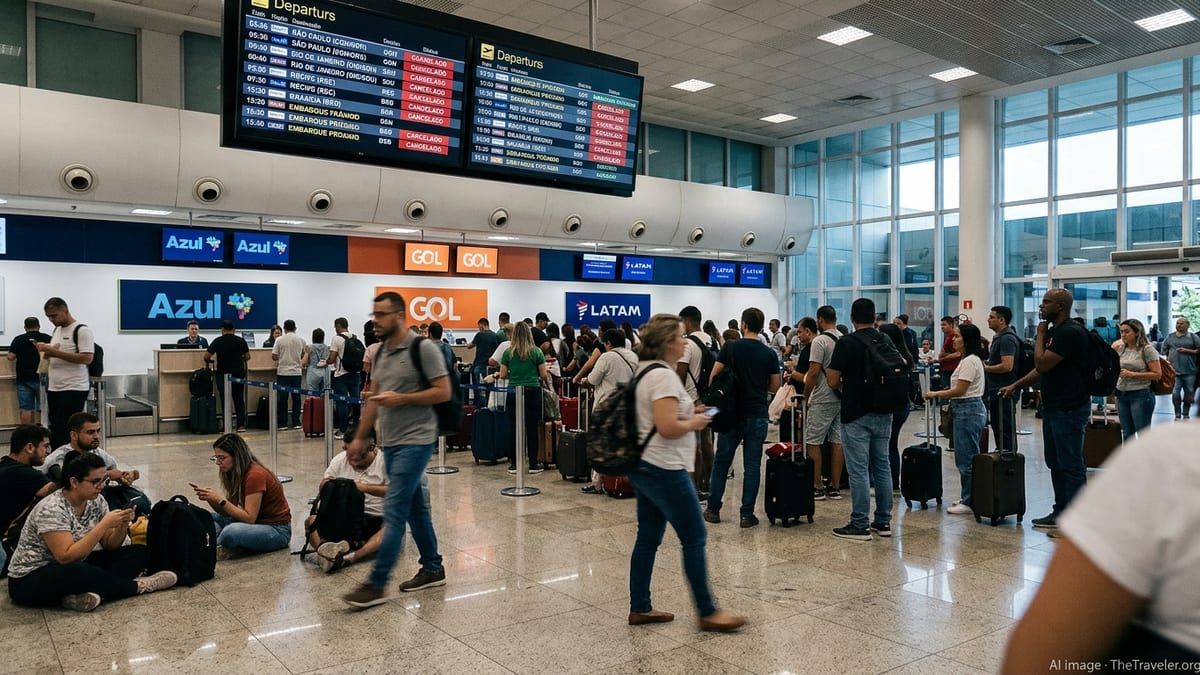
Heavy Disruptions Hit Brazil’s Core Air Bridge
The shuttle corridor linking São Paulo and Rio de Janeiro is one of the densest domestic air routes in the world, with more than one flight every few minutes on peak days between Congonhas, Guarulhos, Santos Dumont and Galeão. According to published schedules for July 2026, LATAM, GOL and Azul collectively operate the majority of frequencies on these city pairs, especially on the traditional air bridge between Congonhas and Santos Dumont.
Across the first part of July, operational data from flight-tracking platforms and airport boards shows an unusual concentration of cancellations and extended delays on this corridor, affecting both shuttle-style services and connecting flights into the two metropolitan areas. When tallied over several days, roughly 340 LATAM, GOL and Azul flights touching the São Paulo and Rio de Janeiro hubs were either canceled outright or operated with significant delays, disrupting travel plans in both directions.
The disruptions have hit a mix of business travelers, domestic tourists and international passengers connecting through São Paulo Guarulhos and Rio de Janeiro Galeão to long haul services. Reports indicate that missed connections have led some travelers to rebook via alternative Brazilian hubs or even to abandon air travel altogether in favor of overnight intercity buses or last minute car rentals.
While July is a traditionally busy month on Brazilian domestic routes, particularly for leisure traffic and school holidays, recent growth in capacity on the Rio–São Paulo axis has left airlines with dense schedules at slot constrained airports. Any disturbance in aircraft rotation or staffing can therefore cascade quickly across dozens of departures in a single day.
Weather, Congestion and Tight Scheduling Amplify Impact
Publicly available information points to a combination of factors behind the July disruptions rather than a single cause. Periodic winter weather in southeastern Brazil has produced low visibility conditions and runway flow restrictions at Congonhas, Guarulhos, Santos Dumont and Galeão, reducing the number of aircraft movements that can be handled per hour and triggering rolling delays.
At the same time, the high concentration of short haul flights on the Rio–São Paulo air bridge means that aircraft and crews cycle rapidly between the two cities. When an early rotation is delayed or diverted, subsequent flights on the same aircraft can depart hours behind schedule, and in some cases airlines have opted to cancel later sectors to stabilize operations. Flight tracking records for early July show chains of late departures on multiple LATAM, GOL and Azul services along this corridor.
Operational constraints at key airports have added further pressure. São Paulo Congonhas and Rio de Janeiro Santos Dumont rely on closely managed slot systems that limit takeoff and landing opportunities. If an aircraft misses its allocated slot due to incoming delays or ground handling issues, it can face extended holding on the ground or in the air, compounding schedule disruption. According to published coverage, the tight slot environment has been a recurring challenge for Brazilian carriers trying to grow in these markets.
Industry analyses of Brazilian aviation have long highlighted the sensitivity of the domestic network to bottlenecks at a few large hubs. With LATAM and GOL maintaining major operations at São Paulo airports and Azul strongly present in the wider region, irregular operations in early July have had an outsized impact on overall national on time performance.
Travelers Report Long Queues, Missed Connections and Rerouting
Accounts shared on social platforms and travel forums in recent weeks describe long lines at airline counters in São Paulo and Rio de Janeiro as passengers seek rebooking options after cancellations or multi hour delays. Several posts reference travelers missing onward domestic and international connections out of Guarulhos or Galeão, and in some cases choosing alternative modes of transport to reach Rio or São Paulo when same day flight options became scarce.
Some passengers transiting between Guarulhos or Congonhas and Santos Dumont or Galeão reported difficulty securing same day seats during peak disruption periods, especially on popular morning and late afternoon departures often used by business travelers. Where spare capacity did exist, travelers noted significant price differences between carriers on last minute bookings, with Azul frequently described as the higher priced option compared with LATAM and GOL on similar routes.
Publicly visible feedback also highlights frustration with communication at crowded hubs. Travelers describe conflicting information between airline apps, departure boards and airport staff during disruption peaks. While some flyers reported smooth reaccommodation and hotel vouchers on longer delays, others recounted situations in which they waited hours in customer service queues before receiving new itineraries or confirmation of refunds.
For visitors unfamiliar with São Paulo or Rio de Janeiro, changing airports within the same metropolitan area has added complexity. Several reports reference tight connections that required crossing the city between Congonhas and Guarulhos or between Santos Dumont and Galeão, a transfer that becomes more stressful when initial flights are delayed.
LATAM, GOL and Azul Balance Growth With Reliability
The three leading Brazilian carriers have been rebuilding and expanding their domestic networks as demand recovers and international connectivity grows. Public filings and investor presentations in 2026 emphasize increased deployment of newer, more fuel efficient aircraft and a focus on high demand city pairs, including the Rio–São Paulo corridor, where shuttle style operations can generate strong yields.
LATAM, GOL and Azul collectively dominate traffic at São Paulo and Rio de Janeiro airports, each using them not only as origin and destination markets but also as key connection points to the rest of Brazil and to long haul services. Published data on route structures shows that Guarulhos and Congonhas in particular serve as linchpins for domestic feed into international departures, magnifying the effect of any disruption within the local shuttle network.
Analysts following the Brazilian market have frequently noted that this growth strategy depends on maintaining tight operational reliability. Disruptions affecting hundreds of flights in a short period can erode passenger confidence, especially among business travelers who value punctuality on the shuttle corridor. Some observers have argued that Brazilian carriers may need to build more slack into their schedules at congested hubs, even at the cost of slightly lower aircraft utilization.
In parallel, ongoing infrastructure improvements, such as upgrades at larger airports and potential redistribution of traffic to secondary hubs, are being discussed in policy and industry circles as ways to reduce the strain on São Paulo and Rio de Janeiro. Until such changes materialize, episodes like the July 2026 disruption underline how quickly conditions at a handful of airports can ripple across the national network.
What July’s Disruptions Mean for Upcoming Travelers
For travelers planning flights between São Paulo and Rio de Janeiro later in July and into the coming months, recent disruptions serve as a reminder to allow extra buffer time, particularly when connecting to international services. Publicly accessible travel advisories and historical delay data suggest that early morning and late evening flights can be especially vulnerable because they depend heavily on aircraft positioning from previous days.
Many frequent travelers on this corridor recommend booking slightly longer layovers when connecting through Guarulhos or Galeão, and avoiding same day cross town airport changes when possible. Purchasing fares that permit free or low cost changes can also provide flexibility if operational issues recur.
Travel planning resources advise passengers to monitor flight status closely and to check both airline and airport channels on the day of departure. In disruption scenarios, acting quickly to request rebooking through mobile apps or customer service centers may secure earlier alternatives, as seats on remaining flights tend to fill rapidly once widespread delays become apparent.
While the July 2026 episode has been disruptive, Brazil’s main carriers continue to operate dense schedules between São Paulo and Rio de Janeiro, and most flights still depart and arrive as planned. For now, however, the recent wave of cancellations and delays illustrates the fragility of one of South America’s most important air corridors and the challenge of balancing ambitious growth with reliable operations.