


Mohammed V International Airport outside Casablanca is the main international gateway to Morocco. If you are landing here for the first time, the mix of French and Arabic signs, the busy arrivals hall and the different transport options can feel overwhelming after a long flight. This guide walks you, step by step, through the airport, ground transport, SIM cards, money and Royal Air Maroc connections so that your first hour in Morocco is calm and predictable instead of chaotic.
Get the latest updates straight to your inbox!
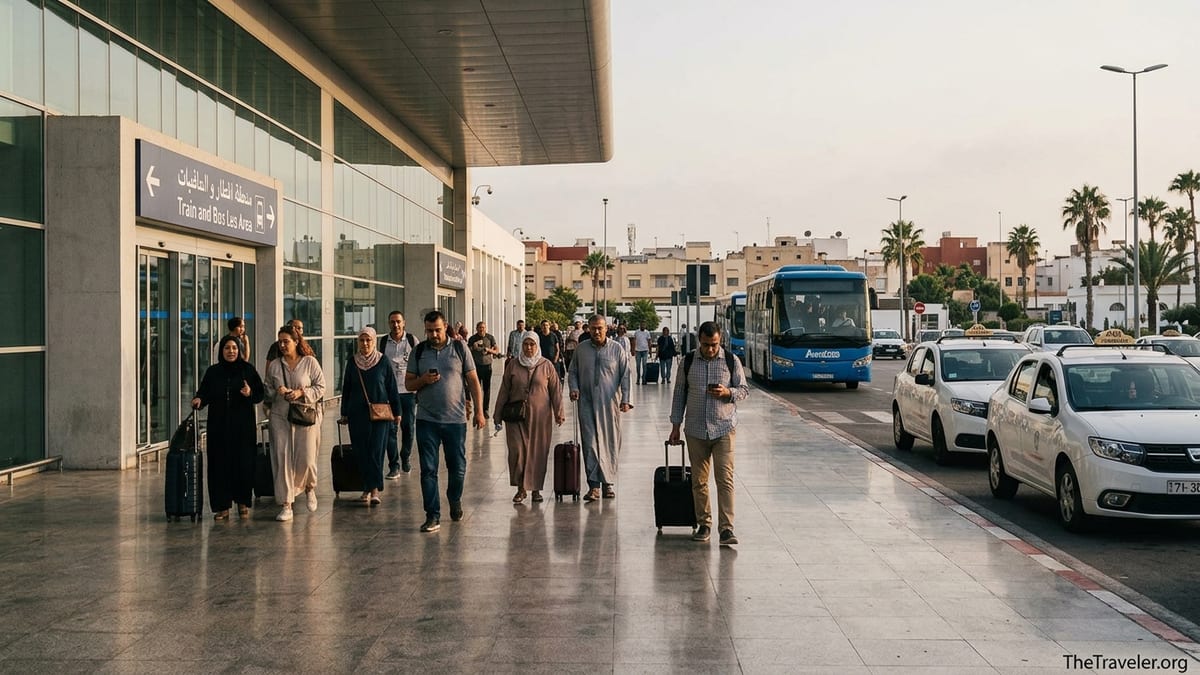
Understanding Casablanca’s Mohammed V Airport Layout
Mohammed V International Airport (IATA code CMN) sits about 30 kilometers southeast of central Casablanca. It is Morocco’s busiest airport and the main hub for Royal Air Maroc, so you will see a steady stream of European, African, Middle Eastern and domestic flights arriving and departing at almost all hours. For a first-time visitor, the most useful thing to know is that CMN is effectively one large complex with two main passenger terminals, Terminal 1 and Terminal 2, connected landside so you can walk between them without going outside.
Most Royal Air Maroc and Royal Air Maroc Express flights use Terminal 1, especially domestic and many African routes, while a mix of Royal Air Maroc and other international airlines, including some European low-cost carriers and Air Arabia Maroc, use both Terminal 1 and Terminal 2. Airlines sometimes move during renovations or season changes, so always check your booking or boarding pass to confirm which terminal you need before arriving. Inside, the design is more functional than glamorous: long corridors, plenty of glass and marble floors, and a central shopping and food area that serves both terminals airside.
If you are connecting through Casablanca on Royal Air Maroc, you will usually remain airside and follow transit signs without going through passport control. Passengers ending their journey in Morocco, on the other hand, will funnel from the arrival gate to immigration, baggage claim and customs on the lower level. The airport has clear bilingual French and Arabic signage, with some English, but announcements are often in Arabic and French only. Giving yourself a few extra minutes to read signs before following the crowds is an easy way to avoid ending up in the wrong queue.
One helpful landmark is the on-site train station, located beneath Terminal 1. From arrivals you follow signs for the train icon, walk along the corridor linking the terminals and then down escalators to the lower level. Even if you do not plan to take the train, noticing this station gives you a mental map: arrivals above, train and long-distance connections below.
Arrivals, Immigration and First Steps After Landing
On landing, most flights park at jet bridges, although remote stands with bus transfers do appear at busy times. Once off the plane you simply follow the “Arrivals” and “Police / Police de l’Air et des Frontières” signs. Transit passengers continuing on Royal Air Maroc should instead watch for “Transit / Correspondances” and bypass passport control. Immigration queues fluctuate sharply: a late-evening arrival from Europe may clear in 15 to 30 minutes, while a bank of long-haul flights from North America, the Gulf and West Africa can easily push waits past 45 minutes.
At passport control, you present your passport and often your return or onward ticket details. You will be asked basic questions such as where you are staying in Morocco and for how long. Have your first hotel name and address ready on paper or on your phone, as mobile data may not yet be active. The entry card information that used to be filled manually is now often captured electronically, but procedures can change, so check the latest with your airline before departure and carry a pen just in case a paper form is handed out on the plane.
After immigration you proceed down to baggage claim. Baggage delivery at CMN is average by international standards. When several wide-body aircraft arrive close together, it is not unusual to wait 20 to 40 minutes for luggage to appear. While you wait, this is a good time to use airport Wi-Fi for a quick message to your hotel or driver and to check your ground transport options. Once you have your bags, you pass through customs. Most travelers walk straight through the green “Nothing to declare” channel; random bag checks are possible but not particularly frequent.
As soon as you exit customs into the public arrivals hall, you will encounter a crowd of drivers holding signs, friends and relatives greeting passengers, and sometimes informal touts offering taxis, tours or currency exchange. For a calm arrival, it helps to know exactly what you want to do next: buy a SIM, get some cash, and then head either to the train, Aerobus, a pre-booked driver, or a regulated taxi rank. Ignoring unsolicited offers and walking straight to official counters or clearly marked transport desks is the simplest way to start your trip on the right foot.
Money, ATMs and Buying a Moroccan SIM Card
The Moroccan dirham is a closed currency, so many visitors arrive with only foreign cash or credit cards. Inside the arrivals hall you will usually see at least one bank-branded exchange counter and several ATMs. Airport exchange kiosks typically offer less favorable rates than city-centre banks, so a practical approach is to change or withdraw just enough for your first 24 hours: for example 400 to 600 dirhams to cover train or taxi fares, a snack and some contingency. ATMs from major Moroccan banks tend to work with international Visa and Mastercard debit cards, though daily limits vary.
For most travelers, using an ATM to withdraw dirhams is more cost-effective than exchanging large amounts of foreign cash at the airport. If you do use a card, watch out for dynamic currency conversion prompts that offer to charge you in your home currency instead of dirhams. Declining that option and paying in dirhams almost always results in a better rate from your own bank. Keep small notes, such as 20 and 50 dirham bills, for luggage trolleys, coffee and tips. Big notes like 200 dirhams can be surprisingly hard to break on your first taxi ride or at a corner café.
Mobile coverage in Morocco is generally strong, and a local SIM with data is one of the best-value purchases you can make on arrival. You will find sales counters or small kiosks for the main Moroccan operators Maroc Telecom (often branded IAM), Orange and Inwi in or just outside the arrivals hall. Typically you bring your passport, choose a starter pack that includes both voice and data, and let the staff register and activate the line for you. As of mid 2026, typical offers for tourists include roughly weekly or monthly data bundles, while exact volumes and prices change regularly, they are usually inexpensive by international standards.
As a concrete example, many recent visitors have reported paying the equivalent of a few US dollars for several gigabytes of data valid for a week, enough for messaging, maps and light browsing. If you expect to use ride-hailing apps such as Careem or inDrive, or if you are heading straight from Casablanca to cities like Marrakech or Fes by train, having mobile data from the start will make navigation and communication far easier. When the kiosk staff insert the SIM, ask them to confirm that data is working by opening a map or browser page in front of you, and keep your original SIM card in a safe place so you do not lose it before the return journey.
Getting to Casablanca: Train, Aerobus, Taxi and Ride-Hailing
From CMN into Casablanca you have three main public options: the airport train, the dedicated Aerobus coach and standard taxis. The on-site train station beneath Terminal 1 connects the airport with Bouskoura, several suburban stops and the two major city stations Casa Voyageurs and Casa Port. Trains typically run about once an hour, with first departures from the airport in the early morning and last departures around late evening. The trip to Casa Voyageurs takes roughly 35 to 45 minutes, and from there you can connect to onward trains for Rabat, Marrakech, Fes and beyond.
Tickets are sold at staffed counters and vending machines in the station area. Prices are modest by European standards; a one-way second-class ticket from the airport to Casa Voyageurs is usually the equivalent of just a few US dollars. In practice, many first-time visitors do exactly this: land at CMN, buy a train ticket within the airport, ride to Casa Voyageurs and then either walk or take a short taxi to a hotel in central Casablanca or to Casa Port station if staying near the old medina and port area. If you are catching a train the same day to Marrakech or Fes, buying a combined ticket or at least checking onward departure times at the same counter will reduce stress.
The Aerobus service, operated by the city bus network, offers another direct connection between the airport and central Casablanca. These modern coaches are designed for travelers, with luggage space and air conditioning. Buses usually run day and night, with departures every 25 to 40 minutes depending on the time of day. They serve several city stops, typically including Casa Voyageurs and central hubs such as Place Mohammed V. Payment can be made in cash on board and, increasingly, by bank card or transport smartcard. For a solo traveler or a couple staying near one of the main stops, Aerobus can be almost as quick as a taxi at a fraction of the price.
Official airport taxis wait outside the arrivals level. These are generally large white taxis operating on a fixed or semi-fixed fare for airport runs. Typical quoted prices to central Casablanca sit in the range of a few hundred dirhams, with surcharges at night. That makes them considerably more expensive than the train or Aerobus but still reasonable for two to four people with luggage, especially if you are arriving very late or very early when public transport is less frequent. Always agree the total fare before getting in, ask clearly whether the price is in dirhams and clarify if it is per car, not per person. Having small notes ready makes the payment easier.
Ride-hailing options have evolved in Casablanca. Uber’s presence has fluctuated, while regional apps such as Careem and the global inDrive service are more commonly used by residents. Not every driver is willing or licensed to pick up directly from the airport, and rules can change, but many travelers now open Careem or inDrive after clearing customs to compare prices against taxi quotes. A typical inDrive offer from the airport into the city might be comparable to or slightly lower than an official taxi’s fixed fare, especially off-peak, because you can propose a price and see if a driver accepts. For all app rides, it is safest to meet drivers at clearly marked pickup points outside the terminal and to double-check the license plate before getting in.
Royal Air Maroc Connections and Transit Tips
Royal Air Maroc uses Casablanca as its main hub, so countless passengers connect here between Europe or North America and destinations across Morocco and West Africa. If CMN is not your final stop, your experience depends on whether your bags are checked through. On a through ticket with Royal Air Maroc or a partner, your luggage will normally be tagged to your final destination, meaning that on arrival in Casablanca you simply follow “Transit / Correspondances” signs, clear the security checkpoint for transferring passengers and then enter the departures hall for your next gate.
Connection times at CMN can be tight, especially on banked waves of flights. One-hour domestic connections are common in the timetable and usually workable as long as your inbound flight is on time, because you remain airside and the airport is compact compared with giant hubs like Istanbul or Paris. However, you should move briskly, watch information screens immediately for your next gate number and be prepared for another security screening. If your first flight is delayed and you are on a single ticket, go straight to the Royal Air Maroc transit desk for rebooking assistance and, for long delays, potential meal vouchers or hotel accommodation according to airline policy.
Travelers connecting between two separate tickets, such as a low-cost European carrier into Casablanca and a domestic Royal Air Maroc flight bought separately, face a more complex process. In this case, you almost always need to pass immigration, collect your luggage, exit customs and then re-check in landside at the departure terminal. That means you must allow extra time: three or more hours is sensible, particularly at busy times. An overnight between tickets is even safer if you are heading deep into Morocco, for instance flying to Marrakech, Agadir or Oujda with little flexibility for missed flights.
Royal Air Maroc also carries many passengers whose final destination is not Casablanca itself but cities like Marrakech, Tangier, Fes or Agadir. A common itinerary from North America, for example, sees travelers arrive early morning from New York and immediately board a short domestic hop to Marrakech. In these cases, you might never see the city of Casablanca, only its airport. If you would like to explore the city, consider building in a longer layover and taking the airport train into town for a few hours, leaving plenty of time to return well before your onward departure.
First-Time Morocco Arrival Etiquette and Safety
Walking out of the arrivals hall at CMN is, for many, their first direct experience of Morocco. The scene is usually busy but not threatening: families waiting with flowers, professional drivers in suits holding printed name boards, and a handful of freelance taxi touts who approach foreign-looking passengers. The simplest strategy is to avoid engaging with anyone who approaches you unsolicited and to keep moving purposefully toward the transport option you chose. A polite “no thank you” in French or English is generally enough; if someone persists, simply repeat and continue walking.
Culturally, Morocco is welcoming but socially reserved in public spaces. Dressing modestly on arrival is appreciated, especially if you are heading straight from the airport to a medina riad in cities like Fes or Marrakech later in your trip. For both men and women, long trousers or a skirt and a T-shirt or light long-sleeved top are completely fine and will help you blend in more than beachwear or revealing clothing would. At the airport itself anything within normal international travel standards is acceptable, but starting the trip with a respectful outfit makes the transition smoother.
In practical safety terms, CMN is similar to many mid-sized international airports. Pickpocketing is uncommon inside secure areas but can occur in crowded spots like the public arrivals hall, bus stops and taxi ranks. Keep passports, phones and wallets in zipped pockets or money belts, especially if you are distracted after a long overnight flight. When using ATMs, shield your PIN and avoid assistance from strangers. For solo travelers or those arriving late at night, pre-booking a reputable hotel car or transfer service can provide extra reassurance, even if it costs more than public transport.
Language is another common concern. Staff at airline check-in desks, passport control and major transport services typically speak at least some French and basic English. If you know a few words of French or Moroccan Arabic, they are warmly received, but you can manage with English alone. Printing out your hotel confirmation, including address and phone number, is a practical backup in case a taxi driver does not fully understand your pronunciation. Many drivers are more comfortable reading an address on paper or on your phone and then using their own knowledge or apps for navigation.
Beyond Casablanca: Using CMN as a Rail and Bus Gateway
Even if you do not plan to stay in Casablanca, Mohammed V Airport is your launching point for the rest of Morocco. The airport train feeds directly into Casa Voyageurs station, which is a main hub of the national rail network. From here you can board frequent trains to Rabat and onwards to Meknes and Fes, as well as long-distance services to Tangier and Oujda in the northeast. For example, a common route for first-time visitors is airport train to Casa Voyageurs, then a comfortable intercity train to Fes, arriving the same afternoon or evening.
For Marrakech, you have a choice. You can connect by train via Casa Voyageurs, with several direct services a day heading south, or you can pre-book a private transfer from CMN straight to Marrakech, which takes several hours by highway. Online discussions and recent visitor reports show that quotes for private cars between Casablanca airport and Marrakech vary widely, but they are especially attractive for small groups sharing the cost. For solo travelers, the train is usually the better-value option, even if it means a change of trains and a short taxi ride at each end.
If your itinerary leans more on buses, such as CTM or Supratours, you will almost always travel first from the airport into Casablanca by train, Aerobus or taxi and then reach the appropriate coach station. CTM, for example, uses a main bus terminal in Casablanca from which coaches fan out to coastal and inland destinations. A practical real-world scenario might be landing at CMN in the morning, taking the train to Casa Voyageurs, grabbing a quick lunch nearby and then catching an afternoon CTM bus to Essaouira or Chefchaouen.
Whichever onward route you choose, the principle is the same: use the airport’s integrated train link or Aerobus to get yourself into the city efficiently, and then switch to long-distance rail or bus. Keeping your first day’s plan simple, with only one major connection, reduces stress. For example, it is ambitious to attempt a same-day sequence of international flight, airport train, long-distance train and then late-night bus to a remote town. Breaking the journey with one night in Casablanca, Rabat or Marrakech is usually more pleasant, especially when you factor in jet lag.
The Takeaway
For many travelers, Mohammed V International Airport is not only the entry point to Morocco but also their first encounter with North Africa. The key to a smooth arrival lies in a few predictable steps: move calmly through immigration and baggage claim, get a modest amount of local currency, buy a Moroccan SIM if you need data, and choose the ground transport option that best fits your budget and arrival time. The combined terminal layout, on-site train station and dedicated Aerobus service mean that once you exit customs, you are rarely more than an hour from central Casablanca.
Royal Air Maroc’s hub operations make CMN particularly important for those connecting to domestic destinations. If you are on a through ticket, follow the transit signs and trust that the compact size of the airport plays in your favor, while still allowing generous buffers for delays. If you are on separate tickets, accept that you will need more time for formalities. Above all, remember that almost every scenario you fear as a first-time visitor has been lived and resolved by thousands of travelers before you. With a bit of preparation and realistic expectations, Casablanca’s airport becomes not a hurdle, but the beginning of the adventure.
FAQ
Q1. How long does it usually take to get from landing at CMN to central Casablanca?
In normal conditions, allow around two hours from scheduled landing to reaching your hotel: roughly one hour for immigration and baggage, then another 45 to 60 minutes by train, Aerobus or taxi into town.
Q2. Is the train from Casablanca Airport to the city safe for solo travelers at night?
Yes, the airport train is generally considered safe, including in the evening, provided you keep an eye on your luggage, avoid very empty carriages if possible and use common-sense precautions as you would in any big city.
Q3. Should I take a taxi, Aerobus or train from CMN if I am staying near Casa Port station?
If you arrive during normal hours, the train is usually the most straightforward, because it runs directly to Casa Port. Outside train hours, Aerobus or a taxi are good alternatives; a taxi is simplest late at night or with heavy luggage.
Q4. Can I buy a Moroccan SIM card at Casablanca Airport even if I arrive late?
SIM card counters tend to keep long hours but may not operate through the night. If you land very late, you may find only one operator open or sometimes none, so consider downloading offline maps in advance as a backup.
Q5. How much cash should I withdraw or exchange on arrival at CMN?
A practical amount for most first-time visitors is the local currency equivalent of one day’s expenses, for example enough to cover transport into the city, a meal and some small incidental purchases, then use city ATMs later for larger amounts.
Q6. Do I need to speak French or Arabic to manage in Casablanca Airport?
No, you can get by with English, especially at airline counters, immigration and major transport services, although knowing a few basic French or Arabic phrases is helpful and appreciated by staff and drivers.
Q7. How much time should I allow for a Royal Air Maroc connection in Casablanca?
For a protected connection on a single ticket, one and a half to two hours is usually workable. For separate tickets where you must clear immigration and re-check bags, plan at least three hours, and more if you are risk-averse.
Q8. Are ride-hailing apps like Careem available directly at Casablanca Airport?
Many travelers do use apps like Careem or inDrive from the airport, but local regulations and driver willingness can change, so it is wise to check the app after landing and compare any offers with the official taxi prices.
Q9. Is it realistic to travel from CMN straight to Marrakech or Fes the same day?
Yes, many visitors do this by connecting through Casa Voyageurs station. However, it is important to allow enough time between your flight and onward train, and to have a backup plan such as a later departure or an overnight stay if delays occur.
Q10. How can I avoid scams or overpaying for taxis at Casablanca Airport?
Use the official taxi rank, confirm the total fare in dirhams before getting in, and do not accept vague answers about “meter later” or “price depends on traffic.” If the quoted price seems excessive, you can politely decline and ask another driver or compare with ride-hailing apps.