


Landing at Casablanca’s Mohammed V International Airport and heading straight for Morocco’s trains is not just possible, it is usually the smartest way to reach cities like Marrakech, Rabat, Tangier and Fes. The key hub is Casa Voyageurs, Casablanca’s main railway station and the southern terminus of the Al Boraq high speed line. This guide walks you step by step from the arrivals hall at the airport to your onward platform, with practical advice on tickets, luggage, real-world connection timings and what to do if things do not go to plan.
Get the latest updates straight to your inbox!
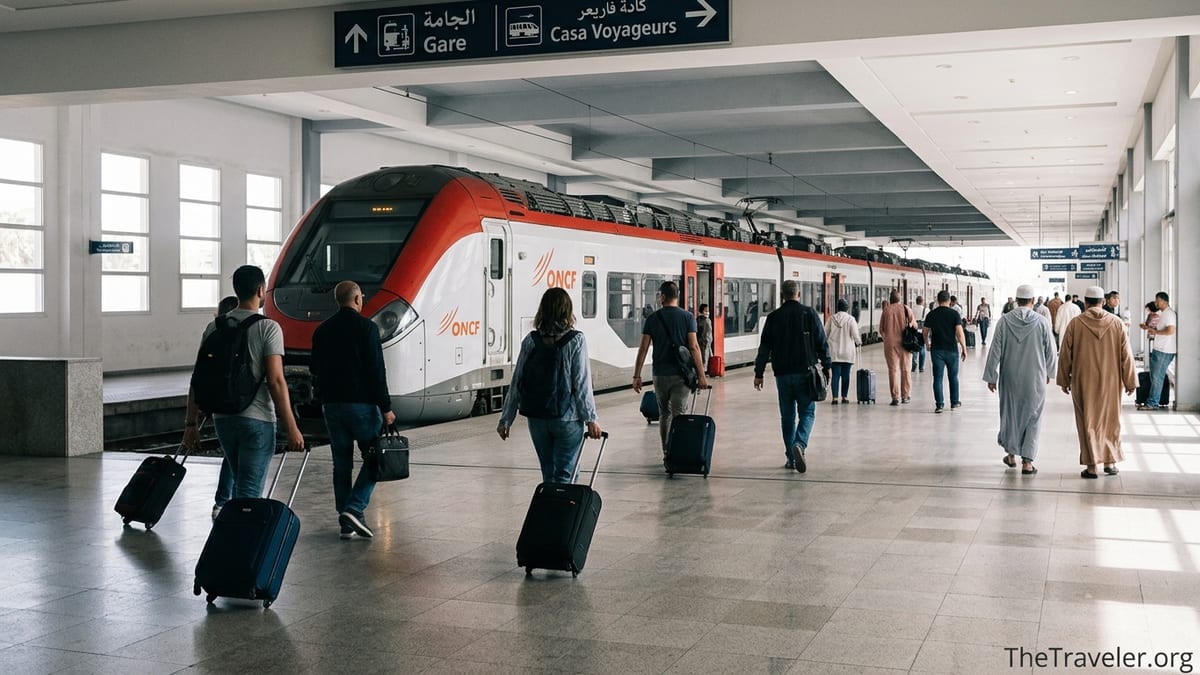
From Casablanca Airport to Casa Voyageurs: How the Direct Train Works
Mohammed V International Airport has its own ONCF rail station built directly into Terminal 1, on the lower level beneath arrivals. After clearing passport control and customs, you simply follow the “Train / Gare” signs down one level. There is no need for a shuttle bus or taxi to get to the station, which makes this one of the most convenient airport-to-city rail links in North Africa.
The airport train is a regular ONCF service that runs between the airport and central Casablanca stations, including Casa Voyageurs. Official information from the airport operator and recent traveler reports indicate that trains typically run about every hour during the day, with the first services in the early morning and the last in the late evening. Journey time from “Aéroport Mohammed V” station to “Casa Voyageurs” is usually around 45 to 50 minutes, depending on intermediate stops and the exact train you board.
Fares are relatively modest by European standards. Recent examples show that a second-class ticket between the airport and Casa Voyageurs often costs the equivalent of a few euros or dollars, with first class priced somewhat higher but still affordable for most international visitors. You can expect air‑conditioned coaches with simple but functional interiors. At peak times, such as Sunday evenings or around national holidays, the train can be busy with students and workers commuting to Casablanca and Rabat, so standing for part of the journey is possible if you board a popular departure.
On arrival at Casa Voyageurs, the train pulls into one of several ground-level platforms in a modern, renovated station building. Clear signs in French and Arabic indicate exits, platforms for onward trains, and services such as ticket counters, food outlets and the tram stop outside. If your luggage is manageable, you can transfer from your airport train to a long-distance departure in just a few minutes, provided you already know which platform you need and you have your ticket in hand.
Planning a Safe Connection Window at Casa Voyageurs
Although the airport train is generally reliable, Moroccan rail services can experience delays, especially in bad weather, on very busy travel days or when there are infrastructure works. If you have a prebooked ticket from Casa Voyageurs to Marrakech, Tangier or Fes, it is wise to plan a generous connection window instead of counting on a perfectly on-time arrival.
A realistic rule of thumb for most travelers is to allow at least 1 hour 30 minutes between the scheduled arrival of your airport train at Casa Voyageurs and the departure of your onward intercity or high-speed train. This buffer covers minor delays and gives you time to find your platform, buy snacks, and deal with any confusion at the ticket machines. If you are arriving in Morocco for the first time, traveling with children, or carrying bulky luggage, many visitors prefer a 2-hour connection for peace of mind.
For example, if your flight from Europe lands at 13:00, you might reasonably expect to clear immigration, collect bags and walk to the airport train station by around 14:00. If you then catch a train that arrives at Casa Voyageurs around 14:45, booking a Marrakech departure at 16:15 would give you a comfortable margin. Travelers who schedule a 15:00 or 15:15 departure on the same day sometimes make it without problems, but they have much less room to absorb flight or train delays.
Passengers connecting to the high-speed Al Boraq services toward Tangier should be especially conservative. These trains are often reserved-seat only in both classes, and specific departures can sell out, particularly on Friday evenings and Sunday afternoons. If you miss a reserved high-speed train because your flight landed late or your airport train was delayed, switching to another departure may require paying a fare difference or waiting several hours for seats on a later service.
Onward Trains from Casa Voyageurs: Marrakech, Rabat, Tangier and Fes
Casa Voyageurs is the main national rail hub, so almost all long-distance journeys in Morocco can be reached with a simple same-station connection. For Marrakech, classic intercity Al Atlas trains run south via Casa Oasis and Settat. The journey from Casablanca to Marrakech generally takes about 2 hours 30 minutes to 3 hours, depending on stops and timetable changes. These trains are not high-speed, but they are the standard, well-used link that many tourists rely on to reach the country’s biggest tourist destination.
To the north, high-speed Al Boraq trains connect Casablanca and Tangier in roughly 2 hours 10 minutes, with a short stop at Rabat Agdal along the way. For Rabat itself, there are also frequent conventional trains that take around 1 hour from Casa Voyageurs to Rabat Ville or Rabat Agdal. Many travelers arriving from overseas choose to spend their first night in Rabat rather than Casablanca or Marrakech, and the straightforward one-train ride from Casa Voyageurs makes this an easy option.
For Fes, intercity trains leave from Casa Voyageurs and run via Rabat, Kenitra, Meknes and other intermediate stations. Typical journey times are in the range of 3 hours 45 minutes to around 4 hours 30 minutes. The route is part of the country’s main east-west rail corridor, so it is well served. However, direct services can vary by time of day and season, so using the official online timetable or the ONCF app shortly before you travel is important for checking exact departure times.
From Casa Voyageurs you can also reach other cities with one or two train changes, including Meknes, Oujda and Nador. In places not yet served by rail, such as Agadir or Essaouira, ONCF’s partnered buses and private operators fill the gap. A typical real-world itinerary might look like: airport train to Casa Voyageurs, high-speed train to Tangier, then a separate Supratours or private bus on to Chefchaouen. While these combinations require more planning, using Casa Voyageurs as your first anchor point remains the most efficient start.
Tickets and Payment: Buying Before or After You Land
Morocco’s national operator ONCF sells tickets in several ways: at staffed ticket counters in stations, from touchscreen vending machines, and online through its website and official mobile apps. At Mohammed V Airport station and at Casa Voyageurs you will find ticket windows as well as machines that offer menus in French and sometimes English. Typical international passengers arriving with no advance arrangements can walk off their flight, go straight to the train level, and buy a paper ticket for the next airport train or an onward journey from the desk.
Buying online in advance is generally recommended for high-speed Al Boraq trains and for popular long-distance routes like Casablanca to Marrakech or Casablanca to Fes. Advance purchase often provides access to cheaper fare buckets and discounts compared with buying at the last minute. Many recent travelers report that foreign credit and debit cards work more reliably when using a major international brand card and a bank that supports online purchases in North Africa. However, success can still vary, so having a backup plan to buy tickets in person is wise.
If you do buy tickets at the station, you can choose between first and second class. First class generally offers reserved seating in air‑conditioned six-seat compartments or open-plan coaches, while second class is mostly open seating and can be crowded on busy trains. On a 2-hour 15-minute ride between Casablanca and Marrakech, many visitors find the extra cost of first class worthwhile, especially if they are jet-lagged or carrying several bags. On shorter legs, such as Casa Voyageurs to Rabat, second class is often perfectly comfortable.
When connecting from the airport to an onward train, you can either buy separate tickets for each leg or a through ticket that covers the full journey from “Aéroport Mohammed V” to your final destination. In practice, many visitors buy one ticket as soon as they land to cover the airport train plus the onward intercity train. Others prefer to keep things flexible by buying only the airport leg at first, then deciding on their next departure once they see how crowded Casa Voyageurs is and how they feel after the flight.
Luggage, Station Layout and On-the-Ground Practicalities
Both the airport station and Casa Voyageurs are designed to handle travelers with suitcases, but the experience is more like a European regional rail hub than an airport-style terminal. There is usually no formal weight limit for luggage and no check‑in process; you simply carry your bags onto the train and store them in overhead racks or luggage spaces at the ends of coaches. Large wheeled suitcases, backpacks and smaller cabin trolleys are all common sights on the airport trains and intercity services.
At Mohammed V Airport station, platforms are accessible via escalators and elevators from the arrivals level, which helps if you are managing heavy bags or a stroller. Once on board, the airport train has standard car doors and steps; boarding with heavy luggage is manageable but not completely barrier-free. Traveling during quieter hours, such as mid-morning or early afternoon on weekdays, makes finding space for bags much easier than in the evening rush.
Casa Voyageurs has been significantly modernized in recent years, with a spacious main hall, digital departure boards, food outlets and a small shopping arcade. The platforms are fairly level and linked to the main concourse by stairs, escalators and lifts. When changing trains, you simply follow the platform numbers on signage and screens. If you are connecting from the airport with large suitcases, allow extra minutes to negotiate the escalators, find your correct coach, and settle your bags before departure.
For travelers continuing by city transport within Casablanca, a modern tram line stops directly outside Casa Voyageurs, and taxis and ride-hailing services wait near the main entrance. If you are staying overnight in the city before an early train to Marrakech or Tangier, many hotels and guesthouses advertise themselves as being a short taxi ride or even walking distance from Casa Voyageurs; in practice, checking the exact street location is important because Casablanca’s traffic and one-way system can add time to even short trips.
Delays, Missed Trains and How Flexible ONCF Tickets Really Are
ONCF’s official conditions of sale foresee situations where travelers may need to exchange or cancel their tickets. For many fare types, especially more flexible ones, exchanging to a different train before departure is possible at a station ticket office or sometimes via the online system, subject to seat availability. Higher-discount promotional fares tend to have more restrictions, while semi-flex or flex fares may allow free or low-cost changes up to a certain time before departure.
In practice, if you miss a reserved train from Casa Voyageurs because your flight was delayed or your airport train arrived late, the outcome can vary. Some passengers report that station staff were able to move them to the next train on the same route by paying a fare difference or a small exchange fee. Others have faced buying entirely new tickets on busy days when their original fare was non-flexible and no cheaper seats were available on later services. Having some budget margin for such contingencies is sensible.
For unreserved second-class travel on certain conventional trains, you sometimes have more informal flexibility, as long as your ticket is valid for that day and route. However, depending on the timetable and seasonal demand, that may mean standing for part of the journey if no seats are free. On days such as Eid, major public holidays or large football matches, trains on the Casablanca to Rabat and Casablanca to Marrakech routes can be packed, and exchanging a missed ticket may be difficult even with flexible terms.
If you are booking a high-stakes connection, such as an airport arrival followed by a same-day high-speed Al Boraq departure to Tangier for a time-sensitive business meeting or a pre-booked tour, building in extra hours or even planning an overnight in Casablanca is advisable. Travel insurance that covers missed connections due to flight delays can also help offset the cost of buying new train tickets at short notice.
Realistic Sample Itineraries for Popular Routes
To make the connection process more concrete, consider a typical itinerary from London or Paris to Marrakech via Casablanca. You arrive at Mohammed V Airport at 11:30. Factoring in immigration and baggage reclaim, you might reach the airport train station by 13:00. You buy a through ticket to Marrakech that includes the airport leg and an intercity train from Casa Voyageurs, paying roughly what many travelers report as a moderate, mid-range rail fare for a 5‑ to 6‑hour combined journey in first class. You board a 13:10 train to Casa Voyageurs, arriving shortly before 14:00, then take a 15:00 departure toward Marrakech. You reach Marrakech in the early evening, having traveled entirely by rail from the airport.
Another common pattern is for visitors heading to northern Morocco. Imagine landing from North America at 08:00 after an overnight flight. After clearing formalities, you catch a mid-morning airport train to Casa Voyageurs and arrive around 10:30. You have prebooked a high-speed Al Boraq service to Tangier at 12:00, giving you ample time to change money, grab a coffee in the station mall, and find your platform. Around 14:15, you arrive in Tangier and connect either to a local train to the city station or to a pre-arranged taxi or rental car for onward travel to Tetouan or Chefchaouen.
For travelers focused on Rabat or Fes, Casa Voyageurs is still the logical transfer point. A traveler arriving on a late-afternoon European flight might decide to spend one night in Casablanca, taking the airport train into town and checking into a hotel near Casa Voyageurs. The next morning, they could catch a mid-morning train to Fes, enjoy a quieter, less rushed connection, and use the station’s shops to buy snacks and water. This approach reduces stress for families with children or older travelers who prefer not to gamble with tight same-day connections after a long-haul flight.
These examples illustrate a general principle: Morocco’s rail system gives you good options, but it is worth trading a little speed for reliability. An extra 60 to 90 minutes in Casa Voyageurs or a hotel night in Casablanca can make your onward journey to Marrakech, Rabat, Tangier or Fes noticeably smoother.
The Takeaway
For most visitors, the best way to connect from Casablanca’s Mohammed V Airport to Morocco’s rail network is to use the built-in airport station and ride the direct train to Casa Voyageurs. From there, you have straightforward options to Marrakech, Rabat, Tangier, Fes and many smaller destinations, with a mix of high-speed and conventional services to choose from.
Successful connections come down to three main things: leaving enough buffer time between your airport arrival and onward train, choosing the right ticket type and class for your budget and comfort, and having realistic expectations about occasional delays and crowds. With those points in mind, the airport-to-Casa Voyageurs train link is a practical backbone for itineraries across Morocco, whether you are heading straight to the medina in Marrakech or breaking your journey in Casablanca or Rabat.
By planning with real-world timings instead of tight theoretical schedules, and by understanding how ONCF tickets, luggage and station layouts work in practice, you can step off your flight and onto the rails with confidence. For many travelers, that smooth first connection through Casa Voyageurs sets the tone for an enjoyable overland journey across the country.
FAQ
Q1. How long does the train from Casablanca Airport to Casa Voyageurs usually take?
The direct airport train to Casa Voyageurs normally takes around 45 to 50 minutes, depending on the specific service and intermediate stops.
Q2. How often do trains run from Mohammed V Airport to Casa Voyageurs?
Services typically run about every hour during the day and evening, though exact frequency can vary by time of day and season.
Q3. Can I buy a single ticket from Casablanca Airport all the way to Marrakech?
Yes, you can usually buy a through ticket at the airport station that covers the airport train to Casa Voyageurs and the onward intercity train to Marrakech.
Q4. Is it better to book ONCF tickets online in advance or buy at the station?
For high-speed Al Boraq trains and busy routes like Casablanca to Marrakech or Fes, booking online in advance is often better, while the airport leg can easily be bought on arrival.
Q5. Are there luggage limits on Moroccan trains from Casa Voyageurs?
There is generally no strict weight limit; passengers carry their own bags onto the train and store them in overhead racks or luggage areas at the ends of coaches.
Q6. How much connection time should I allow at Casa Voyageurs?
Most travelers should aim for at least 1 hour 30 minutes between their airport train’s scheduled arrival and their onward departure, with 2 hours being more comfortable.
Q7. What happens if I miss my reserved train because my flight was delayed?
Outcomes vary; station staff may be able to exchange your ticket to a later train for a fee or fare difference, but on busy days you may need to buy a new ticket.
Q8. Is first class worth paying for on routes like Casablanca to Marrakech or Fes?
Many visitors find first class worthwhile on longer legs, as it usually offers more space, air‑conditioning and either reserved or more predictable seating.
Q9. Do I need to validate or stamp my train ticket before boarding?
In most cases you simply board with your ticket and present it to onboard staff during inspection; there is no separate platform validation process like in some European systems.
Q10. Is Casa Voyageurs the only station I should use for long-distance trains from Casablanca?
Casa Voyageurs is the main long-distance hub and the usual choice for connections to Marrakech, Rabat, Tangier and Fes, even though Casablanca has other stations such as Casa Port.