


Casablanca’s Mohammed V International Airport is a major gateway between Europe, Africa and the Americas, and many itineraries involve a layover here. The big question for most travelers: with just a few hours in Casablanca, is it realistic to visit the Hassan II Mosque, stroll downtown or along the Corniche, or should you stay close to the airport? This guide breaks down the timing, transport, and practicalities so you can decide with confidence.
Get the latest updates straight to your inbox!
Understanding Casablanca Airport and Layover Reality
Mohammed V International Airport (CMN) sits roughly 30 kilometers from central Casablanca. In light traffic, a direct drive between the airport and the Hassan II Mosque can take around 45 minutes, but in busier periods it can easily stretch closer to an hour. Trains from the station in the basement of Terminal 1 connect the airport with the city, typically taking about 40 to 45 minutes to reach Casa Voyageurs or Casa Port depending on the specific service.
For an international layover, you should plan to be back at the airport at least 3 hours before your next long-haul departure, and about 2 hours before a short-haul regional flight. That buffer is not overcautious. Passport control at CMN can move smoothly at some times of day and be unexpectedly slow at others. You might clear immigration in 20 minutes on a quiet Monday morning, or wait 60 minutes or more after several wide-body flights land close together.
The key concept is usable layover time. If you have a 7-hour scheduled layover, you might only have 3 to 3.5 hours to spend in the city once you subtract deplaning, immigration, baggage handling if needed, travel into town and the required early return to the airport. This is enough for a focused visit to the Hassan II Mosque and a quick meal, but not enough to wander widely without a plan.
There is also a psychological factor. Some travelers are comfortable cutting it fine, jumping in a taxi and relying on good traffic and short lines at security on the way back. Others prefer to avoid any risk of misconnection. Knowing your own risk tolerance will help you decide whether an off-airport excursion feels like an enjoyable mini-visit or a stressful rush.
Minimum Layover Time: When a City Visit Makes Sense
As a rule of thumb, leaving the airport is rarely worth it for any layover under 6 hours on separate international tickets. By the time you disembark, clear immigration and possibly customs, and then reverse the process before your onward flight, the margins are simply too tight. In this case, you are better off resting airside, booking a day room at the airport hotel if available, or enjoying a slow meal in the terminal.
For layovers of about 6.5 to 8 hours, a quick visit can work if everything goes smoothly and if you prioritize one area. A concrete example: a traveler arriving from Paris at 09:00 and departing to Dakar at 17:00 on a single through-ticket might clear immigration by 09:45, board a train around 10:15, reach Casa Port around 11:00, taxi to the Hassan II Mosque by 11:15, visit the exterior, grab a light lunch nearby, and then head back toward the airport by 13:30 or 14:00 to arrive in plenty of time. This kind of plan leaves little room for unplanned shopping or long seaside walks but offers a satisfying taste of the city.
Layovers of 9 to 12 hours are the sweet spot. In that time window, you can typically visit the Hassan II Mosque during public tour hours, stroll around the city center near Place Mohammed V, and perhaps stop for coffee or a simple tagine. You might, for instance, land at 08:00, be in town by 10:00, join a late-morning mosque tour, have lunch overlooking the Atlantic, and still be back at the airport by 16:00 for a 19:00 flight.
Very long daytime layovers over 12 hours open up even more flexibility. You can potentially combine the mosque, downtown and the Corniche, or even check into a hotel for a few hours’ rest and a shower. For overnight layovers, however, the calculus is different because trains do not run all night and taxi costs add up. A traveler arriving at 22:00 and leaving at 06:00 the next morning would typically be better off staying at or near the airport rather than rushing into a mostly-quiet city and then navigating back in the early hours.
Trains, Taxis and Risks: Getting Between CMN and the City
One of Casablanca’s biggest advantages is that the airport has its own railway station in the basement of Terminal 1. Trains operated by the national rail company ONCF generally run about once per hour during the day and evening on a route that connects the airport with several city stations, including Casa Voyageurs and Casa Port. The journey usually takes around 40 to 50 minutes depending on the schedule pattern and intermediate stops.
In practice, many travelers find the train the most predictable option, especially for heading back to the airport. The price is modest compared with taxis, and you avoid haggling. For example, a one-way airport-to-Casa Port ticket typically costs the equivalent of a few US dollars, which makes it good value for solo travelers or couples. First class compartments offer slightly more comfort and can be worthwhile on busy departures when seats in second class may be scarce.
Taxis are the main alternative. Official airport taxis usually wait outside arrivals and are licensed to operate fixed-price trips to central Casablanca. In reality, enforcement can be inconsistent, and visitors regularly report being quoted higher-than-expected prices, especially late at night or when arriving alone. A typical fare into the city might be several times the cost of the train, and drivers rarely use a meter for airport transfers. Two or three travelers sharing a taxi may find the cost acceptable compared with buying multiple train tickets, but it is important to agree on a price before departing and to have small Moroccan dirham notes ready.
Ride-hailing apps operate in Casablanca but often in a gray zone around airports. Some travelers manage to use app-based services by walking slightly away from the official taxi rank; others find that the app shows limited availability near the terminals. Because availability and local regulations can change, the safest strategy is to treat these services as a bonus rather than your only plan. If you do rely on a taxi back to the airport instead of a train, allow extra buffer for traffic and do not schedule your departure so tightly that a short traffic jam could jeopardize your flight.
Can You See the Hassan II Mosque on a Layover?
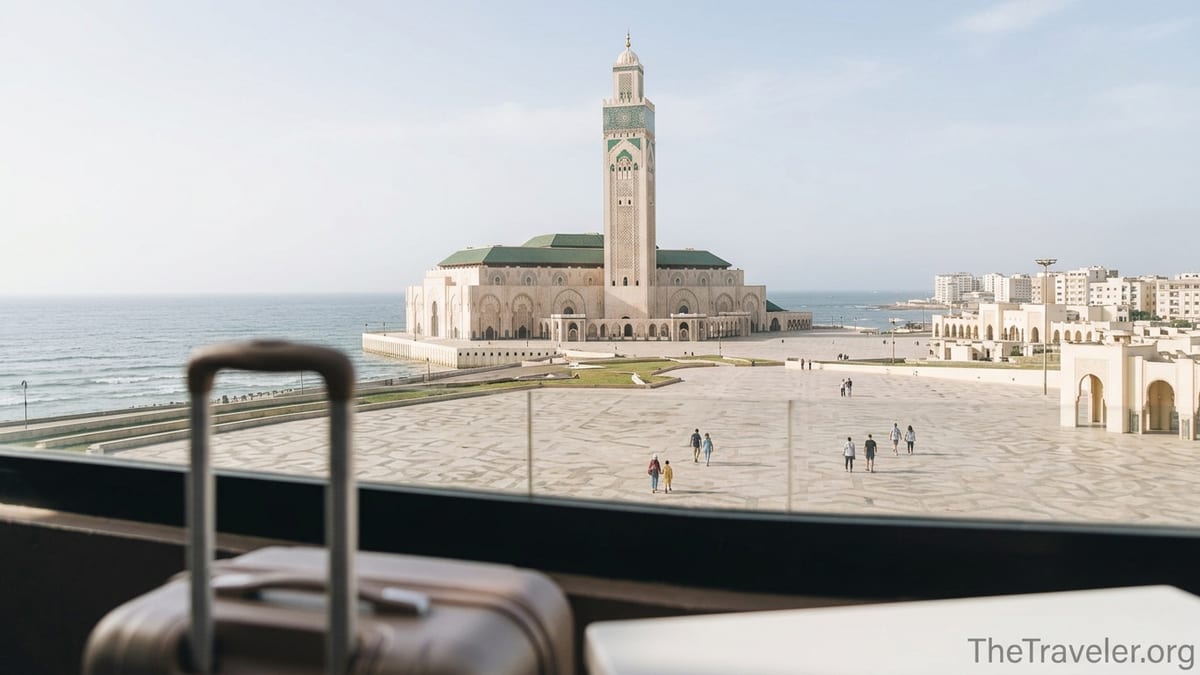
The Hassan II Mosque, one of the largest mosques in the world, is the single most popular layover destination from Casablanca Airport. Positioned on a promontory overlooking the Atlantic, it is photogenic even from the outside, and non-Muslim visitors are welcome on guided interior tours at set times most days. Tour times typically cluster in the late morning and early afternoon, with extra sessions in high season, but they can shift around holidays and religious events, so you should not count on a very specific time slot unless you have checked close to your travel date.
Reaching the mosque from the airport by public transport usually involves taking the train to Casa Port station and then either walking about 30 minutes or taking a short taxi ride of around 10 minutes. Travelers report paying an inexpensive fixed or metered fare for the small hop from Casa Port to the mosque’s main entrance. In light traffic, a taxi from the airport directly to the mosque can take about 45 minutes to an hour, but you should factor in the time needed to find a driver, agree on the fare, and possibly navigate congestion along the coastal boulevard.
If you want to join an interior tour, a daytime layover of at least 8 hours is the most comfortable. That allows extra time in case immigration is slow or the first train you aim for is delayed or full. For example, arriving at 09:00 and departing at 19:00 gives ample room to clear formalities, reach Casa Port around late morning, join a midday tour, spend time on the esplanade taking photos, have lunch nearby, and then retrace your steps without hurrying. On shorter layovers, you can still visit the mosque exterior, which is impressive, but you should not rely on making a particular tour slot.
Dress modestly in line with local expectations, especially if you intend to go inside. Shoulders and knees should be covered, and it is wise to carry a light scarf or shawl. Inside the mosque, everyone removes shoes; you are usually offered a bag to carry them. Photography is generally allowed but using drones is prohibited. If your layover falls on a Friday around the main prayer times, expect larger crowds and potentially more limited visiting hours.
Downtown Casablanca and the Corniche: Worth the Detour?
Beyond the mosque, some layover passengers hope to explore downtown Casablanca or the seaside Corniche area near Ain Diab. These experiences can be rewarding, but only if your layover is long enough to avoid rushing. The historic center around Place Mohammed V and the United Nations Square offers European-style boulevards, art deco facades, and a mix of cafes and modern offices. From Casa Voyageurs station, you can reach this area by tram or taxi in around 10 to 15 minutes when traffic is reasonable.
With around 9 to 12 hours on the ground, a realistic itinerary might include Hassan II Mosque plus a stop in the city center for coffee and a short walk. One concrete example: after a mosque tour and a taxi back toward town, you might ask to be dropped near Place Mohammed V, spend an hour walking between the square and the nearby Arab League Park, and then head back to Casa Voyageurs by tram or taxi in time for an afternoon train to the airport.
The Corniche and Ain Diab district provide a different flavor of Casablanca: beach clubs, seaside promenades, and restaurants overlooking the Atlantic. Getting there from the mosque or downtown typically takes another 15 to 25 minutes by taxi, depending on traffic. This added leg means the Corniche is best reserved for longer layovers of 10 to 14 hours or for travelers who are already familiar with the city and comfortable moving quickly. A short stop for a sunset drink along the water can be magical, but you should be ready to leave well before dark if you still need to navigate back across town and catch a train.
Remember that every extra neighborhood you add introduces more variables: another taxi to find, another chance of a traffic jam, another point where you might get disoriented in an unfamiliar environment. If Casablanca is completely new to you, prioritizing just the mosque plus either a short downtown walk or a sit-down meal is usually more enjoyable than trying to “do everything.”
Luggage, Security and Airport Practicalities
How you handle luggage can make or break a layover excursion. If your bags are checked through to your final destination on a single ticket, you only need to carry your cabin bag into the city, which is manageable. If you are flying separate tickets and must collect and recheck luggage at Casablanca, your usable time in the city will shrink significantly. You may spend 30 to 60 minutes waiting at the carousel, plus additional time checking in again later and queuing for security.
Casablanca Airport has periodically offered left-luggage or storage services, but availability and location can change with renovations and security policies. Before assuming you can store a suitcase, verify this close to your travel date with your airline or the airport information desk. Many travelers simply keep their cabin-size wheelie case with them, especially if they plan only a short mosque visit and a nearby meal. Sidewalks around the mosque are wide and relatively smooth, though cobblestones and curbs make a backpack or soft bag more comfortable than dragging a heavy hard-shell suitcase.
For the return to the airport, build in time for both security and immigration. Even if there is a dedicated lane for connecting passengers, queues can grow quickly at peak times when flights to Europe and the Gulf all depart within a short window. Having your boarding pass ready in digital or printed form can help you move faster through checkpoints. If your airline offers online check-in and mobile boarding passes for Casablanca departures, use them so you can head directly to security if you have no checked luggage.
It is also important to consider local holidays and Fridays, when prayer times and family travel patterns can affect both crowd levels and operating hours in the city. During major religious or national holidays, some services may run on different timetables, and tourist sites can have altered visiting hours. If your layover falls around such dates, opt for a more conservative plan and confirm any time-sensitive visits, like mosque tours, as close to departure as possible.
Staying Near the Airport vs Heading Into Town
For many travelers, particularly those on overnight or very tight daytime layovers, staying near the airport is the most sensible choice. Hotels close to CMN cater to transit passengers with free or paid shuttles, early breakfast options and flexible check-in policies. While they do not offer the romance of a seaside view, they provide peace of mind. A traveler arriving from North America late at night with a flight onward to West Africa early the next morning, for example, may benefit far more from six hours of uninterrupted sleep near the terminal than from a hurried trip into the city.
Day rooms can be a smart compromise for long layovers of 8 to 12 hours where you are unsure whether you will feel like sightseeing after a long-haul flight. Checking into a nearby hotel for a shower, a nap and a meal gives you the option of heading into town later if you still have the energy and the timing works. Some passengers also use this approach to hedge against schedule disruptions: if the inbound flight is delayed, they can simply use more of the hotel time and skip the city visit without worrying about nonrefundable bookings.
On the other hand, if Casablanca is a place you do not expect to visit again soon and your layover is comfortably long during daylight hours, going into the city can be intensely rewarding. Even one or two focused experiences, such as standing on the esplanade of the Hassan II Mosque and hearing the Atlantic waves crash below, can be a highlight of a multi-country journey. The key is to treat the city visit as a bonus, not a guaranteed entitlement. If conditions on the day do not cooperate, you can always stay at or near the airport, rest, and save Casablanca for a future trip with more time.
Whichever option you choose, keep your airline informed if you are on a single through-ticket and anything unusual happens, such as a missed connection or a flight cancellation. Airlines operating through Casablanca are accustomed to handling connecting passengers, but their responsibility typically ends at the airport perimeter. If you voluntarily leave the airport and get stuck in traffic so badly that you miss your onward flight, you may be treated differently from someone delayed by a late inbound aircraft.
The Takeaway
Planning a Casablanca layover does not have to be complicated, but it does require realistic expectations. The airport is far enough from the city center that short connections are better spent resting and preparing for your onward journey. Once your layover reaches around 7 to 8 hours in daylight, however, the Hassan II Mosque becomes an attainable and memorable destination, especially if you keep your itinerary tight and use the airport train to manage your timing.
For layovers beyond 9 or 10 hours, adding a brief stroll through downtown or a relaxed meal by the sea can turn a connection into a mini city break. Always factor in immigration queues, train frequencies, and the inherent unpredictability of taxis and traffic. When in doubt, err on the side of more buffer time; flights are harder to replace than a missed photo opportunity.
Ultimately, the best Casablanca layover strategy balances curiosity with caution. Decide in advance what would make the stop feel worthwhile for you, whether that is a quiet hotel room, a single iconic landmark or a taste of city life. Then build a conservative schedule around that goal. If everything goes smoothly, you will leave with both your onward boarding pass and a vivid memory of Morocco’s largest city.
FAQ
Q1. What is the minimum layover time needed to visit Hassan II Mosque from Casablanca Airport?
The minimum practical daytime layover is around 7 to 8 hours. This allows for immigration, train or taxi into town, time at the mosque and a conservative return to the airport 2.5 to 3 hours before your next international flight.
Q2. Is it better to take the train or a taxi from Casablanca Airport into the city?
For most travelers, the train is more predictable and better value, running roughly once an hour from the station under Terminal 1 to Casa Voyageurs and Casa Port. Taxis are faster door to door in light traffic but cost more and require negotiating a fare in advance.
Q3. Can I store my luggage at Casablanca Airport during a layover?
Luggage storage options at Casablanca Airport have varied over time, and availability can change with renovations and security rules. Do not assume storage will be available; instead, check close to your travel date or plan to carry your hand luggage with you into the city.
Q4. How early should I return to Casablanca Airport before my onward flight?
Plan to be back at the airport at least 3 hours before an international departure and 2 hours before a regional or domestic flight. This buffer covers potential queues at security and passport control as well as any check-in formalities.
Q5. Is a night-time layover enough to see downtown Casablanca?
Most of the time, no. With an overnight layover such as 22:00 to 06:00, trains do not run all night, taxis are relatively expensive for the distance, and many city sights will be closed. In this case, staying at or near the airport is usually the better option.
Q6. How do I get from the airport train to Hassan II Mosque?
Take the airport train to Casa Port station, then either walk around 30 minutes to the mosque or take a short local taxi ride of about 10 minutes from the station forecourt to the mosque entrance.
Q7. Is it safe to take taxis from Casablanca Airport?
Official airport taxis are generally safe, but overcharging is a common complaint. Always agree on the fare before getting in, use small local currency notes, and avoid unmarked vehicles. If a quoted price feels unreasonable, you can walk away and try another driver or choose the train instead.
Q8. Can I join an interior tour of Hassan II Mosque during a layover?
Yes, if your layover is long enough and your arrival time lines up with the public tour schedule. Aim for a layover of at least 8 hours during daylight, and check expected tour times close to your travel date since they can vary by season and religious holidays.
Q9. Is visiting the Corniche or Ain Diab realistic on a layover?
Visiting the Corniche is realistic on layovers of around 10 to 14 hours, especially if you have already seen the mosque or are comfortable moving quickly. For shorter layovers, focusing on the mosque and possibly a brief downtown visit is usually a better use of time.
Q10. What should I do if my inbound flight to Casablanca is delayed?
If a delay significantly cuts into your planned city time, be ready to cancel your outing and stay at or near the airport instead. Prioritize making your onward flight, and inform your airline if the delay affects a through-ticket connection so they can advise you on rebooking options if necessary.