


Landing at Casablanca Mohammed V International Airport and heading straight to Rabat is a common route for visitors who prefer to skip Casablanca’s hustle and get to Morocco’s calm political capital. The good news is that the connection is straightforward, with direct trains from the airport into Casablanca and frequent onward services to Rabat, plus a growing choice of taxis, private transfers and rental cars. This guide walks you through each option using current on-the-ground information, so you can choose what fits your budget, luggage and schedule.
Get the latest updates straight to your inbox!
Overview: Casablanca Airport to Rabat at a Glance
The distance from Casablanca Mohammed V International Airport (CMN) to central Rabat is roughly 120 to 130 kilometers, and most journeys take between 1.5 and 2.5 hours door to door, depending on your connection in Casablanca and your final address in Rabat. You can travel almost the entire way by train, mix the airport train with a taxi or tram in Casablanca, or go directly by road in a taxi, private transfer or rental car.
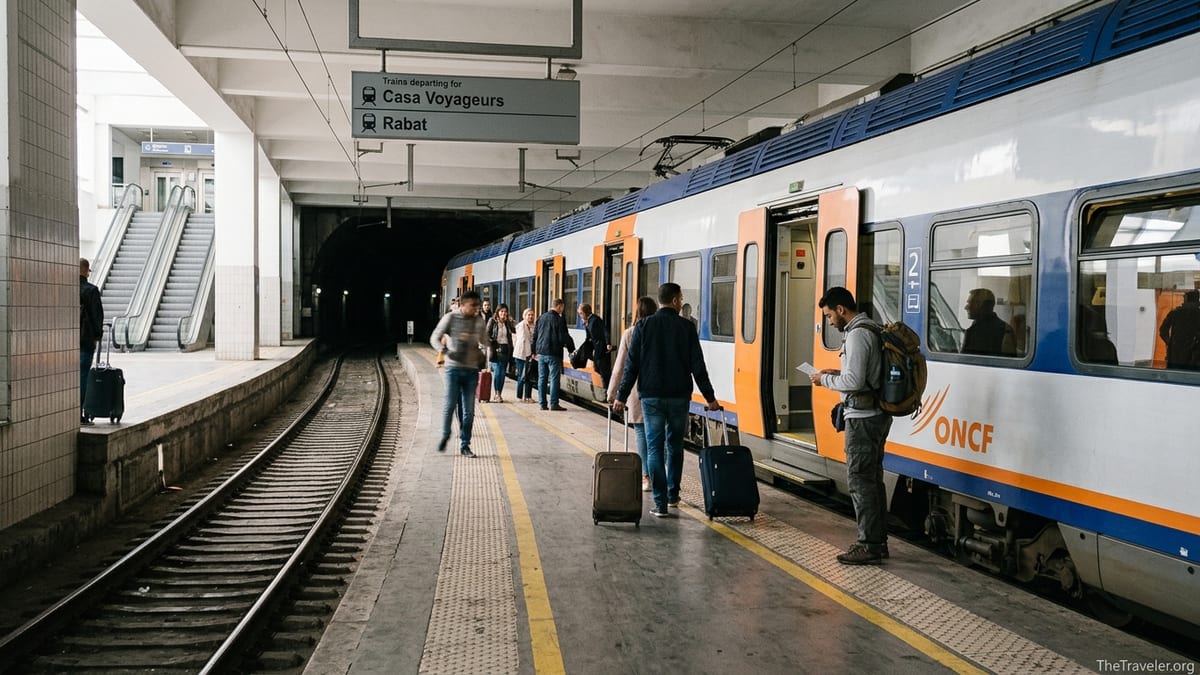
For most travelers, the simplest and best value option is the train. There is a dedicated railway station in the basement of Terminal 1 at the airport, with hourly trains running to the two main stations in Casablanca, Casa Voyageurs and Casa Port. From Casa Voyageurs you have frequent ONCF mainline trains to Rabat Agdal and Rabat Ville, usually taking around one hour. Combined, the airport leg plus the mainline train leg typically comes to about two hours of rail travel, plus any time you need for changing platforms and buying tickets.
Road options are useful if you are arriving late at night after the last airport train, traveling in a group with lots of luggage, or you simply prefer a door to door experience. Official “grand taxis” and prebooked private transfers can run directly from CMN to Rabat, normally in around 1.5 to 2 hours in light traffic. These will cost considerably more than the train, but can be good value when split between three or four people, or if you are heading to a specific suburb in Rabat that is not convenient for the train.
Whether you should break the journey and stay in Casablanca depends on your arrival time and interests. With the Aerobus into town, the tram, and the airport train, it is easy to stop in Casablanca for a night, see the Hassan II Mosque and the corniche, and then continue to Rabat the following day. If your time is limited and your main focus is Rabat and perhaps Fes or Chefchaouen afterward, it often makes more sense to go straight through.
Taking the Train: From Airport Basement to Rabat Ville
The airport train is the backbone of most budget conscious and independent trips from CMN to Rabat. The station, known simply as Gare de l’Aéroport Mohammed V, is built into the basement of Terminal 1. After clearing immigration and customs, you follow the “Train” signs down one level by escalator or elevator to reach the ticket hall and platforms. This setup is similar in feel to the airport train stations found in many European hubs, which makes the process intuitive even if it is your first time in Morocco.
Trains typically leave the airport around once per hour from early morning to late evening. Schedules can shift seasonally, but departures roughly between 05:00 and 23:00 are a good rule of thumb, with services timed to meet the busiest arrival and departure waves. The same train runs through to Casa Voyageurs and then on to Casa Port, stopping at suburban stations such as Bouskoura and L’Oasis along the way. The ride from the airport to Casa Voyageurs usually takes about 30 to 40 minutes, and another 10 to 15 minutes to reach Casa Port if you stay on board.
Ticket prices for the airport train are modest by international standards. Expect to pay in the region of a few dozen dirhams for second class from the airport to Casa Voyageurs, with first class costing a bit more. You can buy tickets at staffed counters or from machines in the station, paying in cash or by card. Many travelers simply buy a through ticket from the airport to Rabat Ville or Rabat Agdal; the ticket office staff are used to this request and can suggest the next useful connection in Casablanca. If you prefer flexibility, you can also buy just to Casa Voyageurs and then decide on the next train to Rabat once you are there.
From Casa Voyageurs, frequent ONCF trains run north along the Atlantic corridor through Mohammedia and Kenitra. Rabat has two main intercity stations, Rabat Agdal and Rabat Ville. For most tourists staying in the city center, Rabat Ville is the more convenient option, as it sits a short walk or quick petit taxi ride from the medina, the kasbah and many mid range hotels. Typical journey times from Casa Voyageurs to Rabat Ville hover around one hour, and standard second class fares are usually in the range of a few dozen dirhams, with first class seats priced higher but still reasonable.
Casa Voyageurs vs Casa Port: Which Route Makes More Sense?
Casablanca can be confusing because it has two major train stations that matter for this journey. Casa Voyageurs is the main long distance hub, used by almost all intercity trains heading north to Rabat, Tangier and Fez or south toward Marrakech. Casa Port is the downtown terminal near the port, marina and a cluster of business hotels. The airport train used to be most strongly associated with Casa Voyageurs, but current services link the airport with both Casa Voyageurs and Casa Port, forming one continuous line between the three points.
If you are heading directly to Rabat, Casa Voyageurs is the more logical interchange. Nearly all trains from Casablanca to Rabat pass through Casa Voyageurs, and onward tickets are easy to buy on the day. The station has multiple platforms, electronic boards and a clear split between first and second class cars. An example itinerary for a daytime arrival might look like this: land at CMN around 11:00, clear formalities in 45 minutes, catch the 12:50 airport train, arrive at Casa Voyageurs around 13:30, then board a 14:00 or 14:30 train to Rabat Ville, reaching Rabat around 15:00 or 15:30.
Casa Port becomes relevant if you decide to stay in Casablanca for a night or two before continuing to Rabat, or if your hotel is close to the city center and you want the easiest drop off. The same airport train that calls at Casa Voyageurs typically continues to Casa Port, which means you can simply stay seated until the final stop and then walk or take a short petit taxi ride to your hotel near the port, the old medina or the United Nations Square area. The next day, you can either backtrack by local train to Casa Voyageurs to catch a long distance service to Rabat, or pick up a direct Rabat bound train from Casa Port if the timings suit.
In practice, the choice often comes down to your accommodation. A traveler booked at a chain hotel near Casa Port or along the city center boulevards may prefer to ride the airport train all the way to Casa Port, drop their bags, and use the tram or taxis for local sightseeing. Someone whose goal is to be in Rabat by nightfall will usually leave the train at Casa Voyageurs, walk upstairs to the main hall and cross over to the appropriate platform for the northbound service to Rabat Agdal or Rabat Ville.
Private Transfers and Taxis Direct to Rabat
For travelers arriving late at night, with heavy luggage, or after a long haul flight, the idea of wrestling with train timetables and platform changes can feel daunting. In these cases, booking a private transfer or taking an official airport taxi directly from Casablanca Airport to Rabat can be worth the additional cost. The ride is straightforward: you exit onto the A3 motorway towards Casablanca, then swing onto the A1 coastal highway that runs up to Rabat.
Official grand taxis from the airport operate on fixed or semi fixed tariffs that are usually displayed near the taxi rank or inside the terminal. Fares are regularly adjusted, but a typical ballpark for a daytime direct run from CMN to central Rabat is in the low to mid hundreds of dirhams. At night and in the early hours of the morning, there may be a modest surcharge. These taxis are usually older Mercedes sedans or similar models. Some drivers prefer to negotiate the fare as a flat amount before departure, especially for long intercity rides. In that case, it is reasonable to confirm the price clearly, ask whether tolls are included, and agree whether you will pay any motorway tolls separately in cash at the booths.
Prebooked private transfers, arranged through international comparison sites or Moroccan agencies, generally cost more than flagging a taxi on the spot, but they offer predictability. A typical product will include an English or French speaking driver waiting in the arrivals hall with a name sign, a modern vehicle with air conditioning, and an all inclusive price that covers tolls and waiting time. For example, a family of four arriving from North America at 21:00 might prebook a minivan transfer to Rabat so they can go straight to their riad in the old town without changing trains or worrying about timetables. The price will usually be higher than four train tickets plus a short taxi ride in Rabat, but many people see it as a fair trade for door to door convenience.
When comparing road and rail, consider traffic patterns. Outside the busiest rush hours, the motorway between Casablanca and Rabat flows relatively smoothly, and the drive can take about 90 minutes. In heavy traffic, especially on Sunday evenings or before major holidays, it can stretch toward two hours or more. Trains are less affected by road traffic, but you might still wait up to an hour at Casa Voyageurs for a good onward connection, especially if you have just missed one departure.
Rental Cars and Driving Yourself to Rabat
Renting a car at Casablanca Airport and driving yourself to Rabat can be appealing if Rabat is just the first stop on a wider road trip. Several international and Moroccan rental brands maintain desks in the arrivals area or just outside the terminal, and you can either prebook online or walk up to see what is available. Compact cars are the most common category, but you can also find small SUVs and family sized sedans. A typical daily rate varies by season and demand, with additional costs for insurance, one way drop fees if you plan to return the car in another city, and any extras like a child seat or GPS.
The route from CMN to Rabat is relatively straightforward, mostly on modern toll motorways. After exiting the airport road you join the motorway toward Casablanca, then follow signs for Rabat onto the A1. Toll booths along the way accept cash in dirhams, and many rental cars are equipped with electronic tags that allow you to pass through designated lanes and have tolls billed later. The motorway is generally well maintained, but driving standards can be assertive, so it is wise to leave extra space and avoid the fastest lane unless you are comfortable with local speeds and habits.
Parking in Rabat is more relaxed than in Casablanca or Marrakech, but you still need to think about where you will keep the car. Many mid range hotels along avenues like Mohammed V and Hassan II offer secure parking or deals with nearby garages. Traditional riads in the old medina, by contrast, are often located in pedestrian streets, so you may need to park at a public lot near Bab El Had or outside the medina walls and walk in with your luggage. For a short city stay where you plan to explore mainly on foot or by tram, it can sometimes be easier and cheaper to rely on trains and taxis rather than paying to park a car you rarely use.
Car hire makes most sense if your onward route after Rabat takes you to places that are poorly served by public transport, such as coastal villages between Rabat and Larache, remote surfing beaches, or rural areas in the Middle Atlas. In that case, picking up a car at CMN, driving to Rabat, and then continuing onward can be an efficient way to structure your trip. Just factor in that you will be driving after a flight, often while jet lagged, and on unfamiliar roads. Some travelers choose to take the train to Rabat, rest there, and only then rent a car locally for the next leg.
Luggage, Comfort and Accessibility Considerations
Your choice of transfer from Casablanca Airport to Rabat will also depend heavily on how much you are carrying and how mobile you are. The airport train and ONCF services are comfortable, but you do need to be able to maneuver bags onto the train, lift them over small gaps between platform and carriage, and sometimes navigate stairs or ramps between platforms at Casa Voyageurs and Rabat Ville. Newer rolling stock has overhead racks and luggage shelves near the doors, but at busy times space can be tight.
If you are traveling with several large suitcases, sports equipment or musical instruments, a private transfer or taxi can reduce stress. The driver will typically help load the boot, and you will not have to keep an eye on your belongings in a shared train carriage. This is particularly valuable for families with young children or older travelers who prefer not to handle heavy bags. An example might be a couple arriving from a long haul flight with two large checked cases and a stroller. For them, paying more for a private vehicle straight to a Rabat hotel could be money well spent compared with changing trains in Casablanca.
For travelers with limited mobility or using a wheelchair, it is worth checking the latest accessibility arrangements before you go. The airport station has elevators, but the reliability of lifts and escalators can vary. Trains themselves often have a small step up from platform level, which can be challenging without assistance. Some private transfer companies can arrange vehicles with more space or specific accessibility features, provided you request this in advance and confirm the details. In Rabat, pavements around Rabat Ville station and the central boulevards are improving, but kerbs and uneven sections remain common.
Comfort also involves crowd levels. Trains between Casablanca and Rabat are popular with commuters, especially in the morning and late afternoon. Around those times, second class can be very full, with people standing in the aisles. If you value a quieter ride, consider paying the supplement for first class, where carriages are usually less crowded and seats are reserved. Alternatively, aim for off peak trains in the late morning or early afternoon. For example, arriving at CMN mid morning and reaching Casa Voyageurs for a midday or early afternoon train to Rabat will often give you a calmer journey than aiming for a 17:00 departure.
Should You Stay in Casablanca First, or Go Straight to Rabat?
Many itineraries to Morocco involve landing in Casablanca and then moving on quickly to more atmospheric cities. That said, Casablanca itself is worth at least a brief stop, especially for the Hassan II Mosque, one of the few major mosques in Morocco that non Muslims can visit on guided tours. The question is whether it makes sense to spend that night in Casablanca or to continue directly to Rabat and perhaps visit Casablanca later as a day trip.
If your flight lands late in the evening, staying in Casablanca often makes practical sense. After 22:00 or so, airport train frequencies drop off, and direct trains from Casa Voyageurs to Rabat become less frequent. In that scenario, you could take the airport train or Aerobus into central Casablanca, check into a hotel near Casa Port or along the city center tram line, sleep, and then head to Rabat the next morning by train. This staggered approach reduces the risk of dealing with long overland travel late at night and may be safer and less tiring, especially for solo travelers.
On the other hand, if you land during the day and Rabat is your main base for exploring northern Morocco, going straight there is usually the smarter move. The combined airport plus intercity train journey is manageable, and Rabat is a relaxed place to get over jet lag. The medina is calmer than those in Marrakech or Fez, the seafront walks are pleasant, and tram lines make it easy to get around. From Rabat, you can later visit Casablanca as a day trip by train, taking around an hour each way. For example, you might spend three nights in Rabat, then travel down to Casablanca for a day to tour the Hassan II Mosque and stroll the corniche, returning to Rabat in the evening.
Think also about where you are going after Rabat. If your next stop is Tangier or Fez, Rabat is a logical staging point, sitting on the same mainline railway with frequent services. In this case, it can be more efficient to head straight to Rabat from the airport, spend a couple of nights, and then continue north or east. Casablanca can be slotted in at the end of the trip if you have an early morning flight from CMN and want to be near the airport the night before.
Realistic Itineraries: What the Journey Looks Like in Practice
To understand how these options play out, it helps to imagine some real world scenarios. Consider a solo traveler arriving from Paris at 10:00 on a weekday, with one checked bag and one backpack, heading for a hotel near Rabat Ville station. After clearing immigration and picking up luggage, they reach the airport station around 11:15, buy a combined ticket to Rabat Ville, and catch the 11:50 or 12:50 train to Casa Voyageurs. The ride takes about 35 minutes. At Casa Voyageurs they look for the next Rabat bound train on the departures board, board a second class carriage, and reach Rabat Ville about an hour later. By mid afternoon they are checking into their hotel, having spent relatively little and without needing any road travel beyond a short taxi hop at the Rabat end if their hotel is not walkable.
Now imagine a family of five landing from New York at 21:30 with multiple large suitcases and two young children. By the time they have cleared formalities, it is approaching 23:00. Instead of navigating the airport train and a late night connection in Casablanca, they have booked a private minivan transfer in advance. Their driver meets them in the arrivals hall, helps load the luggage, and drives directly to their riad just outside Rabat’s medina walls, arriving a little after midnight. The fare is higher than using public transport, but when divided between five people, with tired kids and no connections to worry about, it feels like a sensible choice.
A third scenario might involve a couple planning a slow trip up the Atlantic coast. They rent a compact car at CMN for a week, drive to a hotel in Rabat with secure parking, and spend two nights exploring the city and neighboring Salé. From there they continue north by road, visiting coastal stops that would be awkward by train. At the end of their trip, they return the car at Casablanca Airport before flying home. For them, the flexibility of having a car from the very beginning outweighs the relative ease of the airport train and ONCF services.
In each case, the key is to match your arrival time, tolerance for connections, group size and luggage load to the strengths of each option. Trains work brilliantly if you arrive during the day with a manageable amount of luggage and enjoy using public transport. Private road options shine when you are tired, heavily loaded or arriving at off hours. Rental cars add flexibility but require confidence behind the wheel in a new country.
FAQ
Q1. Is there a direct train from Casablanca Airport to Rabat?
There is no single train that runs directly from the airport to Rabat without a change, but you can travel almost entirely by rail. You take the airport train from the station in the basement of Terminal 1 to Casa Voyageurs or Casa Port, then change onto a frequent ONCF intercity train to Rabat Agdal or Rabat Ville. The whole rail journey usually takes around two hours of travel time, not counting any waiting between trains.
Q2. How much does it cost to go from Casablanca Airport to Rabat by train?
Exact fares change periodically, but as a rough guide you can expect to pay the equivalent of a few dozen dirhams for the airport leg to Casa Voyageurs, plus a similar amount for a second class ticket from Casa Voyageurs to Rabat Ville. First class on the mainline section costs more, but is still affordable by European standards. Overall, many travelers find that the total cost from airport to Rabat by train is significantly lower than a direct taxi or private transfer, especially for solo travelers or couples.
Q3. How long does the journey from Casablanca Airport to Rabat take?
The total time depends on connections, but a realistic door to door estimate for the train plus train option is between 1.5 and 2.5 hours. The airport train to Casa Voyageurs usually takes around 30 to 40 minutes, and the onward train to Rabat Ville about one hour. You then need to factor in any waiting time at Casa Voyageurs and the time required to walk or take a taxi from Rabat’s station to your accommodation. A direct road transfer by taxi or private car often takes around 1.5 to 2 hours in normal traffic.
Q4. What happens if my flight arrives after the last airport train?
If you land very late at night and miss the last airport train, your remaining options are to take a taxi or prebooked private transfer from the airport. In that situation, many travelers choose to spend the night in Casablanca, either near the airport or in the city center, and then continue by train to Rabat the next morning. You can also ask an official taxi to drive directly to Rabat, but expect to pay more than during the day and confirm the price clearly before leaving the airport.
Q5. Should I stay in Casablanca for a night before going to Rabat?
It depends on your arrival time and interests. If you arrive late in the evening, staying in Casablanca can be a practical choice that avoids long travel at night. You can use the airport train or Aerobus to reach a central hotel, then catch a mid morning train to Rabat the next day. If you arrive earlier and Rabat is your main destination, going straight there is often better, as it is a calmer place to recover from a flight and a convenient base for onward trains to Tangier or Fez.
Q6. Is it safe to take trains and taxis between Casablanca and Rabat?
Trains and official taxis on this corridor are widely used by locals and visitors and are generally considered safe. Common sense precautions apply: keep valuables close, avoid displaying expensive items unnecessarily, and use official taxi ranks at the airport and stations. Many travelers prefer to sit in busier carriages, particularly in the evening, and some choose first class on the train for a quieter, more predictable environment. If you are arriving late at night alone, a prebooked transfer or staying one night in Casablanca can feel more comfortable.
Q7. Can I buy train tickets in advance, or should I purchase them on arrival?
You can usually buy tickets on arrival at the airport station or at Casa Voyageurs, and many people do exactly that. For standard second class tickets between Casablanca and Rabat, buying on the day is usually sufficient, as there are frequent departures. If you prefer the certainty of a reserved first class seat on a specific train, or you are traveling at a particularly busy time such as major holidays, it can be worth looking at advance purchase options through official channels before your trip. Even then, leave some buffer time at the airport in case of delays.
Q8. Is driving from Casablanca Airport to Rabat difficult for visitors?
The route is mostly on modern toll motorways and is not technically difficult, but it does require confidence to drive in Moroccan traffic. Speeds on the motorway can be high, and lane discipline is sometimes loose. In urban areas near Casablanca, traffic can be dense and fast moving. If you are an experienced driver used to big city roads, you may find it manageable, especially during daylight hours. If you are tired after a long flight or nervous about driving in a new country, the train or a private transfer will likely be more relaxing.
Q9. Which Rabat station should I choose, Agdal or Ville?
Rabat Ville is in the heart of the city and is usually the best choice if you are staying near the medina, the kasbah, the main boulevards or many mid range hotels. Rabat Agdal is slightly further inland and is convenient for some residential districts and modern hotels, as well as for high speed trains toward Tangier. Both stations are connected by local transport and taxis. If in doubt, check which station is closer to your accommodation and buy your ticket accordingly when changing trains in Casablanca.
Q10. Are there luggage limits on the trains between Casablanca and Rabat?
There are no strict airline style luggage limits on ONCF trains, and many passengers travel with suitcases and backpacks. The practical limit is what you can comfortably carry and store. Carriages usually have overhead racks for smaller bags and shelving near doors for medium sized suitcases. Very large or numerous bags can be awkward to manage in busy carriages or on station stairs. If you are traveling with an unusually large amount of luggage, or bulky items like surfboards, a private transfer or taxi may be easier than navigating the train system with everything in tow.