


Far beneath the noise of Naples’ traffic, two ancient underground cemeteries preserve the city’s earliest Christian history. The catacombs of San Gennaro and San Gaudioso are not just atmospheric places to visit. They are key archaeological sites that tell the story of how Neapolitans buried their dead, expressed their faith and shaped a neighborhood that is now one of the city’s liveliest districts.
Get the latest updates straight to your inbox!
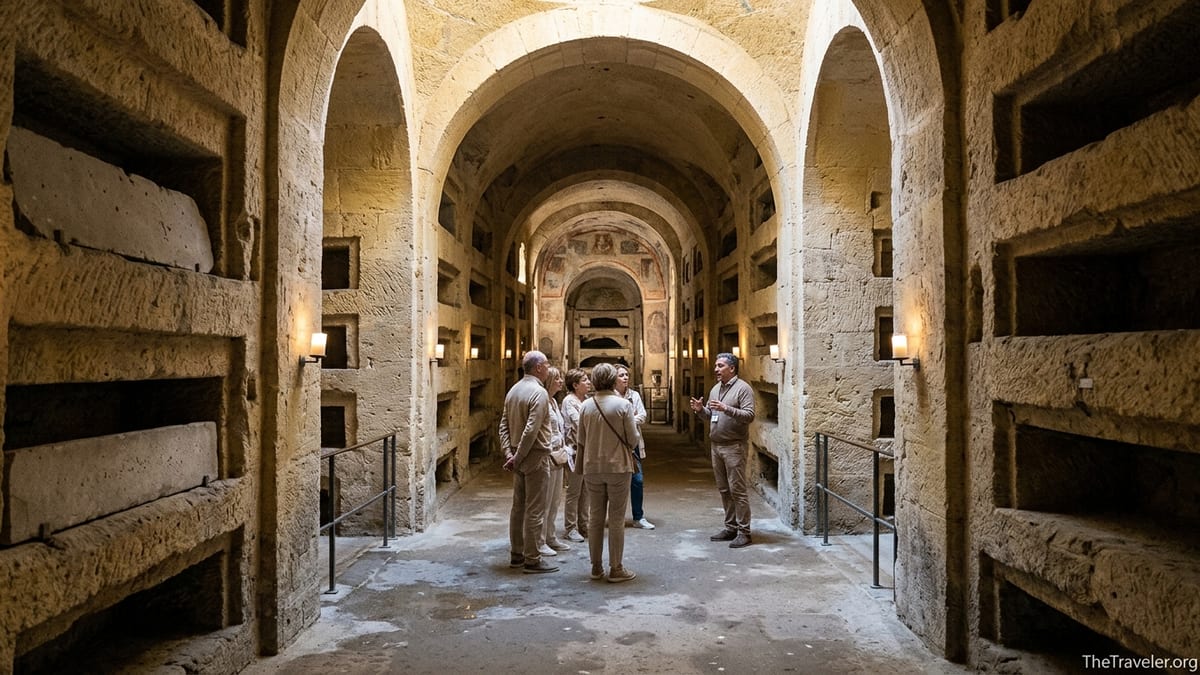
What and Where Are the Catacombs of San Gennaro and San Gaudioso
The Catacombs of San Gennaro and the Catacombs of San Gaudioso are two large early Christian burial complexes dug into the soft volcanic tuff beneath the Rione Sanità and Stella districts, just north of Naples’ historic center. Both date back roughly to the 4th and 5th centuries, when Christianity was taking root in the Roman Empire and new ways of burying the faithful were emerging. Today they are considered among the most important Christian catacombs in Italy after those of Rome and Syracuse, and they are the main underground attractions in Naples for travelers interested in history and archaeology.
San Gennaro is the bigger of the two and lies under the Basilica of San Gennaro extra Moenia on the slopes leading up toward Capodimonte. It is spread over multiple levels and is the largest early Christian catacomb complex in southern Italy, with long galleries, chapels, and an underground basilica. San Gaudioso, slightly smaller and more compact, sits directly beneath the Baroque Basilica of Santa Maria della Sanità, closer to the dense heart of Rione Sanità. Its atmosphere feels more intimate, with lower ceilings, visible skulls in the walls, and a striking mix of late antique and Baroque-era interventions.
For travelers, the two sites are easy to combine in a half day. You can typically walk from the National Archaeological Museum up into Rione Sanità in around 15 minutes and then reach San Gennaro on foot or by a short bus or taxi ride further uphill. Guided tours are compulsory at both sites and are run by the same local cooperative, which means information is consistent and access is controlled to protect the fragile frescoes and tombs.
On a practical level, tickets bought on site for San Gennaro are usually valid for both complexes within a set period, often around 12 months, which means you can visit the second catacomb on another day if you prefer not to do them back to back. Prices and conditions change slightly from year to year, but adult tickets are typically in the region of what you would expect for a major archaeological site in Italy, with reductions for students and children and free entry for very young kids.
A Brief History of San Gennaro: From Family Tomb to Pilgrimage Site
The origins of the Catacombs of San Gennaro go back to a private family hypogeum carved into the tuff outside the ancient city walls around the 2nd century AD. Over time the complex expanded as other families began to use the same underground space for burials. The site became truly important when the remains of Saint Agrippinus, one of the earliest bishops and first patron saint of Naples, were buried here. This helped transform the family burial area into a Christian cemetery that served the growing community on the outskirts of Roman Neapolis.
The catacombs took on an even more central religious role in the 5th century, when the relics of San Gennaro, or Saint Januarius, were moved here. San Gennaro, now the city’s patron saint, became the focus of intense local devotion, and his burial place quickly turned into a pilgrimage destination. As believers sought to be buried near the saint, new galleries and tombs were dug, and an underground basilica was created around his tomb and the nearby crypt of the bishops of Naples. For several centuries bishops and prominent Christians were interred here, leaving behind a dense record of early Christian funerary art.
Like other catacombs in Italy, San Gennaro gradually fell into disuse as burial customs shifted and as the city expanded. Over time, frescoes were damaged by humidity, collapses and later reuse of the spaces for practical purposes. During the Second World War, parts of the underground network in this area were adapted as air-raid shelters, which further altered the catacombs’ environment. Only in the late 20th and early 21st centuries did systematic restoration and research bring the site back into focus as a major cultural and religious monument.
Today, walking through San Gennaro with a guide, you move across centuries in a few steps. You see simple niches for ordinary believers next to carefully decorated arched tombs, and you pass the modest but powerful crypt where the early bishops were buried. Although San Gennaro’s relics now rest in Naples Cathedral, this hillside necropolis still serves as a physical reminder that the city’s identity has been closely tied to Christian worship and the veneration of saints for more than 1,500 years.
The Distinctive World of San Gaudioso: Skulls, Frescoes and Baroque Touches
The Catacombs of San Gaudioso began as another early Christian cemetery on the northern edge of ancient Naples, linked to the African bishop Gaudiosus, who is believed to have arrived in the city in the 5th century. As with San Gennaro, the location outside the old city walls was typical of late Roman burial practice. The earliest levels contain arched tombs and small chambers decorated with frescoes and mosaics that echo other paleo-Christian sites in the Mediterranean.
What makes San Gaudioso especially striking to modern visitors, though, is what happened much later. In the 17th century, when the basilica of Santa Maria della Sanità was built above the old underground church, Dominican friars modified parts of the catacombs to create a new burial system. The bodies of notable Neapolitans were treated in special niches, and after decomposition only the skulls were preserved and embedded into the walls of the main ambulatory. Artists then frescoed the remaining parts of the bodies on the plaster surface, often painting clothes and professional tools that indicated the dead person’s social role.
As you walk through San Gaudioso today, you see rows of skulls emerging from the rock, each topped by a painted torso. One might show a noblewoman in an elegant dress, another a doctor indicated by the instruments of his trade. This practice offers a vivid and slightly unsettling lesson in how early modern Neapolitans combined devotion with an unflinching familiarity with death. It also shows how the catacombs continued to evolve long after their original paleo-Christian phase, reflecting new religious orders and changing attitudes to the afterlife.
San Gaudioso also contains important early Christian frescoes, including a 9th century depiction of the Madonna and Child between two bishops, which survived a mudslide known as the Lave dei Vergini that partially blocked the ancient entrance. These layered traces mean that a visit here feels less like entering a single historical moment and more like reading a palimpsest, where late Roman, Byzantine and Baroque Naples all leave claims on the same underground space.
Art, Architecture and What You Actually See Underground
Both catacomb complexes give visitors a rare chance to see early Christian art in situ rather than in a museum. In San Gennaro, you walk along wide corridors cut into the tuff, with lateral niches and cubicula, or family burial rooms, opening off the main passages. Many of these are decorated with 5th and 6th century frescoes and mosaics. You might see simple Christian symbols such as fish, grapes, peacocks and lambs, delicate portraits of the deceased, or painted biblical scenes that were meant to comfort the living and advertise the faith of the dead.
The lower basilica level of San Gennaro is particularly impressive. Here, the rock has been carved out to create a church-like space with pillars and a central nave. The crypt of the bishops, close to where San Gennaro’s remains once lay, contains painted medallions with their portraits, giving a rare glimpse into how church leaders wanted to be remembered. Travelers interested in art history can compare these works to frescoes in the catacombs of Rome or in later medieval churches in Campania and see how styles shifted from classical Roman naturalism to more symbolic Christian imagery.
In San Gaudioso, the visual experience is more compressed but no less rich. The arcosolia, or arched tombs carved into the walls, retain frescoes of saints, crosses and geometric patterns from the late antique period. Moving into the areas reworked by the Dominicans, the skull-and-body compositions and the small crypt under the basilica show how 17th century Naples interpreted its own past. The contrast between the older, faint frescoes and the comparatively more recent painted bodies can be quite sharp, and guides often use specific examples to explain the shift in theology and funerary practice.
Lighting plays an important role in both visits. Modern spotlights are installed to highlight key frescoes and mosaics while keeping the overall light level low enough to protect the pigments. You will often find yourself stepping from a relatively dark gallery into a softly lit chapel where colors suddenly come alive. The effect is atmospheric but not theatrical, and it allows you to appreciate textures in the tuff stone, tool marks from the original excavation, and traces of later restoration work.
Why These Catacombs Matter for Understanding Naples
The catacombs of San Gennaro and San Gaudioso are important first of all as rare survivals of early Christian burial practice in southern Italy. They offer archaeologists and historians direct evidence for how communities buried their dead, commemorated bishops and martyrs, and developed Christian iconography in the centuries after the Roman persecutions. Because both sites were used over long periods, they allow scholars to track changes in tomb types, naming conventions and religious symbols across late antiquity and the early Middle Ages.
For the city of Naples, the catacombs also hold deep symbolic weight. San Gennaro’s role as patron saint remains central to local identity. His famous blood relic, now kept in the cathedral, is the focus of ceremonies several times a year, when Neapolitans gather to see if the blood will liquefy. The fact that his earlier resting place lies in these catacombs helps anchor those modern rituals in a physical landscape. Similarly, San Gaudioso ties Naples to wider Mediterranean networks, reminding visitors that an exiled African bishop found refuge here and became part of the city’s spiritual story.
On a broader cultural level, the catacombs connect directly to the Rione Sanità neighborhood above them. For centuries, this valley outside the old city walls functioned as a burial zone, with Hellenistic tombs, Roman hypogea and early Christian cemeteries all concentrated in a relatively small area. In more recent times, Rione Sanità became a densely populated working-class district, famous for its Baroque palazzi and lively street life but also facing high unemployment and social challenges. The rediscovery and careful opening of the catacombs to visitors have been part of a wider effort to revalue the neighborhood’s heritage.
Finally, these underground cemeteries offer visitors a different perspective on Naples compared with the more familiar stories of pizza, traffic and seaside views. Spending an hour or two walking through quiet tuff corridors, looking at fragile portraits painted more than 1,400 years ago, makes it easier to sense the depth of time in the city. For many travelers, the catacombs become the moment when Naples changes from chaotic modern metropolis into a place where layers of faith, art and daily life have been building up continuously since antiquity.
Community-Led Restoration and the Modern Visitor Experience
One of the most significant aspects of the catacombs today is how they are managed. In the early 2000s, a group of young people from Rione Sanità formed a cooperative that took on the task of reopening and running the sites in partnership with church authorities and heritage organizations. Their goal was not only to protect the catacombs but also to create local jobs, offer guided tours, and reinvest tourism revenue into the neighborhood. Over time, this model has become a widely cited example of community-based cultural management in Italy.
As a visitor, you experience the results of this work directly. Guided tours are available in several languages at scheduled times throughout the day, and many guides are locals who grew up in the surrounding streets. Tours are typically small group experiences that last about an hour for each catacomb, with clear explanations adapted to different levels of prior knowledge. Guides often interweave archaeological information with stories about how the neighborhood has changed and how locals see their relationship with the underground heritage.
Current projects, supported by Italian cultural authorities, focus on improving accessibility to the catacombs of San Gennaro, securing the tuff cliff above them and creating new visitor facilities such as a ticket office, bookshop and café at the entrance area. While works can occasionally affect access or slightly alter the visitor route, they are part of a long-term effort to make the site safer and more inclusive, including for travelers with reduced mobility. Checking current opening hours and any temporary closures just before your visit is advisable, as schedules can shift seasonally or during major restoration phases.
Importantly, the cooperative also uses income from the catacombs to support cultural and social initiatives in Rione Sanità, from youth programs to events in local churches and public spaces. When you buy a ticket, you are not just paying for an archaeological tour; you are indirectly contributing to the neighborhood’s ongoing regeneration. This social dimension is often highlighted at the end of tours and is one reason why the catacombs are frequently described in Italian media as a symbol of positive change in Naples.
Planning Your Visit: Practical Tips & Realistic Expectations
For most travelers staying in central Naples, the simplest way to reach the catacombs is to start from the National Archaeological Museum and walk or take a short taxi ride up into Rione Sanità. The area is busy and lived-in rather than polished, with fruit stalls, cafes and kids playing in piazzas, so allow extra time just to find your bearings and enjoy the atmosphere before your tour. Many visitors choose to book a mid-morning tour at San Gennaro, then walk or ride downhill to San Gaudioso for an early afternoon visit, with a lunch break in between at one of the small trattorias near Piazza Sanità.
Tickets are usually sold on site at the entrance to San Gennaro, and online booking options are often available in high season. Typical adult prices for a combined ticket are in line with other major Italian archaeological attractions, with discounts for students and seniors and free or heavily reduced entry for children under a certain age. The same ticket generally grants access to both catacombs within a set period, but the second visit must be reserved or timed according to available guided slots. Tour commentary is commonly offered in Italian and English, and sometimes in other languages depending on staff availability.
Underground conditions are cool and humid even in summer, with temperatures often around the low teens Celsius. Wearing a light jacket or sweater and comfortable closed shoes is recommended, especially if you are visiting after spending time in the Mediterranean heat on the streets above. The ground can be slightly uneven, and while the main galleries of San Gennaro are relatively spacious and have ramps in several sections, some smaller side passages and certain parts of San Gaudioso involve steps or low ceilings. If you have mobility issues or severe claustrophobia, it is worth checking current access information in advance and discussing options with staff.
Photography rules can vary, but in recent years non-flash photography has typically been allowed in many parts of the catacombs, while the use of tripods or professional equipment is restricted. Even when photos are permitted, guides often ask visitors to focus on listening and looking first, then taking a few respectful shots at the end of explanations. Because the catacombs are consecrated burial places, modest dress and quiet behavior are appreciated, and some travelers find the atmosphere reflective enough to treat the visit almost like a religious or meditative experience rather than just a sightseeing stop.
The Takeaway
The Catacombs of San Gennaro and San Gaudioso are far more than “spooky tunnels” beneath Naples. Together they form one of the most significant early Christian archaeological areas in southern Italy, preserving fragile frescoes, mosaics and burial spaces that illuminate how ancient and early medieval Neapolitans understood death, faith and memory. Their connection to the city’s patron saints, bishops and religious orders turns them into a kind of underground archive of local identity.
At the same time, these catacombs matter for what they represent in the present. Managed by a neighborhood cooperative and supported by ongoing restoration projects, they have become a driver of cultural and social renewal in Rione Sanità, drawing visitors into a part of Naples that many tourists once skipped. For travelers willing to venture beyond the waterfront and main piazzas, a visit here offers not only unique art and archaeology but also a chance to see how heritage, community and everyday life intersect.
Walking back up into the sunlight after an hour underground, you carry with you the images of ancient portraits, painted saints and silent skulls, along with the sound of local guides explaining how their grandparents remember the same streets above. In a city famous for its dramatic contrasts, the catacombs provide one of the clearest lenses through which to understand Naples as a place where the living and the dead, the sacred and the ordinary, have always shared the same ground.
FAQ
Q1. Are the catacombs of San Gennaro and San Gaudioso scary to visit?
The atmosphere is quiet and a little eerie, but most visitors describe the experience as reflective rather than frightening. Lighting is soft, guides are present throughout and the focus is on history, art and spirituality more than on shock or horror.
Q2. How long should I plan for visiting both catacombs?
Each guided tour usually lasts about one hour. If you include walking or transport between the two sites and a break for coffee or lunch in Rione Sanità, planning three to four hours in total is realistic and allows you to move at a relaxed pace.
Q3. Can I visit the catacombs without a guide?
No. To protect the fragile frescoes and ensure safety underground, visits are only possible on guided tours operated by the managing cooperative. This is a benefit rather than a drawback, as guides provide context you would not get on your own.
Q4. Is it suitable to take children to the catacombs?
Many families visit with school-age children who are curious about history and archaeology. Parents should explain in advance that these are real burial places and judge based on the child’s sensitivity. The skulls and dark passages may be intense for very young or easily frightened kids.
Q5. Which catacomb should I see if I only have time for one?
If you must choose, San Gennaro is usually recommended because it is larger and offers a broader overview of early Christian Naples, with more extensive galleries and an underground basilica. San Gaudioso is smaller but particularly memorable for its skull-lined walls and Baroque-era additions.
Q6. Do I need to book tickets in advance?
In high season and on weekends, advance booking is advisable to secure a spot on your preferred tour time, especially for specific language tours. Outside peak periods, it is often possible to buy tickets on site, but schedules can change, so checking the latest information before you go is wise.
Q7. Are the catacombs accessible for visitors with limited mobility?
San Gennaro has comparatively wider passages and some ramps, and ongoing projects aim to improve accessibility, but there are still uneven surfaces and sections with steps. San Gaudioso is more compact and includes tighter spaces. Travelers with mobility issues should contact the site or check updated access details before planning a visit.
Q8. What should I wear and bring for the visit?
Wear comfortable closed shoes with good grip and bring a light jacket, as the underground temperature is cool even in summer. Modest clothing is recommended out of respect for the sacred nature of the sites, and a small bottle of water is useful, especially in warm weather above ground.
Q9. Is photography allowed inside the catacombs?
Non-flash photography is often permitted in many areas, but rules can change and certain sections may be off limits to protect sensitive frescoes. Guides will explain what is currently allowed at the start of the tour, and visitors are expected to follow these instructions carefully.
Q10. How do the catacombs fit into a wider Naples itinerary?
Many travelers combine a morning at the National Archaeological Museum with an afternoon in Rione Sanità and the catacombs, or pair the visit with a walk to nearby Baroque palazzi and churches. The underground experience offers a strong contrast to busy streets and coastal views, rounding out a fuller picture of Naples.