


The Cathedral of Santa Maria del Fiore, better known as the Florence Duomo, is usually the very first landmark visitors see when they arrive in the city. Its terracotta dome dominates the skyline, and the square around it is crowded from early morning to late at night. For a first-time visitor, figuring out tickets, time slots, dress codes and what is actually worth seeing can feel overwhelming. This guide walks you through the entire experience step by step, using current information and practical examples so you can plan a smooth, memorable visit.
Get the latest updates straight to your inbox!
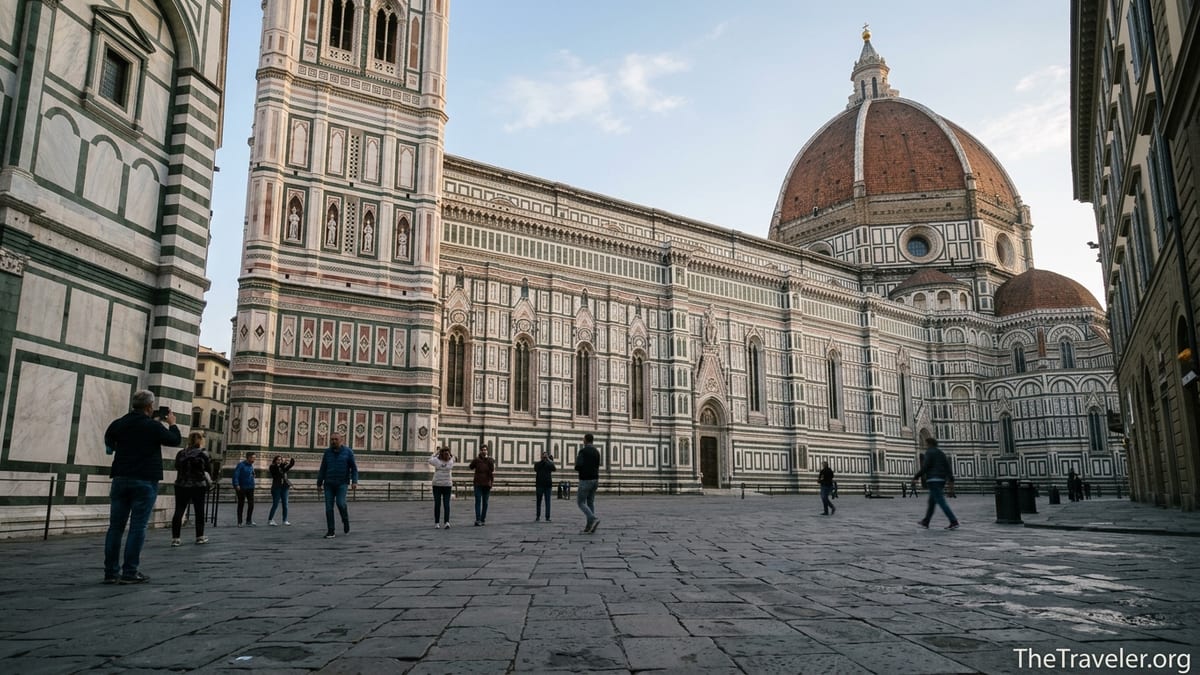
The Duomo Complex: What You Are Really Visiting
When people say “the Duomo,” they often mean the whole cluster of monuments in Piazza del Duomo, not just the cathedral nave. The official name of the church is the Cathedral of Santa Maria del Fiore, and it anchors a larger religious complex managed by the Opera di Santa Maria del Fiore. The complex includes Brunelleschi’s Dome on top of the cathedral, Giotto’s Bell Tower, the Baptistery of San Giovanni, the archaeological area of Santa Reparata beneath the nave, and the Opera del Duomo Museum just behind the cathedral.
The cathedral nave itself is free to enter for visitors, subject to security checks and capacity limits. Everything else requires a paid ticket in the form of a combined pass. That means you cannot, for example, buy a single ticket just to climb the dome or just to visit the Baptistery. For first-time visitors this is actually an advantage: you purchase one pass and then choose how much of it to use over several days.
Architecturally, the cathedral is a mix of late medieval and early Renaissance design. Arnolfo di Cambio started the structure in the late 13th century, but it is Filippo Brunelleschi’s 15th‑century dome that makes the building unmistakable. Giotto’s Bell Tower stands beside it with white, green and pink marble decoration that matches the cathedral facade. The Baptistery, older than the current church, faces the cathedral across the square and is famous for its bronze doors and mosaic interior.
Understanding this layout helps you plan: allow quiet time for the cathedral interior, schedule climbs and museum visits around the heat and crowds, and remember that your ticket covers more than just one attraction. Many first-time visitors arrive planning only a dome climb and later realize the museum and Baptistery are among the most rewarding parts of the visit.
Tickets and Passes: How Access Works in 2026
As of mid‑2026, the Duomo complex sells only combined passes, not separate tickets for each monument. The main options are typically named Brunelleschi Pass, Giotto Pass and Ghiberti Pass. Exact inclusions can change slightly, but in general the Brunelleschi Pass is the most complete option and is the only one that includes the climb to Brunelleschi’s Dome. The Giotto Pass generally includes Giotto’s Bell Tower instead of the dome, along with the Baptistery, the museum and Santa Reparata. The Ghiberti Pass usually covers the Baptistery, museum and Santa Reparata without any climb.
These passes are valid for three consecutive days starting from the date of your timed monument reservation, and they allow one entry to each included site. For example, if you reserve a dome climb on June 10 at 10:30 in the morning, your Brunelleschi Pass will normally be valid on June 10, 11 and 12. You can climb the dome only at your booked time, but you may visit the museum, Baptistery and other included sites at any point during opening hours on those three days.
Prices vary slightly by season and seller, but to give a rough idea, a Brunelleschi Pass for adults often costs in the range of 30 to 35 euros when purchased from the official Opera del Duomo ticketing system, with reduced prices for children roughly between seven and fourteen years old. Third‑party websites sometimes add a booking fee or bundle guided tours that push the price higher. Many experienced travelers recommend buying directly from the official system to avoid confusion and to ensure that your time slot for the dome or bell tower is genuinely confirmed.
Because same‑day availability is increasingly limited in peak months, first-time visitors are better off treating these passes like timed museum tickets. In a typical July week you might find that morning slots for the dome climb are sold out several days in advance while late afternoon spots remain. If standing in line outside ticket offices in the summer heat does not appeal to you, plan to book your pass online as soon as your Florence dates are firm.
Opening Hours, Closures and When to Go
Opening hours for each monument in the Duomo complex can vary by season and may change for liturgical events, but there are recurring patterns worth planning around. The cathedral nave typically opens mid‑morning on weekdays and closes by late afternoon, with more restricted tourist access on Sundays and religious holidays when Mass is celebrated. The dome, bell tower, Baptistery and museum usually open earlier and stay accessible into the early evening, but last entry is often 30 to 60 minutes before closing.
For example, a representative schedule in 2026 has the cathedral open to visitors from late morning to mid‑afternoon Monday through Saturday, closed to tourists during main Mass times and much more limited on Sundays. Brunelleschi’s Dome often opens around 8:15 in the morning and closes in early evening, with slightly shorter hours on Sundays. Giotto’s Bell Tower tends to operate full days with morning opening and an evening closing time around sunset or slightly before. The Opera del Duomo Museum and the Baptistery usually open around 9:00 in the morning and close in the early evening, and the museum is commonly closed on the first Tuesday of each month.
Because of frequent exceptions for religious services, processions and special maintenance work, it is wise to treat any printed schedule as approximate and to verify times just before your trip. If you are visiting around Easter, major Catholic feasts or on significant civic dates, assume there will be extra closures or reduced hours for at least the cathedral itself. Travelers who arrive expecting to climb at sunset should also know that security and staffing requirements mean the last allowed entry is normally well before sunset in summer, not during golden hour.
In terms of crowd levels, the square is busy almost all year, but there are clear patterns. Roughly from April through October, tour groups and day-trippers from cruise ships make the midday hours particularly congested. If you want a quieter experience inside the cathedral or on the climbs, aim for the first time slots of the day or late afternoon on weekdays. In winter, from November to early March, visitor numbers are lower, lines are shorter and the light on the facade can be especially beautiful on clear days, though some outdoor time on the dome or bell tower can feel chilly in the wind.
Planning a Half‑Day or Full‑Day Duomo Itinerary
First-time visitors often underestimate how long a thorough Duomo visit can take. Even a “quick” dome climb, if done in the heat of the day, can leave you wanting a rest before tackling the museum and Baptistery. A realistic plan is to give the complex either a focused half day or to spread it over two mornings, especially in high season.
For a compact half‑day, a common strategy is to book the first available dome or bell tower slot of the morning, usually around 8:15 or 8:30, and arrive at least 15 minutes early for the security check. After the climb and time at the top, allow roughly 90 minutes total including photos and the descent. By late morning you can walk straight to the Opera del Duomo Museum, which is only a short distance away behind the cathedral. Many visitors spend at least an hour there, more if they linger over the original Baptistery doors or the sculptural gallery that reconstructs part of the medieval facade.
Following a break for lunch on a nearby side street, where a simple plate of fresh pasta and water might cost approximately 12 to 18 euros per person depending on the restaurant, you can visit the Baptistery in the mid‑afternoon. The small interior space is often packed during peak hours, but if you time your arrival between major tour group waves you can stand in the center and admire the mosaic ceiling without constant jostling. You might then enter the cathedral nave itself toward the end of the day when lines sometimes shorten, remembering that access is free but subject to dress code checks.
Travelers with more time often prefer to split the experience. One example: on day one, climb Giotto’s Bell Tower in the morning and explore the museum before lunch, then save the dome climb and cathedral interior for the following day. This approach gives your legs a rest between stair-intensive visits and lets you revisit the square at different times of day, including just after dawn when delivery trucks are still active and the square feels more like a working city than a stage set.
Climbing Brunelleschi’s Dome and Giotto’s Bell Tower
Climbing Brunelleschi’s Dome is the marquee experience for many first-time visitors. It involves more than 450 narrow stone steps spiraling between the inner and outer shells of the dome, with low ceilings, tight passageways and limited passing room. There is no elevator. The climb includes a close-up view of the vast Last Judgment frescoes on the interior of the dome, and at the top you step out onto a circular terrace ringed by protective railings, with panoramic views over Florence’s terracotta roofs and distant hills.
Because of safety and capacity limits, access to the dome is only possible with a timed reservation linked to a Brunelleschi Pass. Arrive early for your slot, and expect the climb to take about 45 minutes up and 30 minutes down, depending on your pace and how long you linger at the viewing level. In high summer the interior can become hot and stuffy even in the morning, so many travelers choose earlier slots before the stone has absorbed a full day of sun. If you are claustrophobic, have significant mobility issues or trouble with steep stairs, the dome climb may not be a good choice.
Giotto’s Bell Tower, included in the Giotto and Brunelleschi passes depending on the option you purchase, offers an alternative or additional climb. The tower has around 400 steps and no elevator, but it is divided into several levels with open loggias. You can pause at intermediate terraces to catch your breath and enjoy different framed views of the dome and city. Many repeat visitors say that while the dome climb feels more iconic, the bell tower provides more varied and arguably more photogenic vistas because the cathedral and dome remain in full view rather than beneath your feet.
For a first-time visitor choosing only one climb, the decision often comes down to your priorities and what is still available when you book. If a Brunelleschi Pass with dome access is sold out on your dates, a Giotto Pass still allows you to experience the complex, enjoy sweeping city views and photograph the dome from outside. If both are available, and you are comfortable with sustained stair climbing, doing the dome one day and the bell tower the next is an excellent way to deepen your understanding of the structure and the city’s layout.
Inside the Cathedral, Baptistery and Opera del Duomo Museum
The interior of Santa Maria del Fiore is surprisingly austere compared with the elaborate facade. As you enter, the space feels wide, cool and relatively uncluttered, with high Gothic arches and patterned marble floors. One of the main focal points is the enormous clock above the entrance, designed in the 15th century and painted by Paolo Uccello, which uses a 24‑hour dial that once reflected liturgical time. Farther toward the crossing, you can look up to see the interior of Brunelleschi’s Dome, painted in vibrant scenes of the Last Judgment.
Beneath the nave, access with a Duomo pass leads to the archaeological site of Santa Reparata, where you walk among the remains of an earlier church and see fragments of early Christian mosaics. This area often feels much quieter than the nave, giving you a sense of how the sacred site evolved over centuries. It is a good place to pause and reflect if the crowds above feel overwhelming.
The Baptistery of San Giovanni, just across from the cathedral facade, is much smaller but intensely decorated. Inside, the octagonal dome is lined with glittering mosaics that narrate biblical scenes, including a striking image of Christ in Majesty. On the exterior, the building is famous for its bronze doors, especially the set known as the Gates of Paradise. The originals are preserved in the Opera del Duomo Museum, while high‑quality replicas stand on the Baptistery itself, so a thorough visit combines both locations.
The Opera del Duomo Museum is arguably the most rewarding component of the complex for travelers interested in art and history. Spread over multiple levels, it houses the original sculptures from the cathedral facade and bell tower, the battered but powerful original reliefs of the Baptistery doors, and masterpieces like Michelangelo’s late Pietà intended for his own tomb. A highlight is a vast hall that reconstructs the medieval facade of the cathedral at full scale, with sculptures reinstalled on a mock front. Many visitors who rush through the climbs and spend little time in the museum later say they wish they had reversed that priority.
Dress Code, Security and Practicalities
The Duomo complex operates as an active religious site, so visitors are expected to follow a modest dress code, especially inside the cathedral and Baptistery. In practice this means covering shoulders and knees and avoiding transparent clothing, beachwear and slogan T‑shirts that could be considered offensive. In summer, many first-time visitors arrive in shorts and sleeveless tops and are turned away or asked to purchase disposable cover‑ups sold by nearby vendors. A simple strategy is to bring a light scarf or shawl and choose knee‑length shorts or skirts for the day of your visit.
All monuments now use airport‑style security screenings. You will pass your bag through an X‑ray machine and walk through a metal detector before entering the cathedral and before starting climbs. Small backpacks and day bags are generally allowed, but large luggage, hard‑sided suitcases and very bulky items are refused. There is no bag storage inside the complex itself, so if you are arriving or leaving Florence the same day by train, consider using left‑luggage lockers at Santa Maria Novella station rather than bringing bags to the piazza.
Photography is permitted in most parts of the complex, usually without flash and tripod. However, you may be asked not to take photos during Mass, confessions or private prayer, and staff can intervene if visitors block circulation in narrow areas like staircases or the viewing terraces. Informal behavior that might be acceptable at a secular monument, such as loud phone calls or eating while walking through the nave, is discouraged here. Being attentive to the atmosphere improves not just your own experience but also that of worshippers and other visitors.
As with all major European attractions, pickpocketing can be a concern in the densest crowds outside, especially in the lines that form around the square. Using a cross‑body bag that closes securely, keeping phones and wallets in front pockets and avoiding distracted rummaging through backpacks in public are simple steps that significantly reduce risk. Inside the paid monuments, the flow is more controlled, but it is still wise to keep your valuables close when climbing or navigating busy stairwells.
Accessibility, Families and First‑Time Visitor Tips
Accessibility varies significantly across the Duomo complex. The cathedral nave and the Opera del Duomo Museum are generally accessible to visitors with limited mobility, with relatively level entrances and, in the case of the museum, elevators between floors. The Baptistery usually has a small threshold step that many wheelchair users can manage with assistance. In contrast, the dome and bell tower climbs are not accessible: they require taking hundreds of steps in narrow, historic staircases without lifts or alternate routes. Visitors with heart conditions, severe vertigo or serious mobility challenges are strongly advised to skip the climbs and focus instead on the museum and exterior views from nearby vantage points in the city.
Families visiting with young children often have a good experience at the museum, where large spaces and visual works keep attention spans engaged. However, pushing a stroller through the cathedral or Baptistery at peak times can be awkward, and carrying a stroller up the dome or bell tower is not allowed. A common compromise is for one adult to take older children on a climb while the other explores the square, visits the museum or enjoys a café break nearby with younger siblings. Bringing snacks and water is sensible, but remember that eating is not permitted inside the sacred spaces.
First-time visitors can also benefit from simple timing and comfort strategies. In summer, consider scheduling climbs and outdoor photography before 10:00 in the morning or after 4:00 in the afternoon to avoid the most intense heat and glare. Wear comfortable shoes suitable for stone steps and polished marble; thin sandals with smooth soles are more likely to slip. Shoulder seasons like late March, April, October and early November usually offer the best balance of daylight, temperate weather and manageable crowds, although there are no guarantees in a city as popular as Florence.
If you are combining the Duomo with other major sights such as the Uffizi or Accademia, resist the temptation to stack multiple intense visits back‑to‑back without breaks. A dome climb followed immediately by a three‑hour tour of Renaissance paintings is a lot to absorb in one day. Many experienced travelers suggest choosing one major indoor museum and one primarily outdoor or architectural experience per day, and leaving space for unstructured wandering through nearby neighborhoods like Santa Croce or Oltrarno.
FAQ
Q1. Is the Florence Cathedral itself really free to enter?
The main nave of the Cathedral of Santa Maria del Fiore is free for individual visitors, but you must pass a security check and respect the dress code. Expect a separate line from the ticketed monuments, and at busy times waits of 30 to 60 minutes are common.
Q2. Which Duomo pass should a first‑time visitor choose?
If you are fit enough for stairs and want the signature experience, the Brunelleschi Pass is usually the best choice because it includes the dome climb along with the museum, Baptistery, bell tower and Santa Reparata. If dome slots are sold out or you prefer fewer enclosed spaces, a Giotto Pass with the bell tower climb is an excellent alternative.
Q3. How far in advance should I book Duomo tickets in 2026?
In peak months such as May through September, it is sensible to book passes with dome or bell tower climbs at least one to two weeks before your visit, and earlier if you have only one available day. In quieter months you may find more last‑minute availability, but relying on same‑day booking is increasingly risky.
Q4. Can I see sunset from the dome or bell tower?
In practice, no. Last admission to climbs is typically scheduled well before sunset for safety and staffing reasons, especially in summer when the sun sets late. For sunset views of the city and the Duomo, locals often recommend walking up to Piazzale Michelangelo or the hill behind San Miniato al Monte instead.
Q5. What if I have a fear of heights or enclosed spaces?
The dome climb in particular includes narrow, curving staircases, low ceilings and sections where people must squeeze past each other. If you are strongly claustrophobic or uneasy with heights, you may want to skip the climbs and enjoy the cathedral from below, visit the museum and photograph the exterior from ground level or nearby hills.
Q6. Are guided tours worth it for a first Duomo visit?
Guided tours can be valuable if you are interested in history, engineering and religious context, or if you prefer someone else to manage timing and logistics. However, many first-time visitors have a satisfying experience with a self‑guided approach using the official passes, supplemented by a reliable guidebook or audio guide for the museum and cathedral.
Q7. What should I wear to meet the Duomo dress code?
Plan on clothing that covers shoulders and reaches at least to the knees, for both men and women. Lightweight trousers, capris or knee‑length skirts, along with a T‑shirt or blouse and a packable scarf, work well in warm weather. Closed shoes or sturdy sandals are better than flip‑flops for climbing and walking on smooth stone.
Q8. Can I attend Mass at the Florence Cathedral as a visitor?
Yes. Visitors are welcome to attend Mass and other services, which are held in designated areas of the cathedral. During liturgical celebrations, access is reserved for worshippers and tourist visits may be paused or diverted, so plan sightseeing at other times if your goal is to explore rather than participate in worship.
Q9. Is the Duomo complex suitable for visitors with limited mobility?
The cathedral nave, Baptistery and especially the Opera del Duomo Museum are generally accessible, with level or gently sloped entrances and staff who can advise on best routes. The dome and bell tower climbs, by contrast, are not accessible because they involve hundreds of steps in confined medieval staircases without lifts.
Q10. How can I avoid long lines at the Duomo?
Booking a combined pass online before your trip and choosing early morning or late afternoon time slots for climbs usually helps the most. Arriving 15 to 20 minutes before your reserved time, visiting in the shoulder seasons when possible and saving the free cathedral nave for later in the day also reduce waiting.