


Few buildings in Europe inspire the kind of devotion that draws travelers back year after year like the Cathedral of Santa Maria del Fiore in Florence. Anchoring the historic center that UNESCO has recognized for its exceptional Renaissance urban landscape, the Duomo is both a masterpiece of engineering and a living place of worship. Whether it is a first glimpse of Brunelleschi’s dome from a side street or a third climb to the lantern for sunrise over Tuscany’s hills, this cathedral has a way of turning one-time visitors into lifelong repeat guests.
Get the latest updates straight to your inbox!
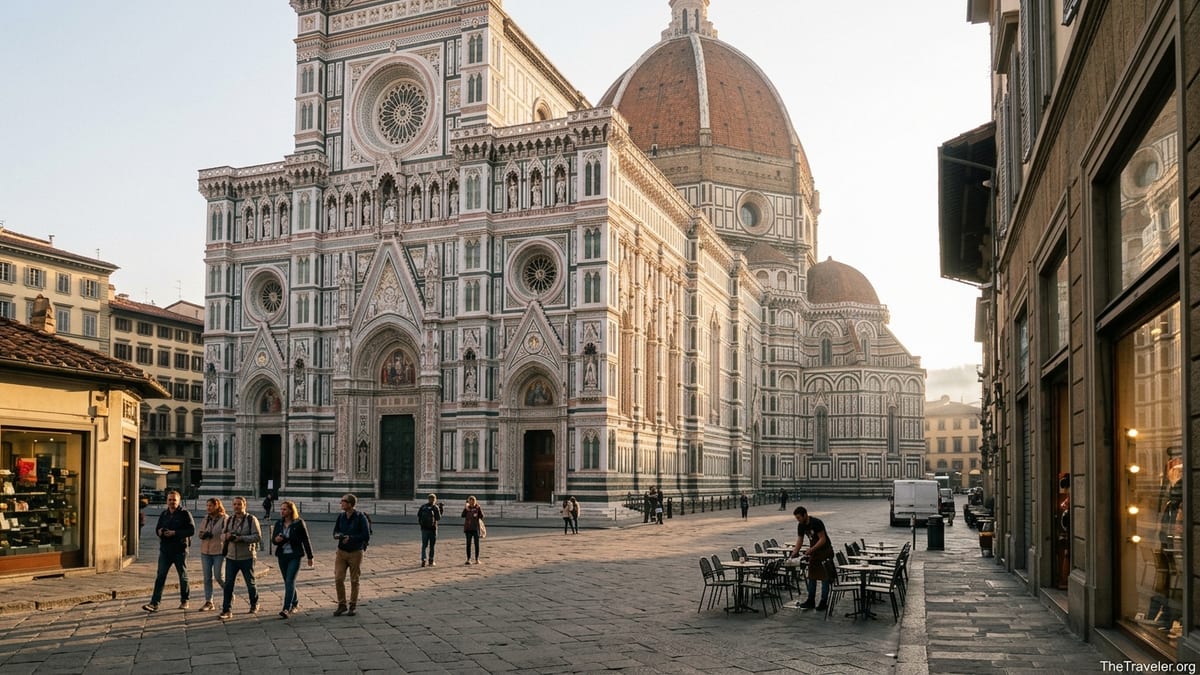
A Masterpiece at the Heart of a UNESCO City
Travelers keep returning to the Cathedral of Santa Maria del Fiore because it is inseparable from the story of Florence itself. The cathedral dominates Piazza del Duomo, the spiritual center of a historic district that UNESCO inscribed as a World Heritage Site in 1982 for its unique concentration of Renaissance art and architecture. Walking into the square from Via dei Calzaiuoli, visitors are immediately surrounded by the cathedral, Giotto’s bell tower and the octagonal Baptistery, three structures that collectively define Florence’s skyline and identity.
Part of the reason the cathedral draws repeat visitors is that it cannot be understood in a single visit. On a first trip, many travelers step briefly inside the church after waiting in the often substantial security line that snakes across the square in peak season. On a second or third visit, they return with more time and a clearer sense of what they want to see: the vast interior vaults, the archaeological remains of the earlier church of Santa Reparata beneath the nave, or a slow circuit around the exterior to appreciate the colored marble inlays up close.
Visitor numbers reflect this enduring appeal. In 2024 the monuments managed by the Opera di Santa Maria del Fiore, which include the cathedral, dome, bell tower, baptistery and museum, welcomed roughly 1.35 million paying visitors, slightly more than the previous year according to Italian cultural reports. Many of these are not first-timers. Guides regularly mention guests who are back for a second honeymoon, returning after a semester abroad in Florence, or visiting with their children after having first seen the Duomo as backpackers in the 1990s.
The cathedral’s role in the wider city experience also explains why travelers build it into every Florence itinerary, no matter how short. It sits within easy walking distance of the Uffizi Gallery, Palazzo Vecchio and the Arno River, so repeat visitors often use it as a familiar landmark for orientation. A traveler staying in the Santa Croce neighborhood might cut through Piazza del Duomo several times a day, catching the facade in morning shade, at bright midday and lit after dark, each time experiencing the building in a different mood.
Brunelleschi’s Dome: Engineering Wonder and Repeat Climb
For many travelers, the single biggest reason to come back to Santa Maria del Fiore is Brunelleschi’s dome. Completed in the 15th century and still one of the largest masonry domes ever built, it rises to about 116 meters above street level and can be seen from almost any viewpoint in Florence. Guides often describe it as the city’s “burnt orange crown,” a terracotta presence that changes color with the light and weather, from pale peach at dawn to deep rust before a summer storm.
The experience of climbing the dome itself encourages repeat visits. Access normally requires a timed reservation included in the Brunelleschi Pass, a combined ticket valid for three consecutive days that covers the dome climb as well as the bell tower, museum, baptistery and Santa Reparata. Prices can shift, but recent seasons have seen adult passes in the range of a few dozen euros, a cost many travelers happily pay again to repeat the ascent. The climb of roughly 460 steps takes visitors between the two shells of the dome, along cramped spiral staircases and narrow passages where they can see the brickwork and support ribs that made Brunelleschi’s design so revolutionary.
Because each climb is shaped by time of day and season, even those who have done it once often return. A traveler who first ascended in July at midday, when the queue for the initial security check stretched almost to Via Martelli, might plan a second climb in March, booking the earliest morning slot available. At that hour, the city’s terracotta roofs are still soft with mist, and the bells from nearby churches echo across the valley in a way that feels entirely different from the high-summer experience. Photographers in particular sometimes plan multiple days in Florence just to catch the changing light from the lantern balcony.
The view at the top is also a reason people come back. From the narrow exterior gallery around the lantern, visitors can pick out landmarks they have grown attached to over multiple trips: the green dome of the Medici Chapels in San Lorenzo, the tower of Palazzo Vecchio, the distant line of the Fiesole hills. Repeat travelers often talk about using this vantage point to reflect on how their relationship with the city has evolved, comparing the Florence they first saw during a budget interrail trip with the one where they now bring their own teenagers.
A Living Canvas of Renaissance Art and Faith
Another powerful reason travelers return is the chance to experience Renaissance art in the setting for which it was created. Inside the dome, visitors stand directly beneath The Last Judgement, the vast fresco cycle begun by Giorgio Vasari and completed by Federico Zuccari in the late 16th century. Restoration campaigns in the last decades have cleaned centuries of soot and wax smoke from these frescoes, so repeat visitors often notice details that were less visible during earlier trips, such as individual faces in the angelic choirs or the colors in the robes of the resurrected.
Beyond the dome, the entire cathedral complex functions as a kind of open textbook of Florentine art. The Baptistery’s famous bronze doors, created by artists including Lorenzo Ghiberti, are now preserved and displayed in the Museo dell’Opera del Duomo, with high quality replicas installed on the building itself. Travelers who first admired the doors outdoors often come back to see the originals up close in the climate-controlled galleries, where lighting reveals subtleties in the relief work that are hard to discern in the piazza’s glare.
Regular worship and music also keep the cathedral from feeling like a static monument. Daily services and special liturgies punctuate the calendar, and the organ is used for both regular Masses and occasional concerts. A traveler who first encountered the Duomo in high summer, sharing the nave with large tour groups and guides speaking in multiple languages, may choose to return in November and attend an early evening Mass. The experience of hearing Italian hymns echo beneath the dome, with fewer tourists and softer interior lighting, can be so moving that it becomes a personal tradition.
For many visitors from around the world, there is spiritual significance in revisiting the same sacred space over time. Some couples return on milestone anniversaries to light a candle at the same side chapel as on their honeymoon. Others, especially Italian Americans tracing family roots, may build repeated Duomo visits into wider journeys through Tuscany, using Florence’s cathedral as a kind of anchor point in a longer story of heritage travel.
Ever-changing Restorations and New Visitor Experiences
Santa Maria del Fiore is not frozen in time, and that constant evolution is another reason people come back. The Opera di Santa Maria del Fiore, the historic institution that manages the complex, invests heavily in restoration and maintenance, and has recently planned extensive multi-year works on the monuments in Piazza del Duomo. Scaffolding moves from one section of the facade or dome to another, conservation teams clean stonework and mosaics, and interpretive materials in the museum are updated to reflect the latest research.
What this means in practical terms is that a traveler’s second or third visit often reveals areas that were previously closed or covered. Someone who first visited when part of the cathedral’s south flank was under scaffolding might return to find those sections newly cleaned, the white Carrara marble and green serpentine bands glowing in the afternoon light. Conversely, they may find a different area undergoing work, which can be disappointing in photographs but also offers a rare chance to see conservators’ platforms and sometimes even watch specialists at work from the ground.
The visitor infrastructure also adapts over time. In recent years, the introduction of timed entries for the dome has reduced some of the extreme queuing that once characterized peak summer days, though waiting times at security and the free cathedral entrance can still be substantial during Easter week and August. Ticketing is now centered around a small official office and online platform where travelers can choose among passes like the Brunelleschi Pass or alternative options that exclude the dome but include the museum and bell tower at a lower price point. Repeat visitors often refine their strategy, booking an early dome slot on one day, the bell tower late in the afternoon on another, and leaving the museum for the hottest hours of midday.
Even experienced Florence travelers can find new layers to explore. The reopening and partial reimagining of the Museo dell’Opera del Duomo over the last decade created a more coherent narrative route through artifacts, models and original sculptures. Visitors now commonly report spending two or three hours there, far more than the quick 30 minute look of earlier years. Many who once skipped the museum to prioritize outdoor sights deliberately plan a return trip partly to see the restored façade sculptures and full-scale recreations that bring the cathedral’s original appearance into focus.
Unbeatable Views from the Dome and Giotto’s Bell Tower
Florence is a city made for viewpoints, and the Duomo complex offers two of the most compelling: the dome and Giotto’s Campanile. Travelers who have climbed one are often curious to compare it with the other, which naturally leads to repeat visits. The bell tower, slightly shorter than the dome but offering a more open staircase and several platforms, provides a frame of Brunelleschi’s dome rising above the city that many consider their favorite Florence photograph.
On a first trip, a visitor might choose the dome because of its fame, then realize afterwards that none of their photos actually show the dome itself. On a subsequent visit, they book a bell tower ascent, spacing it a few hours apart from the dome climb or saving it for a separate day. The two experiences are distinct. The dome’s narrow inner corridors feel almost like being inside an enormous machine, with glimpses of frescoes and brickwork, while the campanile offers repeated open-air pauses on its landings, ideal for catching breath and framing new angles of the cathedral facade and surrounding streets.
Seasonal conditions also shape these visits. In July and August, when temperatures regularly push into the high 30s Celsius in mid-afternoon, repeat visitors often schedule climbs for early morning or after 5 p.m., combining them with gelato stops at nearby cafés to cool down. In late October or early November, the air can be crisp and clear, perfect for long distance views toward the Apennine mountains. Travelers who have experienced both seasons frequently cite the change in light and atmosphere as a compelling reason to keep coming back.
There is also a practical side. Because tickets for the dome are limited and popular time slots can sell out days in advance, many travelers do not manage to secure their preferred slot on a first visit. Returning a year or two later, better informed and planning earlier, they treat the dome or bell tower climb as a central pillar of their itinerary, sometimes shaping hotel bookings and train times around a particular ascent they were not able to do before.
Atmosphere in Piazza del Duomo: From Dawn to Late Evening
One of the quiet reasons travelers return to Santa Maria del Fiore is the changing atmosphere of Piazza del Duomo across the day and across seasons. The square is almost never empty, but its character at 7 a.m. on a January morning is utterly different from a summer afternoon packed with tour groups and school trips. Repeat visitors learn to seek out their favorite moments and often organize strolls to coincide with them.
Photographers and early risers sometimes step into the square just after sunrise when shop shutters are still down and delivery vans are restocking nearby cafés. At that hour, the facade’s pink and green marble takes on pastel tones, and the bells sound particularly clear. Travelers who have only seen the cathedral in the heat and glare of midday often find this quieter side of the piazza a revelation and cite it as a reason to stay in accommodation within walking distance on future trips.
Evenings offer a different pull. After dinner in nearby neighborhoods like San Lorenzo or Santa Croce, people often detour through Piazza del Duomo on their way back to their hotel or apartment. Street musicians sometimes set up near the north flank of the cathedral, and the building is lit with warm white floodlights that highlight the sculptural details. Many repeat visitors speak of a ritual goodnight walk around the cathedral, circling it slowly while savoring the relative calm after the day’s crowds.
There are also the small rituals that accumulate over multiple visits. A traveler might always stop for a coffee at the same bar on Via de’ Servi before entering the square, or buy a paper cone of roasted chestnuts from a seasonal vendor in November. Over time, these habits turn the cathedral from a one-time sight into a personal landmark woven into the fabric of the traveler’s own life, which is a powerful motivation to keep coming back.
Practical Ease: Flexible Passes and Central Location
Familiarity and practicality also contribute strongly to the Duomo’s repeat appeal. By the second or third visit to Florence, many travelers have a clear understanding of how the ticketing system works and how to avoid the longest queues. The Opera’s combined passes, such as the Brunelleschi Pass, typically give visitors three consecutive days to use the included entries. This allows flexibility: a family could climb the dome on a Tuesday morning, explore the museum during the hottest hours that afternoon, and tackle the bell tower on Wednesday or Thursday, adjusting plans if weather or energy levels shift.
The cathedral’s location further encourages impromptu returns. It is a roughly ten-minute walk from Santa Maria Novella train station for a reasonably fit traveler rolling carry-on luggage, which means even day trippers from Rome, Milan or Bologna can work a Duomo visit into a tight schedule. Repeat visitors often plan train departures that allow just enough time for one last lap around the square or a quick museum stop before heading home.
Costs play a role too, particularly for budget-conscious travelers who might skip more expensive museums on return trips but still want a meaningful cultural experience. Entry to the cathedral itself typically remains free, subject to security screening and dress code, while the paid monuments are bundled in passes that, when used fully, compare favorably to individual museum tickets elsewhere in Florence. A couple returning to the city for a weekend might decide to focus on the Duomo complex and one other major site, like the Uffizi, keeping overall cultural spending manageable while still feeling immersed in history.
Finally, the Duomo functions as an accessible shared experience for mixed-interest groups. In a family where one person is passionate about Renaissance art, another about engineering, and a third primarily interested in photography and café culture, the cathedral offers something to engage each of them. That versatility means it repeatedly wins its place on group itineraries, often outcompeting lesser-known churches or museums that might only appeal to one member of the party.
The Takeaway
The Cathedral of Santa Maria del Fiore endures as a repeat destination because it offers more than a single postcard moment. It is at once an engineering marvel, an artistic treasury, a working place of worship and a daily stage for Florentine life. Each return visit reveals new details: freshly cleaned marble, changing exhibition layouts in the museum, a different quality of light on Brunelleschi’s dome or a quieter Mass in the side aisles.
Practical elements help make those repeat experiences possible. Flexible passes, improved timed entries and the cathedral’s central location make it relatively easy for travelers to fit the Duomo into itineraries that might only allow a night or two in Florence. Over time, many find that seeing the cathedral evolve across seasons and years becomes part of their own travel story, a way of measuring not only changes in Florence but also the stages of their own lives.
In a world where many attractions are checked off once and never revisited, Santa Maria del Fiore stands out as a place worth returning to. Whether it is the pull of the dome climb, the desire to show the square to a new traveling companion, or the simple wish to stand again in the heart of a Renaissance city at sunrise, the reasons to come back are as layered as the history of Florence itself.
FAQ
Q1. Is visiting the interior of the Cathedral of Santa Maria del Fiore free?
Yes, entry to the main interior of the cathedral is typically free, but all visitors must pass through security checks, and lines can be long at peak times.
Q2. Do I need a separate ticket to climb Brunelleschi’s dome?
Yes, climbing the dome requires a paid ticket, usually included in the Brunelleschi Pass or similar combined pass, and you must reserve a specific time slot in advance.
Q3. How many steps are there to the top of the dome?
The dome climb involves roughly 460 steps. There is no elevator, so visitors should be prepared for a fairly demanding ascent through narrow stairways.
Q4. What is the difference between climbing the dome and Giotto’s bell tower?
The dome climb takes you inside Brunelleschi’s structure with close views of the frescoes and a top platform, while the bell tower offers multiple open-air terraces and the classic view of the dome itself.
Q5. How far in advance should I book tickets for the Duomo complex?
In busy periods such as Easter, May to September, and major holidays, it is wise to book dome climbs several days, sometimes a week, in advance to secure preferred time slots.
Q6. Is there a dress code for visiting the cathedral?
Yes, visitors are expected to dress modestly, with shoulders and knees covered. Sleeveless tops, very short shorts and hats may lead to being refused entry to the church interior.
Q7. When is the best time of day to visit to avoid crowds?
Early morning on weekdays, shortly after opening, generally has fewer crowds. Late afternoon can also be calmer than midday, though it depends on season and holidays.
Q8. Can I attend Mass at Santa Maria del Fiore even if I am a tourist?
Yes, Mass is open to everyone, though the primary purpose is worship rather than sightseeing. Photography is usually discouraged during services, and visitors should remain respectful and quiet.
Q9. Are children allowed to climb the dome or bell tower?
Children are usually allowed if accompanied by an adult, but very young children or those afraid of heights or tight spaces may find the climb challenging. Families should consider the physical effort and narrow stairways before deciding.
Q10. Why do travelers visit the Duomo again if they have already seen it once?
Many return because each visit feels different: new restoration work, changing light and seasons, upgraded museum displays and personal milestones all give fresh meaning to repeat experiences at the cathedral.