


Florence’s Cathedral of Santa Maria del Fiore is one of Europe’s most visited churches, and in peak season the lines can look intimidating. Yet with up-to-date ticket knowledge, smart timing and a realistic plan, you can experience the Duomo, Brunelleschi’s dome, Giotto’s bell tower and the surrounding complex without spending your day stuck in queues. This guide uses current information and real examples to help you get the most out of your visit while keeping waiting times to a minimum.
Get the latest updates straight to your inbox!
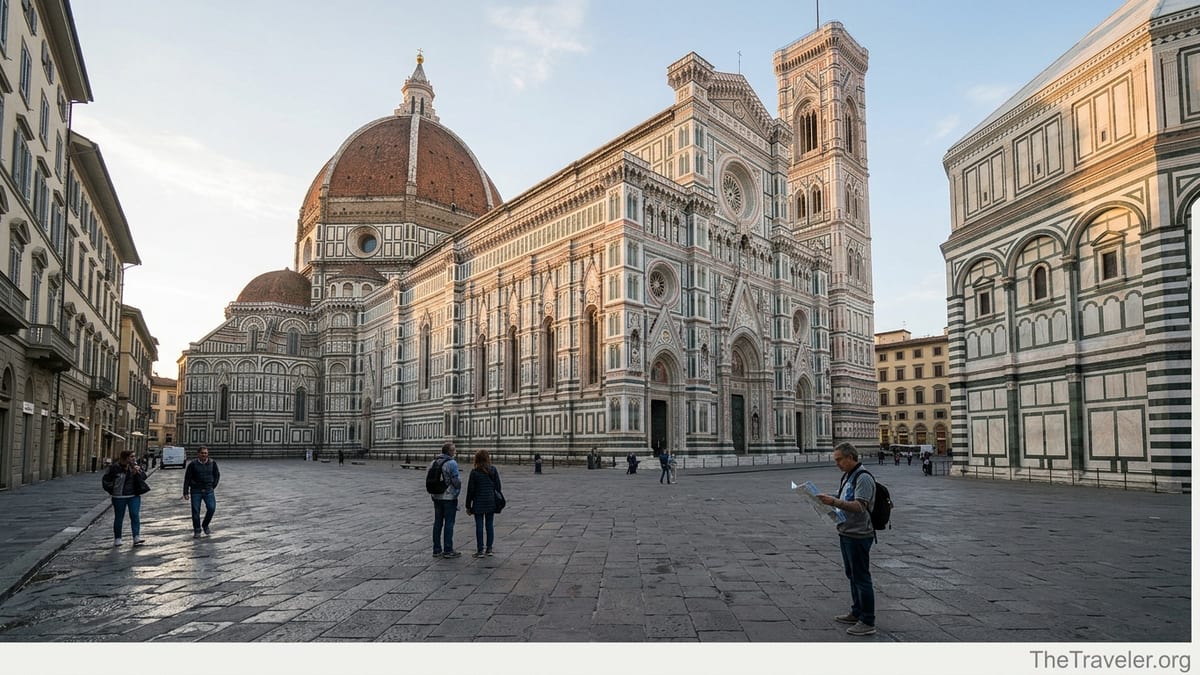
Understand What Is Free and What Requires a Ticket
The first step to avoiding unnecessary waits is understanding exactly what you do and do not need a ticket for. As of mid-2026, entry to the cathedral nave of Santa Maria del Fiore itself is free, with a separate security queue but no ticket check. This is the long line many people notice wrapping around the building in high season. In contrast, the dome climb, Giotto’s bell tower, the Baptistery of San Giovanni, the Opera del Duomo Museum and the archaeological area of Santa Reparata all require a paid pass, purchased in advance or on site when available.
The dome and the bell tower are the two biggest bottlenecks. Both now operate with mandatory timed reservations tied to specific passes, and same-day slots can sell out, particularly from April through October and on holiday weekends. Many visitors only discover at the ticket office that no dome times remain for the next two days. If standing beneath the frescoed interior of the cupola or photographing the city from Giotto’s Campanile is a priority, you should treat those reservations like you would a major museum booking rather than a casual add-on.
By contrast, the free cathedral line usually moves more quickly than it looks, especially outside the hottest part of the day. On a typical May afternoon, a queue stretching halfway around the façade might represent 25 to 40 minutes of waiting. In July at midday, that can stretch toward an hour or more as security slows down and visitors linger for photos. Knowing that the cathedral is free, but everything else requires passes and reservations, lets you prioritize what you care about rather than burning time in the wrong line.
Another important distinction is that the cathedral’s worship schedule affects access. On Sundays and major religious holidays, the nave is closed to tourist visits for much of the day. Travelers who do not realize this sometimes spend half an hour in line only to be turned away at the door. Always check the posted hours for that specific day and be ready to shift your visit to another part of the complex, such as the museum, if the cathedral is closed for services.
Choose the Right Duomo Pass for Your Priorities
The Opera di Santa Maria del Fiore now uses three main passes, each valid for three consecutive calendar days from the first use. The Brunelleschi Pass is the top-tier option, including the dome climb, bell tower, Baptistery, museum and Santa Reparata. At around 30 euros per adult, it is the only pass that guarantees a dome climb with a dedicated time slot, provided you book early enough. The Giotto Pass, roughly 20 euros, covers the bell tower, Baptistery, museum and Santa Reparata but not the dome, while the Ghiberti Pass focuses on the Baptistery, museum and Santa Reparata for those who prefer to stay on the ground.
For visitors who dream of climbing the dome, the Brunelleschi Pass is the clear choice. Dome slots on the official ticket site now disappear several weeks in advance for spring and summer dates, and by the time many travelers arrive in Florence, the only remaining option is the Giotto Pass. That can still be a great experience, since the bell tower offers similar panoramic views and an equally intense stair climb, but it is not a substitute if seeing the inside of the cupola up close is on your must-do list. Booking your Brunelleschi Pass as soon as your travel dates are fixed is the single most effective way to avoid last-minute frustration and long waits at resale counters.
If you are not interested in climbing hundreds of steps, the Ghiberti Pass plus the free cathedral entrance can still deliver a rich experience. For example, a couple visiting in November might spend a relaxed morning in the Baptistery and museum, then join the free cathedral line in the early afternoon when bus groups are thinner. They will avoid both the cost and the crowds of the vertical attractions while still seeing the original Gates of Paradise, Donatello sculptures and the reconstructed medieval façade inside the museum.
It is also worth emphasizing that so-called “skip the line” packages sold by third-party agencies rarely bypass the official security and entry lines. The Opera explicitly warns that no outside operator is authorized to sell priority entrance to the cathedral or other monuments. In practical terms, a 60 euro “Duomo skip-the-line” tour may save you the time of buying a ticket at the office, but it will not beam you past security or ahead of everyone else with a timed reservation. Buying directly from the official system gives you the same queue position at a much lower price.
Book Timed Entries Strategically to Avoid Peak Crowds
Timed entries are your main tool for trading money and planning for saved time on the ground. The dome and the bell tower now run on strict time slots, with entry limited to the window printed on your pass. For Brunelleschi’s dome, weekday slots typically start at 8:15 in the morning and run into early evening, with a shorter window on Saturdays and a midday start on Sundays. The bell tower operates on a similar schedule, opening at 8:15 and closing in the early evening, though the exact last slot can vary with the season.
To minimize waiting and heat, aim for the first or second slot of the day, or the final hour before closing, especially in the warm months. A family visiting in late June who book the 8:15 dome climb on a Tuesday will often find only a short line of people having their tickets scanned, then a steady but uncrowded ascent in cooler air. Those who choose an 11:45 slot on a Saturday may encounter backups at the narrowest parts of the staircase and stop-and-go movement as visitors ahead snap photos. On a busy Sunday in May, late-morning lines around the whole complex can merge visually, making it easy to lose 20 minutes in the wrong queue, so arriving early with a clear sense of where you are supposed to go is essential.
A smart strategy is to separate the dome and bell tower climbs by at least half a day, ideally on different days within your three-day pass window. Physically, both involve over 400 steps in tight spaces with limited ventilation. Trying to do both back to back at midday in July will not only be uncomfortable but will also make you more sensitive to any pauses or congestion that do arise. For example, you might book the dome for 8:15 on Monday morning, then schedule the bell tower for 5:15 on Tuesday, using the midday hours for the museum and Baptistery when those spaces are better at absorbing crowds.
Finally, remember that for some passes, only certain attractions require a reservation. As of 2026, Brunelleschi Pass holders can visit the bell tower and Santa Reparata at any time within the three days, without choosing a specific slot, while Giotto and Ghiberti passes may require you to pick a time to start Santa Reparata or the bell tower. When you purchase, check which entries are tied to specific times and which can be used flexibly. This will prevent you from accidentally queuing for something you could have visited later with little or no wait.
Time Your Day Around Real Opening Hours and Worship Times
Because the Duomo complex operates on a patchwork of schedules that shift slightly across weekdays, weekends and public holidays, many long waits are simply the result of arriving at the wrong door at the wrong time. As of mid-2026, the cathedral itself is generally open to visitors from about 10:15 to mid-afternoon Monday through Saturday, with last admission around 3:30 in most seasons. On Sundays and religious holidays, the nave is reserved for worship and closed to tourist visits, even though the exterior space remains busy with visitors.
The dome and bell tower open significantly earlier, with first climbs at 8:15. That makes early morning an ideal time to tackle the vertical attractions before the heat and crowds peak. The Opera del Duomo Museum typically opens around 8:30 and runs into the early evening, while the Baptistery opens about 8:30 and closes a bit later than the cathedral. There are occasional exceptions, such as shorter hours on certain Saturdays or restorations inside the Baptistery that may partially limit views of the mosaics, but the broader pattern remains consistent: morning is for climbing and interior visits, early afternoon is best for the museum, and late afternoon is good for a slower stroll through the Baptistery or a second look at the cathedral exterior.
In practice, that might mean planning your day in Florence around a specific Duomo anchor. Imagine you have a 9:00 dome slot on a Wednesday. You could arrive at the Piazza del Duomo by 8:30 to find the correct entrance and pass security, complete your climb by about 10:00, then take a coffee break on a side street before entering the museum around 11:00, when many tour groups are up on the dome or at the Uffizi. After a long lunch in the nearby Sant’Ambrogio neighborhood, you might return to the piazza after 3:00, when the line for the free cathedral often shrinks, slotting in a 20 to 30 minute wait instead of the 60 minute queues common at midday.
Aligning your visit with worship times can also reduce friction. For travelers who would like to attend mass, the cathedral offers services in Italian that are open to the faithful, and entry for worship uses a separate door and line. Dress codes are enforced more strictly during services, and photography is not appropriate during the liturgy. If your main goal is sightseeing, it is usually better to avoid the busiest mass times and use those hours to visit the museum or Baptistery, then return when the cathedral is again open for tourists.
Use the Museum and Santa Reparata to “Flip the Script” on Crowds
Most visitors approach the Duomo complex from the outside in, starting with the free cathedral and leaving the museum or Santa Reparata for later, if there is time. To avoid long waits and get a deeper understanding of what you are seeing, it is smarter to invert that sequence. The Opera del Duomo Museum, housed behind the cathedral, contains the original façade sculptures, the restored Gates of Paradise, and a powerful display of Michelangelo’s unfinished Pietà, all in climate-controlled galleries with controlled entry.
Because many tour groups allocate only an hour for the entire complex, the museum often feels calmer, especially from late morning into early afternoon when the piazza is at its noisiest. A traveler visiting on a hot June day who starts directly at the museum at 9:00 will bypass the already forming cathedral line, enjoy the art with space to breathe, and emerge a couple of hours later with a much richer sense of the building’s history. When they then enter the cathedral nave, they will recognize copies versus originals and pick out specific sculptural details they first saw up close.
Santa Reparata, the archaeological area beneath the cathedral, is another underused way to access the complex while avoiding some of the most crowded strip of the piazza. Certain passes require a timed entry here, while others, such as the Brunelleschi Pass, allow flexible access within the three-day validity. Once inside Santa Reparata, visitors move through the remains of the earlier basilica and burials before emerging near the front of the cathedral, effectively entering the nave from a different route than the main free line.
A practical example: a pair of friends in late September might reserve a 1:30 slot for Santa Reparata, timed so that they arrive just as the sun and crowds peak in the square. They scan their passes at the designated door, descend into the cooler underground space, explore at their own pace, and then come up into the cathedral itself without having stood in the long exterior queue. While exact routing and crowd levels change, using the museum and Santa Reparata as primary experiences rather than afterthoughts helps you distribute your time more evenly and reduces your exposure to the longest lines.
Navigating Security, Dress Codes, and Accessibility Without Delays
Even with perfect timing and the right pass, it is easy to lose time at the Duomo to basic practicalities. Security screening is now standard at all major entry points, with bag checks and metal detectors at the cathedral, dome and bell tower. Bringing only a small daypack or handbag speeds this significantly. Large backpacks, rolling suitcases and bulky camera gear can trigger secondary inspections or, in some cases, outright refusal of entry. There is no cloakroom at the cathedral complex, so arriving without heavy luggage is essential.
Dress codes, while sometimes relaxed at busy moments, are enforced with more consistency inside the cathedral and Baptistery. Shoulders and knees should be covered for all visitors, and hats removed. A common real-world scenario involves visitors in shorts and strappy tops being pulled aside at the door and asked to purchase or borrow disposable cover-ups, adding both cost and delay. A lightweight scarf or shawl and longer shorts or skirts can prevent that. For men, a simple cotton T-shirt and knee-length shorts are generally acceptable, though in the hottest months it can be tempting to underdress and risk being held at the entrance.
Accessibility is another area where advance planning can reduce stress. The dome and bell tower both involve more than 400 narrow steps, low ceilings and few chances to exit once on the route. There are no elevators. Visitors with mobility impairments, heart conditions, severe claustrophobia or vertigo are strongly advised to skip these climbs. Instead, they can focus on the level-access museum, which has elevators and ramps, and the cathedral floor. The official accessibility information notes that Giotto’s bell tower, in particular, is not wheelchair accessible and is considered strenuous even for fit visitors.
To streamline your path through the piazza, take a moment before you go to familiarize yourself with which entrance corresponds to each monument. For example, the dome climb begins on the north side of the cathedral, not at the main façade doors, while the museum entrance is one block behind the apse. The Baptistery sits freestanding across the square, with its own line. Visitors who arrive with only a general idea that they have a “Duomo ticket” often bounce between different doorways and information signs, losing 10 or 15 minutes and valuable patience before even joining the correct queue.
When a Guided Tour Makes Sense (and When It Does Not)
With so many agencies advertising skip-the-line Duomo tours at a markup, it can be difficult to know when paying extra genuinely saves time. For most independent travelers who are comfortable booking online, purchasing passes directly from the official ticket portal is enough to avoid the longest waits. Timed dome and bell tower entries reserved in advance place you in the same line as tour groups, and you will go through the same security checks as everyone else. The key difference is that group tours often include commentary and a set route through the complex, not magically shorter security queues.
There are, however, situations where a high-quality, small-group or private tour can enhance your experience and indirectly help with time management. For example, a family visiting Florence for just one full day in August might choose a morning Duomo tour led by an art historian that includes a pre-booked dome climb. The guide will keep the group moving efficiently, handle any minor issues at ticket checks, and provide context that helps you understand details you might otherwise walk past. You still pass through the same turnstiles, but you are much less likely to waste time in the wrong place or miss something important.
Conversely, a couple staying in Florence for several days in October, comfortable with self-guided exploration, may find that a tour adds more structure than they want. With Brunelleschi or Giotto passes bought directly, they can choose their own sequence for the museum, Baptistery and Santa Reparata, lingering where interest strikes and stepping outside to rest whenever crowds feel overwhelming. In this scenario, the main advantage of a tour, beyond commentary, would be psychological reassurance rather than raw time savings.
Whatever you decide, treat language like “skip the line” with caution. The most honest way to think about Duomo tickets is that an advance pass lets you skip the ticket-purchase line, and a timed reservation lets you avoid open-ended waiting by replacing it with a specific arrival window. What it does not do is eliminate security checks or allow you to walk straight into a monument at the exact minute you choose. Keeping that expectation realistic will help you judge whether a tour’s price makes sense for your own priorities and comfort level.
The Takeaway
Experiencing the Cathedral of Santa Maria del Fiore without long waits is less about secret entrances and more about informed planning. Know what is free and what requires a pass, and buy your Brunelleschi or Giotto ticket through the official system as soon as your travel dates are firm. Anchor your days around timed dome or bell tower entries, then layer in the museum, Baptistery and Santa Reparata during periods when the piazza is hottest and most crowded.
Use the three-day validity of the passes to your advantage, spreading your visits across mornings and late afternoons instead of cramming everything into a single midday rush. Dress appropriately, travel light, and study the layout of entrances so you are never that person wandering the square trying to find “the Duomo line” five minutes before a time slot. When you do all this, the cathedral complex shifts from a source of stress to a highlight of your time in Florence, delivering both its famous skyline views and its quieter, more contemplative spaces without the feeling that you spent the day queuing.
FAQ
Q1. Do I need a ticket to enter the Cathedral of Santa Maria del Fiore?
Entry to the cathedral nave is currently free and does not require a ticket, but you must pass through a security line and respect opening hours and dress code.
Q2. Which ticket should I buy if I want to climb the dome?
You should purchase the Brunelleschi Pass, which is the only pass that includes the dome climb. Book your timed slot on the official ticket system as early as possible.
Q3. How far in advance should I book a dome climb in peak season?
In busy months such as May through September, it is wise to book several weeks in advance. Last-minute travelers often find that dome slots for their dates are sold out.
Q4. Is there really such a thing as a “skip the line” Duomo ticket?
Officially, no external company can sell priority access to the cathedral or other monuments. Advance tickets help you skip ticket-purchase lines but not security checks.
Q5. What is the difference between the Brunelleschi, Giotto and Ghiberti passes?
The Brunelleschi Pass includes the dome, bell tower, Baptistery, museum and Santa Reparata. The Giotto Pass includes everything except the dome, and the Ghiberti Pass focuses on the Baptistery, museum and Santa Reparata.
Q6. When are the shortest lines for the free cathedral entrance?
Lines are often shortest shortly after opening on weekdays and again later in the afternoon. Midday in high season usually has the longest queues and strongest sun.
Q7. Can I visit the Duomo complex on a Sunday?
You can usually visit the dome, bell tower, museum and Baptistery on Sundays, subject to their hours, but the cathedral nave is generally closed to tourist visits during services.
Q8. Are the dome and bell tower climbs suitable for everyone?
No. Both involve more than 400 narrow steps, with no elevator and confined spaces. They are not recommended for visitors with mobility issues, heart conditions or severe claustrophobia.
Q9. Is it better to climb the dome or Giotto’s bell tower for views?
Both offer superb views. The dome includes close-up frescoes, while the bell tower gives a classic panorama that includes the dome itself. Many visitors choose one to avoid repeating a strenuous climb.
Q10. Can I use my Duomo pass over multiple days?
Yes. Current passes are valid for three consecutive days starting from the first time you use them, allowing you to spread visits across several mornings or afternoons.