


More news on this day
Major Gulf carriers are keeping most of their fleets in the air despite a sharp escalation in the Iran conflict, relying on rerouted flight paths, layered security measures and flexible schedules to preserve vital air links through hubs in Dubai, Doha, Abu Dhabi and Sharjah.
Get the latest news straight to your inbox!
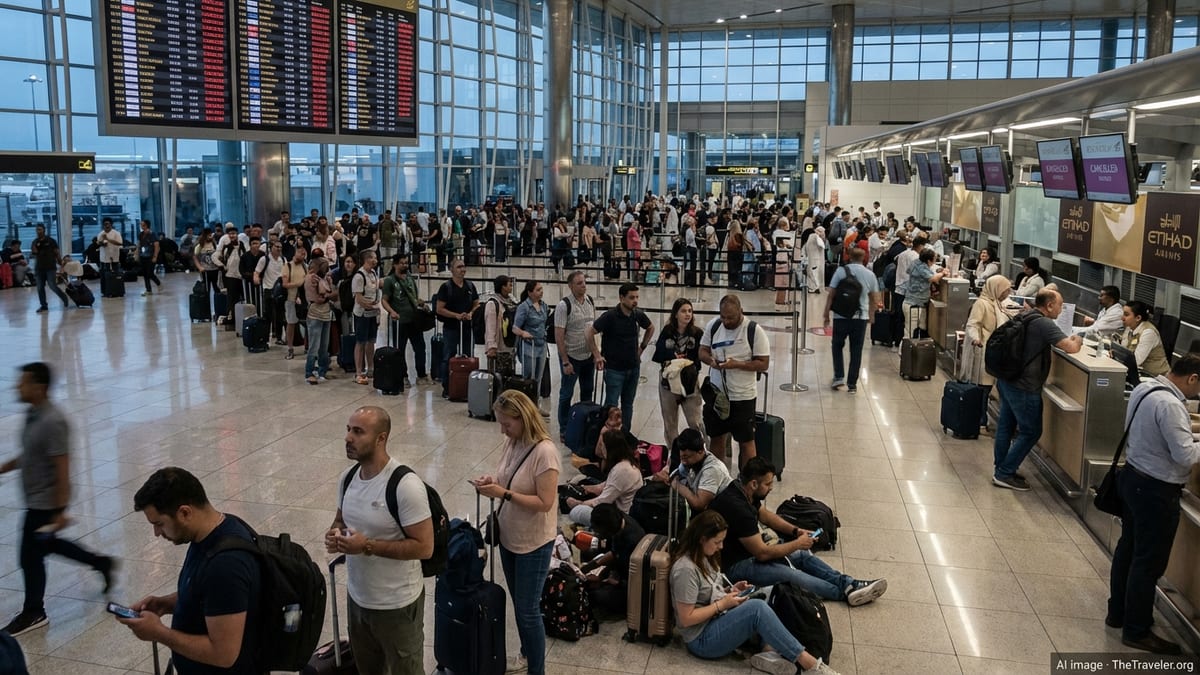
Renewed strikes test the region’s aviation backbone
The latest round of Iranian missile and drone attacks on Gulf states in mid-July has again placed the region’s aviation sector under intense scrutiny, with airports and airspace across the Arabian Peninsula operating against a volatile backdrop. Published coverage describes strikes or attempted strikes on targets in Qatar, the United Arab Emirates, Bahrain, Kuwait, Jordan and Oman, alongside warnings over the strategic Strait of Hormuz and surrounding waters.
While parts of the region experienced temporary airport closures and diversions during earlier phases of the war in late winter, current reports indicate that the main hubs serving Gulf mega-carriers are largely open, albeit with heightened alert levels and revised routings. Travel advisories note that airspace over Iran and several neighbouring states remains subject to restrictions, forcing airlines to thread narrower corridors that still allow long-haul connections between Europe, Asia and Africa.
This marks a significant shift from the early months of the conflict, when some Gulf airlines sharply curtailed or suspended operations as missiles struck near major airports and airspace closures rippled across the region. Industry analyses published in the spring detailed how daily flight movements for leading Gulf carriers fell dramatically before beginning a gradual recovery as infrastructure was repaired and risk assessments evolved.
With the conflict flaring again in July, those same carriers are applying the lessons learned from earlier disruptions, seeking to maintain schedules where possible while building in more contingency for rapidly changing security conditions.
Gulf carriers opt for rerouting rather than grounding
Operational updates from airlines based in the United Arab Emirates and Qatar show that, this time, large-scale, open-ended groundings have largely been avoided. Reports in regional trade publications and travel media state that Emirates, Etihad Airways, flydubai and Air Arabia are operating scheduled services across their networks, with selected route adjustments and timing changes where risks are elevated.
According to aviation tracking data cited in specialist coverage, much of the adaptation is occurring invisibly to passengers, with flight planners plotting longer, more southerly routings to avoid Iranian and Iraqi airspace. Where overflight of specific zones is still prohibited or deemed too risky, carriers have been diverting via Saudi Arabia, the Arabian Sea or, for some Europe–Asia services, via Egypt and the Eastern Mediterranean.
Qatar Airways, which previously relied heavily on Iranian airspace during the 2017–2021 regional diplomatic rift, is again drawing on its experience of contingency routing. Press material from the airline highlights its focus on network resilience and the ability to “re-optimise” schedules in response to airspace constraints, while continuing to expand in selected long-haul markets.
The result is that, despite renewed military activity and warnings about missile and drone threats, the core role of Gulf carriers as connective hubs between continents remains broadly intact, even as their operating margins are squeezed by longer flight times, higher fuel burn and tighter crew scheduling.
Targeted cancellations highlight uneven risk landscape
The picture is not one of uninterrupted normality. Reports from Gulf-based news outlets on July 14 detail targeted cancellations and diversions to specific airports closer to front-line flashpoints, underscoring how uneven the risk landscape has become within the wider region.
Flights to Saudi Arabia’s Abha airport, near the border with Yemen, were among those disrupted after an attack there prompted a temporary closure. Travel desks in the UAE reported multiple cancellations and at least one flydubai service diverted to Taif, illustrating how quickly localized security incidents can ripple through passenger itineraries, even when major hubs remain open.
Elsewhere, some European and Asian airlines have extended suspensions of services to Doha, Dubai or other Gulf destinations, or are continuing to avoid large swaths of Middle Eastern airspace altogether. Factboxes compiled by international news agencies show a patchwork of resumptions and ongoing suspensions, with some foreign carriers opting for a conservative approach even as regional airlines press ahead with reduced or rerouted operations.
For travellers, this means that booking with a Gulf-based carrier may currently offer more options for reaching the region or transiting through it, while itineraries involving multiple airlines are more exposed to the decisions of the most risk-averse operator in the chain.
Regulators and insurers reshape flight paths
Behind the scenes, advisories from aviation regulators and security agencies are playing a central role in determining how far airlines are willing to go in maintaining connectivity. In early July, the European Union Aviation Safety Agency reiterated guidance advising carriers to avoid the airspace of Iran, Iraq and Lebanon, as well as certain high-risk portions of the wider Gulf region, while noting that blanket restrictions had eased compared with the height of the crisis in March.
Insurers and corporate security consultancies have added further layers of caution, issuing daily assessments of missile and drone ranges, anti-aircraft capabilities and the proximity of flight paths to potential targets. These analyses are feeding into airline risk matrices that weigh the commercial value of a route against the possibility of sudden airspace closures or near-miss incidents.
Industry briefings also highlight the financial dimension of the latest disruption. Longer routings and increased fuel burn come on top of earlier conflict-related losses for Gulf carriers, which were already contending with higher insurance premiums and war-risk surcharges after attacks in and around key hubs earlier in the year. For some airlines, maintaining a near-normal schedule is therefore as much about protecting market share and network relevance as it is about short-term profitability.
Yet the fact that major hubs such as Dubai International, Hamad International in Doha and Abu Dhabi International are currently handling significant volumes of traffic suggests that regulators, insurers and airlines see the present configuration of airspace restrictions as manageable, provided there are no direct hits on runways, terminals or fuel infrastructure.
Travellers weigh convenience against perceived risk
The persistence of Gulf airline operations amid the renewed conflict is prompting mixed reactions from travellers. Online forums frequented by frequent flyers and aviation professionals show some passengers expressing unease about transiting through Gulf hubs while the Iran war remains active, even as others point to stringent risk management procedures and historical precedents for commercial flights operating near conflict zones without incident.
Publicly available information suggests that demand has softened on some routes compared with a year earlier, with capacity still below pre-conflict levels despite the resumption of many services. At the same time, the approaching peak summer travel season is testing just how much war-related concern will deter passengers from taking advantage of competitive fares and convenient one-stop connections offered by Gulf carriers.
Travel advisers currently recommend that passengers bound for or transiting through the region monitor airline operational updates closely, allow extra time for potential reroutings and be prepared for last-minute schedule changes. Many Gulf-based carriers are offering waivers or flexible rebooking options on affected routes, which can provide a measure of reassurance for those weighing whether to proceed with travel plans.
For now, the steady flow of aircraft in and out of Dubai, Doha, Abu Dhabi and Sharjah underscores the determination of Gulf airlines to stay in the air, even as the strategic fault lines around Iran and the wider Middle East remain far from settled.