


More news on this day
Singapore’s Changi Airport is entering 2026 from a position of strength, reclaiming the top spot in global airport rankings while handling record passenger traffic and accelerating major service and infrastructure upgrades across its terminals.
Get the latest news straight to your inbox!
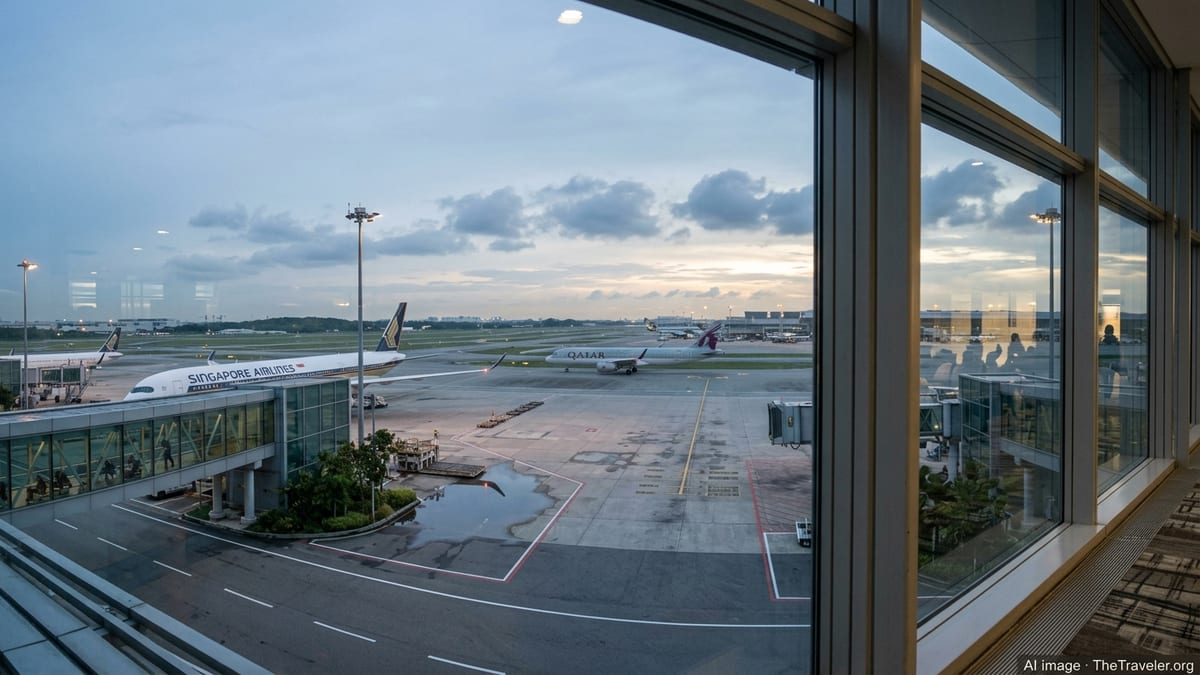
Global Rankings Confirm Changi’s Lead
Recent global assessments place Singapore Changi Airport at the top of international league tables once again. The latest Skytrax World Airport Awards rank Changi as the world’s best airport for 2025, ahead of Doha’s Hamad International and Tokyo Haneda, reflecting the views of travelers surveyed worldwide over the 2024 and early 2025 period. The accolade marks Changi’s return to first place after a brief period in second position and extends its record as the most frequently crowned airport in the history of the awards.
Separate published listings of the world’s top airports by overall quality and passenger experience continue to highlight Changi’s strengths in terminal ambiance, efficiency, retail and dining, as well as family and transit facilities. Industry coverage notes that Changi’s performance is particularly noteworthy amid intensifying competition from other large hubs in the Middle East, East Asia and Europe that are investing heavily in new terminals and digital services.
Analysts observe that Changi’s position at the top of the rankings is supported by a combination of strong operational metrics and consistently high customer satisfaction scores. The airport’s recognition spans multiple subcategories, including cleanliness, leisure amenities and transit experience, suggesting that its appeal is broad rather than driven by a single flagship feature.
Record Passenger Volumes Through 2025
Traffic data compiled from Changi Airport Group and international aviation statistics show that 2024 and 2025 marked a decisive return to growth for the Singapore hub. In calendar year 2024, Changi handled about 67 to 68 million passengers, reaching roughly pre‑pandemic volumes and registering double‑digit year on year growth as regional and long haul routes ramped up.
By the financial year 2024 to 2025, passenger movements climbed further to around 68.4 million, according to business press reports on Changi Airport Group’s results. More recent coverage referencing 2025 operational data indicates that the airport has now crossed the symbolic threshold of nearly 70 million passenger movements in a single year, an all time high that underlines Singapore’s role as a key gateway for Southeast Asia and the wider Asia Pacific region.
Industry statistics also show that Changi has emerged as one of the world’s busiest airports for international passenger traffic, reflecting its position as a major transfer point rather than primarily a domestic hub. The airport’s growth has been closely linked to the recovery and expansion of Singapore Airlines and partner carriers, as well as rising demand on routes connecting China, India, Australia and the broader ASEAN region.
Expanded Connectivity and Market Diversity
The composition of traffic through Changi is becoming more diverse as airlines rebuild networks and add new links. Changi Airport Group’s published market breakdown for 2024 highlighted China, Indonesia, Malaysia, Australia and India among the largest passenger markets, with strong growth from North and Southeast Asia alongside steady flows from the Southwest Pacific. Key city pairs such as Kuala Lumpur, Bangkok, Jakarta, Denpasar and Hong Kong remained among the busiest routes.
By early 2026, publicly available information indicates that about 100 airlines operate more than 7,000 weekly scheduled flights to and from Changi, reaching over 170 cities in around 50 countries and territories. This breadth of connectivity reinforces Singapore’s importance as a transfer hub, where passengers link between Southeast Asia, North Asia, the Pacific and Europe on single or mixed‑carrier itineraries.
Industry observers note that the spread of markets helps cushion Changi from volatility in any one region. The recovery of Chinese outbound travel, the continued strength of Southeast Asian tourism and business links, and solid demand on Australia and India routes collectively support the airport’s traffic base. New long haul and point to point services also broaden options for travelers who previously relied on more circuitous routings.
World Class Services from Kerb to Gate
Changi’s position in global rankings has long been tied to its reputation for passenger friendly design and services, and recent developments suggest the airport is aiming to stay ahead of rivals. Operational updates and annual reporting highlight investments in early check in options, fast and seamless travel systems and expanded use of biometrics to streamline the journey from kerb to gate.
Airport guides and travel industry coverage for 2025 describe an extensive early check in network spanning Jewel Changi Airport and the main terminals, with dozens of airlines now allowing passengers to drop bags and obtain boarding passes hours in advance. This arrangement is particularly attractive for travelers who wish to spend time in Jewel’s retail and attraction complex or use airport lounges and facilities before formal departure procedures would traditionally begin.
At the border control stage, Singapore’s New Clearance Concept has introduced more automated lanes and increased use of iris and facial recognition, supporting faster passport free processing for eligible travelers. These systems reduce queuing times at immigration while addressing manpower constraints, a factor that commentators say is increasingly relevant as passenger volumes set new records.
Beyond processing, Changi continues to market its extensive mix of retail, dining, entertainment and wellness spaces, from nature themed installations in the terminals to the Rain Vortex and indoor forest at Jewel. Reviews and travel features frequently point to these elements as differentiators that turn the airport into an attraction in its own right rather than just a transit point.
Investing for Future Capacity and Competition
While current rankings and traffic numbers favor Changi, the airport’s long term position depends on how effectively it delivers new capacity and technology. Planning documents and corporate reports describe a pipeline of projects aimed at supporting continued growth into the 2030s, most prominently the multibillion dollar Terminal 5 development on reclaimed land at Changi East.
Work associated with Changi East encompasses not only the new terminal but also additional taxiways, aircraft parking stands and supporting systems intended to handle tens of millions of extra passengers annually. Travel industry analysts suggest that this expansion will be essential if Singapore is to keep pace with rising demand and heightened competition from newer hub airports in the Gulf and East Asia.
In the nearer term, Changi is focusing on incremental upgrades within its existing terminals and at Jewel, including periodic refreshes of retail and dining offerings and the rollout of more automation in baggage handling and security. Commentaries on the Skytrax 2025 results note that leading airports increasingly distinguish themselves through integrated systems that deliver both resilience and a smooth passenger experience rather than through iconic architecture alone.
Against this backdrop, Changi’s strong start to 2026, with top global rankings and record traffic, positions the airport as a benchmark for other hubs seeking to blend operational efficiency, technology and hospitality. Observers will be watching how the airport manages crowding risks and service consistency as volumes climb further and as its ambitious expansion program moves from planning to delivery.