


More news on this day
Travellers flying out of Charleston International Airport on Saturday faced mounting disruption as a cluster of regional carriers racked up at least 25 delays and nine cancellations on routes to major hubs including Philadelphia, New York City, Dallas–Fort Worth and Detroit, according to live flight-status boards and aviation data services.
Get the latest news straight to your inbox!
Regional Carriers Bear Brunt of Operational Strain
Publicly available schedules and tracking platforms show that the bulk of Saturday’s disruption at Charleston involved regional operators flying under major-airline brands, including PSA Airlines, Republic Airways and Endeavor Air. These carriers operate many of the short-haul connections linking Charleston with large domestic hubs, where any weather or congestion can quickly cascade into missed connections and tight aircraft rotations.
Data for June 2026 indicate that PSA Airlines and Republic Airways are active partners on American- and Delta-branded routes into major hubs such as Philadelphia, Dallas–Fort Worth and New York, while Endeavor Air feeds Delta’s network through cities including Detroit and New York. When several of these networks experience stress at the same time, relatively modest local delays in Charleston can translate into significant knock-on effects for passengers.
Tracking sites on Saturday showed waves of delayed departures in Charleston toward northern and midwestern hubs during the afternoon and evening bank of flights. Short-haul routes that typically turn aircraft quickly appeared particularly vulnerable, as late inbound aircraft forced rolling departure times and, in several cases, outright cancellations of later segments.
The pattern reflects a broader national trend in which regional operators, often running tight schedules with smaller fleets, have less flexibility to recover from weather or airspace constraints compared with larger mainline operations. When a single early flight in a sequence runs significantly late, subsequent legs from airports such as Charleston can be left without an available crew or aircraft.
Hubs From Philadelphia to Dallas Experience Knock-On Effects
The disruptions extended across several of the nation’s busiest connecting points. Flights from Charleston bound for Philadelphia and New York were among those most affected, according to aggregated status information, coinciding with intermittent air traffic management programs and weather-related metering affecting major Northeast airports.
Services linking Charleston with Dallas–Fort Worth and Detroit also experienced delays as operators attempted to reconcile late arrivals from earlier legs with scheduled departures to and from South Carolina. Travellers aiming to connect in those hubs to onward domestic and international services faced particularly uncertain itineraries as delay estimates shifted through the day.
Industry data for 2026 show that PSA Airlines maintains substantial operations into Dallas–Fort Worth and Philadelphia, while Endeavor Air and Republic Airways play prominent roles in Delta’s networks through New York and Detroit. When weather, congestion or staffing issues constrain traffic flow at those hubs, spoke airports such as Charleston are often where passengers first experience the tangible impact in the form of long waits at the gate and last-minute gate changes.
On Saturday, the pattern of disrupted departures from Charleston toward these hubs suggested that constraints were not limited to a single airline or airport, but rather reflected the complexity of interlinked schedules, shared airspace and constrained runway capacity at several major nodes of the system.
Weather and Airspace Management Add to Summer Travel Pressures
The latest delays came as the broader US air travel system continued to manage early-summer weather patterns and associated traffic management initiatives. Federal airspace status information for mid-June has shown periodic ground delay programs and ground stops at several large airports, particularly in the Northeast, when thunderstorms or low ceilings reduce arrival and departure rates.
When such programs are in place at major hubs, flights from smaller and mid-sized markets like Charleston may be held at the gate or subject to extended departure slots, as controllers prioritize long-haul and previously delayed services. This can contribute to a scenario in which an individual airport appears to be operating under clear skies yet still experiences a high proportion of delayed departures.
Aviation performance data compiled by the US Department of Transportation for recent months underline the impact of these systemic factors. National statistics for spring 2026 show that carrier-related issues, air traffic control programs and weather together account for a significant share of delays, with regional affiliates often more exposed due to tight scheduling and limited spare aircraft.
In Charleston’s case, the convergence of these dynamics on Saturday meant that even routine afternoon convection and modest congestion at northern hubs could translate into missed departure windows, aircraft arriving out of sequence and crews reaching duty-time limits before scheduled rotations were complete.
Passengers Confront Missed Connections and Rebooking Challenges
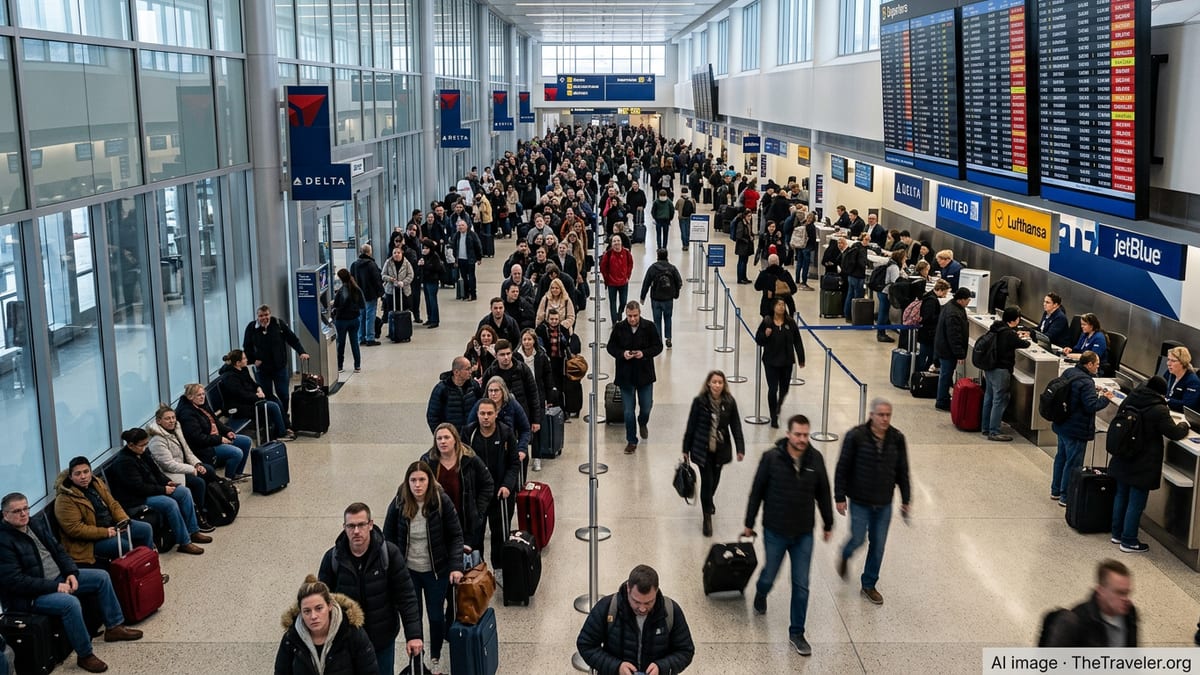
For travellers on the ground in Charleston, the operational picture translated into crowded departure areas, rebooked itineraries and, in some cases, unexpected overnight stays. With at least nine flights cancelled alongside dozens of late departures, many passengers connecting in Philadelphia, New York, Dallas–Fort Worth and Detroit were left seeking alternative routings or same-day standby options on already busy weekend services.
Publicly accessible airline advisories indicate that, during similar disruption events, carriers often encourage affected passengers to use mobile apps and self-service tools to confirm rebookings rather than waiting in physical queues. However, when multiple flights on the same route are delayed or cancelled and spare seats are scarce, even digital tools can offer limited choices for same-day travel.
The situation can be particularly challenging for travellers relying on the Charleston flights to connect to longer-haul transcontinental or international services from the major hubs. In such cases, a delay of even one to two hours on the initial leg can cause passengers to misconnect with no equivalent onward departure until the following day, leading to a need for hotel accommodation and modified ground transport arrangements at the destination.
Travel forums and recent consumer reports suggest that passengers on regional affiliates may sometimes face additional uncertainty compared with mainline flights, as crew positioning, aircraft swaps and coordination across multiple operating partners lengthen the time it takes to finalize new itineraries during irregular operations.
What Travellers Through Charleston Can Expect Next
With the busy summer travel period ramping up, operational data and recent performance trends point to continued vulnerability to disruption on regional routes linking smaller airports with large hubs. Charleston International, which has experienced strong passenger growth in recent years, relies heavily on such feeder services to connect local travellers with the wider national network.
Aviation analysts note that while airlines have added capacity and adjusted schedules since the most acute staffing challenges of earlier years, many regional operations still run with limited slack, making them sensitive to weather, air traffic control initiatives and any technical or crew availability issues. In practice, this means that a relatively small number of delayed or cancelled flights, such as Saturday’s tally of 25 delays and nine cancellations, can affect a far larger group of travellers once downstream connections are considered.
Prospective passengers departing Charleston in the coming days are likely to monitor flight status closely, particularly for evening departures into known congestion points such as the New York area, Philadelphia and major midwestern and southern hubs. Travel-planning guidance from consumer advocates consistently emphasizes allowing longer connection times through these airports during peak summer months.
While Saturday’s disruptions were concentrated on a single day, they highlight broader structural pressures facing regional carriers and the airports that depend on them. For travellers using Charleston as a gateway to the national network, the experience serves as a reminder of how conditions hundreds of miles away in crowded airspace over the Northeast or Midwest can quickly reshape local departure boards along the South Carolina coast.