


More news on this day
Chicago’s O’Hare International Airport is confronting a fresh wave of operational turmoil today, as publicly available data and media coverage indicate at least 267 combined flight delays and cancellations affecting United Airlines, American Airlines and their regional partners, triggering mounting frustration for travelers across one of the country’s most important air hubs.
Get the latest news straight to your inbox!
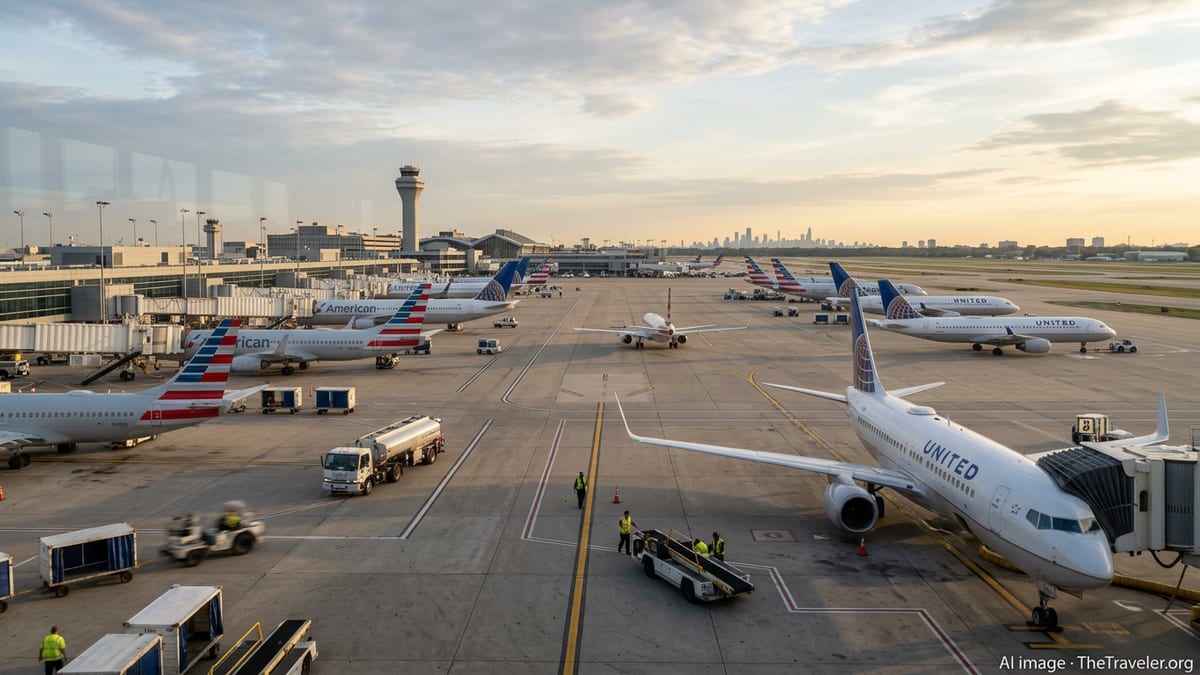
Surge in Disruptions at the Nation’s Busiest Hub
Reports compiled from airport tracking portals and aviation coverage show that O’Hare is again facing heavy schedule strain, with delays sharply elevated over typical summer baselines. Data from the Chicago Department of Aviation’s flight delay dashboard for recent days point to hundreds of tardy movements within a 24-hour window, illustrating how quickly operations can become saturated when weather and congestion collide.
The latest disruption involves an estimated 267 flights either delayed or cancelled, disproportionately affecting operations tied to United and American, which together carry the vast majority of O’Hare’s passengers. Regional affiliates serving those networks, including SkyWest-operated services, appear to be absorbing a large share of the schedule slippage, amplifying the impact on smaller cities that rely on Chicago connections.
Travelers at the terminals have faced long lines, rolling gate changes and increasingly uncertain connection windows. Social media posts and anecdotal accounts describe hours-long waits at departure gates and customer service counters as airlines work through the backlog created by compressed schedules and knock-on delays.
While disruptions at O’Hare are not uncommon during peak travel periods, the scale and speed of the current wave, spanning mainline and regional flights, underline the vulnerability of a tightly packed schedule at an already busy airport.
United and American Networks Bear the Brunt
Publicly available schedules show that United and American have both significantly expanded their summer 2026 operations at O’Hare, turning the airport into an even denser connecting hub. Industry coverage notes that, on peak days, more than 3,000 flights are planned at the airport, with United and American responsible for a major share of those movements. That expansion has increased connectivity for travelers but also magnified the risk when even a small portion of the schedule falters.
According to aggregated operational data and commercial flight-tracking feeds reviewed today, the latest wave of 267 delays and cancellations has concentrated on banks of United and American departures into and out of key domestic and transatlantic markets. Delayed departures from O’Hare have quickly cascaded into later arriving flights, compressing turnaround times and pushing subsequent legs behind schedule.
Regional partners that feed United and American’s hubs appear especially exposed. Coverage of today’s operations indicates that SkyWest, which operates under both brands on certain routes, is managing dozens of delayed flights tied to the disruption. For travelers in secondary markets that rely on O’Hare for onward connections, even a modest delay of an initial regional leg can mean missed long-haul departures and the need for extensive rebooking.
The resulting strain across the two largest carriers’ networks highlights a structural challenge at O’Hare: incremental gains in capacity deliver more seat options, but also reduce the margin for error when storms, airspace constraints or ground delays intervene.
Weather, Congestion and Structural Pressure Converge
Weather appears to be a key contributor to the latest difficulties. Recent reporting from Chicago-area outlets has documented repeated ground delays and temporary ground stops at O’Hare during strong storm systems, with some events earlier this year producing hundreds of cancellations in a single day. Even when skies over the airport itself are relatively clear, convective weather along arrival and departure routes can slow traffic and force schedule adjustments.
At the same time, O’Hare is heading into the heart of the busy summer travel period, when demand for both domestic and international trips remains high. Policy announcements from federal transportation officials in recent weeks have acknowledged that O’Hare’s peak-day schedule has risen sharply compared with last year, prompting calls for airlines to pare back some planned operations to preserve reliability.
The confluence of those factors means that even routine thunderstorms or temporary air traffic management initiatives can trigger disproportionate disruption. Once departure slots are pushed back, aircraft and crews often end up out of position, leading to rolling delays that can last into the evening and, in some cases, force outright cancellations when crews reach duty-time limits.
Operational analysts note that O’Hare’s role as a dual hub for two global carriers, each with their own tightly timed arrival and departure “banks,” can intensify bottlenecks at shared infrastructure points such as runways, taxiways and security screening areas, especially during irregular operations.
Traveler Impact: Missed Connections and Frayed Itineraries
The human impact of the latest disruptions is significant. Passengers transiting O’Hare today have reported missed onward connections, extended layovers and unplanned overnight stays in Chicago. With many of the affected flights serving as feeder legs into long-haul journeys, a single delayed regional or domestic segment can unravel an entire multi-stop itinerary.
Publicly accessible traveler accounts describe families rebooked onto flights departing many hours or even a full day later than planned, as limited spare capacity constrains options. Some customers have reported being routed through alternative hubs such as Dallas, Denver or Charlotte in order to complete trips initially built around a Chicago connection.
Digital tools provided by the airlines, including mobile rebooking and push alerts, are playing an increasingly prominent role as carriers work through disrupted schedules. However, when hundreds of passengers simultaneously seek new seats on already full flights, digital channels can only go so far, leaving many to queue at service desks for individual assistance and hotel or meal vouchers when they qualify.
The situation has renewed debate among frequent travelers over how heavily to rely on tightly timed connections at O’Hare during peak seasons. Some aviation commentators recommend building longer layovers into itineraries that use the airport as a hub, particularly during months that historically see strong storm activity across the Midwest.
Growing Scrutiny of O’Hare’s Summer Capacity
The turbulence around today’s disruptions unfolds against a backdrop of intensifying scrutiny of O’Hare’s summer capacity. Recent statements and policy materials from federal transportation authorities describe the airport as the busiest in the United States by flight volume, with planned peak-day operations for summer 2026 significantly higher than in 2025. In response, regulators have urged a “responsible level” of operations to avoid chronic gridlock and protect safety margins.
Industry and local media reports indicate that this pressure has already translated into tangible changes, including schedule adjustments on some regional routes feeding Chicago and strategic reductions or reallocations of capacity by certain carriers. Other airlines, such as Southwest, have opted to consolidate their Chicago presence at Midway, citing the operational complexities and congestion associated with O’Hare.
For United and American, which both view O’Hare as a cornerstone of their domestic and international networks, scaling back too aggressively risks ceding market share at a critical Midwest gateway. The latest episode of 267 delays and cancellations illustrates the fine balance those carriers must strike between growth ambitions and operational resilience at an airport already operating close to its limits.
As summer unfolds, travelers and industry observers alike will be watching whether the combination of regulatory pressure, infrastructure constraints and volatile weather continues to translate into sharp swings in day-to-day reliability at O’Hare, or whether incremental schedule and staffing adjustments are enough to keep future waves of disruptions from reaching today’s levels.